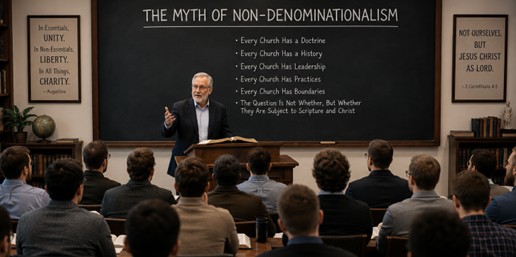
The myth of non-denominationalism is not that independent churches do not exist. They clearly do.
The myth is the belief that a church can exist without a doctrinal identity, historical tradition, leadership structure, institutional culture, and practical boundaries.
Every church:
- Interprets Scripture
- Defines doctrine
- Recognizes leaders
- Establishes practices
- Develops customs
- Determines membership
- Sets boundaries
- Exercises discipline
- Forms a culture
- Inherits a history
A non-denominational church may be independent in government while being Baptist in its ordinances, dispensational in its prophecy, charismatic in its worship, Reformed in its salvation doctrine, or congregational in its government.
Removing a denominational name does not remove denominating characteristics.
The real question is not, “Does this church have a tradition?” Every church does.
The real questions are:
- Is the tradition acknowledged honestly?
- Is it consistent with Scripture?
- Can it be questioned?
- Can it be corrected?
- Does it serve the church?
- Does it point people toward Christ?
- Does it produce humility or pride?
- Does it clarify truth or conceal doctrine?
- Does it preserve fellowship or create unnecessary division?
A Practical Diagnostic for Recognizing Denominationalism
Denominational identity is becoming sinful denominationalism when a church or believer begins saying, explicitly or implicitly:
- “Our group alone understands the Bible.”
- “Questioning our tradition is questioning God.”
- “Faithful Christians must use our label.”
- “Our confession cannot be corrected.”
- “Our leaders should not be publicly examined.”
- “Anyone outside our network is spiritually suspect.”
- “Institutional unity matters more than doctrinal truth.”
- “Our customs are binding upon every Christian.”
- “Protecting our reputation is more important than exposing sin.”
- “Agreement with our secondary positions determines whether someone is a genuine believer.”
- “Our denomination is the only faithful church.”
- “Our non-denominational church has escaped all human tradition.”
- “Leaving our organization means leaving Christ.”
- “Supporting our institution is the same as supporting the gospel.”
- “Disagreement with our pastor proves rebellion against God.”
These attitudes reveal that a useful identity has become a rival authority.
Practical Applications for Modern Churches
Keep Scripture Above Every Tradition
Every confession, policy, sermon, ministry method, and denominational ruling must remain subject to Scripture.
Churches should repeatedly remind members that the Bible is inspired and infallible while human interpretations and documents are not. Confidence in Scripture should be joined with humility about our own understanding.
The Bereans provide the proper example.
If apostolic preaching was examined by Scripture, no modern pastor, denomination, convention, confession, or ministry network should demand exemption from examination.
Make the Statement of Faith Clear and Accessible
Doctrinal vagueness does not prevent denominationalism. It often conceals it.
Churches should clearly state their convictions concerning:
- The authority and sufficiency of Scripture
- The Trinity
- The deity and humanity of Christ
- Christ’s substitutionary death
- Christ’s bodily resurrection
- Salvation by grace through faith
- The universal offer of the gospel
- Eternal security
- The ministry of the Holy Spirit
- Baptism
- The Lord’s Supper
- Church leadership
- Marriage and sexuality
- The sanctity of human life
- The return of Christ
- The final judgment
- Heaven and hell
The statement should also explain that it is a human summary of biblical teaching and not an additional revelation.
Distinguish Essential Doctrine from Secondary Convictions
Churches should hold every biblical teaching seriously, but they should not pretend that every disagreement has the same consequences.
Disagreeing about the resurrection is not comparable to disagreeing about the frequency of the Lord’s Supper. Denying the deity of Christ is not comparable to preferring a different worship style.
Church leaders should distinguish among:
- Essential doctrines necessary to biblical Christianity
- Serious doctrines necessary for church membership or leadership
- Secondary doctrines over which faithful Christians may disagree
- Matters of conscience and local application
- Cultural preferences that should not bind others
This distinction allows churches to be firm without becoming needlessly divisive.
Teach Church History Honestly
Churches should acknowledge their theological ancestry.
An independent congregation may have Baptist ordinances, dispensational eschatology, charismatic worship practices, Reformed soteriology, or Wesleyan views of sanctification. Recognizing those influences allows members to examine them openly.
Pretending to have no tradition merely makes the tradition harder to identify and correct.
Church history can also help believers avoid repeating old errors under new names.
Refuse to Build the Church Around a Personality
Pastors are servants, not spiritual brand names.
Churches should resist organizing their identity around:
- A celebrity pastor
- A founding family
- A worship leader
- An online teacher
- A conference speaker
- A ministry franchise
- A denominational president
- A political personality
Healthy pastors direct attention toward Jesus Christ rather than cultivating personal dependence and unquestioning loyalty.
Establish Meaningful Leadership Accountability
Independent churches should not use local autonomy as a shield against correction. Denominational churches should not use institutional processes to avoid responsibility.
Healthy accountability may include:
- A plurality of qualified leaders
- Transparent financial procedures
- Independent review of serious allegations
- Clear child-protection policies
- Written discipline procedures
- Congregational access to governing documents
- Honest reporting of conflicts of interest
- Safe channels for raising concerns
- Relationships with faithful pastors outside the congregation
Accountability structures cannot eliminate sin, but secrecy and unchecked authority make abuse easier.
Identify Unwritten Rules
Church leaders should periodically ask:
- Which practices do we treat as biblical commands without clear scriptural support?
- Which questions are members afraid to ask?
- Do we confuse loyalty to leadership with loyalty to Christ?
- Do we measure spirituality by attendance at optional programs?
- Do we elevate cultural preferences into moral requirements?
- Do we treat influential members differently from ordinary members?
- Do we discipline certain visible sins while ignoring pride, gossip, greed, or favoritism?
- Do visitors understand our actual beliefs?
- Are disagreements handled with patience and truth?
- Can our traditions be examined openly?
Bringing unwritten expectations into the light helps distinguish biblical conviction from institutional habit.
Cooperate Without Compromise
Believers can cooperate with other faithful churches in evangelism, benevolence, prayer, disaster relief, and community service without pretending that doctrinal differences do not exist.
The amount of doctrinal agreement required should correspond to the nature of the cooperation.
A church may cooperate broadly in feeding hungry families while requiring much closer doctrinal agreement for:
- Pulpit ministry
- Church planting
- Missionary support
- Pastoral training
- Theological education
- Joint worship
- Ordination
- Membership recognition
Wisdom avoids both isolation and undiscerning partnership.
Practice Humble Correction
A church should be able to say:
“This is what we believe Scripture teaches. We hold these convictions sincerely and firmly, but Scripture, not our history, remains the final authority.”
That posture does not weaken conviction. It recognizes that God’s Word is infallible while human interpreters remain capable of error.
Correction should be firm when essential truth is threatened, but gracious toward sincere believers who are confused or mistaken.
Judge Churches by Doctrine and Fruit, Not Labels
A denominational name neither proves nor disproves faithfulness.
A Baptist church may abandon the gospel. A non-denominational church may preach it faithfully. An independent Bible church may conceal serious error behind broad evangelical language. A historic denomination may contain both faithful and unfaithful congregations.
1 Timothy 4:16 “Take heed unto thyself, and unto the doctrine” – A church must examine both conduct and teaching. Sound words cannot excuse corrupt character, and respectable conduct cannot replace sound doctrine.
A label should lead to further examination, not replace it.
Preserve Unity Without Sacrificing Truth
Modern churches must avoid two opposite errors.
The first is separation over every minor disagreement. The second is unity purchased through doctrinal compromise.
Faithful churches should:
- Contend earnestly for essential doctrine
- Correct serious error
- Separate from false gospels
- Refuse support for false teachers
- Show patience over secondary disagreements
- Respect legitimate matters of conscience
- Recognize genuine believers outside their own tradition
- Speak truth without contempt
- Cooperate where cooperation does not require compromise
Keep Christ at the Center
The final defense against denominationalism is not abandoning every name, confession, organization, or tradition. The final defense is keeping each of them subordinate to Jesus Christ.
A church name may communicate useful information. A confession may preserve doctrine. An association may support missions. A seminary may train pastors. A denomination may coordinate ministry.
None of them died for our sins. None of them rose from the dead. None of them can save. None of them is the Head of the Church.
[suo_quote] Colossians 1:18 “That in all things he might have the preeminence” – Every structure, tradition, confession, and leader must remain subordinate to the supreme authority of Jesus Christ. [/su_quote]
Conclusion
To denominate is to name, identify, or distinguish. That act is necessary and often biblical. Churches must identify their congregations, define doctrine, recognize leaders, explain practices, and distinguish truth from error.
A denomination is a voluntary association of churches sharing a name, doctrine, history, and cooperative structure. Such an association is not directly instituted in Scripture, but it may serve legitimate biblical purposes when it remains subordinate to Christ, Scripture, and the responsibilities of the local church.
Denominationalism begins when the name becomes a party, the confession becomes an unquestionable authority, the institution becomes an object of loyalty, the pastor becomes the center of identity, or secondary distinctions become causes of pride and unnecessary division.
The answer is not doctrinal vagueness, historical amnesia, or pretending that a church has no tradition. The answer is honest identification, clear doctrine, humble correction, wise cooperation, meaningful accountability, and unwavering submission to the written Word of God.
Denominate, Denomination, Denominationalism, and the Myth of Non-Denominationalism
Part One: Denominate, the Practical Need to Identify and Distinguish
Part Two: Denomination, a Shared Identity Among Churches
Part Three: Denominationalism, When Distinction Becomes Sinful Division
Part Four: The Myth of Non-Denominationalism