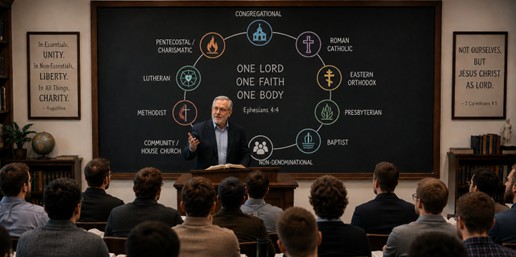
What Does It Mean to Denominate?
The English verb denominate comes from the Latin idea of naming, designating, or identifying something according to a particular class. To denominate is simply to give something a name or to describe the category to which it belongs.
Currency may be denominated according to value. Objects may be denominated according to size or purpose. Religious groups may be denominated according to doctrine, practice, government, history, or affiliation.
The words Baptist, Presbyterian, Methodist, Lutheran, Pentecostal, Anglican, and Mennonite denominate particular religious traditions. They identify groups according to recognizable beliefs, practices, histories, or forms of church government.
The term “non-denominational” also denominates. It identifies a congregation as belonging to the category of churches that do not formally identify with a larger traditional denomination. The label may reject one kind of denominational affiliation, but it still names and classifies the church.
This does not necessarily make the label dishonest. A non-denominational church may genuinely be independent of any outside convention, synod, presbytery, diocese, or denominational headquarters. The myth begins when “non-denominational” is understood to mean that the church has no theological tradition, doctrinal distinctives, historical influences, or institutional culture.
Scripture Regularly Names and Distinguishes Churches
The Bible does not use the modern English verb denominate, but it repeatedly identifies congregations by name and location.
- 1 Corinthians 1:2 “Unto the church of God which is at Corinth” – The Corinthian congregation was a distinct and recognizable local church. Its identity did not separate it from the universal body of Christ, but it distinguished that congregation from churches in other locations.
- Galatians 1:2 “Unto the churches of Galatia” – Paul could identify multiple congregations within a particular geographical region. These local churches shared the same gospel while remaining distinguishable assemblies.
- Philippians 1:1 “To all the saints in Christ Jesus which are at Philippi, with the bishops and deacons” – The church at Philippi had a location, identifiable members, and recognized leaders. These are basic denominating characteristics.
- 1 Thessalonians 1:1 “Unto the church of the Thessalonians which is in God the Father and in the Lord Jesus Christ” – The congregation was identified geographically while its deepest spiritual identity remained in God and the Lord Jesus Christ.
The church at Corinth was not the church at Philippi, although both belonged to Christ. Each congregation had particular members, pastors, problems, responsibilities, and ministry opportunities.
Naming local churches is therefore not inherently divisive. It is a practical necessity.
Scripture Names Doctrines, Offices, and Religious Groups
Scripture also denominates people according to their beliefs, offices, practices, or conduct. It speaks of apostles, prophets, evangelists, pastors, teachers, elders, overseers, deacons, Pharisees, Sadducees, Judaizers, Nicolaitans, false apostles, false prophets, and false teachers.
Naming a group does not automatically constitute slander, hatred, or sinful division. Sometimes names are necessary for clarity, accountability, warning, and obedience.
- Acts 5:17 “The high priest rose up, and all they that were with him, which is the sect of the Sadducees” – Luke identifies a recognizable theological party. The label communicates meaningful doctrinal and historical information.
- Acts 24:5 “A ringleader of the sect of the Nazarenes” – The enemies of Christianity used a sectarian label for followers of Jesus. The label did not determine whether the group was true or false. Its doctrine had to be evaluated.
- 2 John 9 “Whosoever transgresseth, and abideth not in the doctrine of Christ, hath not God” – John identifies a doctrinal boundary that must not be ignored. Biblical love requires truth, and truth sometimes requires clear distinctions.
Every Church Must Denominate Itself in Practice
Every congregation must answer practical and doctrinal questions. Those answers denominate the church whether or not it adopts a traditional label.
A church must decide:
- Is the Bible inspired, inerrant, sufficient, and finally authoritative?
- Is God one God eternally existing as Father, Son, and Holy Spirit?
- Is Jesus Christ fully God and fully man?
- Is salvation by grace through faith apart from works?
- Is Christ’s atonement available to all people?
- Is salvation eternally secure?
- Is baptism for believers or infants?
- Is baptism necessary for salvation?
- Should baptism be performed by immersion?
- Is the Lord’s Supper a memorial, a sacrament, or a repeated sacrifice?
- Are miraculous sign gifts continuing today?
- How should the local church be governed?
- Who may serve as a pastor, elder, or overseer?
- How should church discipline be practiced?
- Is Israel distinct from the Church?
- Will Christ return before or after the Tribulation?
- Will Christ reign literally upon the earth?
- How should biblical teaching be applied to marriage, sexuality, and family life?
The moment a church answers these questions, it has taken recognizable theological positions. Its answers may be broadly Baptist, Reformed, Wesleyan, Pentecostal, dispensational, charismatic, restorationist, or some mixture of several traditions.
Avoiding a label does not eliminate the theology.
Examples of Functional Denomination
A church may refuse traditional labels while functioning within a recognizable tradition.
- A church that teaches believer’s baptism by immersion, congregational autonomy, and the symbolic nature of the ordinances is functioning within a broadly Baptist tradition.
- A church that teaches Calvinist election, covenant theology, infant baptism, and elder rule may function within a Reformed or Presbyterian tradition.
- A church that emphasizes tongues, prophecy, healing, and a post-conversion baptism in the Holy Spirit may function within a Pentecostal or charismatic tradition.
- A church that distinguishes Israel from the Church and teaches a pre-tribulation rapture followed by a literal millennial reign of Christ is functioning within a dispensational tradition.
- A church that teaches that water baptism is necessary for the remission of sins may function within a restorationist or Churches of Christ tradition.
- A church that places a strong emphasis on human freedom, universal gospel invitation, and resistible grace may function within an Arminian, Wesleyan, or Provisionist tradition, depending upon its other beliefs.
The question is not whether a church has a theological identity. Every church does. The question is whether that identity is honestly acknowledged and faithfully tested by Scripture.
When Is Denominating Biblical?
Denominating is biblical when it truthfully identifies meaningful distinctions for a righteous purpose.
Denominating Is Biblical When It Identifies a Local Church
The New Testament presents churches as identifiable congregations. A local church must have some recognizable identity. People need to know where it gathers, who leads it, what it teaches, who belongs to it, and how it fulfills its responsibilities.
- 1 Corinthians 4:17 “As I teach every where in every church” – Paul could speak of practices taught throughout multiple identifiable congregations. Individual churches existed within the larger unity of apostolic Christianity.
- Acts 2:42 “They continued stedfastly in the apostles’ doctrine and fellowship, and in breaking of bread, and in prayers” – A church must be identifiable enough to gather, teach doctrine, share fellowship, observe the Lord’s Supper, and pray together.
The local church is not merely an abstract spiritual idea. It is an assembly of believers who gather in a place, recognize leaders, practice ordinances, exercise discipline, and serve together.
Denominating Is Biblical When It Defines Doctrine
A church must be able to explain what it believes. Doctrinal clarity is not the enemy of Christian unity. It is essential to genuine unity.
- 1 Timothy 4:16 “Take heed unto thyself, and unto the doctrine” – Timothy was responsible to guard both his conduct and his teaching. Doctrine was not to be ignored for the sake of institutional harmony.
- Titus 2:1 “Speak thou the things which become sound doctrine” – Pastors must teach doctrine that is healthy, accurate, and consistent with apostolic truth.
- Deuteronomy 6:4 “Hear, O Israel: The LORD our God is one LORD” – Scripture itself provides concise doctrinal affirmations. Summarizing biblical truth is not inherently unbiblical.
- 1 Corinthians 15:3-4 “Christ died for our sins according to the scriptures; and that he was buried, and that he rose again the third day” – Paul summarizes the gospel in a brief confessional form. Clear statements of belief can preserve and communicate essential truth.
- 1 Timothy 3:16 “God was manifest in the flesh, justified in the Spirit, seen of angels, preached unto the Gentiles” – This passage presents a compact summary of truth concerning the incarnation, vindication, proclamation, and glory of Christ.
- Ephesians 4:4-6 “One body, and one Spirit…one Lord, one faith, one baptism, one God and Father of all” – Biblical unity rests upon shared spiritual and doctrinal realities rather than vague organizational togetherness.
A written statement of faith does not have to compete with Scripture. Properly used, it summarizes what a congregation understands Scripture to teach.
The Baptist Faith and Message explains that confessions of faith express shared convictions, provide instruction, and promote doctrinal accountability, while remaining subordinate to Scripture and lacking finality or infallibility.
A sound confession should therefore say, in effect, “This is what we presently understand the Bible to teach.” It must never say, explicitly or implicitly, “This document cannot be questioned or corrected.”
Denominating Is Biblical When It Distinguishes Truth from Error
Biblical love does not require doctrinal vagueness. Scripture openly identifies false gospels, false teachers, and destructive doctrines.
- Galatians 1:6-9 “If any man preach any other gospel unto you than that ye have received, let him be accursed” – Paul drew a sharp boundary around the biblical gospel. Not every religious message is another harmless expression of Christian diversity.
- 2 John 9 “He that abideth in the doctrine of Christ, he hath both the Father and the Son” – The doctrine of Christ is a necessary boundary of Christian fellowship. A group that denies Christ’s biblical identity cannot be accepted merely because it uses Christian language.
It is proper to distinguish Trinitarian Christianity from religions that deny the Trinity. It is proper to distinguish salvation by grace through faith from systems of human merit. It is proper to distinguish biblical revelation from organizations that add later prophets, books, traditions, or authorities that contradict Scripture.
The label itself does not settle the matter, but meaningful labels can help communicate real differences.
Denominating Is Biblical When It Identifies Qualified Leaders
The New Testament gives names to church offices and establishes qualifications for those who serve in them.
- Acts 20:28 “Take heed therefore unto yourselves, and to all the flock, over the which the Holy Ghost hath made you overseers” – Church leaders are responsible to shepherd a recognizable flock. Leadership cannot function without identifiable responsibility.
- 1 Timothy 3:1-7 “If a man desire the office of a bishop, he desireth a good work” – The office of overseer is defined and accompanied by moral, spiritual, and relational qualifications.
- Titus 1:5-9 “Ordain elders in every city…holding fast the faithful word” – Local congregations were to have recognized elders who were doctrinally sound and personally qualified.
- 1 Peter 5:1-4 “Feed the flock of God which is among you…neither as being lords over God’s heritage” – Pastors must shepherd humbly under Christ, the Chief Shepherd. Their authority is real but never absolute.
Because pastors teach, interpret, counsel, appoint leaders, and establish ministry priorities, they inevitably shape the theological identity of the congregation.
A church’s doctrine is not merely what appears on its website. Its actual doctrine includes what the pastors repeatedly teach, emphasize, tolerate, neglect, and practice.
Denominating Is Biblical When It Facilitates Cooperation
Churches may voluntarily cooperate in missions, benevolence, education, theological training, and other ministries.
- Romans 15:25-27 “I go unto Jerusalem to minister unto the saints…for the poor saints which are at Jerusalem” – Believers from different regions cooperated to meet the needs of suffering Christians.
- 2 Corinthians 8:1-4 “The churches of Macedonia…praying us with much intreaty that we would receive the gift” – Multiple churches joined together voluntarily in generosity and ministry.
- Acts 15:2 “They determined that Paul and Barnabas, and certain other of them, should go up to Jerusalem unto the apostles and elders about this question” – Churches consulted one another concerning a serious doctrinal controversy without establishing a permanent authority above Christ and His Word.
Associations, conventions, fellowships, and ministry networks can serve legitimate purposes when participation remains voluntary and when the organization remains accountable to Scripture.
When Does the Act of Denominating Become Sinful?
Naming and identifying become sinful when labels are used dishonestly, arrogantly, manipulatively, or divisively.
It is wrong to apply a label merely to dismiss someone without fairly understanding what he believes. It is also wrong to use broad religious terms in ways that conceal rather than clarify doctrine.
A church should not call itself “biblical,” “evangelical,” “orthodox,” “gospel-centered,” or “Spirit-filled” while refusing to define what those expressions mean.
Denominating becomes sinful when a classification is used as a weapon rather than a truthful description. It also becomes sinful when a secondary label is treated as though it determines salvation.
- Ephesians 2:8-9 “By grace are ye saved through faith…not of works, lest any man should boast” – No denominational identity can save. Salvation is God’s gift received through faith, not the reward of religious affiliation.
- Romans 3:22-24 “The righteousness of God which is by faith of Jesus Christ unto all and upon all them that believe…being justified freely by his grace” – Justification rests upon God’s grace through faith in Christ, not upon church membership or denominational loyalty.
No one is saved by being Baptist, Presbyterian, Methodist, Pentecostal, Lutheran, Reformed, dispensational, Wesleyan, independent, or non-denominational. A label may summarize doctrine, but it cannot regenerate a sinner, justify the guilty, or reconcile anyone to God.
Denominate, Denomination, Denominationalism, and the Myth of Non-Denominationalism
Part One: Denominate, the Practical Need to Identify and Distinguish
Part Two: Denomination, a Shared Identity Among Churches
Part Three: Denominationalism, When Distinction Becomes Sinful Division
Part Four: The Myth of Non-Denominationalism