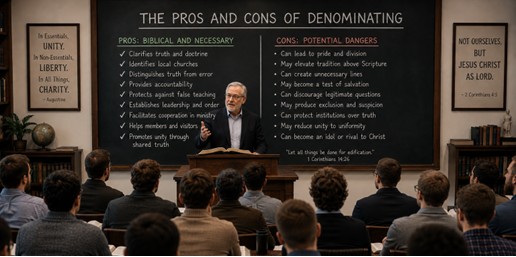
What Is a Denomination?
In ordinary church usage, a denomination is an organized body of churches that shares some combination of the following:
- A common name
- A doctrinal confession
- A historical tradition
- A form of church government
- Shared institutions or ministries
- Recognized leadership, councils, or conventions
- Standards for ministers and churches
- Cooperative missionary, educational, or benevolent work
- Procedures for affiliation or withdrawal
- Common expectations concerning worship and conduct
Strictly speaking, a single independent congregation is not normally a denomination. A denomination generally consists of multiple affiliated churches.
Nevertheless, every independent church possesses denominating characteristics. It has a name, doctrine, location, history, leadership, ordinances, membership expectations, culture, and practical boundaries.
A more precise statement is therefore not, “Every church is technically a denomination,” but rather:
Every church has a denominational identity because every church possesses beliefs, practices, leadership structures, traditions, and boundaries that distinguish it from other churches.
Every Church Has a Location
The New Testament repeatedly identifies churches according to location. Geography does not determine biblical truth, but it influences language, culture, ministry priorities, economic conditions, political pressures, and community expectations.
An urban church in Southern California may face different practical circumstances than a rural church in Tennessee, a house church in Iran, or a historic congregation in England.
These differences do not produce different gospels, but they help produce distinct congregational cultures.
A church’s location affects:
- The people it is likely to reach
- The languages used in ministry
- The economic needs of the congregation
- The social pressures members face
- The legal environment in which the church operates
- The methods used for evangelism
- The ministries needed by the surrounding community
- The unwritten assumptions carried into church life
Location is one of the most basic ways a congregation is denominated.
Every Church Has a History
No church appears out of nowhere. Every congregation was founded by someone, planted from somewhere, influenced by particular teachers, or formed in response to another church or movement.
Even a congregation that rejects denominational labels has a theological family tree. Its leaders attended certain seminaries, listened to particular preachers, read specific books, participated in ministry networks, and learned church practices from previous congregations.
A church may say, “We are simply New Testament Christians,” but its interpretation of the New Testament did not develop in a vacuum.
Every congregation inherits assumptions about:
- Baptism
- Communion
- Spiritual gifts
- Church government
- Membership
- Discipline
- Worship
- Salvation
- Prophecy
- Pastoral authority
- The relationship between the church and culture
Acknowledging history is not a betrayal of biblical authority. It is an act of humility. It helps believers identify their inherited assumptions and test them by Scripture.
- Acts 17:11 “They received the word with all readiness of mind, and searched the scriptures daily, whether those things were so” – The Bereans listened respectfully but examined apostolic preaching by Scripture. Every inherited tradition should be tested with the same seriousness.
Every Church Has a Statement of Faith
A church may say, “We have no creed but Christ and no book but the Bible.” That statement sounds spiritual, but it does not eliminate creeds. It merely leaves much of the church’s creed unwritten.
The word creed comes from the Latin credo, meaning “I believe.” A creed or statement of faith is simply a summary of what a church believes.
Even the statement “We believe only the Bible” is a doctrinal statement. Important questions remain:
- What does the church believe the Bible teaches?
- How does it interpret disputed passages?
- What doctrines are required for membership?
- What doctrines are required for leadership?
- What beliefs would result in removal from teaching?
- What teachings would be considered heresy?
A written statement of faith is usually safer than an unwritten one because members and visitors can examine it. An unwritten confession may be enforced just as strongly while remaining hidden until someone violates it.
Every Church Has Pastoral Leadership
Every congregation is shaped by its leaders. Pastors choose what books of the Bible to teach, which doctrines to emphasize, which ministry philosophies to adopt, and how church discipline should be handled.
Two churches may publish similar statements of faith but function very differently because their leaders interpret and apply those statements differently.
Leadership affects:
- The style and depth of preaching
- The church’s doctrine of salvation
- Its approach to worship
- Its view of pastoral authority
- Its handling of disagreement
- Its financial priorities
- Its treatment of visitors
- Its response to moral failure
- Its emphasis on evangelism
- Its willingness to confront false doctrine
- Its attitude toward other faithful churches
A healthy church does not build its identity around a celebrity pastor. It recognizes qualified leaders while remembering that Christ alone is the Head of the Church.
- Colossians 1:18 “He is the head of the body, the church…that in all things he might have the preeminence” – Jesus Christ, not a pastor, founder, board, bishop, or denomination, holds supreme authority over the Church.
Every Church Has Written Rules
Written rules may include:
- Bylaws
- Membership covenants
- Statements of faith
- Leadership qualifications
- Financial procedures
- Child-protection policies
- Church discipline procedures
- Facility-use policies
- Standards for teachers
- Requirements for missionaries
- Procedures for appointing pastors and deacons
Written rules are not inherently legalistic. Order, accountability, and good stewardship require clear procedures.
- 1 Corinthians 14:40 “Let all things be done decently and in order” – Churches should conduct ministry responsibly and orderly. Written procedures may help fulfill that responsibility when they remain consistent with Scripture.
Every Church Has Unwritten Rules
Unwritten rules are often more powerful because members may not recognize them as rules.
Unwritten expectations may determine:
- How members are expected to dress
- What style of music is considered spiritual
- Which Bible translation is preferred
- Whether questions are welcomed
- Whether questioning a leader is treated as rebellion
- Which political opinions may be expressed
- How spiritual maturity is measured
- Whether members are expected to attend every church program
- Which sins receive public attention
- Which sins are quietly ignored
- Whether visitors are genuinely welcomed
- Whether disagreement is handled graciously
- Whether loyalty to leadership is valued above truth
- Whether wealth, education, or social influence affects treatment
- Whether members may fellowship with Christians from other traditions
Some unwritten expectations may be wise applications of biblical principles. Others are merely cultural preferences. Still others become methods of manipulation and control.
- Mark 7:9 “Full well ye reject the commandment of God, that ye may keep your own tradition” – Tradition becomes sinful when it is protected at the expense of God’s command.
- Mark 7:13 “Making the word of God of none effect through your tradition” – A religious custom may become a rival authority that weakens or nullifies obedience to Scripture.
- Colossians 2:20-23 “Why…are ye subject to ordinances…after the commandments and doctrines of men?” – Man-made regulations may appear spiritual while lacking divine authority and power over sin.
The problem is not that churches develop customs. Customs are inevitable. The problem arises when local preferences are presented as universal commands from God.
Is a Denomination Biblical?
The local church is explicitly instituted in the New Testament. The modern denomination is not.
Scripture gives direct instructions concerning:
- Local congregations
- Pastors, elders, and overseers
- Deacons
- Baptism
- The Lord’s Supper
- Church discipline
- Worship
- Giving
- Evangelism
- Missions
- Doctrine
- Christian fellowship
Scripture does not command Christians to establish national denominational corporations, centralized bureaucracies, publishing houses, seminaries, pension boards, missionary agencies, or denominational headquarters.
That absence does not automatically make these organizations sinful. They are better understood as practical or prudential arrangements. They may help churches accomplish legitimate biblical work, but they possess no inherent divine authority.
A denomination may serve biblical purposes when it:
- Helps churches cooperate without controlling their consciences
- Promotes sound doctrine
- Encourages qualified leadership
- Supports missions and evangelism
- Provides theological education
- Coordinates benevolence
- Encourages financial accountability
- Helps expose moral or financial misconduct
- Makes its beliefs clear and public
- Recognizes Scripture as the final authority
- Allows local churches to obey Christ when the denomination drifts
The denominational structure must remain a servant rather than becoming a master.
Potential Strengths of Denominational Cooperation
Denominational affiliation may provide several legitimate benefits.
- Shared Missionary Work – A group of churches may combine resources to train, send, and support missionaries who could not be adequately supported by one congregation.
- Doctrinal Accountability – A clear confession can help churches identify theological drift and establish basic standards for pastors, teachers, schools, and missionaries.
- Ministerial Training – Churches may cooperate to establish seminaries, Bible colleges, training programs, libraries, and publishing ministries.
- Benevolence and Disaster Relief – Multiple churches can respond more effectively to large-scale needs than one congregation acting alone.
- Financial and Moral Accountability – Outside review may help expose abuse, fraud, or misconduct that an isolated leadership group might conceal.
- Fellowship and Encouragement – Pastors and churches benefit from relationships with other believers who share common convictions and ministry burdens.
- Potential Strengths of Non-Denominational Independence – Non-denominational independence is not inherently wrong. A local church should not surrender Christ’s authority to an outside institution.
Independence may allow a congregation to:
- Resist denominational doctrinal drift
- Respond quickly to local ministry needs
- Maintain greater control over teaching
- Avoid supporting institutions that have abandoned biblical truth
- Select missionaries according to local convictions
- Develop ministries suited to its community
- Withdraw from partnerships that require compromise
Autonomy can protect faithfulness, but autonomy alone does not guarantee faithfulness.
Potential Dangers of Denominations
Denominational structures can become spiritually dangerous when preserving the institution becomes more important than obeying Christ.
A denomination may:
- Protect its reputation rather than expose sin
- Preserve financial assets rather than correct false doctrine
- Move slowly because of bureaucracy
- Allow political pressure to shape doctrine
- Require churches to support compromised institutions
- Elevate denominational rulings above Scripture
- Reward loyalty more than faithfulness
- Conceal abuse to avoid scandal
- Treat denominational identity as evidence of salvation
- Pressure churches to remain affiliated after serious doctrinal drift
Potential Dangers of Non-Denominational Churches
Independence can become isolation. A church with no meaningful outside accountability may become dominated by one pastor, one family, or one leadership circle.
A non-denominational church may:
- Conceal its actual doctrine behind a minimal statement of faith
- Build its identity around a charismatic personality
- Lack a safe process for confronting leadership
- Develop strong unwritten rules
- Treat its ministry philosophy as uniquely biblical
- Become dependent upon one founding pastor
- Refuse correction from believers outside the congregation
- Reinvent errors that church history has already addressed
- Hide denominational beliefs behind neutral language
- Become a denomination centered upon one congregation or network
The absence of denominational oversight may protect a faithful church from compromise, but it may also protect an unfaithful leader from accountability.
When Does a Denomination Become Sinful?
A denomination becomes sinful when its organization, traditions, or authority contradict Scripture or compete with Christ.
When Tradition Overrides Scripture
Historic confessions, respected seminaries, prominent leaders, and impressive institutions do not prove present faithfulness.
Every generation must examine inherited teachings by the Word of God. A long history can provide wisdom, but age does not transform human tradition into divine revelation.
When Institutional Loyalty Replaces Loyalty to Christ
A denomination may begin protecting its reputation, property, finances, influence, or leaders at the expense of truth.
Serious sin may be concealed because exposing it could harm the institution. False doctrine may be tolerated because confronting it might reduce membership or financial support.
When the denomination exists mainly to preserve itself, it has ceased to function as a servant of the churches.
When the Organization Claims Authority Over Conscience
Church leaders have genuine biblical authority, but their authority is ministerial rather than absolute. They are authorized to teach and apply God’s Word, not to create new revelation or bind the conscience with man-made commandments.
A denomination becomes oppressive when it demands obedience merely because a council, board, bishop, convention, or president has spoken.
When the Denomination Becomes a Test of Salvation
A church may properly require doctrinal agreement for leadership or membership. It must not teach that affiliation with its organization is necessary for salvation.
The biblical gospel calls sinners to repent and believe in the Lord Jesus Christ. It does not call them to place saving faith in a denomination.
When Unity Requires Doctrinal Compromise
A denomination may preserve organizational unity by tolerating serious error. Biblical unity, however, is built upon truth.
- John 17:17 “Sanctify them through thy truth: thy word is truth” – Jesus connects the sanctification and unity of His people with the truth of God’s Word.
- Ephesians 4:5 “One Lord, one faith, one baptism” – Christian unity is not doctrinal emptiness. It is unity centered upon shared truth and allegiance to Christ.
Unity that abandons biblical truth is not Christian unity.
Denominate, Denomination, Denominationalism, and the Myth of Non-Denominationalism
Part One: Denominate, the Practical Need to Identify and Distinguish
Part Two: Denomination, a Shared Identity Among Churches
Part Three: Denominationalism, When Distinction Becomes Sinful Division
Part Four: The Myth of Non-Denominationalism