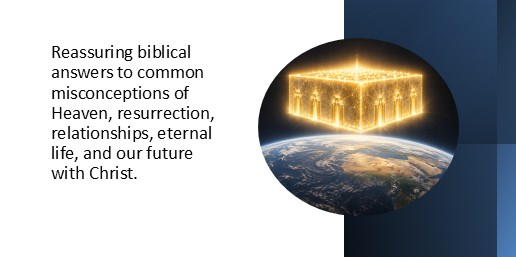
What comes to mind when you think about Heaven? Perhaps you picture clouds, angels with wings, deceased relatives looking down on us, or people spending eternity singing while floating somewhere in a spiritual realm. Some of those misconceptions about heaven contain fragments of biblical truth, while others come more from movies, cartoons, sentimental traditions, and popular culture than from Scripture.
Misconceptions about Heaven matter because what we believe about our future affects how we live today. Paul did not teach about the resurrection merely to satisfy curiosity. After describing our future resurrection, he concluded, “Therefore, my beloved brethren, be ye stedfast, unmoveable, always abounding in the work of the Lord” (1 Corinthians 15:58). Biblical hope produces faithful living.
The Bible gives us something much better than speculation. It tells us that believers will be with Christ, raised bodily, reunited with God’s redeemed people, freed permanently from sin and death, given meaningful service, and eventually live with God in His renewed creation.
Here are reassuring biblical answers to ten common misconceptions about Heaven.
1. Misconception: Everyone Automatically Goes to Heaven
At a funeral, someone quietly says, “Well, at least we know he’s in a better place.” Nobody knows whether the deceased ever trusted Christ, but the statement seems comforting, so no one questions it. Death itself has almost become the qualification for Heaven. If someone was loved, sincere, or basically decent, people naturally assume that Heaven must now be his home.
This misconception sounds plausible because we want death to end well. We love our family and friends, and it is emotionally difficult to contemplate eternal judgment. We also know that God is loving, so it can seem reasonable to assume that a loving God simply receives everyone eventually. But the same Jesus who revealed the Father’s love also warned repeatedly that eternal life is not automatic.
- John 3:16 “Whosoever believeth in him should not perish, but have everlasting life” – Eternal life is genuinely offered to everyone, but Jesus connects receiving that life with believing in Him.
- John 3:18 “He that believeth on him is not condemned: but he that believeth not is condemned already” – Humanity does not begin spiritually neutral. Because of sin, we already stand under condemnation, and faith in Christ is the dividing line between condemnation and life.
- John 14:6 “I am the way, the truth, and the life: no man cometh unto the Father, but by me” – Jesus did not present Himself as one path among many. Access to the Father comes through Him.
- Matthew 7:13-14 “Narrow is the way, which leadeth unto life, and few there be that find it” – Jesus explicitly rejected the assumption that everyone naturally travels toward eternal life.
- Acts 16:31 “Believe on the Lord Jesus Christ, and thou shalt be saved” – Salvation is received through faith in Christ, not through death, morality, religious heritage, or human merit.
This truth is serious, but it is also wonderfully reassuring. God has not hidden the way of salvation behind an unknowable religious system. We do not have to wonder whether we have accumulated enough goodness to qualify. Jesus Christ has already accomplished the work necessary for our salvation through His death and bodily resurrection. The invitation is genuinely extended to all who will believe.
That gives tremendous hope for the future. The believer’s confidence about Heaven does not rest upon wishful thinking. Christ promised eternal life to those who trust Him, and His resurrection demonstrates His victory over death. Heaven is a prepared place for people who have been prepared by God’s grace through faith in Christ.
The practical preparation is therefore not to become “good enough for Heaven.” It is to personally trust Jesus Christ. If you have believed the gospel, then live as someone whose citizenship is already in Heaven. Share the gospel lovingly with others instead of comforting them with the dangerous assumption that everyone will eventually arrive at the same destination.
2. Misconception: People Become Angels When They Die
A grieving parent looks at a picture of a deceased child and says, “God needed another angel.” Someone else sees a butterfly after a funeral and says, “That must be Grandma letting us know she got her wings.” Such expressions are usually intended lovingly. They try to communicate that the person is safe, alive, and with God.
The idea sounds plausible because angels are associated with Heaven. Popular art also portrays angels as deceased humans with wings and halos. Over generations, the distinction between redeemed human beings and angels has become blurred in popular imagination.
But Scripture never says human beings become angels.
- Luke 20:35-36 “Neither can they die any more: for they are equal unto the angels” – Jesus compares resurrected believers to angels in specific respects, particularly immortality and the absence of earthly marriage. Being “equal unto” or “like” angels does not mean becoming angels.
- Hebrews 1:14 “Are they not all ministering spirits, sent forth to minister for them who shall be heirs of salvation?” – Angels are a distinct class of created spiritual beings who minister according to God’s purposes.
- 1 Corinthians 6:3 “Know ye not that we shall judge angels?” – Paul continues to distinguish redeemed human beings from angels even in the future.
Human beings have something remarkable awaiting them that is not improved by turning them into another kind of creature. God created humanity in His image. The Son of God became truly human, died as a man, rose bodily as a man, and remains the God-Man forever. Our destiny is resurrection and glorification, not transformation into angels.
That is reassuring now because God is not going to erase who He created us to be. Salvation is not God’s abandonment of humanity. It is His redemption of humanity. Our identity as His redeemed people has eternal significance.
Our future hope is therefore greater than “getting wings.” Christ intends to raise His people from death and conform our bodies to His glorious body. We will remain human beings, but human beings finally liberated from sin, corruption, weakness, and death.
We prepare for that future by learning to value God’s design rather than sentimental substitutes for it. When comforting grieving believers, we can say something more biblical and more wonderful than “Your loved one became an angel.” We can say that those who die in Christ are with the Lord and await the resurrection of the body.
3. Misconception: Heaven Is Only a Spiritual Existence
Someone imagines eternity as an endless ghostlike existence. There are no bodies, no physical surroundings, no meaningful activity, and nothing resembling real life as we know it. The soul simply floats somewhere in an invisible spiritual dimension forever. For some people, that picture makes Heaven sound less appealing rather than more.
This misunderstanding sounds plausible because believers who die today are indeed consciously with Christ before the resurrection. Paul desired “to depart, and to be with Christ” (Philippians 1:23), and he spoke of being “absent from the body” and “present with the Lord” (2 Corinthians 5:8). The mistake is taking this intermediate condition and treating it as the believer’s final state.
The Bible places enormous emphasis on bodily resurrection.
- 1 Corinthians 15:42-44 “It is sown in corruption; it is raised in incorruption… it is raised in power” – The body that dies is raised transformed. Resurrection is not merely the survival of the soul.
- 1 Corinthians 15:52-53 “The dead shall be raised incorruptible, and we shall be changed” – At the resurrection, mortality gives way to incorruption.
- Philippians 3:20-21 “Who shall change our vile body, that it may be fashioned like unto his glorious body” – Christ will transform the believer’s body according to the pattern of His own glorified body.
- Romans 8:23 “Waiting for the adoption, to wit, the redemption of our body” – Salvation ultimately includes the redemption of the body, not merely deliverance of the soul from the body.
- 1 John 3:2 “We know that, when he shall appear, we shall be like him” – Our future glorification is inseparably connected with the appearing of Christ.
Jesus’ own resurrection shows us that a glorified body is a real body. He could be seen and touched. He ate with His disciples. Yet His resurrection body was no longer subject to death.
This is reassuring because our present physical weakness is temporary. Aging, disability, disease, exhaustion, injury, and death do not get the last word. Christianity does not teach that the physical creation is inherently evil and must be escaped. God created the physical world good, and He intends ultimately to redeem His creation.
Our future hope is resurrection. The cemetery does not contain the believer’s final remains in the ultimate sense. What has been sown in weakness will be raised in power.
We prepare for this by caring for our bodies without worshiping them. We can face aging realistically without despair. We can serve Christ with the strength we have now, knowing that even when this present body fails, resurrection is coming. Paul therefore concludes his resurrection teaching by telling believers to remain “stedfast, unmoveable, always abounding in the work of the Lord” (1 Corinthians 15:58).
4. Misconception: We Will Not Recognize One Another
A widow wonders whether she will know her husband again. Parents who have buried a believing child wonder whether their reunion will feel like a reunion at all. Someone tells them, “I don’t think relationships will matter there. We’ll probably just be absorbed into Heaven and forget who everyone was.”
That idea can sound plausible because our future bodies will be glorified and our relationships will be transformed. Scripture does not describe every detail of interpersonal recognition in eternity. Yet nothing in Scripture suggests the erasure of personal identity. In fact, the biblical evidence consistently points in the opposite direction.
- Luke 24:39 “Behold my hands and my feet, that it is I myself” – The resurrected Jesus emphasized continuity of personal identity. The One who rose was the same Jesus who had been crucified.
- Matthew 17:3 “There appeared unto them Moses and Elias talking with him” – Moses and Elijah remained identifiable persons centuries after their earthly lives.
- Matthew 8:11 “Many shall come… and shall sit down with Abraham, and Isaac, and Jacob, in the kingdom of heaven” – Jesus speaks of Old Testament believers as continuing personal individuals in God’s future kingdom.
- 1 Thessalonians 4:17 “Then we which are alive and remain shall be caught up together with them” – Paul’s comfort to grieving Christians includes reunion. Believers are gathered “together,” not dissolved into an anonymous mass.
- 1 Corinthians 13:12 “Then shall I know even as also I am known” – Although this verse is primarily about the incompleteness of our present knowledge, it points toward greater knowledge rather than diminished identity in the age to come.
We should not claim more than Scripture reveals. The Bible does not tell us precisely how every relationship will function, nor does it promise that every earthly relational pattern continues unchanged. But it gives strong reason to believe that glorification perfects personality rather than destroying it.
This is reassuring today because Christian love is not meaningless. The relationships God forms among His people have genuine eternal significance. Death creates painful separation, but for those in Christ, separation is temporary.
Our future hope is not simply that we will exist in the same enormous place. Paul comforted the Thessalonians with the expectation that believers would be gathered together with the Lord. Recognition, fellowship, and shared joy fit naturally within that promise.
We prepare for this by investing in eternal relationships now. Forgive quickly. Love sincerely. Encourage other believers. Share the gospel with those who do not know Christ. The people around us matter eternally.
5. Misconception: We Will Forget Everything About Our Earthly Lives
Someone trying to comfort a grieving Christian says, “Don’t worry, in Heaven you won’t remember any of this. God will erase all the painful memories.” It sounds comforting because forgetting sorrow seems like an obvious way to eliminate suffering. If we remembered earthly heartbreak, some reason, how could Heaven possibly remain joyful?
Scripture gives us a better answer. God does not need to destroy our memories in order to heal us. Our perspective will be perfected.
- 2 Corinthians 5:10 “We must all appear before the judgment seat of Christ… according to that he hath done” – The believer’s earthly service has continuing significance before Christ. This judgment concerns evaluation and reward, not condemnation for sin, which Christ has already borne.
- Revelation 6:9-10 “I saw under the altar the souls of them that were slain for the word of God… And they cried… How long?” – These believers retain awareness of their earthly martyrdom and of God’s unfinished purposes in history.
- Revelation 7:14 “These are they which came out of great tribulation” – Their earthly history remains part of their identifiable testimony before God.
Some point to Isaiah’s statement that “the former shall not be remembered” (Isaiah 65:17) and conclude that God literally erases all memory. Yet in context the emphasis is that the former world of sorrow will no longer dominate the renewed creation. Scripture elsewhere clearly portrays redeemed people retaining identity, history, and awareness.
Our problem is not simply that we remember painful events. Our problem is that we presently remember them through minds affected by grief, misunderstanding, sin, fear, and incomplete knowledge. God can preserve truth while completely removing the sting.
That is deeply reassuring. The Lord does not need to erase your story in order to redeem it. Nothing faithful done for Christ is wasted. Nothing suffered for Him is forgotten. Nothing that currently seems inexplicable will remain outside His righteous perspective forever.
Our future hope is not amnesia. It is understanding without anguish, memory without bitterness, and history viewed in the light of God’s completed purposes.
We prepare by living today in a way we will be glad to place before Christ. Confess sin instead of hiding it. Forgive rather than nurturing bitterness. Serve faithfully when no one seems to notice. Store treasure in Heaven. The God who remembers your service will put your entire story into its proper eternal perspective.
6. Misconception: Heaven Will Be Boring
A teenager hears someone describe eternity as “singing hymns forever” and quietly thinks, “I know I’m supposed to want Heaven, but that sounds exhausting.” Another person imagines sitting on a cloud with a harp while nothing ever changes. Eternity sounds less like abundant life and more like an endless church service with no lunch break.
The misconception sounds plausible because Scripture repeatedly describes worship in Heaven. If our definition of worship is limited to singing during a Sunday service, we may assume eternal worship means doing one activity without interruption forever.
Biblical worship, however, is much bigger than singing.
- Revelation 22:3 “His servants shall serve him” – Eternity includes meaningful service to God.
- Revelation 22:5 “They shall reign for ever and ever” – God’s redeemed people are given purposeful responsibility under His rule.
- Revelation 21:3 “The tabernacle of God is with men, and he will dwell with them” – The central reality of eternity is unhindered fellowship with God.
- Revelation 21:4 “There shall be no more death, neither sorrow, nor crying, neither shall there be any more pain” – Eternal life is not empty existence. It is life completely liberated from the curse.
- Revelation 5:9 “Thou wast slain, and hast redeemed us to God by thy blood” – Heavenly worship springs from an ever-deepening appreciation of Christ’s worth and His redemptive work.
Boredom flourishes in a fallen world because our minds tire, pleasures fade, relationships disappoint, activities become repetitive, and even wonderful experiences eventually leave us unsatisfied. None of those limitations should be projected onto God’s perfected creation.
God Himself is inexhaustible. We will never reach a point where there is nothing more worth knowing about Him, no further reason to worship, no meaningful service to perform, and no joy remaining to experience.
This reassures us now because the meaningful parts of life are not merely temporary distractions before eternity. Service, creativity, stewardship, worship, fellowship, learning, and responsible work all reflect aspects of God’s original design for humanity. Sin has frustrated those things, but it has not made them meaningless.
Our future hope is purposeful life without frustration. We will serve without exhaustion, worship without distraction, fellowship without conflict, and reign with Christ without corruption.
We prepare by practicing faithful service today. Worship God with your whole life, not merely with songs. Develop the gifts He has given you. Learn to enjoy serving others. Become faithful in small responsibilities. Eternity will not make faithfulness obsolete. It will finally allow God’s servants to serve Him without the interference of sin.
7. Misconception: Marriage Continues Exactly as It Does on Earth
A devoted husband says, “I cannot imagine Heaven without being married to my wife exactly as we are now.” His concern is understandable. Their marriage may represent decades of companionship, sacrifice, laughter, children, hardship, prayer, and shared memories. The thought that earthly marriage does not continue can initially sound more like loss than hope.
This misconception seems plausible because love is good, marriage is God’s creation, and genuine Christian marriages can become some of life’s deepest relationships. If Heaven perfects everything good, people naturally wonder why marriage would not simply continue unchanged.
Jesus answered the question directly.
- Luke 20:34-36 “They which shall be accounted worthy to obtain that world, and the resurrection from the dead, neither marry, nor are given in marriage” – Earthly marriage does not continue as an institution after the resurrection.
- Ephesians 5:31-32 “They two shall be one flesh. This is a great mystery: but I speak concerning Christ and the church” – Human marriage has always pointed beyond itself toward the greater relationship between Christ and His people.
- Revelation 19:7 “The marriage of the Lamb is come, and his wife hath made herself ready” – The imagery reaches its fulfillment in the glorious union of Christ and His redeemed people.
Marriage therefore does not cease because God has decided that love matters less. Earthly marriage fulfills its God-given purpose and gives way to something greater. A road sign is valuable precisely because it points toward a destination. Once you arrive, you do not lament that you no longer need the sign.
This truth also honors unmarried believers. No Christian is spiritually incomplete because he or she is single, widowed, or never married. Marriage is an extraordinary earthly gift, but Christ is the eternal portion of every believer.
For married Christians, this is reassuring because nothing good about your marriage is wasted. The history you share, the sanctification God accomplished through it, and the love formed between two redeemed people do not become meaningless. Personal identity remains. What changes is the covenant structure and purpose of marriage.
Our future hope is that no believer will arrive in eternity thinking God has diminished his capacity for love. The God who invented marriage is not preparing a lesser relationship. He is bringing His people into the reality toward which faithful marriage has always pointed.
We prepare by refusing to make marriage an idol while also treating it as sacred. Husbands should love their wives as Christ loved the church. Wives should respect their husbands. Singles should pursue wholehearted faithfulness to Christ. Parents should remember that their highest goal is not merely keeping the family together on earth, but pointing each family member toward Jesus Christ.
8. Misconception: Heaven Is Primarily About Seeing Our Loved Ones
Someone who has lost a parent says, “The only thing that makes me want Heaven is knowing I’ll see Mom again.” That longing is understandable and can be very tender. Scripture gives believers genuine reason to anticipate reunion with other believers. But if reunion becomes the center of Heaven, even a beautiful truth can become distorted.
This misconception sounds plausible because human relationships are tangible to us now. We have seen our spouse’s face, heard our child’s voice, held our parent’s hand, and laughed with our friends. We have not yet seen Christ face to face, so reunion with someone we remember can sometimes feel more emotionally concrete.
Yet Jesus described Heaven differently.
- John 14:3 “I will come again, and receive you unto myself; that where I am, there ye may be also” – The heart of Christ’s promise is not merely that believers will reach a location. He receives us to Himself.
- Philippians 1:23 “Having a desire to depart, and to be with Christ; which is far better” – Paul’s longing beyond death centered upon being with Christ.
- 1 Thessalonians 4:17 “So shall we ever be with the Lord” – Even in a passage that includes the reunion of living and resurrected believers, Paul’s great conclusion is eternal presence with Jesus.
- Revelation 21:3 “Behold, the tabernacle of God is with men, and he will dwell with them” – The greatest blessing of the eternal state is God’s immediate presence among His redeemed people.
Yes, Christians have wonderful reason to anticipate reunion with believing loved ones. Paul’s language in 1 Thessalonians 4 is explicitly intended to comfort Christians grieving believers who have died. But loved ones cannot carry the weight of being our ultimate hope. Only Christ can do that.
This is reassuring for those whose family situations are complicated. Some believers have lost nearly everyone they love. Others came to Christ from families that rejected the gospel. Some never married or had children. Others carry painful memories of broken families. Heaven will not be less glorious for them because Christ Himself is its greatest treasure.
Our future hope is therefore both vertical and relational. We will be with the Lord, and we will be gathered with His redeemed people. We do not need to choose between loving Christ and loving one another. Our love for one another will finally exist in perfect harmony with supreme love for Him.
We prepare by cultivating love for Christ now. Read His Word. Pray. Worship. Serve Him. Learn to say with Paul that being with Christ is “far better.” And because people matter eternally, lovingly tell your family and friends the gospel rather than merely assuming that everyone will eventually be reunited in Heaven.
9. Misconception: Good People Earn Their Way Into Heaven
Two neighbors discuss eternity over a backyard fence. One says, “I’m not worried. I’ve tried to be a good person. I’ve never murdered anyone, I pay my taxes, I help my family, and I think God will take all that into consideration.” By ordinary human comparison, his argument seems reasonable. He may indeed be kinder and more respectable than many people around him.
This misconception sounds plausible because nearly every human system operates by merit. Students earn grades. Employees earn promotions. Athletes earn trophies. Responsible people often receive better outcomes than irresponsible people. It seems natural to assume that Heaven works the same way.
But salvation is fundamentally different because God’s standard is not “better than average.” His standard is righteousness, and all of us are sinners.
- Romans 3:23 “For all have sinned, and come short of the glory of God” – Our problem is universal. Moral comparison with other sinners cannot make us righteous before a holy God.
- Romans 3:24 “Being justified freely by his grace through the redemption that is in Christ Jesus” – Justification is a gift of God’s grace grounded in Christ’s redemption.
- Ephesians 2:8-9 “For by grace are ye saved through faith… not of works, lest any man should boast” – Human achievement cannot purchase salvation. It is received by grace through faith.
- Titus 3:5 “Not by works of righteousness which we have done, but according to his mercy he saved us” – Even our righteous deeds cannot remove the guilt of sin.
- Romans 4:5 “To him that worketh not, but believeth on him that justifieth the ungodly, his faith is counted for righteousness” – Justification rests on faith in God’s provision, not accumulated personal merit.
The gospel is that Jesus Christ died for our sins, was buried, and rose bodily from the dead. The sinner who trusts Him receives forgiveness and eternal life. Good works follow salvation, but they never become the price of salvation.
Ephesians 2:10 “Created in Christ Jesus unto good works” – Good works are the intended fruit of salvation, not its purchasing price.
This is extraordinarily reassuring. If eternal life depended upon maintaining a sufficiently good record, no one could ever possess genuine assurance. There would always be one more failure to remember and one more uncertainty about whether we had done enough.
Christ’s finished work changes the basis of our confidence. The believer can look away from his imperfect performance and toward a perfect Savior.
Our future hope therefore rests in Christ rather than ourselves. Jesus paid the penalty of sin completely. The believer has “passed from death unto life” and “shall not come into condemnation” (John 5:24).
We prepare for Heaven first by receiving God’s gift through faith. Then, because we have been saved by grace, we live gratefully and obediently. We pursue holiness, serve others, resist sin, and do good, not to purchase God’s acceptance, but because we already belong to Christ.
10. Misconception: Heaven Is Our Final Destination as Disembodied Souls Forever
A cartoon shows a man arriving at pearly gates, receiving a white robe and harp, and sitting on a cloud forever. For many people, that image summarizes the entire Christian future: believers die, their souls go to Heaven, and they remain there eternally while earth is permanently abandoned.
This misconception contains enough truth to sound convincing. Believers who die today really are with Christ. Heaven is real. Jesus is there. Paul could therefore say that to depart and be with Christ is “far better.” The mistake comes when the present heavenly state is treated as the complete biblical picture of our eternal future.
Scripture presents a much larger redemptive plan.
- Philippians 1:23 “To depart, and to be with Christ; which is far better” – A believer who dies is consciously with Christ. Death does not separate the Christian from the Lord.
- 1 Thessalonians 4:16-17 “The dead in Christ shall rise first… and so shall we ever be with the Lord” – The future of deceased believers includes bodily resurrection, not permanent disembodied existence.
- Revelation 20:4 “They lived and reigned with Christ a thousand years” – Scripture describes a real future reign of Christ associated with a thousand-year kingdom.
- Revelation 20:11 “I saw a great white throne… from whose face the earth and the heaven fled away” – After Christ’s kingdom comes the final judgment and the removal of the present creation.
- Revelation 21:1 “I saw a new heaven and a new earth” – God’s eternal purpose includes a renewed creation, not the permanent abandonment of creation.
- Revelation 21:2 “I John saw the holy city, new Jerusalem, coming down from God out of heaven” – Strikingly, the movement in the final vision is not redeemed humanity permanently escaping earth, but the New Jerusalem coming down from Heaven.
- Revelation 21:3 “Behold, the tabernacle of God is with men, and he will dwell with them” – God’s redemptive plan culminates in His dwelling with His redeemed people in the renewed creation.
- Revelation 22:3 “There shall be no more curse” – The final biblical picture is creation freed from the curse and filled with God’s presence.
A dispensational reading also keeps the major stages of this future hope distinct. Believers who die now are with Christ. The Church awaits Christ’s coming for His people and the resurrection and transformation described in 1 Thessalonians 4 and 1 Corinthians 15. Scripture then reveals Christ’s return in glory and His earthly kingdom, including the thousand-year reign of Revelation 20. After the final rebellion and final judgment comes the New Heaven, New Earth, and New Jerusalem described in Revelation 21 and 22.
The believer’s final hope, therefore, is not to spend eternity as a ghost floating among clouds. It is resurrection life with Christ in God’s completed kingdom and ultimately in His renewed creation.
That is enormously reassuring now because God does not abandon His purposes when the world appears broken. Sin has devastated creation, but sin will not win. Satan will not win. Death will not win. The curse will not win. Jesus Christ will finish the work He began.
This also changes the way we think about ordinary faithfulness. Creation matters to God. Our bodies matter. Work matters. Service matters. Relationships matter. What sin has corrupted, Christ will ultimately bring under His righteous rule.
Our future hope is breathtakingly concrete. God’s servants will see His face. They will serve Him. They will reign with Him. There will be no curse, death, sorrow, crying, or pain. Eternity is not an escape from God’s good purposes for humanity. It is their fulfillment.
We prepare by living as citizens of Christ’s coming kingdom. Set your affection “on things above” (Colossians 3:2), but do not interpret that as indifference toward faithful life on earth. Serve Christ here because He is coming. Pursue holiness because our future world is one “wherein dwelleth righteousness” (2 Peter 3:13). Hold possessions loosely, endure suffering faithfully, proclaim the gospel, and remember that history is moving toward the visible triumph of Jesus Christ.
Heaven Is Better Than the Misconceptions
The Bible’s teaching about Heaven is much richer than the popular images surrounding it. Heaven is not automatic for everyone, but salvation is freely offered to everyone who will trust Jesus Christ. We do not become angels. We remain redeemed human beings who will ultimately receive glorified bodies. Our identities are not erased, our relationships are not meaningless, and our earthly lives are not forgotten as though nothing here mattered.
Heaven will not be boring. It will be filled with worship, fellowship, service, purpose, and the presence of God. Earthly marriage will have fulfilled its temporary purpose, but love will not be diminished. Reunion with believing loved ones will be wonderful, but Jesus Christ Himself will remain the greatest joy of eternity.
Most importantly, nobody earns admission by becoming sufficiently good. Eternal life is God’s gift, received by grace through faith in Jesus Christ and His finished work.
And even “going to Heaven” does not exhaust the Christian hope. We await resurrection, Christ’s coming kingdom, and ultimately the New Heaven and New Earth in which righteousness dwells and God lives among His redeemed people forever.
John 14:1-3 “Let not your heart be troubled… I go to prepare a place for you… I will come again, and receive you unto myself” – Jesus gave teaching about our future for the explicit purpose of reassuring troubled hearts.
That is the point of biblical prophecy about Heaven. God did not reveal these things merely so that Christians could construct timelines or satisfy curiosity. He revealed them so that troubled believers could hope, grieving believers could be comforted, suffering believers could endure, and every Christian could live faithfully while waiting for Jesus Christ.
Heaven is Christ-centered, not self-centered. It is physical as well as spiritual. It is relational rather than lonely. It is purposeful rather than boring. And it is prepared for those who have trusted Jesus Christ.
The Christian’s future is not an uncertain wish.
It is a promise secured by a risen Savior.
Flying Higher
- Heaven: A Comprehensive Guide to Everything the Bible Says About Our Eternal Home (Clear Answers to 44 Real Questions About the Afterlife, Angels, Resurrection, and the Kingdom of God) by Randy Alcorn – In the most comprehensive and definitive book on Heaven to date, Randy invites you to picture Heaven the way Scripture describes it’s a bright, vibrant, and physical New Earth, free from sin, suffering, and death, and brimming with Christ’s presence, wondrous natural beauty, and the richness of human culture as God intended it.