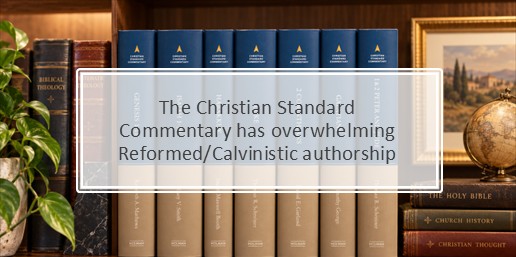
The Christian Standard Commentary from B&H Academic based on the CSC translation is often described simply as evangelical, but that only tells part of the story. A closer look at the individual contributors shows a significant Reformed and Calvinistic influence, especially in the New Testament volumes.
That does not mean every volume is Reformed. Some contributors are evangelical and dispensational, some are clearly non-Calvinist, and others are harder to classify. In fact, the theological outlook can change quite a bit from one biblical book to another.
That matters because a commentator’s theology can shape how he handles passages about election, regeneration, the atonement, perseverance, Israel and the Church, covenants, and prophecy. The series can still be very useful, but it is wise to know who is writing before assuming the commentary is theologically neutral.
- Whosoever will may come – God’s amazing gospel message is a universal invitation! We dive into the powerful reality that “whosoever will” may come to eternal life through Christ. The divine call ensures salvation remains open to every person.
- God Predestined the Plan of Salvation – Discover how God sovereignly predestined the eternal Plan of Salvation before time began. We explore the divine decree that established the redemptive gospel in Christ, assuring His finished work for all who believe.
- The gospel according to Calvinism is not the gospel according to the Bible – Do the doctrines of Calvinism truly reflect the Biblical gospel? We compare two plans of salvation to clarify how Scripture emphasizes God’s universal mercy, calling all who believe through Christ.
- Calvinism and Arminianism Reject the Finished Work of Jesus Christ – Understand that both Calvinism and Arminianism risk rejecting the finished work of Jesus Christ! Salvation is a free gift through grace. Our faith rests entirely on Christ’s perfect atonement—He paid for all sin so we can receive eternal life by trusting Him.
The following guide looks at each Christian Standard Commentary volume individually and identifies the author’s general theological leaning so readers can use the series with greater discernment and, as always, test every interpretation by Scripture.
Christian Standard Commentary: theological orientation by volume
Genesis (1–11:26) by Kenneth A. Mathews (Unclear / mixed) Conservative evangelical Baptist. DTS-trained, but I found insufficient evidence to label his mature theology specifically dispensational or Calvinist. Christianbook
Genesis (11:27–50:26) by Kenneth A. Mathews (Unclear / mixed) Same author and qualification as above. B&H published this volume in 2026. B&H Publishing
Joshua by David M. Howard Jr. (Unclear / mixed) Broad conservative evangelical. Has taught at Bethel, TEDS, NOBTS, and Bethlehem College & Seminary. I would not assign a soteriological system from those affiliations alone. Bethel University
1–2 Samuel by Robert D. Bergen (Unclear / mixed) Conservative evangelical/Southern Baptist scholar; I found no sufficiently clear public basis for placing him in one of the other three camps. B&H has announced the CSC volume. B&H Publishing
1–2 Kings by Trevor Laurence (Reformed / Calvinist) Strong classification. Laurence is a ruling elder in the PCA, a confessionally Reformed denomination. Trinity Church (PCA)
1–2 Chronicles by Jerry Hwang (Unclear / mixed, Reformed-leaning) Evangelical scholar at Regent. His Jeremiah commentary has been described as taking a “broadly Reformed approach,” but that is not enough to call him personally a confessional Calvinist. Regent College
Esther by Andrew E. Steinmann (Unclear / mixed: Lutheran) This needs its own label. Steinmann is confessional Lutheran, neither Provisionist nor dispensational nor conventionally Reformed Baptist. His Daniel explicitly critiques dispensational/premillennial interpretations. Concordia Publishing House
Isaiah (1–39) by Gary V. Smith (Unclear / mixed) Conservative evangelical; taught at Midwestern Baptist, Bethel, and Union. I found no strong evidence warranting a Calvinist or dispensational label. B&H Publishing
Isaiah (40–66) by Gary V. Smith (Unclear / mixed) Same qualification. B&H Publishing
Haggai by Richard A. Taylor) (Dispensational) Strong institutional evidence: longtime/senior OT professor at Dallas Theological Seminary. DTS faculty annually affirm its complete doctrinal statement, including dispensationalism. Dallas Theological Seminary B&H lists release March 1, 2027. B&H Publishing
Habakkuk by Susan Maxwell Booth (Unclear / mixed) Conservative Southern Baptist evangelical, SEBTS-trained, professor at Canadian Baptist Theological Seminary. I found insufficient evidence to call her Calvinist or Provisionist. Canadian Baptist Theological Seminary
Zephaniah by Robert B. Chisholm Jr. (Dispensational) Strong classification. He is chair/senior OT professor at Dallas Theological Seminary; DTS faculty affirm its premillennial, dispensational doctrinal framework. Dallas Theological Seminary
Matthew by Craig L. Blomberg (Unclear / mixed) Broad conservative evangelical. I would not treat Blomberg as a reliably Reformed or dispensational interpreter across theological issues.
Luke by Gregory R. Lanier (Reformed / Calvinist) Very strong classification. Professor at Reformed Theological Seminary and ordained teaching elder in the PCA. Reformed Theological Seminary
Acts by Patrick Schreiner (Reformed / Calvinist-leaning) SBTS-trained, now professor of biblical theology at MBTS; his biblical-theological work is much closer to the Reformed/progressive-covenantal stream than dispensationalism. He has explicitly described his Israel/Church approach as substantially similar to progressive covenantalism. Midwestern Baptist Theological Seminary
1 Corinthians by Eric C. Redmond (Reformed / Calvinist) Very strong. Redmond contributed his own conversion-to-Reformed-theology story to Glory Road: The Journeys of 10 African-Americans into Reformed Christianity. Crossway
2 Corinthians by David E. Garland (Unclear / mixed) Conservative Baptist evangelical scholar, formerly SBTS and Baylor/Truett. His institutional history alone does not establish a present Calvinist identity. B&H Publishing
Galatians by Timothy George (Reformed / Calvinist) Very strong. George explicitly says, “I am also an inerrantist, a Calvinist, and a premillennialist.” Thus Calvinist soteriology combined with premillennial eschatology. Center For Baptist Renewal
Philippians by Richard R. Melick Jr. (Unclear / mixed) Conservative evangelical/Southern Baptist. I found insufficient evidence for a more specific classification. B&H lists the volume as active. B&H Publishing
1–2 Thessalonians by Douglas J. Moo (Reformed / Calvinist) Strong soteriological classification. Moo himself says he tends “to be on the Calvinist side of soteriology.” He is evangelical rather than strictly confessional Reformed. Biblical Training
1–2 Timothy / Titus by Ray Van Neste & David S. Dockery (Mixed Van Neste: Reformed/Calvinist-leaning. Dockery: centrist/mixed.) Van Neste has extensive Calvin/Reformation associations; Dockery has deliberately sought common ground among both Calvinist and non-Calvinist Southern Baptists rather than staking out a hard camp. Union University
Hebrews by David L. Allen (Provisionist / non-Calvinist) Very strong. More precisely, Allen is a Traditionalist Southern Baptist non-Calvinist, closely aligned with Provisionist soteriology. He edited Anyone Can Be Saved: A Defense of “Traditional” Southern Baptist Soteriology and argues explicitly for unlimited atonement against limited atonement. Wright State University Online Bookstore
1–2 Peter and Jude by Thomas R. Schreiner (Reformed / Calvinist) Very strong. Schreiner co-edited The Grace of God, the Bondage of the Will, explicitly described as a reaffirmation of the Calvinist position, and has written extensively on election, perseverance, and Reformed justification. Google Books
1–3 John by Robert L. Plummer (Reformed / Calvinist-leaning) Longtime SBTS professor. His academic environment and published associations point strongly Reformed Baptist, but I did not locate an equally explicit personal “I am a Calvinist” statement, so I would leave the qualifier leaning.
The pattern is more revealing than I expected
If we concentrate only on the authors for whom the evidence is reasonably strong, the series looks approximately like this:
| Orientation | Authors with reasonably strong evidence |
| Reformed / Calvinist | Gregory Lanier, Timothy George, Thomas Schreiner, Eric Redmond, Trevor Laurence, Douglas Moo |
| Reformed / Calvinist-leaning | Patrick Schreiner, Robert Plummer, probably Ray Van Neste |
| Dispensational | Robert Chisholm, Richard Taylor |
| Provisionist / non-Calvinist | David Allen |
| Other / unclear evangelical | Mathews, Howard, Bergen, Hwang, Smith, Booth, Blomberg, Garland, Melick, Dockery |
| Confessional Lutheran | Andrew Steinmann |
The Christian Standard Commentary claims to be a broad conservative evangelical series. [B&H Publishing] But among the contributors whose theology can be identified confidently, there is a overwhelming Reformed/Calvinistic presence, especially in the New Testament.
That does not make the entire series a “Reformed commentary.” The presence of David Allen on Hebrews is particularly significant. He is one of the better-known contemporary Southern Baptist critics of Calvinistic limited atonement. Likewise, Chisholm and Taylor come directly from DTS’s premillennial dispensational tradition, whose faculty are required to affirm the school’s dispensational doctrinal statement. [Dallas Theological Seminary]
Where I would be most cautious
Given the theological framework of BibleTruths, the most important differences concern unconditional election, total inability, regeneration preceding faith, irresistible grace, perseverance as evidence of election, covenant theology/progressive covenantalism, Israel and the Church, and fulfillment of Old Testament promises to national Israel. Therefore, I would put the volumes into three practical research groups:
Most theological cross-checking needed: Luke (Lanier), Acts (Patrick Schreiner), Galatians (George), 1–2 Peter/Jude (Thomas Schreiner), and forthcoming 1 Corinthians (Redmond), 1–2 Thessalonians (Moo), 1–2 Kings (Laurence), and 1–3 John (Plummer). These authors are the most likely to bring Calvinistic or covenantal presuppositions into disputed texts.
Especially compatible on dispensational questions: Zephaniah (Chisholm) and forthcoming Haggai (Taylor). Both come from DTS, whose stated theological framework explicitly combines grammatical-historical interpretation with premillennial dispensationalism. [Dallas Theological Seminary]
Especially compatible on non-Calvinist soteriology: Hebrews by David Allen. Of the whole series, this is the author whose published soteriology most clearly overlaps the Provisionist/non-Calvinist side of your framework, particularly universal provision and a genuine gospel offer to all. [Wright State University Online Bookstore]
The interesting result is that CSC is not a systematic-theology-driven series in the way a clearly Reformed commentary set would be. It is genuinely an evangelical multi-author set. That makes it quite usable for exegetical research, but the author’s identity matters considerably more than the series name when you reach passages involving election, atonement, regeneration, perseverance, Israel, covenant, or prophecy.