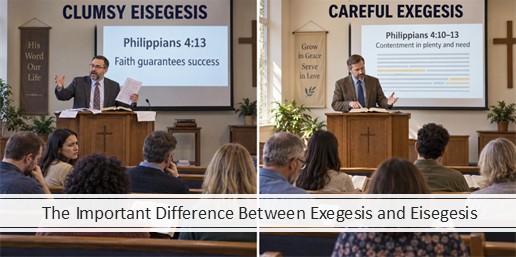
The Important Difference Between Exegesis and Eisegesis

The difference between clumsy eisegesis to accidently teach false doctrine and careful exegesis to accurately give the sense of scripture.

Six part study of important difference between exegesis and eisegesis, including their definitions, Greek origins, and practical examples. Learn how context guides biblical interpretation, why meaning must precede application, and how careful Scripture study protects sound doctrine and encourages faithful Christian obedience. Continue ReadingThe Important Difference Between Exegesis and Eisegesis→

Denominate, Denomination, Denominationalism, and the Myth of Non-Denominationalism

The myth of non-denominationalism hides an important truth: every church has doctrine, history, leadership, traditions, and boundaries. Learn when practical distinctions are biblical, when denominations are useful, and when denominationalism becomes sinful division.

The myth of non-denominationalism hides an important truth: every church has doctrine, history, leadership, traditions, and boundaries. Learn when practical distinctions are biblical, when denominations are useful, and when denominationalism becomes sinful division. Continue ReadingDenominate, Denomination, Denominationalism, and the Myth of Non-Denominationalism→

Denominate, the Practical Need to Identify and Distinguish

A denomination unites churches through shared doctrine, history, leadership, and ministry. Such cooperation can strengthen missions, training, and accountability, but it becomes dangerous when institutional authority competes with Scripture, conscience, or the lordship of Jesus Christ.

Every church must identify what it believes. To denominate means to name and distinguish doctrine, leadership, and practice. Biblical clarity requires honest distinctions, but every label must remain humble, truthful, and subordinate to Scripture. Continue ReadingDenominate, the Practical Need to Identify and Distinguish→

Denomination, a Shared Identity Among Churches

A denomination unites churches through shared doctrine, history, leadership, and ministry. Such cooperation can strengthen missions, training, and accountability, but it becomes dangerous when institutional authority competes with Scripture, conscience, or the lordship of Jesus Christ.

A denomination unites churches through shared doctrine, history, leadership, and ministry. Such cooperation can strengthen missions, training, and accountability, but it becomes dangerous when institutional authority competes with Scripture, conscience, or the lordship of Jesus Christ. Continue ReadingDenomination, a Shared Identity Among Churches→

Denominationalism, When Distinction Becomes Sinful Division

A church identity becomes denominationalism when labels, traditions, pastors, or networks produce pride, rivalry, compromise, or unnecessary division. Practical distinctions become sinful when loyalty to a group replaces biblical truth, Christian love, and allegiance to Christ.

A church identity becomes denominationalism when labels, traditions, pastors, or networks produce pride, rivalry, compromise, or unnecessary division. Practical distinctions become sinful when loyalty to a group replaces biblical truth, Christian love, and allegiance to Christ. Continue ReadingDenominationalism, When Distinction Becomes Sinful Division→