How many eyewitness reports would you need to believe in Elvis Presley, George Washington, or King Arthur? Here are 12 eyewitness accounts from men who saw God over more than 2000 years (from Job’s argument with God before 2100 BC to John’s revelation in 95 AD). Not to mention Adam, Enoch, Noah, and Elijah who all saw God but didn’t write about it. They have been preserved for us through hundreds and thousands of trustworthy ancient manuscripts. The glory and majesty of these eyewitness accounts is so overwhelming, it can be only contrasted to the grandeur of earthly kingdoms and CGI from the imaginations of movie makers.
SPOILER ALERT: Not very many people have seen God physically, but everyone in this study has experienced God in a special way that was recorded “for our instruction, so that through endurance and the encouragement of the Scriptures, we might have hope” (Romans 15:4). You can experience God just like these people did.
A Combined Biblical Description of the Glory of God
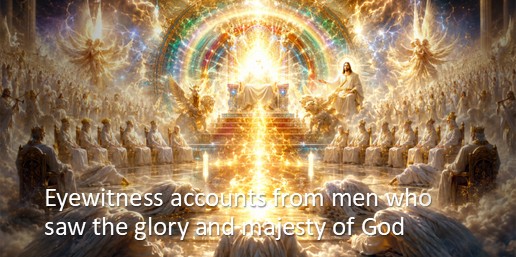
The biblical witnesses describe a heavenly throne room filled with overwhelming light, fire, purity, power, and majesty. At the center is the Lord, seated above all creation as the eternal King and righteous Judge. His throne appears brilliant like precious gemstones, sapphire, jasper, and glowing red stone, surrounded by fire, radiant light, and a rainbow-like brilliance that reflects both His holiness and His covenant faithfulness.
The Lord’s appearance cannot be described as an ordinary human body. The prophets repeatedly use phrases such as “the likeness,” “the appearance,” and “as it were” because human language is inadequate to describe what they saw. He is portrayed in a form resembling a man, clothed in dazzling whiteness, radiant like the sun, and surrounded by blazing fire. His purity is pictured as white as snow, His wisdom and eternal dignity as hair like pure wool, and His presence as brighter than anything found in the natural world.
Around the throne are countless heavenly beings. Cherubim, seraphim, angels, elders, and the armies of heaven stand ready to obey His commands. Some cover their faces in reverence, declaring, “Holy, holy, holy,” while multitudes worship and serve before Him. Thunderous voices, shaking foundations, rushing wings, smoke, clouds, and streams of fire communicate the immeasurable power of His presence.
The throne is not stationary or limited by earthly geography. Ezekiel saw wheels associated with it, showing that God rules everywhere and is never confined to a temple, city, or nation. He remained sovereign over Israel in the land, over the captives in Babylon, and over every human kingdom. Nations rise and fall, but His authority never changes.
When judgment is revealed, fire proceeds from His presence, the books are opened, and no creature can escape His knowledge or authority. Yet the same visions also display mercy, grace, patience, goodness, truth, forgiveness, and covenant faithfulness. God is not only powerful, but perfectly holy, righteous, compassionate, and just.
Beside the Father appears the Son of Man, Jesus Christ, radiant in divine glory. He comes with the clouds of heaven, receives worship, and is given everlasting dominion over every people, nation, and language. At the Transfiguration, His face shone like the sun and His clothing became white as light. Stephen later saw the risen Jesus standing at the right hand of God, confirming that Christ lives and reigns in heaven.
Those who witnessed these revelations did not respond casually. They fell on their faces, trembled, confessed their sin, worshiped, and recognized their unworthiness. Isaiah cried, “Woe is me.” Ezekiel fell facedown. Daniel lost his strength. Peter, James, and John were terrified. John fell before Christ as though dead. A genuine revelation of God’s glory produces humility, reverence, repentance, worship, and obedience.
Taken together, the visions present God as the eternal, radiant, holy, all-powerful King who rules from heaven, commands the spiritual realm, judges evil, keeps His promises, forgives sin, and reveals Himself through Jesus Christ. These witnesses saw true manifestations of God’s glory, but not the full, unlimited essence of God, which no mortal could behold and survive.
Adam and Eve Encounter the LORD God in the Garden
This account is important because Adam and Eve personally encountered the LORD God in the garden and heard Him speak directly to them. After they sinned, the presence that should have brought fellowship instead produced fear and hiding. God’s questions exposed their guilt and called them to acknowledge what they had done.
Genesis 3:8 “They heard the voice of the LORD God walking in the garden in the cool of the day.” – Adam and Eve heard the LORD God approaching in the garden. The language presents God’s presence in an immediate and personal way, although the verse specifically says they heard Him rather than explicitly stating what visible form they saw.
Genesis 3:8 “Adam and his wife hid themselves from the presence of the LORD God amongst the trees of the garden.” – Sin had radically changed their response to God. The man and woman who had been created for fellowship with Him now attempted to hide from His holy presence because guilt had entered their consciences.
Genesis 3:9 “The LORD God called unto Adam, and said unto him, Where art thou?” – God did not ask because He lacked knowledge of Adam’s location. The question summoned Adam out of hiding and required him to confront his broken relationship with God.
Genesis 3:10 “I heard thy voice in the garden, and I was afraid, because I was naked; and I hid myself.” – Adam’s own words revealed the effects of sin: fear, shame, and separation. His attempt to hide showed that he knew something was wrong, even before he openly confessed his disobedience.
Genesis 3:11 “Who told thee that thou wast naked? Hast thou eaten of the tree, whereof I commanded thee that thou shouldest not eat?” – God’s questions exposed the true cause of Adam’s fear and shame. Adam’s condition was not merely emotional discomfort, but the consequence of deliberately disobeying God’s clear command.
Genesis 3:12 “The woman whom thou gavest to be with me, she gave me of the tree, and I did eat.” – Adam admitted eating the forbidden fruit, but he also shifted blame toward Eve and indirectly toward God, who had given her to him. Sin damaged his willingness to accept personal responsibility.
Genesis 3:13 “What is this that thou hast done?” – God called Eve to account for her own action. His question was not a request for information, but an invitation to recognize the seriousness and consequences of her disobedience.
Genesis 3:13 “The serpent beguiled me, and I did eat.” – Eve truthfully acknowledged the serpent’s deception and her own act of eating. Although she had been deceived, she remained responsible for choosing to disregard God’s command.
Genesis presents Adam and Eve as people who personally heard God, lived in His immediate presence, and spoke directly with Him. However, Scripture does not explicitly state that they repeatedly saw God in visible form before the fall. But the account makes it obvious that they spent lots of intimate time walking together in the garden. The statement that Adam “did not know he was lost” can work as a sermonic application, but the text more directly shows that God’s question called Adam out of hiding and exposed the guilt, fear, and separation caused by sin.
Job Saw God (In the Future-Perfect Tense) With His Eyes
Job’s testimony is important because it joins two kinds of eyewitness language. In the midst of suffering, Job expressed confident hope that he would one day see his living Redeemer with his own eyes. Later, after the LORD spoke to him, Job declared that his knowledge of God had moved from secondhand hearing to direct personal encounter.
Job 19:23-24 “Oh that my words were now written!… that they were engraved in the rock forever!” – Job wanted his testimony permanently preserved because he was about to state a conviction that reached beyond his present suffering. His words were intended as an enduring declaration of faith.
Job 19:25 “I know that my Redeemer lives.” – Job expressed personal confidence in a living Redeemer who would ultimately vindicate him. The Hebrew word translated “Redeemer” is goel, referring to a kinsman-redeemer, defender, or one who acts on behalf of another.
Job 19:25 “In the end, he will stand upon the earth.” – Job expected his Redeemer to appear and act decisively in the future. This hope points beyond Job’s immediate circumstances to God’s final intervention and vindication.
Job 19:26 “After my skin is destroyed, then in my flesh shall I see God.” – Job believed that death would not end his hope. Although the Hebrew wording is difficult, the passage strongly expresses his expectation of personally seeing God after the destruction of his present body, consistent with the hope of bodily resurrection.
Job 19:27 “Whom I, even I, shall see on my side. My eyes shall see, and not as a stranger.” – Job expected a personal encounter with God rather than a distant or secondhand knowledge. His repetition emphasizes identity and continuity: Job himself would see God with his own eyes.
Job 19:27 “My heart is consumed within me.” – The expectation of seeing his Redeemer stirred Job’s deepest longing. His hope was not merely intellectual, but intensely personal and emotionally overwhelming.
Job 42:1-2 “I know that you can do all things, and that no purpose of yours can be restrained.” – After the LORD spoke, Job confessed God’s unlimited power and sovereign wisdom. His encounter corrected the assumption that God’s purposes could be measured by Job’s limited understanding.
Job 42:3 “I have uttered that which I did not understand, things too wonderful for me, which I didn’t know.” – Job acknowledged that he had spoken beyond his knowledge. Direct confrontation with God’s wisdom exposed the limits of Job’s perspective.
Job 42:4 “Listen, now, and I will speak; I will question you, and you will answer me.” – Job recalled the LORD’s summons and recognized that he was standing before the divine Judge and Teacher. The encounter reversed the roles Job had sometimes assumed, for God questioned Job rather than being accountable to him.
Job 42:5 “I had heard of you by the hearing of the ear, but now my eye sees you.” – Job’s knowledge of God became immediate and experiential. The statement may describe a visible manifestation of the LORD from the whirlwind, or it may emphasize spiritual perception produced by direct revelation. In either case, Job experienced God personally in a way that surpassed everything he had previously heard.
Job 42:6 “Therefore I abhor myself, and repent in dust and ashes.” – Job’s encounter with God produced humility and repentance. Seeing God more clearly caused him to withdraw his earlier words and recognize his creaturely limitations before the holy and sovereign Lord.
Job 19 records Job’s forward-looking hope that he would personally see his living Redeemer, even beyond death. Job 42 records the fulfillment of a different kind of seeing, as Job encountered the LORD directly and came to know Him with a depth that secondhand testimony alone could not provide.
Jacob: An Eyewitness Through a God-Given Dream
God sometimes revealed Himself to chosen individuals through visible appearances, dreams, or visions. These eyewitness accounts are important because they show that biblical faith is rooted in God’s real activity in history, not merely in human ideas or religious imagination. Jacob did not see God in His full, unveiled glory, but he truly witnessed a revelation that God personally gave to him.
Genesis 28:12 “Behold a ladder set up on the earth, and the top of it reached to heaven: and behold the angels of God ascending and descending on it.” – Jacob witnessed a supernatural vision connecting heaven and earth. The angels demonstrated that the unseen spiritual realm was real and active under God’s authority.
Genesis 28:13 “And, behold, the LORD stood above it, and said, I am the LORD God of Abraham thy father, and the God of Isaac.” – The Lord personally revealed Himself to Jacob and identified Himself as the covenant God of Abraham and Isaac. Jacob’s experience was not an undefined spiritual impression, but a revelation from the true and living God.
Genesis 28:13-14 “The land whereon thou liest, to thee will I give it, and to thy seed… and in thee and in thy seed shall all the families of the earth be blessed.” – God confirmed that the covenant promises would continue through Jacob. The promised blessing would ultimately reach the nations through the coming Messiah, Jesus Christ.
Genesis 28:15 “Behold, I am with thee, and will keep thee in all places whither thou goest… for I will not leave thee, until I have done that which I have spoken to thee of.” – Jacob witnessed God’s personal assurance of His presence, protection, and faithfulness. God’s promise rested upon His own character and His determination to fulfill His word.
Genesis 28:16 “Surely the LORD is in this place; and I knew it not.” – When Jacob awakened, he understood that he had encountered a genuine revelation of God. The Lord had been present and active even before Jacob recognized what God was doing.
Genesis 28:17 “How dreadful is this place! this is none other but the house of God, and this is the gate of heaven.” – Jacob responded with reverent fear and awe. His reaction shows that a true encounter with God produces humility, worship, and a sober awareness of God’s holiness.
Jacob should therefore be described as an eyewitness of a divinely given dream or vision, rather than as someone who saw God’s full essence with his physical eyes. Scripture remains the final authority for understanding such revelations.
Jacob Witnesses God in a Dream
Jacob’s experience is important because it shows that God personally revealed Himself within history. Jacob did not see God’s full, unveiled glory, but he became an eyewitness of a genuine, God-given revelation through a dream. The encounter confirmed God’s covenant promises and changed Jacob’s understanding of God’s presence.
Genesis 28:12 “Behold a ladder set up on the earth, and the top of it reached to heaven: and behold the angels of God ascending and descending on it.” – Jacob saw a supernatural vision in which heaven and earth were connected. The angels ascending and descending revealed that God rules over the unseen spiritual realm and remains actively involved in earthly events.
Genesis 28:13 “Behold, the LORD stood above it, and said, I am the LORD God of Abraham thy father, and the God of Isaac.” – The Lord personally appeared within Jacob’s dream and clearly identified Himself. This was not a vague spiritual experience, but a direct revelation from the covenant God who had previously spoken to Abraham and Isaac.
Genesis 28:13-14 “The land whereon thou liest, to thee will I give it, and to thy seed… and in thee and in thy seed shall all the families of the earth be blessed.” – God confirmed that His covenant promises would continue through Jacob and his descendants. The promised blessing to all families of the earth ultimately points forward to Jesus Christ, the promised Seed through whom salvation would be offered to the nations.
Genesis 28:15 “I am with thee, and will keep thee in all places whither thou goest… for I will not leave thee, until I have done that which I have spoken to thee of.” – Jacob heard God promise His presence, protection, and faithfulness. The fulfillment of the promise depended upon God’s character and His determination to accomplish what He had spoken.
Genesis 28:16 “Surely the LORD is in this place; and I knew it not.” – When Jacob awoke, he realized that God had been present even though he had not previously recognized Him. The revelation opened Jacob’s eyes to the reality that God was actively directing his life.
Genesis 28:17 “How dreadful is this place! this is none other but the house of God, and this is the gate of heaven.” – Jacob responded with reverent fear and awe. His reaction shows that a genuine encounter with the holiness and majesty of God produces humility, worship, and a deeper awareness of His greatness.
This account is best described as Jacob witnessing a revelation of God through a divinely given dream, rather than seeing God’s infinite essence directly with his physical eyes.
Jacob Wrestles With God at Peniel
Jacob’s encounter is important because it presents one of Scripture’s clearest Old Testament appearances of God in human form. The passage first calls Jacob’s opponent “a man,” but Jacob later declares that he had seen God face to face. This was not a vision or dream, but a real, physical encounter through which God humbled, transformed, and blessed him.
Genesis 32:24 “There wrestled a man with him until the breaking of the day.” – Jacob encountered someone who appeared as a man and physically wrestled with him throughout the night. The rest of the passage identifies this mysterious figure as a visible manifestation of God.
Genesis 32:25 “He touched the hollow of his thigh; and the hollow of Jacob’s thigh was out of joint.” – The effortless touch that disabled Jacob revealed that his opponent possessed supernatural power. God allowed the struggle to continue, not because Jacob was stronger, but to bring him to the end of his own strength.
Genesis 32:26 “I will not let thee go, except thou bless me.” – Having been physically broken, Jacob stopped depending upon his own strength and clung to God for blessing. His persistence became an expression of desperate dependence rather than human superiority.
Genesis 32:27-28 “Thy name shall be called no more Jacob, but Israel: for as a prince hast thou power with God and with men, and hast prevailed.” – God changed Jacob’s name to Israel, marking a turning point in his identity and life. Jacob prevailed, not by overpowering God, but by clinging to Him in dependent faith and receiving His gracious blessing.
Genesis 32:29 “And he blessed him there.” – The mysterious man exercised divine authority by blessing Jacob. The encounter demonstrated that true blessing comes from God and cannot be secured merely through human effort, deception, or self-reliance.
Genesis 32:30 “I have seen God face to face, and my life is preserved.” – Jacob understood that he had personally encountered God in a visible, accommodated form. He did not see God’s full and unveiled essence, which no mortal could survive, but he truly witnessed a manifestation of God and lived.
Genesis 32:31 “The sun rose upon him, and he halted upon his thigh.” – Jacob left the encounter blessed but permanently weakened. His limp became a continuing reminder that God’s strength is greater than human strength and that Jacob must walk forward in dependence upon Him.
Many conservative interpreters understand the “man” as a preincarnate appearance of the Lord Jesus Christ, often called a theophany or Christophany. The text clearly identifies the encounter as being with God, although it does not explicitly name the person as Christ.
The Leaders of Israel See the God of Israel
This account is important because God allowed a representative group of Israel’s leaders to witness a real manifestation of His presence. They did not see God’s infinite essence in its fullness, but they truly saw a visible revelation of the God of Israel. Their experience confirmed the covenant and demonstrated that fellowship with the holy God was possible only because He graciously permitted it.
Exodus 24:9-10 “Then went up Moses, and Aaron, Nadab, and Abihu, and seventy of the elders of Israel: and they saw the God of Israel.” – Moses and seventy-three other leaders became eyewitnesses of a visible manifestation of God. This was not merely an inward impression or symbolic idea, but a genuine revelation granted by God at Mount Sinai.
Exodus 24:10 “There was under his feet as it were a paved work of a sapphire stone, and as it were the body of heaven in his clearness.” – The description focuses upon what was beneath God’s feet rather than attempting to describe His full appearance. The brilliant, sapphire-like pavement communicated heavenly purity, majesty, and glory while preserving the mystery of God’s person.
Exodus 24:11 “Upon the nobles of the children of Israel he laid not his hand.” – The leaders survived the encounter only because God restrained His judgment. As sinful men standing before the holy God, their preservation was an act of divine mercy rather than evidence that God’s holiness was diminished.
Exodus 24:11 “They saw God, and did eat and drink.” – The covenant representatives shared a meal in God’s presence, expressing peace, fellowship, and covenant acceptance. Their eating and drinking showed that the encounter was conscious and real, not merely a passing dream or private vision.
The passage does not mean that these men saw God’s full, unveiled essence, since Scripture teaches that no mortal can see God in that manner and live (Exodus 33:20; 1 Timothy 6:16). They saw a true manifestation of God accommodated to human limitation, most likely a theophany, while God mercifully preserved their lives.
Moses Witnesses the Glory of God
Moses’ experience is important because it shows both the reality of God’s self-revelation and the limits of human ability to behold His unveiled glory. Moses truly encountered God, heard Him speak, and witnessed His glory, yet God mercifully shielded him from a revelation no mortal could survive. The lasting radiance on Moses’ face testified that he had been in the presence of the living God.
Exodus 33:14-15 “My presence shall go with thee, and I will give thee rest… If thy presence go not with me, carry us not up hence.” – Moses understood that Israel’s security and identity depended upon God’s personal presence. He did not merely seek divine assistance, but desired God Himself to accompany His people.
Exodus 33:16 “Is it not in that thou goest with us? so shall we be separated… from all the people that are upon the face of the earth.” – God’s presence distinguished Israel from the surrounding nations. Moses recognized that the clearest evidence of divine favor was not military strength or national prosperity, but the Lord dwelling among His people.
Exodus 33:17-18 “Thou hast found grace in my sight, and I know thee by name… I beseech thee, shew me thy glory.” – Because Moses had experienced a personal relationship with God, he desired a deeper revelation of God’s glory. His request arose from grace and reverence, not from idle curiosity.
Exodus 33:19 “I will make all my goodness pass before thee, and I will proclaim the name of the LORD before thee.” – God revealed His glory by displaying His goodness and proclaiming His name. God’s glory is inseparable from His character, including His mercy, grace, holiness, truth, and justice.
Exodus 33:20 “Thou canst not see my face: for there shall no man see me, and live.” – Moses could not behold God’s full, unveiled glory and survive. This establishes an important distinction between seeing a true manifestation of God and seeing the infinite essence of God without concealment.
Exodus 33:21-23 “I will put thee in a clift of the rock, and will cover thee with my hand while I pass by… thou shalt see my back parts: but my face shall not be seen.” – God graciously protected Moses and allowed him to witness only an accommodated revelation of His passing glory. The imagery emphasizes that Moses saw what God chose to reveal while remaining shielded from the fullness of His majesty.
Exodus 34:5 “The LORD descended in the cloud, and stood with him there, and proclaimed the name of the LORD.” – God manifested His presence in the cloud, stood with Moses, and spoke directly to him. Moses was therefore an eyewitness and an earwitness of a genuine divine revelation.
Exodus 34:6-7 “The LORD, The LORD God, merciful and gracious, longsuffering, and abundant in goodness and truth… forgiving iniquity and transgression and sin, and that will by no means clear the guilty.” – God revealed His glory by declaring His own character. He is compassionate and forgiving, yet perfectly holy and just, showing that mercy never requires God to disregard guilt or compromise righteousness.
Exodus 34:8 “Moses made haste, and bowed his head toward the earth, and worshipped.” – Moses responded to God’s revelation with immediate humility and worship. A genuine encounter with God’s holiness and goodness does not exalt the eyewitness, but brings him low before the Lord.
Exodus 34:9 “Pardon our iniquity and our sin, and take us for thine inheritance.” – After witnessing God’s glory, Moses appealed to the mercy God had just proclaimed. His encounter led to intercession, confession, and a renewed desire for God to dwell among His people.
Exodus 34:29 “Moses wist not that the skin of his face shone while he talked with him.” – Moses’ face visibly reflected the glory of God after speaking with Him. The radiance was not Moses’ own glory, but the outward effect of having stood in God’s revealed presence.
Exodus 34:30 “When Aaron and all the children of Israel saw Moses, behold, the skin of his face shone; and they were afraid to come nigh him.” – The Israelites became eyewitnesses of the effect God’s presence had upon Moses. Even reflected glory produced fear, underscoring the overwhelming holiness and majesty of God Himself.
Exodus 34:34-35 “When Moses went in before the LORD to speak with him, he took the vail off… and the children of Israel saw the face of Moses, that the skin of Moses’ face shone.” – Moses repeatedly entered God’s presence, received His word, and returned bearing visible evidence of the encounter. The veil regulated Israel’s exposure to the fading radiance reflected from Moses’ face.
2 Corinthians 3:7 “The children of Israel could not stedfastly behold the face of Moses for the glory of his countenance.” – Paul confirms that the radiance on Moses’ face was genuine glory associated with the giving of the law. Yet this glory was temporary and pointed beyond itself to something greater.
2 Corinthians 3:13 “Moses… put a vail over his face, that the children of Israel could not stedfastly look to the end of that which is abolished.” – Paul explains that the glory reflected through Moses was fading. The old covenant was glorious, but it was temporary and preparatory rather than God’s final revelation.
2 Corinthians 3:16 “When it shall turn to the Lord, the vail shall be taken away.” – Spiritual understanding comes through turning to the Lord. What remained veiled under the old covenant becomes clear through Jesus Christ, who is the fulfillment and focus of God’s revelation.
2 Corinthians 3:18 “We all, with open face beholding as in a glass the glory of the Lord, are changed into the same image from glory to glory.” – Believers now behold the Lord’s glory through the revelation of Christ and are progressively transformed by the Holy Spirit. Unlike the fading radiance on Moses’ face, this inward transformation increasingly conforms believers to the likeness of Christ.
Moses did not see God’s full, unveiled essence. He witnessed a real but limited manifestation of God’s glory, heard God proclaim His name and character, and carried visible evidence of that encounter back to Israel.
Joshua Encounters the Commander of the LORD’s Army
Joshua’s encounter is important because the mysterious Commander displayed divine authority, received Joshua’s worship, and declared the ground holy. Although the passage does not explicitly identify Him as Jesus Christ, the evidence strongly supports understanding Him as a preincarnate appearance of the eternal Son, a Christophany.
Joshua 5:13 “Behold, there stood a man over against him with his sword drawn in his hand.” – Joshua became an eyewitness of a supernatural figure who appeared in visible human form. The drawn sword presented Him as a divine warrior prepared to execute God’s judgment and accomplish His purposes.
Joshua 5:13 “Art thou for us, or for our adversaries?” – Joshua initially assumed that the man must belong to one of the two human armies. His question was corrected by the greater reality that God does not take His place under human causes; Joshua and Israel needed to submit themselves to God’s command.
Joshua 5:14 “Nay; but as captain of the host of the LORD am I now come.” – The figure identified Himself as the Commander of the LORD’s army. He had not come merely to assist Joshua’s campaign, but to take command, showing that the coming victory over Jericho belonged to the Lord.
Joshua 5:14 “Joshua fell on his face to the earth, and did worship.” – Joshua responded by prostrating himself in worship. Unlike created angels who refuse worship (Revelation 19:10; 22:8-9), the Commander accepted Joshua’s response, strongly indicating that He possessed divine identity and authority.
Joshua 5:14 “What saith my lord unto his servant?” – Joshua immediately placed himself under the Commander’s authority. The military leader of Israel acknowledged that he was only a servant and that the true direction for Israel’s battle must come from the Lord.
Joshua 5:15 “Loose thy shoe from off thy foot; for the place whereon thou standest is holy.” – The Commander declared the ground holy because of His presence. These words closely parallel God’s command to Moses at the burning bush, where the LORD said, “Put off thy shoes from off thy feet” (Exodus 3:5).
Joshua 5:15 “And Joshua did so.” – Joshua obeyed without resistance, recognizing the holiness and authority of the One before him. His response shows that victory would come through reverent submission to God rather than through military ability alone.
The passage identifies the figure as the Commander of the LORD’s army but does not directly call Him Jesus. Nevertheless, His acceptance of worship, His authority over the heavenly host, and His declaration that the ground was holy provide strong biblical reasons to understand this encounter as a Christophany, a visible appearance of the Son of God before His incarnation.
Micaiah Sees the LORD on His Throne
Micaiah’s vision is important because it reveals the unseen heavenly reality behind events on earth. He became an eyewitness through a divinely given vision of the LORD enthroned in sovereign authority, surrounded by the heavenly host. The vision also shows that God remains holy and truthful even when He permits deceiving spirits to bring deserved judgment upon those who have rejected His truth.
2 Chronicles 18:18 “I saw the LORD sitting upon his throne, and all the host of heaven standing on his right hand and on his left.” – Micaiah witnessed a vision of the LORD as the sovereign King and Judge. The heavenly host stood before Him as servants awaiting His command, showing that all spiritual beings remain subject to God’s supreme authority.
2 Chronicles 18:19 “Who shall entice Ahab king of Israel, that he may go up and fall at Ramothgilead?” – God had determined that rebellious King Ahab would face judgment. This was not an arbitrary sentence, because Ahab had repeatedly rejected God’s warnings, promoted idolatry, and preferred flattering falsehood over the true word of the LORD.
2 Chronicles 18:20 “Then there came out a spirit, and stood before the LORD, and said, I will entice him.” – A spirit volunteered to become the means through which Ahab would be drawn toward his appointed judgment. The passage distinguishes the spirit from the LORD, so the deception originated in the spirit’s own corrupt nature rather than in God’s holy character.
2 Chronicles 18:21 “I will go out, and be a lying spirit in the mouth of all his prophets.” – The spirit proposed influencing Ahab’s false prophets to speak the message the king already desired to hear. Their deception was consistent with their existing rejection of God’s truth and their willingness to please Ahab.
2 Chronicles 18:21 “Thou shalt entice him, and thou shalt also prevail: go out, and do even so.” – God sovereignly permitted the lying spirit to carry out its proposal as an act of judicial judgment. God did not become the author of the lie, but He allowed deceivers and a truth-rejecting king to follow the path they had chosen.
2 Chronicles 18:22 “The LORD hath put a lying spirit in the mouth of these thy prophets.” – This language emphasizes God’s ultimate sovereignty over the judgment, not that God personally lied. Scripture teaches that God cannot lie, but He may judicially give people over to deception when they persistently reject His truth (Numbers 23:19; Titus 1:2; 2 Thessalonians 2:10-12).
2 Chronicles 18:22 “The LORD hath spoken evil against thee.” – The word “evil” here refers to calamity or judgment, not moral wickedness within God. Through Micaiah, the LORD openly warned Ahab of the deception and its consequences, leaving Ahab responsible for rejecting the truthful message.
Micaiah did not claim to have seen God’s full, unveiled essence. He witnessed a true heavenly vision in which God revealed Himself as the righteous King presiding over the spiritual realm. The passage shows both God’s absolute sovereignty and Ahab’s genuine responsibility for preferring lies over the clearly revealed truth.
Isaiah saw the LORD Sitting Upon a Throne
Isaiah’s experience is important because it shows that God sometimes made Himself known through overwhelming heavenly visions. Isaiah became an eyewitness of the Lord’s majesty, holiness, and glory, and that encounter exposed his sin, brought cleansing, and prepared him for service. This passage also helps us see that a true vision of God humbles a man before it commissions him.
Isaiah 6:1 “I saw also the Lord sitting upon a throne, high and lifted up, and his train filled the temple.” – Isaiah became an eyewitness of a heavenly vision of the Lord as the exalted King. The throne emphasizes God’s absolute sovereignty, and the robe filling the temple highlights His majesty and glory.
Isaiah 6:2 “Above it stood the seraphims: each one had six wings.” – The presence of the seraphim shows that Isaiah was seeing the heavenly court. Even these holy angelic beings served in reverence before God, underscoring the greatness of the One on the throne.
Isaiah 6:3 “Holy, holy, holy, is the LORD of hosts: the whole earth is full of his glory.” – This threefold declaration emphasizes the perfect holiness of God. Isaiah’s vision was not centered merely on power, but on God’s moral purity, transcendence, and glory that fills the earth.
Isaiah 6:4 “The posts of the door moved at the voice of him that cried, and the house was filled with smoke.” – The shaking thresholds and smoke reveal the overwhelming weight of God’s presence. The vision communicated awe, majesty, and the fearful holiness of standing before the living God.
Isaiah 6:5 “Woe is me! for I am undone… for mine eyes have seen the King, the LORD of hosts.” – Isaiah immediately became conscious of his own sinfulness. A true encounter with God does not inflate human pride, but brings conviction, humility, and the awareness that sinful man is unclean before the holy King.
Isaiah 6:6-7 “Lo, this hath touched thy lips; and thine iniquity is taken away, and thy sin purged.” – God graciously provided cleansing for the very area Isaiah confessed as unclean. The live coal from the altar symbolized purification, showing that fellowship and service before God require atonement and cleansing supplied by God Himself.
Isaiah 6:5 with John 12:41 “Mine eyes have seen the King, the LORD of hosts.” – Isaiah saw a true vision of God’s glory, though not God’s full unveiled essence. John 12:41 connects this vision with Christ’s glory, giving strong biblical reason to understand Isaiah’s vision as a revelation of the glory of the Son.
Ezekiel Sees the Glory of the LORD
Ezekiel’s vision is important because it reveals that God’s glory was not confined to Jerusalem or the temple. While Ezekiel was among the Jewish captives in Babylon, God opened the heavens and gave him a true vision of His sovereign presence. The repeated word “likeness” shows that Ezekiel was describing an accommodated revelation of God’s glory, not God’s infinite essence in its fullness.
Ezekiel 1:1 “The heavens were opened, and I saw visions of God.” – Ezekiel became an eyewitness through a divinely given vision. The experience originated with God, who opened the heavens and revealed spiritual realities that Ezekiel could not have perceived naturally.
Ezekiel 1:26 “Above the firmament… was the likeness of a throne, as the appearance of a sapphire stone.” – The throne revealed God as the sovereign King who rules over heaven, earth, and the nations. Even while Israel was in captivity, the LORD remained enthroned and fully in control.
Ezekiel 1:26 “Upon the likeness of the throne was the likeness as the appearance of a man above upon it.” – Ezekiel saw a humanlike figure seated upon the throne. The carefully repeated word “likeness” shows that he was describing what the revelation resembled, rather than claiming to define God’s full and invisible nature.
Ezekiel 1:27 “I saw as the colour of amber, as the appearance of fire round about within it.” – The radiant fire communicated God’s blazing holiness, purity, power, and judgment. Ezekiel struggled to describe the overwhelming brightness by comparing it to familiar visible things.
Ezekiel 1:27 “From the appearance of his loins even downward, I saw as it were the appearance of fire, and it had brightness round about.” – The entire visible manifestation radiated divine glory. The vision presented God as majestic and unapproachably holy, surrounded by brilliant light.
Ezekiel 1:28 “As the appearance of the bow that is in the cloud in the day of rain, so was the appearance of the brightness round about.” – The rainbow-like brightness recalled God’s covenant sign after the flood. Within a vision of overwhelming holiness and judgment, the rainbow also suggested God’s faithfulness and mercy.
Ezekiel 1:28 “This was the appearance of the likeness of the glory of the LORD.” – Ezekiel carefully identified what he saw as the appearance of the likeness of God’s glory. He witnessed a genuine divine revelation, but he did not claim to have seen God’s unlimited essence directly.
Ezekiel 1:28 “When I saw it, I fell upon my face.” – Ezekiel responded with immediate humility and reverence. Like other biblical eyewitnesses of God’s glory, he did not react with pride or casual familiarity, but fell before the Lord in awe.
Ezekiel 1:28 “I heard a voice of one that spake.” – Ezekiel was both an eyewitness and an earwitness of divine revelation. The God whose glory he saw also spoke to him, preparing him to receive his prophetic commission.
Ezekiel saw a true vision of the LORD’s glory in a visible, humanly understandable form. The passage does not say that he saw God’s full, unveiled essence, but it clearly presents him as an eyewitness of a divinely granted manifestation of God’s majesty and sovereign presence.
Ezekiel Sees the Glory of the LORD Departing
Ezekiel’s vision is important because it reveals both God’s holiness and the seriousness of persistent rebellion. Ezekiel became an eyewitness through a divinely given vision of the LORD’s glory above the cherubim, directing judgment upon Jerusalem and beginning to depart from the defiled temple.
Ezekiel 10:1 “Above the head of the cherubims there appeared over them as it were a sapphire stone, as the appearance of the likeness of a throne.” – Ezekiel again saw the heavenly throne above the cherubim. The throne revealed that the LORD remained the sovereign King, ruling even as judgment approached Jerusalem.
Ezekiel 10:2 “Fill thine hand with coals of fire from between the cherubims, and scatter them over the city.” – The burning coals symbolized divine judgment upon Jerusalem. The command came from the One enthroned above the cherubim, showing that the coming destruction was not accidental, but a righteous response to persistent idolatry and sin.
Ezekiel 10:2 “And he went in in my sight.” – Ezekiel personally witnessed the command being obeyed within the vision. He was not merely reporting a theological idea, but describing events God allowed him to see.
Ezekiel 10:3 “The cloud filled the inner court.” – The cloud signified the manifested presence and glory of God, as it had at the tabernacle and the dedication of Solomon’s temple. Here, however, the cloud appeared in the solemn context of judgment and departure.
Ezekiel 10:4 “Then the glory of the LORD went up from the cherub, and stood over the threshold of the house.” – Ezekiel witnessed the glory of the LORD beginning to move away from its place within the temple. This gradual departure showed God’s withdrawal from a sanctuary that had been corrupted by idolatry.
Ezekiel 10:4 “The house was filled with the cloud, and the court was full of the brightness of the LORD’S glory.” – Even while departing in judgment, God’s glory remained overwhelming in brightness and majesty. His withdrawal did not indicate weakness, but the holy decision of the sovereign LORD.
Ezekiel 10:5 “The sound of the cherubims’ wings was heard even to the outer court.” – The movement of the cherubim was powerful and unmistakable. The sound demonstrated that the heavenly throne was active and that God’s judgment was proceeding with irresistible authority.
Ezekiel 10:5 “As the voice of the Almighty God when he speaketh.” – The thunderous sound reflected the power of the Almighty. Ezekiel’s vision emphasized that the One departing from the temple was not a local or powerless deity, but the sovereign God whose voice commands heaven and earth.
Ezekiel witnessed the visible manifestation of the LORD’s glory rather than God’s full, unveiled essence. The tragedy of the vision is that the glory once associated with God’s dwelling among Israel was withdrawing because the people had repeatedly rejected His covenant and filled His sanctuary with idolatry.
Daniel Sees the Ancient of Days and the Son of Man
Daniel’s vision is important because it reveals God as the eternal Judge who rules over every earthly kingdom. Daniel also witnessed the Son of Man receiving everlasting dominion from the Ancient of Days. This heavenly scene shows that human empires are temporary, but Christ’s kingdom will never be destroyed.
Daniel 7:9 “I beheld till the thrones were cast down, and the Ancient of days did sit.” – Daniel became an eyewitness through a divinely given vision of the eternal God taking His seat as supreme Judge. The surrounding thrones suggest a heavenly court assembled under His sovereign authority.
Daniel 7:9 “Whose garment was white as snow, and the hair of his head like the pure wool.” – The white clothing portrays God’s perfect purity and righteousness. The white hair symbolizes eternal wisdom and dignity, identifying Him as the Ancient of Days who existed before every earthly ruler and kingdom.
Daniel 7:9 “His throne was like the fiery flame, and his wheels as burning fire.” – The fiery throne reveals God’s holiness and His readiness to judge evil. The wheels communicate active, unrestricted sovereignty, showing that His authority is not confined to one place or nation.
Daniel 7:10 “A fiery stream issued and came forth from before him.” – The river of fire represents divine judgment proceeding from God’s presence. His judgment is not arbitrary, but flows from His perfectly holy and righteous character.
Daniel 7:10 “Thousand thousands ministered unto him, and ten thousand times ten thousand stood before him.” – Daniel saw an innumerable heavenly assembly serving and standing before God. The scene emphasizes His unmatched majesty and the universal submission of the heavenly host to His command.
Daniel 7:10 “The judgment was set, and the books were opened.” – God’s judgment is deliberate, informed, and perfectly just. The opened books symbolize the complete record upon which He judges, showing that no deed, ruler, or kingdom escapes His knowledge.
Daniel 7:11 “The beast was slain, and his body destroyed, and given to the burning flame.” – Daniel witnessed the final overthrow of the blasphemous ruler represented by the little horn and the beast. No earthly or satanic power can survive when God executes His appointed judgment.
Daniel 7:12 “They had their dominion taken away: yet their lives were prolonged for a season and time.” – The earlier kingdoms lost their authority according to God’s sovereign timetable. Their rise, duration, and fall remained under His control rather than the power of human ambition.
Daniel 7:13 “Behold, one like the Son of man came with the clouds of heaven.” – Daniel saw a distinct divine-human figure approaching the Ancient of Days. Coming with the clouds is associated with divine majesty, and Jesus later applied the title “Son of man” and this passage to Himself.
Daniel 7:13 “And came to the Ancient of days, and they brought him near before him.” – The Son of Man is personally distinct from the Ancient of Days, yet He enters the divine throne room and is received into God’s presence. This scene supports the distinction of Persons within the one true God.
Daniel 7:14 “There was given him dominion, and glory, and a kingdom.” – The Ancient of Days grants the Son of Man universal royal authority. Jesus Christ does not merely rule one nation or temporary empire, but receives the kingdom promised to the Messiah.
Daniel 7:14 “All people, nations, and languages, should serve him.” – The Messiah’s rule extends over the entire world. The word translated “serve” is used in Daniel for religious service, indicating that the Son of Man receives the honor and allegiance that belong to divine authority.
Daniel 7:14 “His dominion is an everlasting dominion, which shall not pass away.” – Unlike the beastly kingdoms of men, Christ’s dominion will never be transferred, defeated, or brought to an end. His kingdom is everlasting because He is the eternal and victorious King.
Daniel 7:14 “His kingdom that which shall not be destroyed.” – Daniel’s vision looks forward to the certain triumph of Jesus Christ over every rebellious power. His visible messianic kingdom will fulfill God’s promises, and His sovereign reign will continue forever.
Daniel witnessed a true heavenly vision of the Ancient of Days and the Son of Man, but not the unrestricted essence of God. The passage clearly distinguishes the Father and the Son while presenting the Son of Man as possessing divine authority and receiving an eternal worldwide kingdom.
Amos Sees the Lord Standing Beside the Altar
Amos’s vision is important because it reveals the Lord as the holy Judge from whom no rebel can escape. The altar, which should have represented worship and fellowship with God, had become associated with corrupt religion. Amos therefore witnessed God’s presence not bringing comfort to the unrepentant, but announcing unavoidable judgment.
Amos 9:1 “I saw the Lord standing beside the altar.” – Amos became an eyewitness through a divinely given vision of the Lord standing in sovereign authority. The scene shows that God personally presided over the judgment He was about to pronounce.
Amos 9:1 “Smite the capitals, that the posts may shake.” – The Lord commanded that the supporting structure of the sanctuary be struck. The shaking building symbolized the collapse of Israel’s corrupt religious system under divine judgment.
Amos 9:1 “Break them in pieces on the head of all of them.” – Those gathered at the place of false worship would be overtaken by the very structure in which they had placed their confidence. Religious activity could not protect people who persistently rejected God’s truth.
Amos 9:1 “I will slay the residue of them with the sword.” – Those who survived the initial destruction would still face judgment. The repeated first-person language emphasizes that this sentence came from the Lord’s own righteous authority.
Amos 9:1 “There shall not one of them flee away, and there shall not one of them escape.” – God’s judgment would be complete and unavoidable. No human strength, hiding place, or religious claim could deliver the unrepentant from the all-seeing and sovereign Lord.
Amos witnessed a true prophetic vision of the Lord as Judge, not God’s full, unveiled essence. The scene warns that outward worship cannot substitute for repentance, faith, and obedience to God’s revealed Word.
- The last vision is transferred to the shrine at Bethel, the seat of the calf-worship. The prophet sees Jehovah Himself standing in pomp by the altar of burnt offering, and by His side the angel of His presence, to whom now, as on many other occasions, the mission of destruction has been entrusted. –Ellicott’s Commentary for English Readers
- Yahweh stands by the altar at Bethel, which crumbles on the heads of the people (vv.1-4; note the reversal in v.4 of their failing to seek good and hate evil [5:14-15]); after one more hymnic insertion (9:5-6), it concludes with the announcement of Israel’s total annihilation (vv. 8-10). Israel is no better than her pagan neighbors. (v.7). –How to Read the Bible Book by Book
I highly recommend reading all of Amos for an amazing message from God against religious infidelity and social injustice almost 3000 years ago. They didn’t have a clue about the God of the Bible. So the Lion roars and Amos gives him voice.
Peter, James, and John saw Christ Transfigured on the Mountain
The Transfiguration is important because it shows that Peter, James, and John were eyewitnesses of the divine glory of Jesus Christ. They did not merely see a teacher or prophet, but the beloved Son shining in heavenly majesty, with the Father’s voice confirming His identity. This event proves that the apostles’ testimony about Christ was rooted in real history and direct experience.
Matthew 17:1-2 “And was transfigured before them: and his face did shine as the sun, and his raiment was white as the light.” – Peter, James, and John became eyewitnesses of Christ’s unveiled glory in a unique way. The transfiguration revealed that Jesus is far more than a man, for His divine majesty shone visibly through His human form.
Matthew 17:3 “There appeared unto them Moses and Elias talking with him.” – The appearance of Moses and Elijah showed that the Law and the Prophets pointed to Christ. Jesus stood at the center, demonstrating that He is the fulfillment of Old Testament revelation.
Matthew 17:4 “Let us make here three tabernacles; one for thee, and one for Moses, and one for Elias.” – Peter’s suggestion mistakenly placed Jesus alongside Moses and Elijah as though they were equals. The Father’s response would immediately correct this by setting Christ apart as the unique Son who must be heard above all others.
Matthew 17:5 “This is my beloved Son, in whom I am well pleased; hear ye him.” – The Father Himself identified Jesus as His beloved Son. This divine testimony confirmed Christ’s unique person and authority, showing that the disciples were not simply seeing glory, but hearing heaven’s witness to the Son of God.
Matthew 17:5 “A bright cloud overshadowed them.” – The bright cloud recalled the manifest presence of God seen in earlier biblical revelations. The cloud signified that this was a holy encounter in which God was revealing His glory in and through His Son.
Matthew 17:6 “When the disciples heard it, they fell on their face, and were sore afraid.” – The disciples responded with fear and reverence, as men commonly did when confronted with divine glory. Their reaction shows that this was no ordinary mountaintop experience, but a true revelation of God’s majesty.
Matthew 17:7 “Jesus came and touched them, and said, Arise, and be not afraid.” – The same Jesus whose glory overwhelmed them also tenderly comforted them. His touch reveals both His divine majesty and His gracious compassion toward His disciples.
Matthew 17:8 “They saw no man, save Jesus only.” – When the scene closed, Jesus alone remained. This emphasized that He is greater than Moses and Elijah and that the disciples’ ultimate focus must rest upon Christ alone.
Mark 9:7 “This is my beloved Son: hear him.” – Mark confirms the same central truth. The Father’s command directs all attention to Jesus as the final and supreme revealer of God’s will.
Luke 9:31 “Who appeared in glory, and spake of his decease which he should accomplish at Jerusalem.” – Luke adds that Moses and Elijah spoke with Jesus about His coming death. This shows that Christ’s sacrificial death was not a tragedy outside God’s plan, but the very mission toward which the law, the prophets, and the glory pointed.
2 Peter 1:16-18 “We were eyewitnesses of his majesty… when we were with him in the holy mount.” – Peter later testified that he and the others had personally seen Christ’s majesty and heard the Father’s voice. The Transfiguration therefore stands as apostolic eyewitness evidence of Jesus’ divine glory and coming kingdom power.
2 Peter 1:19 “We have also a more sure word of prophecy.” – Peter used the Transfiguration to strengthen confidence in the prophetic Scriptures. The vision did not replace God’s Word, but confirmed that the written prophecies about Christ are true and trustworthy.
In this passage, Peter, James, and John were eyewitnesses of the glory of God revealed in Jesus Christ, and earwitnesses of the Father’s testimony from heaven. The Transfiguration did not show the full, infinite essence of God in an unrestricted way, but it did reveal the true divine glory of the Son incarnate.
Stephen Sees the Glory of God and the Risen Christ
Stephen’s vision is important because it gives direct eyewitness testimony that Jesus Christ was alive, exalted in heaven, and standing in divine glory after His resurrection and ascension. At the moment of death, Stephen saw the heavenly reality his accusers rejected and entrusted his spirit directly to the Lord Jesus.
Acts 7:55 “Being full of the Holy Ghost, looked up stedfastly into heaven, and saw the glory of God.” – Stephen’s vision was given while he was filled and directed by the Holy Spirit. God opened his sight to behold the heavenly glory that remained invisible to those around him.
Acts 7:55 “And Jesus standing on the right hand of God.” – Stephen saw the risen Jesus occupying the place of supreme honor and authority beside the Father. The scene distinguishes the Son from the Father while affirming Christ’s heavenly exaltation.
Acts 7:56 “Behold, I see the heavens opened.” – Stephen openly testified that the boundary between the visible and heavenly realms had been opened to him. His words present the event as a genuine God-given vision, not merely an inward feeling or religious imagination.
Acts 7:56 “The Son of man standing on the right hand of God.” – Stephen identified Jesus by the title “Son of man,” recalling Daniel 7:13-14 and Jesus’ own testimony before the Jewish council. The rejected and crucified Messiah was now revealed as the exalted heavenly King.
Acts 7:57-58 “They cried out with a loud voice, and stopped their ears, and ran upon him with one accord.” – Rather than considering Stephen’s eyewitness testimony, his hearers deliberately refused to listen. Their violent reaction demonstrated their rejection of both Christ and the truth God was revealing through Stephen.
Acts 7:59 “Lord Jesus, receive my spirit.” – As Stephen was being killed, he prayed directly to Jesus and entrusted his departing spirit to Him. This reflects Christ’s divine authority to receive the souls of His people and parallels Jesus’ own prayer to the Father from the cross.
Acts 7:60 “Lord, lay not this sin to their charge.” – Stephen followed the example of Jesus by praying for those who murdered him. His vision of Christ produced forgiveness and compassion rather than hatred or revenge.
Acts 7:60 “And when he had said this, he fell asleep.” – Scripture describes Stephen’s death as sleep because physical death is temporary for the believer. His body died, but his spirit was received by the risen Lord Jesus, with the confident hope of future resurrection.
Stephen was an eyewitness through a supernatural vision of God’s glory and of Jesus Christ standing at the Father’s right hand. The passage does not describe Stephen seeing the Father’s unveiled essence, but it clearly records that he saw the exalted Son and the visible glory of God in heaven.
Paul Is Caught Up Into Paradise
Paul’s experience is important because it confirms that he received genuine visions and revelations from the Lord. However, unlike several other biblical eyewitness accounts, this passage does not explicitly say that Paul saw God or Jesus. Paul carefully emphasizes what God allowed him to hear while refusing to turn the experience into a reason for personal pride.
2 Corinthians 12:1 “I will come to visions and revelations of the Lord.” – Paul identified the experience as a revelation originating from the Lord. It was not imagination, speculation, or a self-produced spiritual experience, but something God chose to disclose.
2 Corinthians 12:2 “I knew a man in Christ above fourteen years ago.” – Paul spoke indirectly about himself, using the third person to avoid self-exaltation. The phrase “in Christ” identifies him as a believer whose spiritual standing rested in Christ rather than in extraordinary experiences.
2 Corinthians 12:2 “Whether in the body, I cannot tell; or whether out of the body, I cannot tell: God knoweth.” – Paul honestly admitted that he did not understand the physical manner of the experience. He refused to claim knowledge beyond what God had revealed, showing humility and careful truthfulness.
2 Corinthians 12:2 “Such an one caught up to the third heaven.” – Paul was suddenly taken into the highest heaven, the dwelling place of God. The passive wording emphasizes that God acted upon Paul; Paul did not ascend through his own spiritual power or technique.
2 Corinthians 12:3 “Whether in the body, or out of the body, I cannot tell: God knoweth.” – Paul repeated his uncertainty to stress that the reality of the revelation did not depend upon his ability to explain its mechanism. God alone knew exactly how the experience occurred.
2 Corinthians 12:4 “He was caught up into paradise.” – Paul described the third heaven as paradise, the blessed heavenly realm associated with God’s presence. This was a genuine glimpse into heavenly reality, although Paul did not provide a visual description of what he saw.
2 Corinthians 12:4 “And heard unspeakable words, which it is not lawful for a man to utter.” – Paul heard heavenly words that God did not permit him to repeat. Biblical revelation remains under God’s authority, and a genuine messenger does not disclose what God has forbidden him to reveal.
2 Corinthians 12:5 “Of such an one will I glory: yet of myself I will not glory, but in mine infirmities.” – Paul refused to build his reputation upon an extraordinary heavenly experience. He chose instead to speak about his weaknesses so that attention would rest upon God’s power and grace.
2 Corinthians 12:6 “I forbear, lest any man should think of me above that which he seeth me to be, or that he heareth of me.” – Paul did not want believers to evaluate him by a private vision. He wanted his life, conduct, and teaching to provide the public evidence by which others judged his ministry.
Paul was an eyewitness of heavenly reality through a divinely given revelation, but this passage does not specifically state that he saw God. It says that he was caught up into the third heaven and paradise, where he heard words he was not permitted to repeat. Therefore, he should be described carefully as a recipient and eyewitness of heavenly revelation rather than as someone whom this passage explicitly says saw God.
John saw God on his throne in heaven
John’s vision is important because it shows that he became an eyewitness of God’s heavenly throne and the majesty surrounding it. This revelation reminds us that history is not ruled by chaos, but by the sovereign Lord who sits enthroned in heaven. It also prepares the reader for everything that follows in Revelation by centering the scene on God’s glory and authority.
Revelation 4:1 “A door was opened in heaven… Come up hither, and I will shew thee things which must be hereafter.” – John received a divinely initiated revelation of heavenly realities and future events. He did not enter by human effort, but by God’s summons and grace.
Revelation 4:2 “Immediately I was in the spirit: and, behold, a throne was set in heaven, and one sat on the throne.” – John became an eyewitness of the heavenly throne room. The throne is the central feature of the vision, emphasizing that God is the sovereign ruler over all creation and all future events.
Revelation 4:3 “He that sat was to look upon like a jasper and a sardine stone.” – John described the appearance of the One on the throne with radiant jewel-like imagery. This language communicates brilliance, majesty, holiness, and glory while preserving the mystery of God’s infinite being.
Revelation 4:3 “There was a rainbow round about the throne, in sight like unto an emerald.” – The rainbow around the throne suggests God’s covenant faithfulness and mercy. Even in a book filled with judgment, the throne is encircled by a reminder of God’s gracious and faithful character.
Revelation 4:4 “Round about the throne were four and twenty seats: and upon the seats I saw four and twenty elders sitting.” – The twenty-four elders show that the throne room is surrounded by ordered heavenly worship and authority under God. Everything around the throne is arranged in submission to the One who reigns.
Revelation 4:4 “Clothed in white raiment; and they had on their heads crowns of gold.” – The white garments and golden crowns symbolize purity, honor, and rewarded dignity. These elders reflect the glory of God’s presence and the ordered worship of heaven around His throne.
John was an eyewitness through a vision of the heavenly throne and the glory surrounding it. The passage does not suggest that he saw God’s full, unveiled essence, but it clearly records a true revelation of God’s majesty, sovereignty, and holiness in heaven.
You Can Be an Eyewitness of God Today
This passage is important because it broadens the idea of eyewitness testimony. Paul is not describing a vision in which someone saw God personally, but the universal witness of creation through which every person can perceive evidence of God’s existence, eternal power, and divine nature. Creation does not reveal the gospel, but it leaves humanity without excuse for denying or dishonoring the Creator.
Romans 1:18 “The wrath of God is revealed from heaven against all ungodliness and unrighteousness of men.” – God’s judgment is directed against humanity’s sinful rejection of Him. The problem is not merely a lack of information, but an unrighteous response to the truth God has made known.
Romans 1:18 “Who suppress the truth in unrighteousness.” – Fallen humanity actively restrains or holds down the truth about God. People do not remain spiritually neutral toward the evidence of their Creator, but resist it because of sin.
Romans 1:19 “That which is known of God is revealed in them, for God revealed it to them.” – God has taken the initiative to make certain truths about Himself evident to humanity. This knowledge is not exhaustive, but it is sufficient to establish moral accountability before Him.
Romans 1:20 “The invisible things of him since the creation of the world are clearly seen.” – Although God Himself is invisible, His attributes are made perceptible through the created world. Humanity does not see God’s essence directly, but sees unmistakable evidence of His existence and character.
Romans 1:20 “Being perceived through the things that are made.” – The order, power, complexity, and existence of creation point beyond themselves to the Creator. The visible universe serves as a continuing witness to the invisible God.
Romans 1:20 “Even his everlasting power and divinity.” – Creation reveals God’s eternal power and divine nature. It shows that the Creator is greater than the universe, possesses immense power, and is worthy of worship.
Romans 1:20 “That they may be without excuse.” – Because God has given a clear witness through creation, no one can rightly claim that there was no evidence of a Creator. General revelation establishes guilt, although salvation still requires the special revelation of the gospel of Jesus Christ.
Romans 1:21 “Because, knowing God, they didn’t glorify him as God, neither gave thanks.” – Humanity’s basic failure is not merely intellectual, but moral and spiritual. People refuse to honor the Creator and withhold the gratitude that rightly belongs to Him.
Romans 1:21 “They became vain in their reasoning, and their senseless heart was darkened.” – Rejecting God does not produce greater wisdom or neutrality. It leads to futile thinking and increasing spiritual darkness.
Romans 1:22 “Professing themselves to be wise, they became fools.” – Human pride claims wisdom while rejecting the clearest truth about the Creator. Scripture describes this exchange as foolishness because created beings elevate their own reasoning above God’s revelation.
Romans 1:23 “Traded the glory of the incorruptible God for the likeness of an image of corruptible man.” – Instead of worshiping the eternal Creator, humanity replaces Him with images drawn from creation. Idolatry exchanges God’s incomparable glory for representations of mortal beings and animals.
Romans 1 does not describe people as eyewitnesses of God’s visible form. Instead, it teaches that all humanity is eyewitness to the created works that reveal His eternal power and divine nature. Creation provides genuine knowledge of God as Creator, but the saving truth of Christ’s death and resurrection must be heard through the gospel (Romans 10:13-17).
Yes , that’s true but in the bible it said God usually visit Adam and Eve in the garden of Eden which means they also see God face to face but you don’t mention them
Psalms 18:10 and 2 Samuel 22:Davld saw Him big time !!!!
I met him 7/12/22
i believe in God