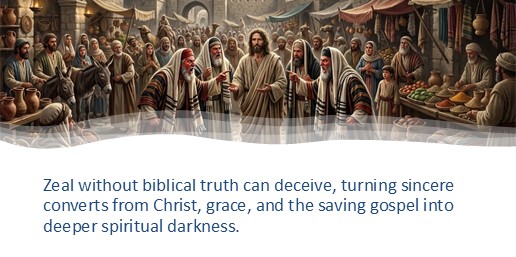
False doctrine rarely introduces itself as false. It often arrives dressed in religious language, carried by sincere-looking teachers, and supported by passionate followers. It may speak often about God, quote selected Bible verses, demand impressive sacrifice, and attract devoted converts. Yet when a religious message replaces the gospel of Jesus Christ with human traditions, personal merit, organizational loyalty, or self-righteousness, it does not lead people closer to God. It leads them farther away.
Jesus gave one of His strongest warnings about this danger in Matthew 23:15:
This verse is not a condemnation of evangelism, missionary work, or seeking the conversion of unbelievers. Jesus commanded His disciples to make disciples of all nations. Rather, Matthew 23:15 warns that religious zeal becomes spiritually destructive when it converts people to a false system instead of bringing them to repentance and faith in Jesus Christ.
The Context of Matthew 23:15
Matthew 23 records a series of solemn warnings Jesus pronounced against certain scribes and Pharisees. These men occupied respected positions as interpreters and teachers of God’s Law, but many of them had corrupted their responsibility. They emphasized outward religious performance while neglecting inward righteousness, mercy, faithfulness, and genuine submission to God.
Jesus had already stated the basic problem two verses earlier:
- Matthew 23:13 “But woe unto you, scribes and Pharisees, hypocrites! for ye shut up the kingdom of heaven against men: for ye neither go in yourselves, neither suffer ye them that are entering to go in.” — These religious leaders were not entering God’s kingdom through faith, and their teaching was also obstructing others from entering.
Their failure was not merely personal. They used their influence to reproduce the same unbelief in others. They possessed religious authority, but instead of using it to direct people toward God’s truth, they used it to build allegiance to their own traditions and interpretations.
Matthew 23:15 therefore describes false teachers who expend enormous effort to gain followers, only to lead those followers into deeper spiritual darkness.
The Meaning of the Important Terms
The word translated “woe”, Greek ouai, expresses both sorrow and warning. Jesus was lamenting their spiritual condition while announcing the judgment that would follow if they remained unrepentant. It carries the sense of “How terrible,” “How tragic,” or “Alas.” The word “hypocrites” comes from hypokritēs, originally referring to an actor who performed behind a mask. These leaders presented an outward appearance of devotion while inwardly resisting God.
A proselyte, Greek prosēlytos, was generally a Gentile who had formally converted to Judaism. “Crossing sea and land” emphasizes the lengths to which these religious leaders were willing to go. Whether Jesus was describing widespread missionary journeys or strenuous efforts among Gentile “God-fearers” in Jewish communities, the central issue is unchanged. Their problem was not their effort to gain converts, but what they taught those converts after gaining them.
The expression “child of hell”, Greek huios geennēs, describes someone characterized by rebellion against God and headed toward final judgment. “Child of” is a Hebrew-style expression identifying a person with a particular nature, behavior, or destiny. Jesus was not engaging in careless name-calling. He was pronouncing a sober spiritual judgment upon people who knowingly resisted God’s revelation.
“Twice” or “twofold more” should not necessarily be treated as a mathematical calculation. It is forceful language showing that the convert often became even more devoted to the false system than the teacher. New converts may embrace a movement with unusual enthusiasm, defend it aggressively, and carry its errors further than those who first instructed them.
Jesus’ words remind us that divine judgment is real. He is loving, compassionate, and patient, but His love never requires Him to ignore deception, hypocrisy, or unbelief. The same Jesus who welcomed sinners also warned false teachers who were leading sinners away from salvation.
- Matthew 23:33 “Ye serpents, ye generation of vipers, how can ye escape the damnation of hell?” — Jesus plainly warned that religious respectability cannot protect anyone who persists in rejecting God’s truth.
- Luke 13:3 “Except ye repent, ye shall all likewise perish.” — The call to repentance applies to openly immoral people and outwardly religious people alike.
Religious Hypocrisy Hides Behind a Spiritual Mask
Jesus called the scribes and Pharisees “hypocrites.” The Greek word was commonly associated with an actor performing a role. A hypocrite presents an outward appearance that conceals the reality within.
These leaders appeared devoted to God. They prayed publicly, studied religious questions, observed rituals, and expected others to respect their spiritual authority. Yet their outward religion concealed pride, unbelief, self-righteousness, and resistance to Jesus Christ.
- Matthew 23:27-28 “For ye are like unto whited sepulchres, which indeed appear beautiful outward, but are within full of dead men’s bones… Even so ye also outwardly appear righteous unto men, but within ye are full of hypocrisy and iniquity.” — Outward religious beauty cannot compensate for an unrepentant heart.
- Matthew 15:8 “This people draweth nigh unto me with their mouth, and honoureth me with their lips; but their heart is far from me.” — Religious words are empty when the heart remains far from God.
Hypocrisy is especially dangerous in a teacher because people often imitate what their leaders honor. When religious leaders reward appearances, followers learn to perform. When leaders promote self-righteousness, followers learn to compare themselves with others. When leaders demand loyalty to themselves, followers may confuse submission to a human authority with obedience to God.
Crossing Land and Sea to Make One Convert
Jesus said these leaders would “compass sea and land” to make one proselyte. A proselyte was generally a Gentile who formally converted to Judaism. The expression emphasizes determined effort. These religious leaders were willing to go to great lengths to gain a follower.
Their diligence was not the problem. Their message was.
Zeal does not prove that a doctrine is true. A person may be sincere, disciplined, sacrificial, courageous, and completely wrong. Religious history contains many examples of people who endured hardship to spread teachings that contradicted Scripture.
- Romans 10:2-3 “For I bear them record that they have a zeal of God, but not according to knowledge. For they being ignorant of God’s righteousness, and going about to establish their own righteousness, have not submitted themselves unto the righteousness of God.” — Religious zeal cannot save when it is separated from the truth about God’s righteousness.
- Proverbs 19:2 “Also, that the soul be without knowledge, it is not good.” — Passion without truth can move a person rapidly in the wrong direction.
The Pharisees were active, committed, and persuasive. Nevertheless, they were recruiting people into a system of self-righteousness that could not save.
The Difference Between Evangelism and False Proselytism
Matthew 23:15 does not condemn seeking converts. Jesus commanded His disciples to proclaim the gospel throughout the world.
- Matthew 28:19-20 “Go ye therefore, and teach all nations… Teaching them to observe all things whatsoever I have commanded you.” — Christians are commanded to make disciples who know and obey Jesus Christ.
- Acts 1:8 “Ye shall be witnesses unto me… unto the uttermost part of the earth.” — The church is called to carry the testimony of Christ to every nation.
The crucial question is not whether people are making converts. The question is what those converts are being taught to believe and follow.
Biblical evangelism brings sinners to Jesus Christ. False proselytism draws people into dependence upon a religious system, organization, ritual, leader, or human tradition. Biblical evangelism proclaims salvation by grace through faith. False religion teaches people to establish their own righteousness through performance.
- Acts 20:21 “Testifying both to the Jews, and also to the Greeks, repentance toward God, and faith toward our Lord Jesus Christ.” — The apostolic message called every person to turn toward God and trust in Jesus Christ.
- Ephesians 2:8-9 “For by grace are ye saved through faith… Not of works, lest any man should boast.” — Salvation is God’s gift, received through faith, not a reward earned through religious effort.
- 1 Corinthians 15:3-4 “Christ died for our sins according to the scriptures; And that he was buried, and that he rose again the third day according to the scriptures.” — The biblical gospel centers upon Christ’s substitutionary death, burial, and bodily resurrection.
True Christian ministry does not merely persuade people to become more religious. It calls them to recognize their sin, believe the gospel, and receive Jesus Christ as Lord and Savior.
“Twice the Child of Hell”
Jesus said that after the Pharisees gained a convert, they made that person “twofold more the child of hell” than themselves.
A “child of hell” describes someone characterized by rebellion against God and headed toward final judgment. It is a statement about spiritual condition and destiny. It does not mean that the Pharisee literally created the convert’s sinful nature. Rather, through false teaching, the convert embraced the same rejection of God’s salvation.
The expression “twofold more” is forceful language emphasizing how converts can become even more zealous for error than their teachers. New followers often feel pressure to demonstrate complete loyalty to the movement they have joined. They may become more rigid, more defensive, and more aggressive than those who recruited them.
Paul’s own history illustrates the danger of misguided religious zeal. Before trusting Christ, he persecuted believers because he believed he was defending God.
- Acts 22:3-4 “I was zealous toward God… And I persecuted this way unto the death, binding and delivering into prisons both men and women.” — Paul’s zeal was genuine, but before his conversion it was tragically directed against Christ and His people.
- Philippians 3:6-9 “Concerning zeal, persecuting the church… But what things were gain to me, those I counted loss for Christ… not having mine own righteousness… but that which is through the faith of Christ.” — Paul had to abandon confidence in religious achievement and receive righteousness through faith in Christ.
A convert to false doctrine may become harder to reach than someone who has never been religious. He may believe that his discipline proves his salvation, that his group alone possesses truth, or that questioning his teachers is equivalent to questioning God.
False Teachers Can Shut the Door of the Kingdom
False teachers do more than communicate incorrect information. Their teaching can prevent people from understanding the way of salvation.
- Luke 11:52 “Woe unto you, lawyers! for ye have taken away the key of knowledge: ye entered not in yourselves, and them that were entering in ye hindered.” — Teachers who obscure God’s truth become obstacles to those who are seeking Him.
- Malachi 2:7-8 “For the priest’s lips should keep knowledge… But ye are departed out of the way; ye have caused many to stumble at the law.” — God intended teachers to preserve truth, but corrupt teachers caused people to stumble.
- Isaiah 9:16 “For the leaders of this people cause them to err; and they that are led of them are destroyed.” — Those who teach error bear serious responsibility because their influence can bring destruction upon others.
This is why Scripture holds teachers to a higher standard.
- James 3:1 “My brethren, be not many masters, knowing that we shall receive the greater condemnation.” — Those who teach God’s Word will answer for how their teaching affected others.
A teacher may impress people with intelligence, eloquence, credentials, confidence, or spiritual experiences. None of these things guarantees faithfulness. Every teacher must be tested by Scripture.
Human Tradition Must Never Replace God’s Word
One of the Pharisees’ central errors was allowing human tradition to overrule the commandments of God.
- Mark 7:8 “For laying aside the commandment of God, ye hold the tradition of men.” — Tradition becomes spiritually dangerous when it displaces the authority of Scripture.
- Matthew 15:6 “Thus have ye made the commandment of God of none effect by your tradition.” — A religious tradition may appear honorable while actually neutralizing what God has said.
- Colossians 2:8 “Beware lest any man spoil you through philosophy and vain deceit, after the tradition of men… and not after Christ.” — Believers must reject every system of thought that draws them away from the sufficiency of Christ.
Tradition is not automatically wrong. Churches naturally develop customs, methods, schedules, and ministry practices. The danger begins when human preferences are treated as divine commandments or when denominational traditions are defended even after Scripture exposes their error.
God’s Word must judge every religious opinion, not the other way around.
This Warning Was Not Directed Against Jewish People
Matthew 23 must never be misused to promote hostility toward Jewish people. Jesus was Jewish, the apostles were Jewish, and the first members of the church were Jewish. Jesus was condemning particular religious leaders for hypocrisy, unbelief, and false teaching, not condemning an ethnicity.
Nicodemus was a Pharisee who showed increasing openness toward Jesus. Paul had also been a Pharisee before he trusted Christ. The gospel remained genuinely available to the very people Jesus warned.
- John 3:1-3 “There was a man of the Pharisees, named Nicodemus… Jesus answered and said unto him… Except a man be born again, he cannot see the kingdom of God.” — Jesus personally called a Pharisee to the new birth rather than treating him as beyond salvation.
- Romans 1:16 “For it is the power of God unto salvation to every one that believeth; to the Jew first, and also to the Greek.” — The gospel is freely offered to both Jews and Gentiles.
The sin condemned in Matthew 23:15 can appear in any culture, denomination, organization, or religious movement. Wherever people substitute human righteousness for God’s grace, the spirit of Pharisaic religion is present.
Practical Applications for Christians Today
Test Every Teaching by Scripture
Christians should never accept a doctrine merely because a respected leader teaches it. Neither popularity, education, denominational history, nor personal charisma can replace biblical authority.
- Acts 17:11 “They received the word with all readiness of mind, and searched the scriptures daily, whether those things were so.” — The Bereans listened respectfully but tested apostolic teaching by the written Word of God.
- 1 Thessalonians 5:21 “Prove all things; hold fast that which is good.” — Believers must examine teaching carefully and retain only what agrees with truth.
- Are you a “Noble Berean?”
Read verses in context. Compare Scripture with Scripture. Do not build doctrine on isolated phrases, emotional experiences, or the claims of a religious personality.
Make Disciples of Christ, Not Followers of Yourself
Church leaders, Bible teachers, parents, and mature believers should constantly direct people toward Jesus rather than cultivating personal dependence.
- 2 Corinthians 4:5 “For we preach not ourselves, but Christ Jesus the Lord; and ourselves your servants for Jesus’ sake.” — Faithful ministry exalts Christ and adopts the posture of a servant.
- 1 Corinthians 3:5 “Who then is Paul, and who is Apollos, but ministers by whom ye believed?” — Christian leaders are servants whom God uses, not spiritual masters who replace Christ.
Healthy teachers are willing for their students to examine their words. They do not demand unquestioning loyalty or treat disagreement with themselves as rebellion against God.
Keep the Gospel Clear
Churches must not confuse salvation with baptism, church membership, political loyalty, moral reform, financial giving, emotional experience, or submission to organizational rules.
A person is saved by grace through faith in Jesus Christ. Good works follow salvation as its fruit, but they do not purchase salvation or maintain a believer’s acceptance before God.
- Romans 3:28 “Therefore we conclude that a man is justified by faith without the deeds of the law.” — Justification is received through faith, apart from works of law.
- Titus 3:5 “Not by works of righteousness which we have done, but according to his mercy he saved us.” — Salvation rests upon God’s mercy, not upon the sinner’s religious accomplishments.
- Romans 10:13 “For whosoever shall call upon the name of the Lord shall be saved.” — God genuinely offers salvation to everyone who calls upon the Lord in faith.
- What is the gospel?
Watch for Errors That Grow More Extreme
A small doctrinal distortion in one generation may become a central teaching in the next. A leader’s personal opinion may eventually become an unofficial test of faithfulness. A helpful practice may be elevated into a condition of salvation.
Teachers should clearly distinguish between the plain teaching of Scripture and their own conclusions. They should also distinguish essential doctrines from secondary issues, justification from sanctification, and biblical commandments from ministry preferences.
- 2 Timothy 2:15 “Study to shew thyself approved unto God… rightly dividing the word of truth.” — Faithful teachers must handle Scripture accurately and carefully.
- Non-negotiable Dealbreakers: The Essential Doctrines a Church Must Not Get Wrong
Examine the Fruit of the Teaching
False doctrine often produces recognizable spiritual fruit. It may create pride, fear, bondage, hostility, elitism, dishonesty, or dependence upon human leaders.
Biblical truth produces humility, love, holiness, gratitude, and increasing dependence upon Christ.
- Matthew 7:16 “Ye shall know them by their fruits.” — The character and consequences of a teacher’s ministry help reveal the nature of the teaching.
- Galatians 5:22-23 “But the fruit of the Spirit is love, joy, peace, longsuffering, gentleness, goodness, faith, meekness, temperance.” — The Holy Spirit produces Christlike character rather than religious arrogance.
- 8 Important Things for Christians to Embrace
- 8 Dangerous Things for Christians to Avoid
Good behavior alone cannot make a false gospel true, but destructive spiritual fruit should never be ignored.
Examine Your Own Heart
It is easy to apply Matthew 23:15 only to cults, false religions, or churches with which we disagree. Jesus’ warning should first cause every believer to examine his own heart.
Do we point people toward Jesus or toward ourselves? Do we teach Scripture faithfully, or merely defend inherited traditions? Do we care more about winning arguments than helping people know Christ? Do our convictions produce humility and love, or pride and contempt?
- 2 Corinthians 13:5 “Examine yourselves, whether ye be in the faith; prove your own selves.” — Biblical discernment must include honest self-examination.
- Psalms 139:23-24 “Search me, O God, and know my heart… And see if there be any wicked way in me, and lead me in the way everlasting.” — The believer should invite God to expose hidden pride, error, and hypocrisy.
- Examine yourselves test your faith (2 Cor 13:5)
Strong conviction is not the same as Phariseeism. Jesus and the apostles spoke with unmistakable conviction. Phariseeism combines religious certainty with pride, hypocrisy, self-righteousness, human tradition, and resistance to the truth of Christ.
Follow Jesus, Not Merely Religious Leaders
Matthew 23:15 warns us that religious zeal can spread spiritual destruction when it is separated from truth. The Pharisees traveled great distances to gain converts, but because they rejected Jesus and trusted in human righteousness, their converts became even more deeply committed to error.
The answer is not less evangelism, less conviction, or less obedience. The answer is faithful evangelism centered upon the gospel, conviction governed by Scripture, obedience flowing from grace, and discipleship that leads people directly to Jesus Christ.
Be careful whom you follow. Test every teacher by the Word of God. Refuse any message that adds human works to the finished work of Christ, replaces Scripture with human authority, or directs your ultimate loyalty toward a religious personality or organization.
Jesus alone is the way, the truth, and the life. Follow Him closely, remain in His Word, trust completely in His finished work, and help others become disciples of Christ rather than converts to a merely human religious system.
- John 8:31-32 “If ye continue in my word, then are ye my disciples indeed; And ye shall know the truth, and the truth shall make you free.” — The true disciple remains in the words of Jesus and finds freedom in His truth.
- John 10:27 “My sheep hear my voice, and I know them, and they follow me.” — The defining mark of Christ’s sheep is that they listen to His voice and follow Him.