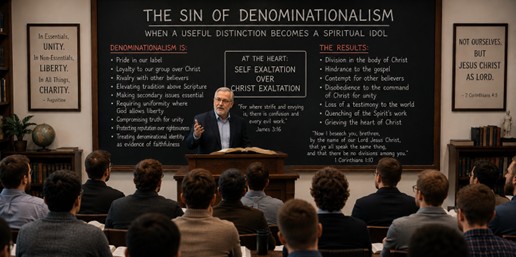
What Is Denominationalism?
Denominationalism is more than membership in a denomination. It is the elevation of a church tradition, institutional affiliation, theological camp, ministry network, or religious label into a party identity.
A useful definition is:
Denominationalism is the elevation of a church tradition, institutional affiliation, theological camp, ministry network, or religious label into a party identity that produces pride, rivalry, coercion, compromise, or unnecessary division within the body of Christ.
A person may belong to a denomination without being denominationalistic. He may appreciate his congregation’s history and convictions while recognizing genuine believers in other faithful churches.
Conversely, a person may attend a non-denominational church while displaying an intensely denominational spirit. He may believe that his independent network, lead pastor, worship style, church culture, or prophetic system represents the only genuinely biblical form of Christianity.
The absence of a traditional label does not eliminate party spirit. It may simply give the party another name.
Denominationalism in Corinth
The Corinthian believers formed competing parties around respected teachers.
- 1 Corinthians 1:12 “Every one of you saith, I am of Paul; and I of Apollos; and I of Cephas; and I of Christ” – The believers turned legitimate teachers into rival party identities.
- 1 Corinthians 1:13 “Is Christ divided? was Paul crucified for you?” – Paul exposes the absurdity of treating a human teacher as the center of Christian identity. Christ alone was crucified for His people.
- 1 Corinthians 3:4 “While one saith, I am of Paul; and another, I am of Apollos; are ye not carnal?” – Party loyalty was evidence of spiritual immaturity and fleshly thinking.
Paul and Apollos were not false teachers. The sin did not arise because the Corinthians recognized differences between them. The sin arose because the church built rival identities around them.
- 1 Corinthians 3:5 “Who then is Paul, and who is Apollos, but ministers by whom ye believed?” – Faithful leaders are servants through whom God works. They must never become replacements for Christ.
- 1 Corinthians 3:23 “Ye are Christ’s; and Christ is God’s” – The believer’s ultimate identity is not found in a pastor, movement, confession, or denomination. Every Christian belongs to Christ.
This is one of the clearest biblical pictures of denominationalism. The slogan changes, but the spirit remains:
- “I am of Paul.”
- “I am of Apollos.”
- “I am of this denomination.”
- “I am of this pastor.”
- “I am of this ministry network.”
- “I am of this theological system.”
- “I am non-denominational.”
Any of these may become sinful when the identity produces pride, rivalry, or contempt.
Biblical Words Related to Denominationalism
The modern English word denominationalism does not appear in Scripture, but the Bible uses words that describe its sinful tendencies.
Schisma
The Greek word schisma refers to a split, tear, division, or rupture.
- 1 Corinthians 1:10 “That there be no divisions among you; but that ye be perfectly joined together in the same mind” – Paul opposed hostile ruptures within the church. Believers were to pursue unity grounded in apostolic truth.
Not every disagreement is a sinful schisma. Christians may disagree while continuing to treat one another with patience, honesty, and love. A sinful division develops when disagreement produces hostile camps, personal contempt, or rivalry.
Hairesis
The Greek word hairesis may refer to a sect, party, faction, or heresy. The word itself can identify a recognizable religious group, but in other contexts it describes destructive factionalism.
- Galatians 5:19-20 “The works of the flesh are manifest…strife, seditions, heresies” – Self-serving factions are works of the flesh. The problem is not simply that a group can be identified, but that party spirit damages Christian fellowship.
This distinction closely parallels the difference between denomination and denominationalism.
A denomination is a recognizable body. Denominationalism is the fleshly factionalism that may develop around that body.
When Does Biblical Denomination Become Sinful Denominationalism?
The transition occurs when a practical distinction becomes an ultimate identity.
When the Name Becomes More Important Than Christ
It may be reasonable to say, “I am Baptist because I believe believer’s baptism by immersion is biblical.” It becomes denominationalism when being Baptist is treated as more fundamental than belonging to Christ.
A church name can communicate useful information, but it must never occupy the place of the Savior.
When the Confession Becomes Equal to Scripture
A confession can protect a church from doctrinal confusion. It becomes dangerous when it is treated as though it cannot be questioned.
The proper order is:
- Scripture is inspired, infallible, sufficient, and finally authoritative.
- A statement of faith summarizes the church’s interpretation of Scripture.
- The statement of faith remains open to correction where Scripture requires it.
- Leaders and members remain accountable to God’s Word above every human document.
When this order is reversed, confessional faithfulness becomes confessional bondage.
When Affiliation Becomes a Test of Salvation
Churches must distinguish the biblical gospel from false gospels. However, they must not add organizational affiliation to the conditions of salvation.
- John 3:16 “Whosoever believeth in him should not perish, but have everlasting life” – Eternal life is promised to the person who believes in Christ, not to the person who joins a particular denomination.
- Romans 10:9 “If thou shalt confess with thy mouth the Lord Jesus, and shalt believe in thine heart that God hath raised him from the dead, thou shalt be saved” – Salvation rests upon faith in the risen Lord Jesus Christ.
- Romans 10:13 “Whosoever shall call upon the name of the Lord shall be saved” – The gospel invitation extends to everyone who calls upon Christ in faith.
A faithful Christian may be mistaken about a secondary doctrine without being unsaved. Not every error is damnable heresy, although every error should be corrected by Scripture.
When Secondary Differences Destroy Christian Fellowship
Some doctrines are essential to biblical Christianity. These include the Trinity, the deity and humanity of Christ, His substitutionary death, His bodily resurrection, and salvation by grace through faith.
Other disagreements concern church government, spiritual gifts, prophecy, worship style, the frequency of communion, and matters of personal conscience. These questions may be important, but disagreement does not always prove that the other person has rejected Christ.
- Romans 14:3 “Let not him that eateth despise him that eateth not; and let not him which eateth not judge him that eateth” – Believers must not despise or condemn one another over legitimate matters of conscience.
- Romans 14:4 “Who art thou that judgest another man’s servant? to his own master he standeth or falleth” – Christians ultimately answer to the Lord. Personal convictions must not be transformed into unauthorized conditions of fellowship.
- Romans 14:10 “Why dost thou judge thy brother? or why dost thou set at nought thy brother?” – Disagreement must not become contempt. Every believer will stand before Christ.
Denominationalism turns every disagreement into a test of loyalty and every difference into a reason for hostility.
When Separation Becomes Pride
Biblical separation from false teaching is sometimes necessary.
- Romans 16:17 “Mark them which cause divisions and offences contrary to the doctrine which ye have learned; and avoid them” – Believers must identify and avoid teachers who create division by contradicting apostolic doctrine.
- 2 John 10-11 “If there come any unto you, and bring not this doctrine, receive him not into your house…for he that biddeth him God speed is partaker of his evil deeds” – Christians must not provide ministry support or endorsement to teachers who deny the doctrine of Christ.
Not every separation is sinful denominationalism. Sometimes separation is obedience.
However, necessary separation can become sinful pride when believers assume that their congregation or movement is the only place where God has preserved faithful people.
- 1 Kings 19:14 “I, even I only, am left” – Elijah felt isolated and assumed that he alone remained faithful.
- 1 Kings 19:18 “Yet I have left me seven thousand in Israel, all the knees which have not bowed unto Baal” – God reminded Elijah that faithful people existed beyond his knowledge. Faithfulness should produce humility rather than spiritual arrogance.
The Compromise of Unity versus Doctrine
Denominationalism can appear in opposite forms.
One form separates over every secondary issue. Another protects organizational unity by tolerating serious doctrinal error.
Biblical unity does not require pretending that doctrine is unimportant. Biblical separation does not justify hostility toward every believer who differs on secondary matters.
Truth without love becomes harsh and proud. Love without truth becomes sentimental and compromising. Biblical faithfulness requires both.
When Institutional Reputation Becomes More Important Than Truth
A denomination or independent church may conceal abuse, moral failure, financial dishonesty, or false doctrine to protect its public reputation.
When leaders ask, “What will make the organization look best?” rather than, “What does obedience to Christ require?” the institution has become an idol.
The reputation of the church matters, but genuine testimony is protected by truth, repentance, justice, and accountability, not by concealment.
When Customs Become Divine Commands
Every church has preferences concerning music, clothing, schedules, facilities, language, and ministry methods. Those preferences may be reasonable.
They become denominationalism when members imply that every faithful Christian must follow the same customs.
A church may prefer hymns without claiming that every modern song is sinful. It may use a particular Bible translation without claiming that everyone using another faithful translation has rejected God. It may develop a membership process without teaching that its exact procedure is divinely mandated for every congregation.
Wisdom distinguishes biblical commands from local applications.
Denominate, Denomination, Denominationalism, and the Myth of Non-Denominationalism
Part One: Denominate, the Practical Need to Identify and Distinguish
Part Two: Denomination, a Shared Identity Among Churches
Part Three: Denominationalism, When Distinction Becomes Sinful Division
Part Four: The Myth of Non-Denominationalism