Every church has a name, a location, a history, a pastoral staff, a statement of faith, a form of government, established practices, and unwritten expectations. Even a congregation that calls itself “non-denominational” must make decisions about baptism, communion, salvation, church leadership, spiritual gifts, prophecy, worship, membership, discipline, and Christian conduct.
For that reason, no church is doctrinally neutral or historically detached. Every church interprets Scripture and develops a recognizable theological identity. Removing a traditional denominational label does not remove the beliefs, customs, boundaries, and leadership structures commonly associated with denominations.
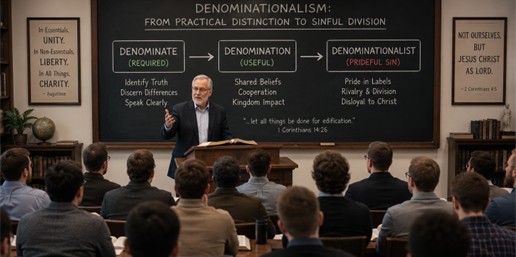
However, three related words must be carefully distinguished. To denominate is to identify something by name. A denomination is a named body of churches sharing certain beliefs and practices. Denominationalism is the sinful elevation of that identity into a party spirit, source of pride, rival authority, or cause of unnecessary division.
The biblical problem is not that Christians recognize meaningful distinctions. Scripture itself names congregations, identifies doctrines, describes offices, exposes false teachers, and distinguishes truth from error. The problem begins when a useful distinction becomes an ultimate identity, when a confession becomes equal to Scripture, or when loyalty to a religious group competes with loyalty to Jesus Christ.
Part One: Denominate, the Practical Need to Identify and Distinguish
Every church identifies itself, whether it realizes it or not. To denominate simply means to name, classify, or distinguish, and that practical act is necessary whenever a church explains what it believes, how it is led, and how it differs from other congregations.
This first study lays the foundation for the entire series. Before we can understand denominations or condemn denominationalism, we must recognize that naming real differences is not automatically divisive. Biblical discernment requires clear distinctions, but those distinctions must remain truthful, humble, and subordinate to Scripture.
Part Two: Denomination, a Shared Identity Among Churches
A denomination is more than a name on a church sign. It is a shared identity formed by doctrine, history, leadership, practices, institutions, and voluntary cooperation among churches.
This second study builds upon the practical need to denominate by showing how individual distinctions become organized relationships. A denomination may help churches cooperate in missions, training, benevolence, and accountability, but it becomes dangerous when the organization begins to control conscience, protect itself from correction, or compete with the authority of Christ.
Part Three: Denominationalism, When Distinction Becomes Sinful Division
A useful church identity can quietly become a spiritual idol. Denominationalism begins when a name, tradition, confession, pastor, or ministry network becomes a source of pride, rivalry, coercion, compromise, or unnecessary separation from other genuine believers.
This third study explains where the earlier concepts go wrong. Denominating can be necessary, and denominations can be useful, but denominationalism corrupts both by turning practical distinctions into party loyalties. The problem is not simply belonging to a group, but allowing that group to become more important than biblical truth, Christian love, and allegiance to Jesus Christ.
Part Four: The Myth of Non-Denominationalism
Removing the denominational name does not remove the denomination-like identity. Every non-denominational church still has a location, history, pastoral staff, statement of faith, leadership structure, ministry culture, written policies, and unwritten expectations.
This final study brings the earlier posts together by exposing the myth that a church can exist without theological or historical distinctives. Non-denominational independence may be legitimate, but doctrinal neutrality is impossible. The real question is not whether a church has traditions and boundaries, but whether they are honestly acknowledged, tested by Scripture, and kept beneath the lordship of Jesus Christ.
Conclusion
To denominate is to name, identify, or distinguish. That act is necessary and often biblical. Churches must identify their congregations, define doctrine, recognize leaders, explain practices, and distinguish truth from error.
A denomination is a voluntary association of churches sharing a name, doctrine, history, and cooperative structure. Such an association is not directly instituted in Scripture, but it may serve legitimate biblical purposes when it remains subordinate to Christ, Scripture, and the responsibilities of the local church.
Denominationalism begins when the name becomes a party, the confession becomes an unquestionable authority, the institution becomes an object of loyalty, the pastor becomes the center of identity, or secondary distinctions become causes of pride and unnecessary division.
The answer is not doctrinal vagueness, historical amnesia, or pretending that a church has no tradition. The answer is honest identification, clear doctrine, humble correction, wise cooperation, meaningful accountability, and unwavering submission to the written Word of God.
Every church has a location, history, leadership structure, statement of faith, culture, and practical boundaries. The question is not whether these things exist. The question is whether they remain servants of the Church or become rivals to Christ.
Jesus Christ alone is the Head of the Church. Scripture alone is the final authority for faith and practice. Every name, denomination, confession, tradition, pastor, and ministry must remain beneath His lordship, so that He alone receives the preeminence and glory.