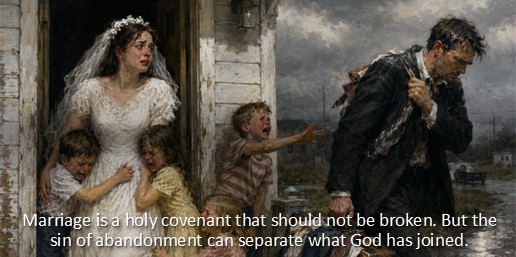
Few subjects require more biblical care, pastoral tenderness, and spiritual honesty than divorce and remarriage. Marriage is holy because God designed it. Divorce is grievous because it tears apart what God joined together. Remarriage is serious because Scripture warns that some remarriages may be adulterous, while also recognizing situations like abandonment where a person may be free to remarry.
The question before us is this: Does God allow believers who have been abandoned by a spouse to divorce and remarry, or does God require them to remain unmarried and celibate for the rest of their lives?
This study seeks to answer that question by carefully comparing Scripture with Scripture. We must begin with God’s original design for marriage, then consider the effects of sin, sexual immorality, abandonment, and Paul’s instruction in 1 Corinthians 7. The goal is not to make divorce easy. The goal is to honor God’s design for marriage, protect the innocent, call sinners to repentance, and apply God’s mercy where Scripture gives it.
Before going further, we must say something important. I cannot make a judgment about any real marriage without hearing both sides. Proverbs 18:17 says, “The one who states his case first seems right, until the other comes and examines him.” Jesus also taught that serious judgments require faithful witnesses, “that every word may be confirmed” (Matthew 18:16). Therefore, this study should not be used as a weapon in a troubled marriage, but as a biblical framework for careful counsel, pastoral wisdom, repentance, reconciliation where possible, and peace before God.
1. Comparing Spiritual Things with Spiritual
When we study divorce and remarriage, we must begin with the authority and sufficiency of Scripture. Paul told Timothy to “rightly divide the word of truth” (2 Timothy 2:15). He also taught that “all scripture is given by inspiration of God” and is profitable for doctrine, reproof, correction, and instruction in righteousness, so that the man of God may be complete and equipped for every good work (2 Timothy 3:16-17).
That means we cannot build our view of divorce and remarriage from one verse in isolation. We must compare Scripture with Scripture. We need Genesis 1–2 for God’s original design. We need Genesis 3 for the entrance of sin. We need Deuteronomy 24 to understand how Moses regulated divorce because of human hardness. We need Malachi 2 to see God’s hatred of covenant treachery. We need Matthew 5 and Matthew 19 to hear the Lord Jesus Himself. We need Romans 7 and 1 Corinthians 7 to understand Paul’s apostolic instruction to believers.
The safest path is not to begin with modern divorce law, personal preference, cultural assumptions, or painful emotions, though pain must be treated with compassion. The safest path is to let Scripture define marriage, divorce, remarriage, sexual immorality, abandonment, bondage, and peace. Scripture is not silent, but it must be handled carefully.
2. Defining Marriage, Divorce, Remarriage, and Abandonment
A careful study requires careful definitions. Confusion in this subject often comes from using biblical words loosely, emotionally, or selectively. If we do not define our terms, we may either loosen what God has bound or bind what God has mercifully released.
Adultery is sexual unfaithfulness in violation of the marriage covenant. It includes becoming “one flesh” sexually with someone who is not one’s covenant spouse. Adultery is not merely a private mistake. It is a sin against God, against the spouse, and against the covenant.
Sexual immorality translates the Greek word porneia, which is broader than adultery alone. It refers to sexual sin generally, including adultery, fornication, incest, prostitution, and other sexual behavior condemned by God. When Jesus says “except it be for fornication” (Matthew 19:9), He is not treating sexual sin lightly. He is identifying a serious covenant-breaking category.
Marriage is a covenant union between one man and one woman before God. It includes public commitment, covenant responsibility, companionship, sexual union, and lifelong faithfulness. Marriage is not merely romance. It is not merely a civil arrangement. It is a covenant relationship before the God who joins husband and wife together.
“One flesh” comes from Genesis 2:24. It refers to the unique union of husband and wife, including but not limited to sexual union. It is covenantal, relational, physical, and spiritual in significance. This is why adultery is so serious. It violates the one-flesh union by taking what belongs within marriage and joining it to another.
Divorce is the breaking or legal dissolution of a marriage relationship. Scripture treats it as a serious matter because it separates what God joined together. Remarriage is entering a new marriage after a previous marriage has ended. The question is not merely whether civil law allows it, but whether Scripture permits it.
Abandonment is willful, settled desertion of the marriage covenant. It is more than temporary conflict, emotional distance, a short separation, or a painful season of marital difficulty. In 1 Corinthians 7:15, Paul specifically addresses an unbelieving spouse who departs and refuses to remain in the marriage.
Defrauding or deprivation refers to withholding what belongs to the spouse within marriage. In 1 Corinthians 7:3-5, Paul says husbands and wives owe one another marital affection and should not deprive one another except by mutual agreement for a limited time. This passage must never be used to justify coercion, pressure, or selfish demand. It teaches mutual responsibility, mutual care, and mutual consideration within marriage.
These definitions matter because unclear words create unclear counsel. “Abandonment,” especially, must be defined carefully. It should not become a loophole for ordinary marital disappointment, nor should it be denied when one spouse has truly deserted the marriage.
3. Marriage in the Beginning, Before Divorce or Remarriage
The Bible first introduces marriage in Genesis 1–2, before sin entered the world. God created mankind male and female in His image (Genesis 1:26-27). He blessed them and commanded them to be fruitful and multiply (Genesis 1:28). Then Genesis 2 gives a closer view of the creation of woman and the institution of marriage.
God said, “It is not good that the man should be alone” (Genesis 2:18). This does not mean woman is inferior to man. She is the corresponding partner God made for him. She is like him in humanity, equal in dignity, and distinct in God-given design. The woman was not created as a servant to be used, but as a helper suitable for him, one who stands beside him in the life God ordained.
When God brought the woman to Adam, Adam said, “This is now bone of my bones, and flesh of my flesh” (Genesis 2:23). Then Scripture gives the foundational marriage statement.
Jesus quoted this passage when He taught on divorce. He said, “What therefore God hath joined together, let not man put asunder” (Matthew 19:6). This tells us that marriage is not merely a human contract. God joins the man and woman together. Therefore, man must not separate what God joined.
This is where every divorce and remarriage discussion must begin. Marriage is not invented by government, church tradition, or personal romance. It is designed by God, defined by God, and accountable to God.
4. Marriage After the Fall
Genesis 3 changed everything. Sin entered the world, and with sin came shame, blame, pain, conflict, domination, desire, sorrow, and death. Yet marriage did not cease to be God’s design. The fall damaged marriage, but it did not abolish marriage.
The Bible gives several purposes for marriage. First, companionship: “It is not good that the man should be alone” (Genesis 2:18). Second, fruitfulness: “Be fruitful, and multiply” (Genesis 1:28). Third, lawful sexual union: “to avoid fornication, let every man have his own wife, and let every woman have her own husband” (1 Corinthians 7:2).
These are biblical themes. Marriage provides companionship, a proper context for sexual union, and, where God grants it, the blessing of children. However, we must be careful. These purposes explain God’s design, but they are not conditions that make a marriage valid or invalid. A childless marriage is still a true marriage. A marriage affected by illness or disability is still a true marriage. A difficult season of intimacy does not dissolve the covenant.
Because of sin, God later regulated situations that were not part of His original ideal. Polygamy, divorce, and remarriage appear in Scripture, but their appearance does not mean they are God’s perfect design. Scripture records many sins without approving them. God may tolerate, regulate, or limit sinful human situations without presenting them as His ideal.
This distinction is essential. If we confuse biblical description with biblical prescription, we will misunderstand much of the Old Testament. The fact that something happened in Scripture does not mean God blessed it. The standard remains God’s original design: one man, one woman, one flesh, for life.
- The Bible Teaches How to be a Godly Husband
- Excellent Wife by Martha Peace
- Biblical relationship checkup
5. Headship, Authority, and Christlike Responsibility
From the beginning, Scripture reveals order in marriage. God created Adam first, then Eve. Paul later refers to this order in passages such as 1 Corinthians 11:3, Ephesians 5:22-33, and 1 Timothy 2:13. The husband is called to loving, sacrificial leadership, and the wife is called to willing, respectful submission to her husband’s servant leadership.
However, this point must be handled carefully, especially in a study about divorce, abandonment, and marital breakdown. Biblical headship never authorizes cruelty, coercion, threats, intimidation, financial control, sexual pressure, abuse, or spiritual manipulation. Ephesians 5 does not command a husband to dominate his wife. It commands him to love her “as Christ also loved the church, and gave himself for it” (Ephesians 5:25).
Colossians 3:19 says, “Husbands, love your wives, and be not bitter against them.” First Peter 3:7 warns husbands to dwell with their wives according to knowledge and honor them, “that your prayers be not hindered.” A man may claim the language of headship while disobeying the spirit and command of Christ. That is not biblical leadership. That is sin wearing religious clothing.
Biblical headship must be defined by Christlike sacrifice, not selfish control. A husband who abandons, terrorizes, neglects, or abuses his wife is not exercising biblical headship. He is sinning against God and against his wife.
- Leadership responsibility of godly husbands
- Godly Husband – Chapter 1 – Leave Your Father and Mother to Cleave unto Your Wife as One Flesh
- Godly Husband – Chapter 2 – The Husband Is the Head of the Wife as Christ Is the Head of the Church
6. God’s Judgment Against Sexual Immorality in Marriage
Scripture treats sexual immorality within marriage as extremely serious. Adultery violates the one-flesh union and attacks the marriage covenant at its most intimate level. It is not merely a failure of desire or discipline. It is covenant treachery.
Even before the Mosaic Law, people recognized the seriousness of taking another man’s wife. Pharaoh and Abimelech understood that such an act would bring guilt and judgment (Genesis 12:10-20; Genesis 20:1-18). Under the Mosaic Law, adultery was treated as a capital offense (Leviticus 20:10; Deuteronomy 22:22). This shows that God did not treat sexual sin as a minor private matter.
When Jesus addressed divorce, He gave a specific exception: “except it be for fornication” (Matthew 19:9). Sexual immorality is the clearest biblical ground for divorce and remarriage. Still, we should state this carefully. Sexual immorality may give the innocent spouse biblical grounds for divorce. It does not require divorce in every case.
Where there is genuine repentance, truth, safety, accountability, and wise counsel, reconciliation may be possible. Permission is not the same thing as command. A betrayed spouse may forgive and rebuild, but forgiveness does not require pretending the sin was small. Reconciliation after adultery requires more than words. It requires repentance, transparency, fruit, accountability, and wisdom.
- Godly Husband – Chapter 9 – Do Not Look at Another Woman with Sexual Desire
- Godly Husband – Chapter 10 – Maintain a Mutually Satisfying Sexual Relationship
7. God Tolerated Deviation From His Original Design
Many Old Testament men had more than one wife, including Lamech, Abraham, Jacob, David, and Solomon. Scripture records these facts honestly, but narrative description is not the same as moral approval.
God’s original design was one man and one woman joined for life. Polygamy appears in Scripture as part of the brokenness of the world after sin. It often produced jealousy, rivalry, sorrow, and disorder. Abraham’s household suffered because of Hagar and Sarah. Jacob’s household suffered because of Leah, Rachel, Bilhah, and Zilpah. Solomon’s many wives turned away his heart (1 Kings 11:1-4).
This helps us understand divorce as well. The fact that God regulated divorce under Moses does not mean divorce was His ideal. Jesus made this clear when He said, “Moses because of the hardness of your hearts suffered you to put away your wives: but from the beginning it was not so” (Matthew 19:8).
That phrase, “from the beginning,” is crucial. God’s original design remains the standard, even when God mercifully regulates the damage caused by sin. God’s regulation of human sin is not the same thing as God’s celebration of human sin.
8. Defrauding a Wife Was Not Tolerated Under the Law
Under the Mosaic Law, even in difficult marital arrangements, God protected the wife’s provision. Exodus 21:10-11 says that if a man took another wife, he was not to diminish the first wife’s food, clothing, or marital rights. If he failed to provide those things, she could go free.
This is an important point. God does not treat covenant responsibilities lightly. A husband was not allowed to keep the name of marriage while withholding the obligations of marriage. He could not deprive, neglect, and defraud his wife while pretending the covenant was intact.
This becomes significant when discussing abandonment. Abandonment is not only a matter of geography. There is such a thing as covenant desertion, where a spouse keeps the technical shell of marriage while willfully refusing covenant faithfulness, care, companionship, protection, and marital responsibility.
Still, we must apply Exodus 21 carefully. That passage addressed a specific Old Covenant legal situation in Israel. It teaches principles about God’s concern for justice and marital obligation, but we should not apply it mechanically as though the church is under Israel’s civil law. The principle is clear: God sees deprivation, neglect, and covenant defrauding.
9. God’s Plan for a Husband to Nourish and Cherish His Wife
God’s design for marriage is not bare permanence. A marriage can remain legally intact while being spiritually and relationally treacherous. Scripture calls husbands to love, nourish, cherish, protect, and honor their wives.
Malachi 2 strongly condemns treachery against one’s wife. God rebuked men who dealt faithlessly with “the wife of thy youth,” calling her “thy companion, and the wife of thy covenant” (Malachi 2:14). God hates divorce, but in that context He also hates the treachery that produces divorce.
Ephesians 5:28-29 says husbands should love their wives as their own bodies, nourishing and cherishing them. This does not mean a wife exists for the husband’s comfort. It means a husband is obligated before God to seek his wife’s good with the same care he naturally gives himself.
This is pastorally important. The sin behind divorce may begin long before legal papers are filed. Neglect, bitterness, harshness, abandonment, adultery, and covenant treachery are all serious before God. A husband cannot mistreat his wife for years, then claim moral superiority because he never filed for divorce. God sees covenant treachery before man sees paperwork.
10. The Lord Jesus and Divorce
Jesus addressed divorce in Matthew 5:31-32, Matthew 19:3-9, Mark 10:2-12, and Luke 16:18. In Matthew 19, the Pharisees asked, “Is it lawful for a man to put away his wife for every cause?” Their question exposed a casual attitude toward divorce. Jesus did not accept that casual approach. He returned them to Genesis.
Jesus said, “What therefore God hath joined together, let not man put asunder” (Matthew 19:6). He also said that whoever divorces his wife, except for sexual immorality, and marries another commits adultery (Matthew 19:9). Jesus therefore upholds both the permanence of marriage and the seriousness of sexual immorality.
In Matthew 5:32, Jesus said that a man who puts away his wife, except for fornication, “causeth her to commit adultery.” This is a sobering statement. Jesus places responsibility on the unlawful divorcer. A man who discards his wife without biblical grounds puts her in a vulnerable and sinful situation. He is not innocent just because she later struggles with the consequences of what he did.
Still, we must not press the verse beyond what it clearly says. Jesus’ words do not mean every remarriage after unjust divorce is automatically guiltless for the remarried person. Nor do they teach a complete doctrine of guilt transfer, as if one person’s sin removes all moral responsibility from every later decision. Jesus is exposing the sin of the one who unlawfully divorces. That warning should make every husband and wife tremble before God.
11. The Church Age and the Work of the Holy Spirit
In the Church Age, beginning at Pentecost in Acts 2, believers are indwelt by the Holy Spirit. The Spirit convicts, regenerates, seals, guides, comforts, produces fruit, and empowers obedience. The Christian does not face marriage, suffering, temptation, or loneliness alone.
But the indwelling Holy Spirit does not abolish God’s created design for marriage. The Spirit empowers believers to obey God, but He does not erase the realities of companionship, sexual desire, temptation, human weakness, or spiritual warfare. The same God who created marriage still knows what man and woman need.
At the same time, the Holy Spirit calls believers to a higher life of holiness, forgiveness, patience, self-control, and love. A Christian should not be quick to divorce. A Christian should pursue repentance, reconciliation, and peace where possible. But the Spirit’s presence does not require a deserted believer to pretend abandonment has not happened. Nor does the Spirit’s presence mean every abandoned believer has the supernatural gift of lifelong celibacy.
Paul does not shame those who lack the gift of singleness. He says, “it is better to marry than to burn” (1 Corinthians 7:9). That is not a low view of holiness. It is a realistic view of human nature under God’s wisdom. Holiness is not pretending we are stronger than Scripture says we are. Holiness is obeying God according to what He has actually revealed.
- Godly Husband – Chapter 11 – Lead Your Family to Serve the Lord
- Godly Husband – Chapter 12 – Provide for the Physical and Spiritual Needs of Your Family
- Practical Evidence of the Holy Spirit in Everyday Life
12. Paul’s High View of Marriage
Paul strongly values marriage. In 1 Thessalonians 4:3-4, he tells believers to abstain from sexual immorality and to possess their vessel in sanctification and honor. In 1 Corinthians 7:2, he says, “to avoid fornication, let every man have his own wife, and let every woman have her own husband.”
Paul does not treat marriage as unnecessary. While Paul personally valued singleness for those gifted for it, he did not require all believers to remain single. He said, “every man hath his proper gift of God” (1 Corinthians 7:7). Some are gifted for singleness. Others are not.
This is vital for the abandonment question. If a believer has been deserted by a spouse and does not have the gift of celibacy, what does Scripture require? Does God require lifelong singleness in every case? Or does 1 Corinthians 7:15 mean the abandoned believer is not enslaved to preserve a marriage the unbelieving spouse has destroyed?
The answer must be anchored in Paul’s words: “A brother or a sister is not under bondage in such cases: but God hath called us to peace” (1 Corinthians 7:15). That statement must be weighed seriously, not explained away.
- Godly Husband – Chapter 4 – Treat Your Wife as Holy and Pure, by the Power of God’s Word
- Godly Husband – Chapter 5 – Present Your Wife Without Spot or Wrinkle or Any Such Blemish
13. Divorce and Remarriage in 1 Corinthians 7
First Corinthians 7 is the central passage for this issue. Paul begins by addressing sexual immorality, marriage duties, mutual authority over the body, temporary abstinence by mutual consent, singleness, widows, married believers, and mixed marriages between a believer and an unbeliever.
Paul says husbands and wives should not deprive one another except by mutual agreement for a limited time, lest Satan tempt them because of lack of self-control (1 Corinthians 7:5). This shows that Paul understood both the spiritual and physical realities of marriage. Marital intimacy is not a selfish demand, but a mutual covenant responsibility.
Then Paul instructs married believers: “Let not the wife depart from her husband,” and “let not the husband put away his wife” (1 Corinthians 7:10-11). If separation occurs between two believers, the instruction is to remain unmarried or be reconciled. This is a strong command against casual divorce among believers.
But then Paul says, “to the rest speak I, not the Lord” (1 Corinthians 7:12). He is not denying inspiration. He means Jesus did not directly address this specific situation during His earthly ministry. Paul now gives apostolic instruction about a mixed marriage where one spouse is a believer and the other is not.
If the unbelieving spouse is willing to live with the believer, the believer should not divorce. But if the unbelieving spouse departs, Paul says, “let him depart.” Then he adds, “A brother or a sister is not under bondage in such cases: but God hath called us to peace.”
This is the key text for abandonment. It does not make divorce casual. It does not excuse selfishness. It does not allow a believer to drive away a spouse and then claim abandonment. But it does speak directly to a real situation: an unbelieving spouse departs and refuses to remain in the marriage.
14. “Let Not” Does Not Mean “Cannot”
Jesus said, “What therefore God hath joined together, let not man put asunder” (Matthew 19:6). Notice the wording. Jesus did not say man is physically or legally incapable of separating what God joined. He gave a command: do not separate what God joined.
This distinction matters. Human beings can do what God forbids. They can murder, steal, commit adultery, lie, abandon, divorce unjustly, and break covenant. The fact that God forbids something does not mean sinners cannot do it.
Therefore, when a spouse abandons a marriage, we should not pretend nothing has happened. The abandoning spouse has sinned against God’s command. He or she may have separated what God commanded not to be separated.
This protects the innocent from a false argument. A deserted spouse should not be told, “Nothing has changed, because no one can separate what God joined.” Jesus’ point is not that separation is impossible. His point is that separation is forbidden unless God gives biblical grounds.
The Bible takes covenant-breaking seriously because covenant-breaking is possible. That is why God warns against it.
15. The Unique Instruction in 1 Corinthians 7
First Corinthians 7 gives unique instruction for a situation not directly addressed in the Gospels: a marriage between a believer and an unbeliever.
Paul says if the unbelieving spouse is willing to remain, the believer should remain. The unbelieving spouse is “sanctified” by the believing spouse, not meaning saved automatically, but set apart in a special household relationship. The children are “holy” in that household sense (1 Corinthians 7:14). Paul is not teaching that marriage to a believer regenerates the unbeliever. Salvation is always through personal faith in Christ. He is saying the household relationship is not defiling to the believer.
But if the unbelieving spouse departs, the believer is not under bondage. God has called us to peace.
Some argue that abandonment without sexual immorality does not itself free the believer unless sexual immorality later occurs. But Paul does not say, “The believer remains bound unless sexual immorality later happens.” He says the believer is not under bondage “in such cases,” referring to the unbeliever’s departure.
A clearer reading is that Jesus gives the sexual immorality exception, and Paul gives apostolic instruction for abandonment by an unbelieving spouse. These are not contradictory. They address different situations.
This does not mean every separation permits remarriage. It does not mean a believer may create abandonment by driving the other spouse away. It does not mean ordinary marital conflict is grounds for divorce. But where an unbelieving spouse willfully and finally deserts the marriage, Paul says the believer is not enslaved.
16. The Law of Her Husband
Romans 7:2-3 and 1 Corinthians 7:39 both teach that a wife is bound to her husband as long as he lives, and if her husband dies, she is free to marry another. This establishes the general rule: marriage is a lifelong covenant normally dissolved by death.
However, general rules must be read together with exception passages. Matthew 19:9 gives an exception for sexual immorality. First Corinthians 7:15 gives instruction for abandonment by an unbelieving spouse.
A balanced conclusion is this: Scripture teaches that marriage binds husband and wife for life. Death clearly dissolves the bond. Sexual immorality may break the covenant in a way that permits divorce. Abandonment by an unbelieving spouse may release the believer from bondage. These exceptions should be interpreted narrowly, carefully, and pastorally, not casually.
We must avoid two errors. One error is to make divorce easy. The other error is to bind the abandoned believer where Scripture gives peace. Faithfulness requires both conviction and compassion.
17. What About Abandonment Without Sexual Immorality?
This is the heart of the matter.
What if a spouse abandons the marriage but there is no known sexual immorality? Does the abandoned believer remain bound forever? Must he or she live unmarried and celibate for the rest of life? Does remarriage become adultery no matter what?
Jesus does say that a man who unlawfully divorces his wife “causeth her to commit adultery” (Matthew 5:32). This means the unlawful divorcer bears real guilt for putting the dismissed spouse in a vulnerable and sinful situation. That is serious. The abandoning spouse is not innocent.
However, we should be cautious about saying that the abandoned spouse’s remarriage is technically adultery, but all guilt is charged only to the abandoning spouse. Scripture clearly assigns guilt to the unlawful divorcer. It does not fully develop a doctrine of guilt transfer that removes all moral responsibility from the remarried person in every case.
A stronger and safer conclusion is this: if an unbelieving spouse willfully abandons the marriage and refuses reconciliation, 1 Corinthians 7:15 says the believer is not under bondage. The abandoned believer should not be forced to chase, control, or preserve the marriage against the deserter’s will. Since God has called us to peace, remarriage may be permitted after careful biblical examination, truthful facts, pastoral counsel, and a clear conscience before God.
This conclusion rests directly on Paul’s words rather than on a complicated chain of implications. It honors marriage as a lifelong covenant, but it also recognizes that Scripture gives mercy and peace when an unbelieving spouse has deserted the covenant.
18. What Counts as Abandonment?
Because abandonment is serious, it must not be defined carelessly. Not every conflict is abandonment. Not every painful separation is abandonment. Not every season of emotional distance is abandonment. A spouse who leaves for a few days after a heated conflict has not necessarily abandoned the marriage. A spouse who is hospitalized, imprisoned, deployed, or physically separated by unavoidable circumstances has not necessarily abandoned the marriage.
Biblical abandonment, as addressed in 1 Corinthians 7:15, is willful, settled desertion. The unbelieving spouse departs and refuses to dwell with the believer. The issue is not merely distance. The issue is covenant refusal.
There may also be complicated cases where a professing believer behaves in hardened rebellion like an unbeliever. Such cases require great care. The church must not quickly declare someone an unbeliever simply because a marriage is painful. At the same time, a person’s profession must be weighed against persistent, unrepentant rebellion. Jesus said, “by their fruits ye shall know them” (Matthew 7:20), and church discipline in Matthew 18 recognizes that a person who refuses correction may have to be treated “as an heathen man and a publican” (Matthew 18:17).
These matters require wise pastoral counsel, careful fact-finding, and patience. The church must not take sides based on one person’s story. Proverbs 18:17 still applies. The first story may sound complete until the other side is examined.
19. Marriage and Its Provisions
Marriage is an institution designed by God. A man and woman enter a covenant before God, and that covenant includes duration, conformity, exclusivity, consideration, and seriousness before the Lord.
The duration of marriage is lifelong. God designed marriage to continue until death separates the spouses. Jesus’ words, “let not man put asunder,” should keep every husband and wife from treating divorce casually.
The conformity of marriage is becoming one flesh. Husband and wife are joined in a unique covenant relationship. They do not merely live together. They belong to one another in covenant faithfulness.
The exclusivity of marriage means the husband is not to become one flesh with another woman, and the wife is not to become one flesh with another man. Adultery is so serious because it violates this exclusivity.
The consideration of marriage means husband and wife owe one another covenant faithfulness, care, companionship, provision, affection, and marital responsibility. Marriage is not only a legal state. It is a covenant life.
The breaking of marriage occurs only under serious biblical categories. Death dissolves the marriage without fault. Sexual immorality may break the covenant and give the innocent spouse grounds for divorce. Abandonment by an unbelieving spouse may release the believer from bondage, because God has called us to peace.
These truths must be held together. If we emphasize permanence without mercy, we may crush the abandoned. If we emphasize mercy without permanence, we may weaken marriage. Scripture gives us both.
20. Practical Applications for Troubled Marriages
God’s desire is always that Christian husbands and wives pursue repentance, forgiveness, holiness, reconciliation, and peace. Two believers should not treat divorce as an ordinary solution to ordinary problems. They should seek counsel, confess sin, forgive as God commands, and labor to preserve what God has joined together.
Where sexual immorality has occurred, the innocent spouse may have biblical grounds for divorce. But divorce is not always required. If the guilty spouse is truly repentant, if truth has replaced deception, if safety and accountability are present, and if wise counsel supports reconciliation, the marriage may be restored by God’s grace.
Where abandonment has occurred, the church must be careful. It must not automatically believe the first story it hears. It must ask wise questions. Was there true abandonment? Was reconciliation refused? Was the departing spouse an unbeliever, or acting in hardened rebellion like an unbeliever? Was there abuse, coercion, adultery, or severe neglect? Are there children involved? Has the abandoned spouse pursued peace in a godly way?
The church should not focus merely on whether someone was saved at the time of a former marriage, as though conversion automatically erases every present responsibility. A painful marriage history is not automatically irrelevant because someone later professed faith. At the same time, the church should not endlessly punish repentant believers for sins that have been confessed and forgiven in Christ. First John 1:9 says that if we confess our sins, God is faithful and just to forgive us and cleanse us from all unrighteousness.
For someone already remarried, if the prior marriage was truly broken beyond reconciliation and the present marriage exists, the goal should normally be to honor the present covenant, not create another divorce. This must be handled carefully, but Scripture does not call people to repair one sin by committing another.
For someone considering remarriage after divorce or abandonment, caution is necessary. First Corinthians 7:28 says that if one marries, he has not sinned, but such people will have trouble in the flesh. A person with a painful marital past should not rush into another marriage. Counsel, time, truth, repentance, and maturity are needed.
21. The Riches of the Mercy of God
Divorce and remarriage are serious because sin is serious. But God’s mercy is also serious. Psalms 103 says that as high as the heavens are above the earth, so great is His mercy toward those who fear Him. As far as the east is from the west, so far has He removed our transgressions from us. He knows our frame. He remembers that we are dust.
God’s mercy does not make sin light. It means sinners can come into the light. The adulterer can repent. The abandoner can repent. The bitter spouse can repent. The unjustly divorced spouse can find comfort. The abandoned believer can seek peace. The remarried couple with a painful past can walk in humility and obedience from this day forward.
The cross of Jesus Christ is sufficient for sexual sin, covenant sin, divorce sin, bitterness, pride, selfishness, and failure. Jesus did not die for imaginary sinners. He died for real sinners. He rose again so that those who trust Him may be forgiven, cleansed, and taught to walk in newness of life.
This does not mean grace excuses sin. It means grace forgives sin, changes sinners, and teaches us to obey. Titus 2:11-12 says the grace of God teaches us to deny ungodliness and live soberly, righteously, and godly in this present world.
22. Applications for the Church
When the church meets someone who has been divorced and remarried, the first question should not be gossip-driven curiosity. The church should not pry for shameful details merely to satisfy suspicion. But when membership, leadership, counseling, or marriage guidance requires understanding, wise pastors may need to ask careful questions.
Was the previous marriage ended by death, sexual immorality, abandonment, or unlawful divorce? Was there repentance? Was reconciliation possible or refused? Is the present marriage legitimate and stable? Are there ongoing obligations to children or a former spouse? Is the person walking in repentance and obedience now?
For those who were sinned against, the church should offer compassion and truth. For those who sinned, the church should call for repentance and offer restoration where repentance is real. For those in danger, the church should protect the vulnerable and involve appropriate authorities where crimes or immediate danger are present. Biblical marriage counsel must never become a cover for abuse.
For those considering marriage to someone with a divorce history, caution is wise. Ask hard questions before making a covenant. Not every divorced person is biblically free to remarry. Not every story is complete. Not every profession of innocence is accurate. But also, not every divorced person is guilty of covenant treachery. Some have been deeply sinned against.
This is why local church pastors, elders, and biblically faithful counselors matter. Nouthetic or biblical counseling, rightly practiced, seeks to bring Scripture to bear with truth, compassion, accountability, and hope. It should not be harsh, simplistic, or one-sided. It should patiently help people examine the facts, confess sin where needed, pursue reconciliation where possible, and obey God with a clear conscience.
- 7 Characteristics of a Real, Genuine, Sincere Apology
- Ten considerations before appointing church leaders
Final Evaluation
The broad biblical conclusion is this: God designed marriage as a lifelong covenant between one man and one woman. No believer should seek divorce casually, selfishly, or for ordinary marital dissatisfaction. Sexual immorality is a clear covenant-breaking sin for which Jesus permits divorce. In 1 Corinthians 7:15, Paul also teaches that if an unbelieving spouse departs, the believing spouse is not under bondage in such cases, because God has called us to peace.
Therefore, abandonment by an unbelieving spouse may release the believer from the obligation to preserve the marriage against the deserter’s will. Such cases require careful factual evaluation, wise pastoral counsel, a willingness to forgive where repentance appears, and obedience to Scripture above emotion, pressure, or convenience.
This conclusion does not weaken marriage. It honors marriage by taking covenant faithfulness seriously. It does not make divorce easy. It recognizes that Scripture gives mercy where one spouse has willfully deserted the covenant. It does not tell the abandoned believer to be bitter, reckless, or hasty. It calls him or her to truth, patience, counsel, and peace before God.
Conclusion
Marriage is holy because God joins husband and wife together. Divorce is grievous because it separates what God joined. Sexual immorality is destructive because it violates the one-flesh covenant. Abandonment is serious because it deserts the covenant responsibilities God gave. Remarriage is weighty because Scripture treats it as either honorable or adulterous depending on whether the prior bond has been biblically dissolved.
The church must therefore speak with both conviction and compassion. We must defend marriage without crushing the abandoned. We must call sinners to repentance without denying mercy to the repentant. We must never make divorce easy, but we must also not bind burdens where Scripture gives peace.
God’s design is lifelong covenant faithfulness. God’s command is holiness. God’s provision is wisdom. God’s heart is mercy. And for every sinner, sufferer, abandoned spouse, repentant adulterer, and wounded believer, the final hope is not in a perfect marital history, but in the perfect Savior, the Lord Jesus Christ, who died for our sins and rose again to make all things new.
This is the best overview and explanation I have ever read. I truly appreciated your overview and synthesis of Scriptures, your High view of marriage. You also explained it in a way that was reachable, biblical and pastoral.