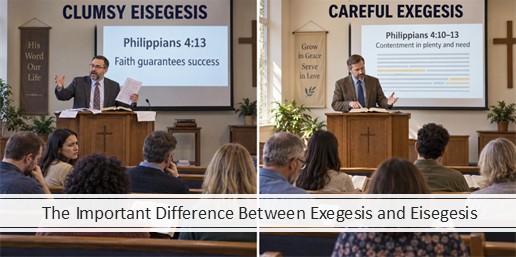
The Important Difference Between Exegesis and Eisegesis

The difference between clumsy eisegesis to accidently teach false doctrine and careful exegesis to accurately give the sense of scripture.

Six part study of important difference between exegesis and eisegesis, including their definitions, Greek origins, and practical examples. Learn how context guides biblical interpretation, why meaning must precede application, and how careful Scripture study protects sound doctrine and encourages faithful Christian obedience. Continue ReadingThe Important Difference Between Exegesis and Eisegesis

The Seven Feasts of Israel: Redemption, Harvest, and Hope: A Simple Biblical Guide

- **Passover** – Christ our Passover Lamb, sacrificed for us (1 Cor. 5:7). - **Unleavened Bread** – Christ sinless, buried, and untouched by corruption (Acts 2:31). - **Firstfruits** – Christ risen, the firstfruits of the resurrection (1 Cor. 15:20). - **Pentecost** – Christ sent the promised Holy Spirit to indwell believers (Acts 2; John 14:16–17). - **Trumpets** – A future gathering and divine intervention (1 Thess. 4:16). - **Day of Atonement** – Christ our perfect High Priest and once-for-all sacrifice (Heb. 9:11–14). - **Tabernacles / Ingathering** – Messiah reigns, gathers, provides, and dwells with His people (Zech. 14:16–19).

The Seven Feasts of Israel reveal a biblical pattern of redemption, harvest, and hope. This simple guide explains each feast’s original purpose, fulfillment in Jesus Christ, and prophetic significance, helping readers see God’s faithfulness across Scripture more clearly. Continue ReadingThe Seven Feasts of Israel: Redemption, Harvest, and Hope: A Simple Biblical Guide

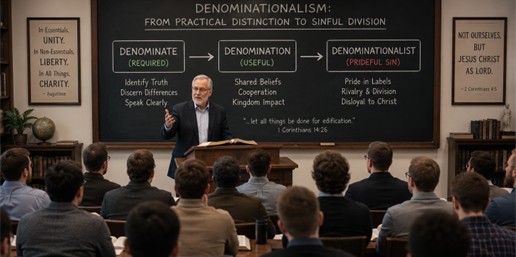
Denominate, Denomination, Denominationalism, and the Myth of Non-Denominationalism

The myth of non-denominationalism hides an important truth: every church has doctrine, history, leadership, traditions, and boundaries. Learn when practical distinctions are biblical, when denominations are useful, and when denominationalism becomes sinful division.

The myth of non-denominationalism hides an important truth: every church has doctrine, history, leadership, traditions, and boundaries. Learn when practical distinctions are biblical, when denominations are useful, and when denominationalism becomes sinful division. Continue ReadingDenominate, Denomination, Denominationalism, and the Myth of Non-Denominationalism

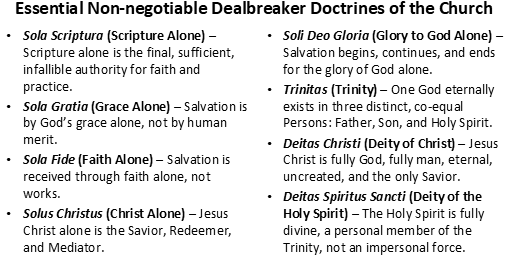
Non-negotiable Dealbreakers: The Essential Doctrines a Church Must Not Get Wrong

Non-negotiable deal-breakers are not about being difficult, divisive, or suspicious. They are about guarding the gospel, honoring Christ, and obeying Scripture. A faithful church does not need to be perfect, impressive, wealthy, famous, traditional, modern, large, or polished. But it must be biblical.

Non-negotiable dealbreakers are not matters of personality, preference, music style, building design, or ministry flavor, they are foundational truths that determine whether a church is standing on biblical Christianity or drifting away from it. A church may be friendly, active, Continue ReadingNon-negotiable Dealbreakers: The Essential Doctrines a Church Must Not Get Wrong

When Should Christians Accept or Reject Teaching?

Deciding to accept or reject teaching? We may tolerate imperfect messengers. We must never tolerate a corrupted message.

Evaluating teaching requires divine wisdom! We will clarify when Christians must accept or reject doctrine by understanding a crucial distinction: motive versus message. Learn how Scripture guides us to test every Good News proclamation against God’s eternal truth. Continue ReadingWhen Should Christians Accept or Reject Teaching?