Non-negotiable dealbreakers are not matters of personality, preference, music style, building design, or ministry flavor, they are foundational truths that determine whether a church is standing on biblical Christianity or drifting away from it. A church may be friendly, active, polished, emotional, traditional, modern, or impressive, but if it is wrong about Scripture, salvation, Christ, the Trinity, or the Holy Spirit, it is wrong at the foundation.
This Bible study will walk through several essential doctrines that every Christian should understand before joining, supporting, or recommending a church. These are not obscure theological arguments for scholars only. They are the basic truths that protect the gospel, exalt the Lord Jesus Christ, preserve the authority of Scripture, and guard believers from false doctrine. The goal is not to make Christians suspicious, harsh, or divisive, but discerning, biblical, and faithful.
One of the best ways to evaluate a church is to read its statement of faith carefully. What does it say about the Bible? What does it teach about salvation? Does it clearly affirm that Jesus Christ is fully God and fully man? Does it confess one God eternally existing as Father, Son, and Holy Spirit? Does it treat the Holy Spirit as a divine Person, or merely as an impersonal influence? These questions matter because doctrine shapes worship, preaching, discipleship, evangelism, and spiritual health.
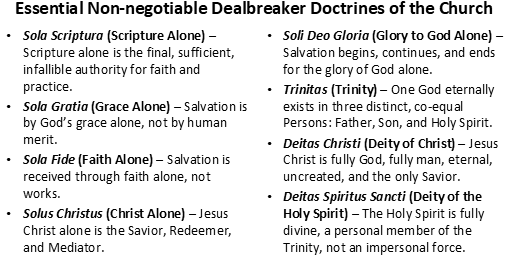
The following list is a table of contents for these non-negotiable dealbreakers. Each phrase introduces an essential doctrine of biblical Christianity, along with the Latin term often used to summarize it. These truths are important because they faithfully summarize what Scripture teaches.
| Doctrine | Latin Phrase | Short Definition |
| Scripture Alone | Sola Scriptura | Scripture alone is the final, sufficient, infallible authority for faith and practice. |
| Grace Alone | Sola Gratia | Salvation is by God’s grace alone, not by human merit. |
| Faith Alone | Sola Fide | Salvation is received through faith alone, not works. |
| Christ Alone | Solus Christus | Jesus Christ alone is the Savior, Redeemer, and Mediator. |
| Glory to God Alone | Soli Deo Gloria | Salvation begins, continues, and ends for the glory of God alone. |
| Trinity | Trinitas | One God eternally exists in three distinct, co-equal Persons: Father, Son, and Holy Spirit. |
| Deity of Christ | Deitas Christi | Jesus Christ is fully God, fully man, eternal, uncreated, and the only Savior. |
| Deity of the Holy Spirit | Deitas Spiritus Sancti | The Holy Spirit is fully divine, a personal member of the Trinity, not an impersonal force. |
Essential doctrine is not a side issue in the Christian life. What a church believes about Scripture, salvation, Christ, the Trinity, and the Holy Spirit will eventually shape what it preaches, how it worships, how it disciples believers, how it evangelizes the lost, and how it responds to error. A weak statement of faith may seem harmless at first, but vague doctrine often becomes the doorway through which confusion, compromise, and false teaching enter.
That is why these essential non-negotiable dealbreakers matter. They are not personal preferences, denominational quirks, or theological hobbies. They are foundation stones of biblical Christianity. Scripture alone must remain the final authority. Salvation must remain by grace alone through faith alone in Christ alone. Jesus Christ must be confessed as fully God and fully man. The Holy Spirit must be honored as a divine Person, not reduced to a force or feeling. The one true God must be worshiped as Father, Son, and Holy Spirit.
Every believer should take time to evaluate his church carefully and prayerfully. Read the statement of faith. Compare it with Scripture. Listen closely to the preaching. Ask whether the church is clear where the Bible is clear, firm where the gospel is at stake, and humble under the authority of God’s Word. The goal is not to become suspicious or divisive, but faithful and discerning, like the Bereans who “searched the scriptures daily, whether those things were so” (Acts 17:11).
A faithful church does not need to be perfect, polished, wealthy, famous, or impressive. But it must be biblical. It must hold fast to the truth once delivered to the saints (Jude 3), proclaim the gospel of Jesus Christ without compromise, and submit every doctrine, tradition, ministry, and opinion to the written Word of God. These dealbreakers are worth studying, worth defending, and, when necessary, worth separating over, because the glory of Christ, the purity of the gospel, and the spiritual health of God’s people are at stake.