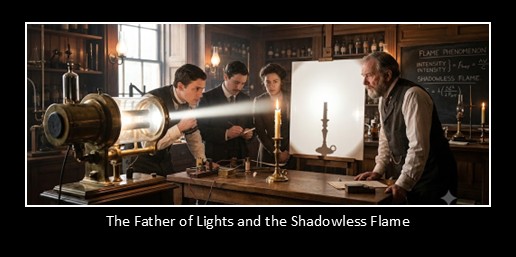
A candle flame can fill a dark room with light, yet under ordinary conditions it casts no sharp, solid shadow. The flame is itself a source of light, and its hot gases are largely transparent. Under intense directional lighting, soot and heated air may create a faint, wavering outline, but a candle flame does not normally produce the dense shadow of an opaque object.
That small wonder of creation points toward a much greater spiritual truth. James writes:
Even the brightest earthly flame flickers, bends, weakens, and eventually goes out. God does not. He is the eternal Father of lights, the unchanging source of everything good, true, holy, and life-giving. From the first chapter of Genesis to the final chapter of Revelation, Scripture presents a grand contrast between light and darkness, revealing the character of God, the tragedy of sin, and the saving glory of Jesus Christ.
God Separated the Light From the Darkness
The Bible opens with darkness covering the unformed earth:
Then God spoke:
After creating the heavens and the earth, God’s first recorded act of ordering the creation was to command light to shine. He did not struggle against the darkness. He did not bargain with it, gradually overcome it, or depend upon some outside power. God merely spoke, and light appeared.
God then made a deliberate distinction:
This separation established one of the Bible’s most important themes. Light and darkness are not presented as equal forces locked in an eternal struggle. Darkness is not an independent power capable of challenging God. God is sovereign over both, but He identifies the light as good and separates it from the darkness according to His purpose.
It is also significant that God created light before He appointed the sun, moon, and stars on the fourth day. The heavenly bodies are not gods, as many ancient cultures imagined. They are created servants. Light does not ultimately originate in the sun. The sun itself depends upon the Creator who spoke light into existence.
This truth prepares us to understand James’s description of God as “the Father of lights.” God is not merely one light among many. He is the Creator, source, ruler, and sustainer of every physical light in the universe.
- 101 Verses that prove Jesus Christ is the Creator
- Why Does Science Keep Agreeing with the Bible? (Consciousness vs. Materialism )
Light and Darkness in the Old Testament
Throughout the Old Testament, light often represents God’s presence, truth, holiness, guidance, salvation, and blessing. Darkness frequently represents ignorance, oppression, sin, judgment, confusion, and separation from God.
David declared:
David did not merely say that God gave him light. He said that the Lord Himself was his light. God was the source of David’s direction, security, deliverance, and hope.
The psalmist also described God’s Word as light:
God’s Word does not reveal every mile of the future at once, but it gives sufficient light for the next faithful step. It exposes danger, corrects error, reveals truth, and directs the believer into the path of obedience.
Light is also closely connected with moral truth. Isaiah pronounced judgment upon those who reverse God’s standards:
Sin does not merely break a religious rule. Sin confuses moral reality. It renames darkness as light and light as darkness. Fallen humanity attempts to redefine what God has already declared, but changing the labels does not change the truth.
Nevertheless, the Old Testament also promised that God would send saving light into a darkened world:
This prophecy looked forward to the coming Messiah. Human beings could not manufacture the light they needed. God Himself would send it. The darkness of sin, oppression, spiritual blindness, and death would be confronted by the glorious light of the promised King.
Isaiah later described nations coming to this light:
The biblical pattern is consistent. Darkness cannot cure darkness. Humanity does not escape spiritual night through education, politics, morality, religion, or human effort. Light must come from God.
The Pillar of Fire in the Wilderness
When God delivered the children of Israel from Egypt, He did not leave them to find their own way through the wilderness. He visibly led them:
The pillar of fire represented several important truths.
First, it revealed God’s presence. Israel was not wandering alone. The Lord who redeemed them from Egypt went before them. The pillar testified that the God of Abraham, Isaac, and Jacob was dwelling among His covenant people.
Second, it provided guidance. The Israelites did not decide their route by human wisdom alone. When the pillar moved, they moved. When it remained, they remained. God determined their direction and their timing.
Third, it provided light in the darkness. The wilderness was dangerous, unfamiliar, and inhospitable. Yet God supplied the light His people needed for their journey.
Fourth, it provided protection. When Pharaoh’s army pursued Israel, the pillar moved between the Egyptians and the Israelites:
The same divine presence that gave light to Israel brought darkness and restraint upon Egypt. God distinguished between His redeemed people and those who pursued them in rebellion.
This does not mean that Israel never experienced fear, hardship, hunger, discipline, or testing. It means they were never abandoned. God’s light did not remove every difficulty, but it assured them that the Lord was present, sovereign, faithful, and able to lead them to the place He had promised.
Believers today are not guided by a visible pillar of fire. We are guided by the written Word of God and the indwelling Holy Spirit, who never contradicts the Scriptures He inspired. Yet the lesson remains: God does not redeem His people and then abandon them in the wilderness. The One who saves is also able to lead, protect, correct, and sustain.
The Glory of God Filled the Tabernacle and Temple
The expression “Shekinah glory” is commonly used to describe the visible manifestation of God’s dwelling presence. The word “Shekinah” does not appear in the biblical text. It comes from a Hebrew term associated with dwelling or residing. The biblical reality behind the expression, however, is clearly described in Scripture.
When the tabernacle was completed, God’s glory filled it:
This was not merely beautiful religious imagery. It demonstrated that the holy God had chosen to dwell among His covenant people. The tabernacle stood at the center of Israel’s camp because God’s presence was to be central to Israel’s life.
Later, when Solomon dedicated the temple in Jerusalem, the same glorious presence appeared:
The glory was so overwhelming that the priests could not continue their service. God was demonstrating that worship was not ultimately about human activity, priestly performance, impressive architecture, or religious ceremony. The temple belonged to God, and His presence gave it meaning.
At the same time, Solomon understood that no building could contain the infinite Creator:
God truly manifested His presence in the temple, but He was never confined within its walls. He remained the sovereign Lord of heaven and earth.
The glory filling the temple also emphasized God’s holiness. Sin could not be treated casually in the presence of a holy God. Sacrifice, priesthood, cleansing, and atonement were necessary because sinful human beings could not approach Him on their own terms.
Tragically, Israel’s persistent idolatry eventually brought judgment. Ezekiel saw the glory of the Lord depart from the temple because of the nation’s rebellion. Religious buildings and ceremonies could not protect a people who continually rejected God’s Word.
Yet God’s plan did not end with an empty temple. The divine glory would be revealed in a far greater way through Jesus Christ.
Jesus Christ Is the True Light
The Gospel of John deliberately begins with language that recalls Genesis:
Jesus Christ did not begin to exist at Bethlehem. He is the eternal Word, fully God, distinct from the Father yet sharing the one divine nature. John declares that everything was created through Him:
The One who commanded light to shine in Genesis entered His creation as a man.
Jesus does not merely carry a message about light. He is the Light. He reveals God because He is God the Son. He exposes sin, reveals truth, offers life, and leads sinners out of spiritual darkness.
John then makes this triumphant declaration:
The word translated “comprehended” can include the idea of overcoming or seizing. The darkness neither understood Christ nor defeated Him. Religious leaders opposed Him. Rome crucified Him. Satan sought to destroy Him. The grave received His body. Yet none of them overcame the Light. Jesus Christ rose bodily from the dead.
John the Baptist came to bear witness to Christ:
The Greek word translated “lighteth” is related to the verb phōtizō, meaning to illuminate, enlighten, or bring to light. Jesus Christ is the true and universal source of divine light for humanity. Every person is accountable to the light God has given through creation, conscience, and the revelation of Christ.
This verse does not teach universal salvation. The verses immediately following explain that many did not receive Him:
Christ genuinely shines His light toward the world, but people may reject that light. Jesus explained why:
The problem is not that God has hidden salvation from sinners who sincerely desire Him. The problem is that fallen humanity loves darkness. People resist the Light because the Light exposes what they want to conceal.
Nevertheless, the invitation is open:
Christ is the Light who enlightens the world, but only those who receive Him by faith become children of God.
Jesus later declared:
He did not claim merely to be a light for one nation, culture, social class, or religious group. He is the Light of the world. There is no other Savior, no competing spiritual illumination, and no alternative path to God.
The Father of Lights Has No Shadow of Turning
James brings the biblical theme of light directly to the unchanging character of God:
In context, James is teaching believers how to understand trials and temptation. God may allow faith to be tested, but He never tempts anyone to commit evil. Evil desire arises from within fallen human beings. God is not the source of sin. He is the source of every truly good gift.
James calls Him “the Father of lights,” which naturally points to God as the Creator of the sun, moon, stars, and all the lights of heaven. These created lights move across the sky. Their positions change. Their brightness appears to vary. As they move, shadows lengthen, shorten, and turn.
God is not like them.
The phrase “no variableness” communicates that there is no change or instability in Him. The expression “shadow of turning” pictures the shifting shadows produced by moving light. Created lights change their apparent position, but the Creator does not change His character.
God does not become more good one day and less good the next. His holiness does not flicker. His truth does not bend with culture. His mercy does not depend upon mood. His promises do not weaken with age. His love does not arise from emotional instability. He is eternally, perfectly, and consistently God.
A candle flame may appear almost shadowless, but it still flickers. It can be bent by the wind, weakened by lack of oxygen, or extinguished by a breath. God cannot be extinguished. He cannot be diminished. He cannot be overcome.
The candle is only an illustration. God is the reality.
Come Out of Darkness and Trust the God of Light
Every human being is born into a world darkened by sin. We have all sinned and fallen short of God’s glory. No amount of religious activity, moral improvement, education, charitable work, or personal sincerity can remove our guilt.
But the God who commanded light to shine out of darkness has shined the saving light of Jesus Christ into the world.
Jesus Christ, the eternal Son of God, became fully man without ceasing to be fully God. He lived without sin, died on the cross as the substitutionary sacrifice for our sins, was buried, and rose bodily from the dead on the third day. He paid the penalty sinners could never pay and accomplished the salvation human works could never earn.
Salvation is offered freely to everyone. It is received by grace through faith in Jesus Christ, apart from works.
Scripture promises:
To trust Christ is to stop hiding in the darkness and come honestly into the light. It is to acknowledge your sin, abandon confidence in your own goodness, and place your faith in the finished work of Jesus Christ alone.
The Father of lights is not unstable, deceptive, or reluctant to save. He gave His Son for the world and genuinely calls every sinner to believe.
Jesus said:
Do not remain in darkness when the Light has come. Do not trust the shifting shadows of human wisdom, religious performance, personal feelings, or cultural approval. Put your trust in Jesus Christ, the Light of the world.
The flame may flicker, the shadows may turn, and the world may grow dark, but the Father of lights never changes. Every good and perfect gift comes from Him, and His greatest gift is eternal life through Jesus Christ our Lord.