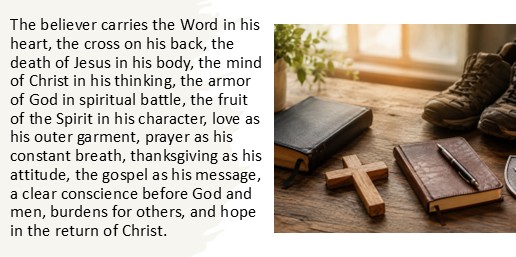
Everyday Carry, often called EDC, usually refers to the practical items a person keeps with them every day. A pocketknife, flashlight, pen, wallet, phone, multitool, or keys may seem ordinary, but each one is carried because it may be needed before the day is done.
The Christian life has an Everyday Carry too.
The believer carries the Word in his heart, the cross on his back, the death of Jesus in his body, the mind of Christ in his thinking, the armor of God in spiritual battle, the fruit of the Spirit in his character, love as his outer garment, prayer as his constant breath, thanksgiving as his attitude, the gospel as his message, a clear conscience before God and men, burdens for others, and hope in the return of Christ.
These are not religious accessories. They are daily necessities.
A Christian does not carry these things to earn salvation. We are saved by grace through faith in the finished work of Jesus Christ, not by works, habits, rituals, or religious performance. Christ died for our sins, was buried, and rose again according to the Scriptures. Those who repent and believe in Him are forgiven, justified, sealed by the Holy Spirit, and given eternal life.
But those who have been saved by Christ are also called to walk with Christ. The Christian life is not meant to be left in the church building, stored on a bookshelf, or remembered only during crisis. We are called to carry the truth of God into the ordinary places of life, our homes, our work, our thoughts, our conversations, our temptations, our suffering, and our witness.
So what should believers never leave home without?
Carry the Word in Your Heart
The first item in the Christian’s Everyday Carry is the Word of God. The psalmist does not merely say he heard the Word, owned the Word, admired the Word, or carried a copy of the Word. He says he hid the Word in his heart.
The Hebrew idea behind “hid” carries the sense of treasuring, storing, or laying something up for safekeeping. God’s Word is not meant to remain outside us as information. It is meant to be stored within us as truth that shapes our thinking, guards our desires, and corrects our steps.
This matters because temptation rarely waits until we are sitting with an open Bible. Temptation often comes while we are tired, pressured, angry, lonely, distracted, or afraid. In those moments, the Word we have hidden in the heart becomes a spiritual defense. It reminds us what is true when our feelings are loud. It exposes sin when our desires are deceptive. It strengthens obedience when compromise looks easy.
Jesus Himself modeled this in the wilderness. When tempted by Satan, He answered with Scripture, saying, “It is written.” The Son of God did not treat the written Word as optional. He used it as the decisive answer against temptation.
Christians should therefore carry Scripture every day through reading, memorizing, meditating, and obeying. A Bible in the hand is good. A Bible on the phone is useful. But the Word hidden in the heart is carried wherever we go.
- Minimum Daily Requirement of Bible Reading
- Failure to read and apply the Bible causes spiritual wasting disease
Carry the Cross Daily
The cross is not only the place where Jesus died for us. It is also the pattern of daily discipleship. Jesus said that whoever would come after Him must deny himself, take up his cross daily, and follow Him.
This does not mean that every hardship is automatically “my cross to bear.” In context, the cross speaks of surrender, self-denial, and identification with Christ. To take up the cross daily is to lay down self-rule and submit again to the Lordship of Jesus Christ.
Every morning, the believer faces a basic question: Who will rule me today? Will I be governed by my flesh, my pride, my appetites, my fears, my bitterness, my ambitions, or my Lord? The cross answers that question. I belong to Christ. I am not my own. I have been bought with a price.
This is why Christian EDC must begin with surrender. Before we carry ministry, knowledge, activity, or service, we must carry the cross. The old self always wants to climb back onto the throne. The disciple must daily say no to self and yes to Christ.
Carry the Death and Life of Jesus
Paul describes the Christian life as carrying “the dying of the Lord Jesus” in the body so that “the life also of Jesus” may be revealed. That is a profound statement. The believer’s suffering, weakness, sacrifice, endurance, and daily surrender become a stage on which the life of Christ is displayed.
This does not mean that believers somehow add to the saving work of Jesus. His atoning death is finished, complete, and sufficient. When Jesus cried, “It is finished,” the payment for sin was fully accomplished. We do not suffer to help pay for sin.
Rather, Paul is describing the visible pattern of Christ’s life being reproduced in His servants. Jesus was rejected, humbled, obedient, sacrificial, and faithful. As believers follow Him in a fallen world, they often experience weakness, pressure, sorrow, and opposition. Yet through those very things, the life of Jesus is displayed.
This is an important part of Christian EDC because it changes how we understand hardship. We are not merely trying to survive the day. We are carrying the testimony of Christ. When we respond to suffering with faith, to mistreatment with grace, to weakness with dependence, and to pressure with endurance, the life of Jesus is made visible in us.
Carry the New Self
The Christian life involves both putting off and putting on. We put off the old self, with its corrupted desires, and we put on the new self, created after God in righteousness and true holiness.
This is not self-improvement in religious language. It is the daily outworking of the new life God has already given to the believer. The Christian has been made new in Christ, and now he must learn to live like who he is.
The old self is marked by deceitful desires. Sin lies. It promises freedom while producing bondage. It promises satisfaction while deepening emptiness. It promises control while enslaving the heart. That is why Paul says the mind must be renewed. We do not overcome the old life merely by trying harder. We must learn to think according to truth.
Every day, the believer must ask: What needs to be put off today? Anger? Lust? Pride? Bitterness? Fear? Laziness? Dishonesty? Harsh speech? Then we must ask: What must be put on? Truth? Forgiveness? Purity? Patience? Humility? Diligence? Kindness? Obedience?
Christian EDC includes daily repentance and daily renewal. The believer should never leave home wearing the old life.
Carry the Mind of Christ
The mind of Christ is one of the most essential things a Christian can carry. Paul points to the humility of Jesus, who, though fully God, took the form of a servant, humbled Himself, and became obedient unto death, even the death of the cross.
To carry the mind of Christ is to carry a servant’s mindset. It means we do not enter the day asking only, “What do I want?” or “How can I be noticed?” or “How can I protect my pride?” Instead, we ask, “How can I obey the Father? How can I serve others? How can Christ be honored through me?”
This is especially important in relationships. Many conflicts continue because both people carry pride instead of humility. Many homes suffer because people carry selfishness instead of servanthood. Many churches are weakened because people carry ambition instead of submission to Christ.
The mind of Christ does not make a believer weak. It makes him strong in the way Jesus was strong. His strength was not selfish domination. It was holy obedience, sacrificial love, and humble service.
Carry the Armor of God
The Christian life is not lived on a playground. It is lived on a battlefield. Paul tells believers to put on the whole armor of God because we wrestle not against flesh and blood, but against spiritual forces of evil.
This is an everyday carry passage in the clearest sense. The believer is told to take up truth, righteousness, the gospel of peace, faith, salvation, the Word of God, and prayer. These are not ceremonial decorations. They are spiritual necessities.
Truth guards us from deception. Righteousness guards us from compromise. The gospel of peace steadies our steps. Faith shields us from the fiery darts of the wicked one. Salvation protects our minds from accusation and despair. The Word of God gives us the Spirit’s sword. Prayer keeps us dependent on God.
Many Christians stumble because they try to face spiritual battle casually. They carry opinions, emotions, habits, and good intentions, but forget the armor God has provided. No believer is strong enough to stand in his own strength. But every believer can stand in the strength of the Lord.
- The whole armor of God to stand against the devil
- The Pattern of Satanic Temptation (and God’s Provision for Victory)
Carry Prayer as Your Constant Breath
Prayer is not merely an emergency flare for crisis moments. It is the constant breath of the Christian life. Paul says to pray always. He does not mean that every moment must be spent with closed eyes and folded hands. He means that the believer should live in ongoing dependence, communion, and responsiveness to God.
Prayer keeps the heart humble. It reminds us that we are not sufficient in ourselves. It brings our needs, fears, sins, burdens, plans, and relationships before the Father. It turns anxiety into dependence and self-reliance into worship.
This also connects with 1 Thessalonians 5:17, “Pray without ceasing.” The Christian should carry prayer into the car, the workplace, the kitchen, the hospital room, the difficult conversation, the temptation, the decision, and the opportunity to witness.
A prayerless Christian is trying to live without breathing. Prayer is not optional equipment. It is daily spiritual oxygen.
- How to start praying with the ACTS model of prayer
- Principles of intercession, interceding, and intercessory prayer
- 3 requirements for effectual fervent prayer: ask, seek, knock
Carry the Fruit of the Spirit
If the armor of God describes how we stand in spiritual battle, the fruit of the Spirit describes the character others should see in us. Christians should carry love into selfish places, joy into discouraging places, peace into anxious places, patience into irritating places, kindness into harsh places, goodness into corrupt places, faithfulness into unreliable places, gentleness into angry places, and self-control into tempting places.
The word “fruit” is important. Fruit is produced by life. The fruit of the Spirit is not manufactured by fleshly effort, personality polish, or religious image management. It is produced as the believer walks in the Spirit and yields to His work.
This does not mean the believer is passive. Galatians 5 also calls us to walk in the Spirit and not fulfill the lust of the flesh. The Christian must actively yield to the Spirit, refuse the works of the flesh, and cultivate obedience to the Word.
Every day, people around us experience what we carry. They feel our impatience or our gentleness. They hear our harshness or our kindness. They see our selfishness or our love. Christian EDC should be visible in Christian character.
Carry Love as the Outer Garment
Paul tells believers to put on compassion, kindness, humility, meekness, patience, forgiveness, and above all, love. Love is the outer garment that holds the others together.
This is crucial because truth without love can become cold and sharp. Service without love can become duty and resentment. Knowledge without love can become pride. Correction without love can become cruelty. But when love governs the heart, truth becomes ministry, service becomes joy, and correction becomes restoration.
Biblical love is not sentimental approval of everything. Love rejoices in truth. Love does not celebrate sin. Love seeks the good of another before God. The greatest display of love is the cross, where Christ gave Himself for sinners.
A Christian should never leave home without love. Before we answer the email, make the phone call, correct the child, confront the brother, speak to the unbeliever, or respond to the critic, we should ask whether we are wearing love.
- Stirring Up Love and Good Works
- The legacy of the Apostle John is love one another. What is your legacy?
Carry Thanksgiving
Thanksgiving is a powerful everyday carry because it protects the heart from bitterness, entitlement, complaint, envy, and fear. A thankful believer remembers that every good gift comes from God and that salvation itself is undeserved grace.
Paul does not say to give thanks for sin or evil as though evil were good. He says to give thanks in everything. That means even in hardship, the believer can thank God for His presence, His promises, His sustaining grace, His final victory, and His purpose in conforming us to Christ.
Thanksgiving changes how we carry burdens. It does not remove every sorrow, but it keeps sorrow from becoming unbelief. It does not deny pain, but it remembers God’s goodness in the middle of pain.
A Christian who carries thanksgiving carries a witness. In a complaining world, gratitude shines.
Carry the Gospel
The gospel is the message every Christian should carry. Not every believer is called to be a pastor, evangelist, missionary, or apologist in the formal sense. But every believer should be ready to speak of Jesus Christ.
The gospel is not “try harder.” It is not “be religious.” It is not “clean up your life so God will accept you.” The gospel is the good news that Jesus Christ, the Son of God, died for our sins, was buried, and rose again. Salvation is offered freely to all who repent and believe in Him.
Romans 1:16 says the gospel is the power of God unto salvation to everyone who believes. That means the power is not in our cleverness, personality, argument, or emotional pressure. The power is in the message of Christ crucified and risen.
This should give believers both courage and humility. We do not have to manipulate people into faith. We faithfully carry the message, speak the truth in love, and trust God to use His Word.
Carry Readiness to Give an Answer
Christian witness includes readiness. Peter says believers should be ready to give an answer, but he also tells us the spirit in which that answer should be given: meekness and fear.
This matters because some believers carry answers without humility. Others carry humility without answers. Scripture calls us to both. We should know what we believe, why we believe it, and how to explain the hope we have in Christ. But we should do so with reverence toward God and gentleness toward people.
Readiness grows through study. A Christian who regularly reads Scripture, listens carefully in church, asks good questions, and learns sound doctrine will become increasingly prepared to speak wisely. The goal is not to win arguments. The goal is to bear witness to Christ.
Every believer should everyday carry a simple, clear explanation of the gospel and a personal testimony of God’s grace.
- BibleTruths Theology
- The Problem with Apologetics (Why I Stopped Being Jealous of Their Snappy Answers)
Carry a Clear Conscience
Paul made it his aim to maintain a clear conscience before God and people. That is a worthy item in the Christian’s Everyday Carry.
A clear conscience does not mean sinless perfection. No believer reaches sinless perfection in this life. A clear conscience means we are not knowingly hiding sin, excusing disobedience, refusing repentance, or avoiding reconciliation when we have wronged someone.
The Christian should keep short accounts with God. When we sin, we confess it. When we hurt someone, we seek to make it right. When Scripture corrects us, we do not argue with God. When the Spirit convicts us through the Word, we respond humbly.
1 John 1:9 reminds believers that God is faithful and just to forgive and cleanse when we confess our sins. That promise should not make us casual about sin. It should make us quick to return to fellowship with the Father.
A guilty conscience is heavy to carry. A clear conscience is a daily mercy.
Carry One Another’s Burdens
Christian EDC is not only personal. It is also relational. We do not walk with Christ alone. We are part of the body of Christ, and part of our daily calling is to help carry the burdens of others.
This includes prayer, encouragement, correction, generosity, patience, hospitality, forgiveness, and presence. Sometimes burden-bearing is practical, such as bringing a meal, making a call, giving someone a ride, or helping meet a need. Sometimes it is spiritual, such as praying with someone, reminding them of Scripture, or helping restore them gently.
Galatians 6 also warns believers to restore the fallen in a spirit of meekness, considering themselves lest they also be tempted. That means burden-bearing must never become prideful superiority. We do not help struggling believers as though we are above weakness. We help them as fellow recipients of grace.
A Christian should enter each day asking, “Whose burden can I help carry today?”
Carry Good Works Prepared by God
Ephesians 2:8-9 makes clear that salvation is by grace through faith, not of works. But Ephesians 2:10 immediately reminds us that those who are saved are created in Christ Jesus unto good works.
Good works are not the root of salvation. They are the fruit of salvation.
This is an important balance. Christians must reject both legalism and laziness. We do not obey in order to make God save us. We obey because God has saved us, made us new, and prepared a path of obedience for us to walk in.
Everyday life is filled with prepared opportunities. A word of encouragement. A moment of patience. A choice to tell the truth. A chance to serve. A temptation resisted. A gospel conversation. A hidden act of generosity. A faithful day of work. A prayer offered for someone in need.
The Christian should not view ordinary life as spiritually empty. God often places good works in ordinary places.
Carry Holiness
Holiness is not merely separation from obvious sins. Holiness means belonging to God and being set apart for His purposes. The Christian is called to be holy because God is holy.
This affects all of life. Peter says “in all manner of conversation,” meaning in the whole conduct of life. Holiness touches our speech, entertainment, relationships, habits, business dealings, private thoughts, online behavior, and desires.
This kind of holiness must be grounded in grace, not pride. A holy life is not a performance meant to impress others. It is a life yielded to the God who redeemed us. Titus 2:11-14 teaches that the grace of God not only brings salvation, but also teaches us to deny ungodliness and live soberly, righteously, and godly.
The believer should never treat holiness as optional equipment. It is part of the daily walk of those who belong to Christ.
Carry Wisdom
Every day requires wisdom. We need wisdom for decisions, conversations, priorities, temptations, conflicts, money, time, family, work, ministry, and witness.
James tells believers to ask God for wisdom. This is wonderfully practical. God does not rebuke His children for needing wisdom. He invites them to ask. Wisdom begins with humility, the honest admission that we do not know enough, see enough, or understand enough apart from God.
Biblical wisdom is more than intelligence. It is skill in living under the fear of the Lord. It knows how to apply truth to real life. It asks not only, “Can I do this?” but “Is this pleasing to God?” It asks not only, “Is this allowed?” but “Will this help me walk faithfully?”
A Christian should carry wisdom by reading Proverbs, studying the whole counsel of Scripture, seeking godly counsel, and praying before decisions.
Carry Peace as Much as Depends on You
Not every conflict can be resolved. Not every person will respond rightly. Not every relationship can be made healthy by one person alone. Scripture is realistic about that. Paul says, “If it be possible,” and “as much as lieth in you.”
But the believer must carry a peace-seeking spirit. We should not be quarrelsome, vengeful, easily offended, or eager to escalate conflict. We should pursue peace without compromising truth, holiness, or obedience to God.
This is especially important in a world trained for outrage. Many people carry anger everywhere they go. Christians should carry peace. That does not mean we avoid hard truth. Jesus spoke hard truth. But it does mean we refuse fleshly hostility.
A peace-seeking Christian can disagree without hatred, correct without cruelty, and stand firm without becoming vicious.
Carry Hope
The Christian should carry hope every day. Not vague optimism. Not denial. Not positive thinking. Biblical hope is confidence rooted in the promises of God.
Titus 2 calls believers to look for the blessed hope, the glorious appearing of our great God and Savior Jesus Christ. Christ is coming again. The present age is not the end of the story. Sin will not win. Death will not have the last word. The body will be raised. The Lord will judge righteously. The redeemed will be with Him forever.
This hope changes how we live now. It teaches us to say no to ungodliness. It strengthens us in suffering. It comforts us in grief. It gives courage in witness. It reminds us that our labor in the Lord is not in vain.
A Christian without hope becomes weighed down by the world. A Christian carrying hope can walk through sorrow with eyes fixed on Christ.
- God’s plans for good and not for disaster, to give you a future and a hope (Jeremiah 29:11)
- 101 Verses of Hope Beyond the Grave
Carry Eternal Perspective
Paul does not deny suffering. He experienced affliction deeply. Yet he calls present affliction “light” and “momentary” when compared with the eternal weight of glory.
This is not because suffering feels light. It is because glory is immeasurably heavy. The eternal future promised by God is so great that present suffering, however painful, cannot compare with what is coming.
The believer must carry eternal perspective because the visible world is loud. Bills, pain, deadlines, conflict, disappointment, politics, sickness, aging, and death all demand attention. But Scripture teaches us to look beyond what is seen to what is unseen and eternal.
This does not make Christians careless about earthly responsibilities. It makes us faithful in them without being ruled by them. We can work, serve, grieve, suffer, and sacrifice because eternity is real.
- Promises of Eternal Life
- The Welcoming Church: How to Talk with Visitors (Friends You Don’t Know Yet)
Carry the Name of Christ Worthily
This may be one of the best summary verses for Christian Everyday Carry. Whatever we do in word or deed is to be done in the name of the Lord Jesus.
The Christian carries Christ’s name into every room. That should affect how we speak, work, drive, spend, post, listen, lead, serve, forgive, and respond. It should affect our private lives as much as our public lives.
The question is simple but searching: Can I do this in the name of the Lord Jesus? Can I say this in the name of the Lord Jesus? Can I watch this, buy this, laugh at this, defend this, pursue this, or post this in the name of the Lord Jesus?
Christianity is not a compartment of life. Christ is Lord over all of life. Therefore, His name belongs over every part of the believer’s day.
A Simple Christian EDC Checklist
- The Christian carries the Word in his heart.
- The Christian carries the cross daily.
- The Christian carries the death of Jesus so the life of Jesus may be seen.
- The Christian carries the new self in righteousness and holiness.
- The Christian carries the mind of Christ in humility and obedience.
- The Christian carries the armor of God for spiritual battle.
- The Christian carries prayer as constant dependence.
- The Christian carries the fruit of the Spirit as visible character.
- The Christian carries love as the outer garment.
- The Christian carries thanksgiving in every circumstance.
- The Christian carries the gospel as the message of salvation.
- The Christian carries readiness to give an answer.
- The Christian carries a clear conscience before God and people.
- The Christian carries the burdens of others.
- The Christian carries good works prepared by God.
- The Christian carries holiness in all conduct.
- The Christian carries wisdom for daily decisions.
- The Christian carries peace as much as possible.
- The Christian carries hope in the return of Christ.
- The Christian carries eternal perspective.
- The Christian carries the name of Christ in word and deed.
Conclusion: Keep Growing Your Christian EDC
Everyday Carry for Christians is not about spiritual decoration. It is about daily readiness. The believer should not step into the day empty-handed, empty-minded, or empty-hearted. We need the Word of God, the cross of discipleship, the armor of God, the fruit of the Spirit, the breath of prayer, the message of the gospel, the humility of Christ, and the hope of His return.
But no Christian begins the day fully mature. We grow into this. We add to our spiritual readiness over time as we walk with the Lord. The Christian life is a lifelong process of sanctification, a Spirit-empowered transformation toward Christlikeness. We do not grow by accident. We grow by grace as we continue in the means God has given.
So keep building your Christian EDC.
Read your Bible daily, because the Word hidden in your heart will guard your steps. Pray without ceasing, because dependence on God is not weakness, but wisdom. Go to church faithfully, because believers need teaching, fellowship, worship, correction, encouragement, and opportunities to serve. Share your faith regularly, because the gospel is not meant to be hidden in your pocket, but carried into the world.
The world has its own everyday carry. It carries fear, pride, lust, anger, confusion, distraction, bitterness, and hopelessness. But the Christian carries something better. We carry the truth of God, the grace of Christ, the presence of the Spirit, the message of salvation, and the hope of glory.
Do not leave home without them.