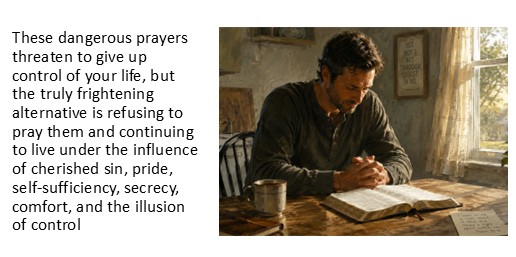
Apparently, there are some prayers Christians are supposed to approach with caution. These are not the ordinary prayers about travel mercies, lunch, parking spaces, or keeping the air conditioner alive through August. These are the prayers people sometimes call “dangerous prayers,” the kind that threaten your comfort, expose your motives, interfere with your plans, and generally make life less manageable.
Naturally, that sounded concerning.
I have spent years developing what I thought was a reasonably efficient system for following Jesus while retaining an appropriate amount of personal control. I pray for God’s guidance, provided His guidance remains reasonably close to the route I already selected. I ask Him to change difficult circumstances, especially the ones inconveniencing me. I am also completely willing for God to transform difficult people, open closed doors, remove frustrating obstacles, and arrange events in ways that happen to coincide with my carefully researched preferences.
Then I began looking at seven prayers from Scripture that are often described as dangerous. They are dangerous because they threaten our comfort, pride, secrecy, self-sufficiency, and desire for control. But the more carefully I examined them, the more I began to wonder whether praying them was really the dangerous choice. Perhaps the greater danger is spending the rest of my life protecting the very things God wants me to surrender.
These prayers are not magical formulas. They do not “shift atmospheres,” force spiritual breakthroughs, guarantee prosperity, or compel God to act because we finally found the correct sequence of religious words. Biblical prayer is not an incantation. We pray to our Father according to His revealed will, trusting that “if we ask any thing according to his will, he heareth us” (1 John 5:14).
Nor does God need our permission to work in our lives. He is God. We are not granting Him authority He somehow lacked until we prayed the right words. What these prayers express is voluntary surrender: “Lord, I am no longer asking only that You change what is around me. According to Your Word, change what is wrong within me, and use my life however You desire.”
That sounded dangerous enough to investigate.
Dangerous Prayer #1: Search Me
“Search me” sounds harmless at first. In fact, it sounds wonderfully devotional, especially if I quietly assume that God will conduct the search and uncover several admirable qualities I have somehow failed to appreciate. Perhaps He will discover unusual patience, hidden generosity, impressive discernment, and a humility so advanced that I had not even noticed it myself.
Unfortunately, David’s prayer in Psalms 139 is not designed to provide spiritual compliments. He is asking God to expose what is really there, including what David may not see clearly himself. That changes the nature of the prayer considerably. It is one thing to invite God to examine my heart after I have already prepared a list of acceptable findings. It is another thing to place the whole heart before the One who knows it perfectly.
This prayer becomes uncomfortable because I have developed explanations for most of my behavior. I was not impatient, I was being efficient. I was not gossiping, I was sharing a prayer concern with unusually thorough background information. I was not angry, I was exercising righteous indignation over something that happened to irritate me personally. I was not looking for praise, I simply felt everyone would be encouraged to know exactly how much work I had done.
Then I pray, “Search me,” and suddenly those explanations are no longer the final word. Psalms 19:12 asks, “Who can understand his errors? cleanse thou me from secret faults.” One of the frightening things about hidden sin is that some of it may be hidden from the sinner. The safer alternative seems to be avoiding the question, comparing myself with people who make me look reasonably mature, and continuing comfortably unaware of whatever I have chosen not to see.
But perhaps being searched is not the dangerous possibility after all. Remaining blind to my own sin may be far worse. Still, this was only the first prayer, so perhaps the next one would finally prove genuinely hazardous.
Dangerous Prayer #2: Your Will, Not Mine
The second dangerous prayer is simple: “Your will, not mine.” That immediately raises several practical concerns because I am very much in favor of God’s will in principle. I simply prefer to receive the full itinerary beforehand, including anticipated inconveniences, financial implications, difficult conversations, approximate duration, and a short explanation of how everything eventually works out.
Once those details have been supplied, preferably in writing, I am prepared to consider surrender.
Jesus did not pray that way in Gethsemane. He was facing the cross, something infinitely greater than any surrender we will ever face. His prayer was neither casual resignation nor passive fatalism. He expressed His desire honestly, yet placed Himself completely under the Father’s will.
This prayer becomes dangerous when God’s revealed will collides with something I want. It is easy to pray for God’s will when His will and my preference happen to be traveling in the same direction. The difficulty begins when Scripture tells me to forgive someone I would rather resent, speak truth when silence feels safer, give generously when keeping feels comfortable, serve when I would rather be noticed, or obey when I cannot see how obedience will improve the situation.
It is possible to pray, “Lord, show me Your will,” while quietly hoping He will eventually approve the decision I have already made. Romans 12:1-2 offers a different picture. Paul calls believers to present themselves as living sacrifices and connects that surrender with transformation and discerning God’s will. The surrendered Christian discovers that God’s will is not an enemy from which he must protect himself.
The apparently safer alternative is insisting on my own way. I can defend my preferences, ignore inconvenient Scripture, and continue asking God to bless decisions I have already settled in my own mind. Yet Proverbs 14:12 warns, “There is a way which seemeth right unto a man, but the end thereof are the ways of death.” Perhaps surrendering my will is not the frightening part. Perhaps insisting that I know better is.
Two prayers down. Surely number three would justify the warning label.
Dangerous Prayer #3: Remove What Hinders Me
“Lord, remove what hinders me” sounds reasonable until Hebrews 12 begins talking not only about sin, but also about “every weight.” Obvious sins are easy enough to categorize. A weight is more complicated because it may not be sinful in itself. It may simply be something that slows us down in the race God has set before us.
That means I may have to reconsider things I have defended with the technically accurate statement, “There is no verse that specifically says I cannot do this.” Scripture sometimes asks a more searching question. Not merely, “Is this forbidden?” but, “Is this helping me run faithfully?”
Weights can become comfortable traveling companions. Perhaps it is a habit that consumes hours without accomplishing much. Perhaps it is entertainment that keeps feeding thoughts I am simultaneously asking God to purify. Perhaps it is resentment that has become so familiar I would almost miss it if it disappeared. Perhaps it is an ambition that was once harmless but has quietly become more important than obedience.
I can picture myself standing at the starting line explaining the situation to God: “Lord, I am absolutely ready to run the race. I will just need to bring this suitcase of old offenses, this backpack of distractions, several bags of excuses, and a small carry-on containing habits I prefer not to examine too closely. Other than that, I am fully committed.”
Psalms 19:12-13 gives us a better posture: “Cleanse thou me from secret faults. Keep back thy servant also from presumptuous sins.” The psalmist recognizes both sins he may not see and sins he knowingly approaches. That is very different from asking God to make the race easier while refusing to put down what makes running difficult.
At first, removing hindrances sounded dangerous. But dragging them through the rest of my Christian life is beginning to sound worse. Perhaps the next prayer, “Humble me,” would finally prove that we should have stopped while we were ahead.
Dangerous Prayer #4: Humble Me
This prayer needs careful wording because Scripture usually tells us to humble ourselves. That seems fair. I would much rather participate voluntarily than require remedial instruction.
James says, “God resisteth the proud, but giveth grace unto the humble” (James 4:6). Peter likewise tells believers to humble themselves under God’s mighty hand. Scripture does not teach us to seek catastrophe or ask God to manufacture suffering merely to “break” us. It does teach us to recognize pride, submit ourselves to God, and abandon the illusion that we are self-sufficient.
Pride is difficult to detect because it rarely announces itself by demanding applause. Sometimes pride looks like an inability to admit I was wrong. Sometimes it appears as resentment when someone else receives recognition. Sometimes it is the quiet conviction that a ministry, family, project, church, or workplace would collapse immediately if I stopped managing everything.
The humble Christian learns to say, “God is indispensable. I am not.” The proud Christian may affirm that sentence doctrinally while maintaining a schedule designed to prove the opposite.
Humility also tends to arrive in less impressive forms than we expect. I may pray, “Lord, teach me humility,” and then receive correction from someone I do not particularly respect. Clearly, that cannot be the answer to prayer. I was expecting humility to develop privately during devotional time, perhaps while watching a sunrise. I was not expecting it to require the words, “You are right. I was wrong. Please forgive me.”
Daniel 4 gives us a sobering picture of where pride can lead. Nebuchadnezzar credited Babylon’s greatness to his own power and majesty until God humbled him and he finally confessed that those who walk in pride God “is able to abase” (Daniel 4:37). We should not turn Nebuchadnezzar’s judgment into a formula for sanctification, but we should certainly hear its warning.
Perhaps humbling myself before God is not the dangerous course. Maintaining the illusion of self-sufficiency while God Himself “resisteth the proud” is much more alarming. Four prayers were now behind me, and I was beginning to suspect a pattern.
Dangerous Prayer #5: Here Am I, Send Me
“Here am I; send me” is the kind of prayer that immediately causes some of us to become interested in defining the geographical limitations of the word “send.”
Surely God can send me somewhere nearby, perhaps across the room, preferably to someone I already like, and ideally during normal business hours.
Isaiah attached none of those conditions.
Before he volunteered, Isaiah saw the Lord high and lifted up. He became painfully aware of his own sinfulness, received cleansing from God, and then heard the question, “Whom shall I send, and who will go for us?” His answer was simply, “Here am I; send me.”
This prayer is dangerous because availability interferes with carefully protected plans. God may not call you across an ocean. He may call you across the street. He may put a lonely person in your path when you are in a hurry, give you an opportunity to serve when nobody will notice, or bring someone who needs patient discipleship into a season you had reserved for yourself.
That may actually be more difficult than some dramatic act of sacrifice. Extraordinary service can make an impressive testimony. Ordinary faithfulness is often unnoticed.
Scripture does not tell us to despise ordinary life. Paul tells believers to “study to be quiet, and to do your own business, and to work with your own hands” (1 Thessalonians 4:11). Raising children, loving a spouse, working honestly, serving faithfully, helping a neighbor, discipling one believer, and quietly supporting the local church may all be exactly where God has sent us.
The issue is not ordinary versus extraordinary. It is obedience versus self-centeredness.
The alternative to “send me” seems safer. I can preserve my comfort, protect my schedule, and wait indefinitely for a calling impressive enough to deserve my participation. Meanwhile, Ephesians 2:10 says believers are God’s workmanship, created in Christ Jesus for good works God has prepared for us to walk in.
Being sent may cost something. But reaching the end of life and realizing how much of it was spent protecting myself from usefulness sounds considerably worse.
Only two prayers remained.
Dangerous Prayer #6: Deliver Me From Evil
“Deliver me from evil” initially sounds like the safest prayer on the list. Who objects to being delivered from evil?
Then I realized that it is possible to want God to deliver me from the consequences of temptation while allowing me to maintain a comfortable relationship with the temptation itself.
I can ask God to protect my mind while repeatedly placing garbage in front of my eyes. I can ask Him to guard my speech while surrounding myself with conversations that feed gossip and bitterness. I can pray for victory over temptation while protecting the habits, entertainment, relationships, and routines through which temptation regularly enters.
Jesus teaches a more serious kind of dependence.
Biblical spiritual warfare is real. Satan and demons are real created beings who oppose God and His people. Ephesians 6:10-18 tells believers to be strong in the Lord, put on the whole armor of God, stand in truth and righteousness, take up faith, rely upon salvation and God’s Word, and pray. James 4:7 gives the order plainly: “Submit yourselves therefore to God. Resist the devil, and he will flee from you.”
There is nothing here about discovering the correct verbal formula to manipulate invisible forces, force breakthroughs, or compel God to release blessings. Prayer is not Christian magic. Our confidence rests in the Lord Jesus Christ, His finished work, His Word, and the indwelling Holy Spirit.
Yet there is another danger that may be much closer to home. Christians can slowly become comfortable with what once troubled their consciences. A little compromise becomes familiar. Familiarity reduces alarm. Eventually something we once resisted becomes something we merely manage.
The seemingly safer alternative is keeping temptation nearby while assuring ourselves that we remain completely in control. But Scripture warns, “Let him that thinketh he standeth take heed lest he fall” (1 Corinthians 10:12). Peter tells believers to be sober and vigilant because the devil walks about “as a roaring lion, seeking whom he may devour” (1 Peter 5:8).
Maybe asking God to deliver me from evil is not dangerous. Becoming comfortable around evil is.
By now, only one prayer remained.
Dangerous Prayer #7: Make Me Bold
“Lord, make me bold” sounds dangerous because boldness has consequences. Bold Christians sometimes say things, and occasionally people disagree with them.
That introduces the possibility of awkwardness, rejection, criticism, damaged reputations, uncomfortable conversations, and sometimes genuine persecution. A much safer evangelistic strategy would be to live such an unusually mysterious Christian life that people eventually interrupt us at the grocery store and demand a complete explanation of the substitutionary atonement.
Unfortunately, the believers in Acts did not adopt that strategy.
Peter and John had been arrested for preaching Jesus Christ. They were threatened and commanded not to speak in His name. After their release, the believers gathered and prayed, but their request was remarkable. They did not primarily ask God to remove the opposition. They asked Him to give them courage to remain faithful in the middle of it.
I would probably have suggested several additional requests. “Lord, remove the threatening people. Improve the political climate. Give the Sanhedrin more reasonable leadership. Provide a ministry opportunity involving significantly less imprisonment.”
Instead, they prayed for boldness, and Acts 4:31 says they “spake the word of God with boldness.” Paul later asked believers to pray that he would proclaim the gospel boldly even while he was imprisoned (Ephesians 6:19-20).
That prayer threatens my desire to be liked. It threatens my ability to remain invisible when truth needs to be spoken. It threatens the comfortable idea that evangelism is primarily the responsibility of unusually outgoing Christians with specialized training.
But then the supposedly safer alternative began to look frightening. I can avoid awkward conversations, protect my reputation, and remain silent while someone desperately needs the gospel. I can know that “Christ died for our sins…and that he was buried, and that he rose again the third day” (1 Corinthians 15:3-4), know that eternal life is offered through faith in Jesus Christ, and still allow fear of another person’s reaction to close my mouth.
Suddenly boldness did not seem like the dangerous possibility.
Silence did.
And that was when the entire experiment stopped being funny.
I Finally Found the Scary Part
I began with seven “dangerous prayers” because I assumed the danger was what God might do if I prayed them sincerely. What if He searched me and exposed something I did not want to see? What if His will disrupted mine? What if I had to surrender something I enjoyed? What if humility required admitting I was wrong? What if God sent me somewhere inconvenient, resisting temptation required changing my habits, or boldness resulted in rejection?
Those possibilities can certainly be uncomfortable, but none of them are frightening because God is untrustworthy. God is good, holy, wise, loving, and faithful. Jesus did not teach His disciples to approach an unpredictable tyrant who might punish them for surrendering too much. He taught them to pray, “Our Father which art in heaven” (Matthew 6:9).
Jesus also reminded His disciples that earthly fathers know how to give good gifts to their children, then asked, “How much more shall your Father which is in heaven give good things to them that ask him?” (Matthew 7:11). Hebrews likewise tells believers to “come boldly unto the throne of grace, that we may obtain mercy, and find grace to help in time of need” (Hebrews 4:16).
The throne belongs to the sovereign God, but for the believer it is also a throne of grace.
That changes the meaning of “dangerous prayer.”
These prayers are not dangerous because God is dangerous to trust. They are dangerous because they threaten things that are dangerous to keep. “Search me” threatens cherished sin and secrecy. “Your will, not mine” threatens self-rule. “Remove what hinders me” threatens tolerated distractions and compromise. “Humble me” threatens pride and self-sufficiency. “Here am I, send me” threatens selfish comfort. “Deliver me from evil” threatens our familiarity with temptation. “Make me bold” threatens the fear that keeps the gospel locked behind our lips.
Then I remembered something Jesus said:
Jesus turns our instinct for safety upside down. The person desperately protecting his autonomy believes he is preserving his life, but Jesus says he is actually losing it. The person who surrenders himself to Christ appears to be giving everything away, yet Jesus says that is where life is found.
The apparent safe choice may actually be the dangerous one.
The Greater Danger Is Resisting God
There is something far more frightening than asking God to search your heart. It is carrying hidden sin for years because you refused to let His Word expose it. There is something more dangerous than surrendering your plans. It is spending your life insisting upon your own way until your heart becomes increasingly resistant to God’s will.
There is something worse than laying aside a cherished hindrance. It is dragging that weight through decades of Christian life while wondering why the race always feels so difficult. There is something more dangerous than humility. It is allowing pride to become so normal that correction feels like persecution and repentance feels like defeat.
There is something worse than saying, “Here am I; send me.” It is reaching the end of a life entrusted to you by God and discovering how much of it was spent protecting your comfort. There is something more frightening than asking God for deliverance from evil. It is becoming so familiar with temptation that evil no longer seems particularly evil.
And there is something more dangerous than asking God for boldness. It is standing silently beside people who desperately need to hear that Jesus Christ died for their sins, was buried, rose again, and offers eternal life to everyone who believes in Him.
Sin promises freedom while producing slavery. Pride promises strength while making us resistant to grace. Self-sufficiency promises independence while separating us from the help God freely provides. Secrecy promises protection while allowing sin to grow in darkness. Comfort promises peace while slowly making obedience negotiable. Control promises security while persuading us to trust the one person in the universe least qualified to control everything: ourselves.
Jesus offers something better.
A Surrendered Life Is Not a Wasted Life
The Christian life is not a frantic effort to persuade a reluctant God to bless us, nor is it an attempt to earn His acceptance through increasingly radical acts of surrender. Salvation is by grace through faith in Jesus Christ, apart from works (Ephesians 2:8-9). The believer is accepted because of Christ, not because he successfully prayed seven difficult prayers.
But the grace that saves us also teaches us how to live. Titus 2:11-13 says that the grace of God teaches believers to deny ungodliness and worldly lusts and to live “soberly, righteously, and godly” while looking for the return of Jesus Christ. Sanctification is not God making us acceptable enough to remain saved. The genuine believer is secure in Christ. Sanctification is the lifelong, Spirit-empowered transformation through which we learn to walk in obedience and become more like Jesus Christ.
That is where these seven prayers belong. They are not formulas, mystical keys, or tests of whether we are radical enough Christians. They are simply biblical expressions of surrender:
- “Search me.”
- “Your will, not mine.”
- “Remove what hinders me.”
- “Help me humble myself before You.”
- “Here am I; send me.”
- “Deliver me from evil.”
- “Make me bold.”
Together they form a natural progression. Search my heart, surrender my will, remove my hindrances, humble my pride, send my life, protect me from evil, and make me bold.
That sounds dangerous until we consider the alternative.
The greater danger is living an entire Christian life protecting the very things Jesus wants us to surrender. Perhaps the truly dangerous prayer is the one we never pray because we remain convinced that we are safer in control.
So perhaps a surrendered prayer sounds something like this:
That prayer may threaten cherished sin, pride, secrecy, self-sufficiency, comfort, and our illusion of control.
And perhaps that is exactly the point.
Those were the dangerous things all along.