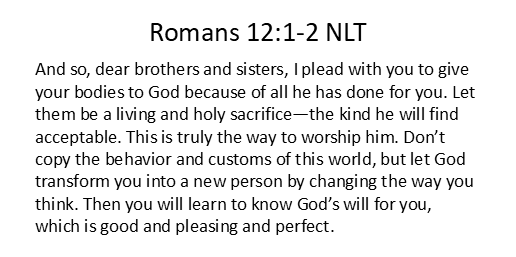
Romans 12:1-2 is one of the clearest and most searching calls to Christian discipleship in the New Testament, but we must consider the whole verse and not overemphasize one word the changes the meaning.
Those words are familiar to many Christians. We quote them, memorize them, preach them, and build discipleship lessons around them. Yet sometimes we can put the emphasis in the wrong place. We may overemphasize one word in the passage in a way that distorts the whole meaning.
If we overemphasize “living” apart from the rest of the verse, we may turn Christianity into the pursuit of spiritual experience. If we emphasize “holy” apart from mercy, we may drift into legalism and religious pride. If we emphasize “acceptable” apart from grace, we may begin to think more highly of ourselves than we ought. If we emphasize “worship” apart from obedience, we may reduce worship to a song, a service, or a mood. If we emphasize “not conformed” apart from inward renewal, we may become obsessed with outward appearance and comparison.
But Paul’s central picture is this: the Christian life is a sacrifice.
The believer is called to present himself to God as a “living sacrifice.” That one word helps hold the entire passage together. The Christian life is not self-expression. It is not self-improvement. It is not self-display. It is the grateful surrender of the whole person to God because of the mercies already received in Christ.
The Mercies of God Come First
Romans 12 begins with the word “therefore.” That means Paul is building on everything he has already explained in Romans 1–11. He has taught that all have sinned and fall short of the glory of God (Romans 3:23). He has declared that sinners are justified freely by God’s grace through the redemption that is in Christ Jesus (Romans 3:24). He has shown that Christ died for the ungodly (Romans 5:6), that believers have been united with Christ in His death and resurrection (Romans 6:3-4), that there is now no condemnation for those who are in Christ Jesus (Romans 8:1), and that nothing can separate God’s people from His love in Christ (Romans 8:38-39).
So when Paul says, “by the mercies of God,” he is not giving a vague religious motivation. He is pointing to the saving compassion of God revealed in the gospel. God has shown mercy to sinners through the death, burial, and resurrection of Jesus Christ. Therefore, the Christian life begins with grace, not performance.
Paul does not say, “Present your bodies so that God will be merciful to you.” He says, “By the mercies of God, present your bodies.” The order matters. We do not offer ourselves to purchase mercy. We offer ourselves because mercy has already been poured out in Christ.
This protects Romans 12:1-2 from legalism. Christian sacrifice is not an attempt to earn salvation. Salvation is by grace through faith, not of works, lest anyone should boast (Ephesians 2:8-9). But this also protects the passage from hyper-grace and careless living. The same passage that rests on mercy calls the believer to full surrender. Grace does not leave the Christian unchanged. Grace teaches us to deny ungodliness and worldly lusts and to live soberly, righteously, and godly in this present age (Titus 2:11-12).
What Paul Means by Sacrifice
The word “sacrifice” naturally takes our minds back to the Old Testament altar. Under the Law of Moses, animals were offered to God as sacrifices. Those sacrifices were bloody, costly, and serious. They taught Israel that sin brings death, that God is holy, and that sinners need atonement.
But Paul does something striking in Romans 12:1. He does not call Christians to bring a dead animal. He calls Christians to present themselves as a “living sacrifice.” The sacrifice is not placed on an altar to die physically. Rather, the believer presents his living body, his whole earthly life, to God.
This includes the mind, hands, eyes, tongue, desires, habits, relationships, work, money, time, sexuality, speech, and service. Paul says, “present your bodies,” because the body is the place where obedience is lived out. Christianity is not merely an inward sentiment. It is embodied surrender.
The Christian’s body is not meaningless. It belongs to God. Paul says in 1 Corinthians 6:19-20, “You are not your own, for you were bought with a price. So glorify God in your body.” That is the same logic as Romans 12. The believer has been redeemed by Christ, therefore the believer belongs to Christ.
Sacrifice, then, is the voluntary offering of the whole self to the Creator and Redeemer.
Sacrifice Is Voluntary Submission to God
Biblical sacrifice, when applied to the Christian life, is not unwilling religious abuse. It is not coerced violence. It is not forced submission to a human tyrant. It is the willing surrender of a redeemed person to the God who created him, loved him, saved him, and has rightful authority over him.
This matters greatly. The Bible teaches that God is the Creator. “In the beginning, God created the heavens and the earth” (Genesis 1:1). He made mankind in His image (Genesis 1:26-27). We owe our existence to Him. He gives life and breath and everything (Acts 17:25). Therefore, God has the rightful claim over our lives.
But God is not merely Creator. For the believer, He is also Redeemer. He has purchased us through the blood of Christ. That means Christian surrender is not slavery to cruelty. It is not the loss of personhood. It is the restoration of proper worship. Sin makes us slaves to corruption, passions, pride, fear, and death. Christ frees us to belong to God.
Jesus said, “If anyone would come after me, let him deny himself and take up his cross daily and follow me” (Luke 9:23). That call is serious, but it is not coercive. Jesus says, “If anyone would come after me.” Discipleship is a call to voluntary surrender. The Lord does not trick His people into following Him. He tells them plainly that following Him means self-denial, cross-bearing, and obedience.
The Christian says, “Lord, I am Yours.” That is sacrifice.
Sacrifice Is Not Coerced Violence
Because the word “sacrifice” can be misused, we must be careful to define it biblically. In Romans 12:1, sacrifice does not mean involuntary, forced, compulsory, mandatory, coerced, unwilling violence. Paul is not describing a victim being overpowered. He is not sanctifying abuse. He is not giving religious language to manipulation. He is calling believers to willingly offer themselves to God.
This distinction is very important.
There is a vast difference between a believer voluntarily submitting to God and a person being forced, threatened, shamed, or abused by another human being. Biblical sacrifice is Godward surrender. Coerced violence is sinful domination. Biblical sacrifice flows from mercy. Coercion flows from control. Biblical sacrifice honors God’s authority. Abuse twists authority for selfish ends.
Jesus never calls His disciples to use violence, manipulation, or compulsion to produce spiritual devotion. He rebuked domineering leadership when He said, “The rulers of the Gentiles lord it over them… It shall not be so among you” (Matthew 20:25-26). Christian leadership is not coercive control. It is humble service. Jesus Himself said, “The Son of Man came not to be served but to serve, and to give his life as a ransom for many” (Matthew 20:28).
Christ’s sacrifice was voluntary. He said, “I lay down my life… No one takes it from me, but I lay it down of my own accord” (John 10:17-18). That is the pattern of biblical sacrifice. It is willing obedience to the Father. It is not unwilling victimization.
So when Romans 12 calls believers to be a living sacrifice, it must never be twisted into a justification for religious abuse, spiritual manipulation, domestic cruelty, or authoritarian control. A Christian may willingly deny himself for Christ, but no human being has the right to play God and force another person onto the altar.
Sacrifice Is Whole-Person Worship
Paul says this living sacrifice is “your spiritual worship.” Worship is more than singing, though singing is a beautiful part of worship. Worship is more than attending church, though gathering with the church is commanded and necessary. Worship is the whole life offered to God.
This is why Paul says to present your “bodies.” The body matters because obedience happens in real life. We worship God with our lips when we praise Him, but also with our hands when we serve, with our eyes when we turn from lust, with our mouth when we speak truth, with our money when we give, with our calendar when we make time for fellowship, with our mind when we meditate on Scripture, and with our feet when we go where obedience requires.
A living sacrifice is not a Sunday-only Christian. A living sacrifice belongs to God at home, at work, at church, in private, online, under pressure, in temptation, and in ordinary routines. True worship is not less practical because it is spiritual. It is spiritual precisely because it brings the whole life under God.
Sacrifice Is Holy and Acceptable
Paul describes this sacrifice as “holy and acceptable to God.” Holiness means being set apart for God. It does not mean self-righteousness. It does not mean man-made rules. It does not mean looking down on others. It means belonging to the Lord.
A holy sacrifice is a life separated from sin and set apart for God’s purposes. The believer cannot present himself to God while clinging comfortably to the world. That is why verse 2 says, “Do not be conformed to this world.” The surrendered life must resist the shape, values, desires, and thinking of this present evil age.
Yet Paul also says the sacrifice is “acceptable to God.” This does not mean the Christian becomes acceptable by personal merit. The believer is accepted in Christ. But the life surrendered to God is pleasing to Him. Like a child who wants to please a loving father, the Christian offers himself to God with reverence, gratitude, and love.
This protects us from two errors. On one side, we must reject legalism, which tries to earn God’s favor by religious performance. On the other side, we must reject careless Christianity, which claims grace while refusing surrender. The gospel produces grateful obedience.
Sacrifice Requires a Renewed Mind
Paul continues, “Do not be conformed to this world, but be transformed by the renewal of your mind.” This shows that Christian sacrifice is not mindless. It is not emotionalism. It is not blind religious intensity. It involves renewed thinking.
The mind must be reshaped by the truth of God. The world presses believers into its mold through desires, fears, entertainments, ambitions, moral confusion, and false promises. The Word of God renews the mind by teaching us what is true, what is holy, what is eternal, and what pleases the Lord.
Psalms 119:11 says, “I have stored up your word in my heart, that I might not sin against you.” Jesus prayed, “Sanctify them in the truth; your word is truth” (John 17:17). A living sacrifice must be a Bible-shaped sacrifice.
This means surrender to God is not the abandonment of thought. It is the healing of thought. Sin twists the mind inward toward self. Grace renews the mind upward toward God. The Christian learns to think God’s thoughts after Him, to love what He loves, hate what He hates, trust what He says, and obey what He commands.
Sacrifice Discerns the Will of God
Paul says that by this renewal believers may discern “what is the will of God, what is good and acceptable and perfect.” This does not mean Christians become fault-finders. It means they learn to recognize and approve what pleases God.
Discernment is not suspicion. Discernment is not criticism as a personality trait. Discernment is the mature ability to distinguish truth from error, wisdom from folly, holiness from worldliness, and obedience from compromise. Hebrews 5:14 says that the mature have their powers of discernment trained by constant practice to distinguish good from evil.
But Romans 12 keeps discernment connected to sacrifice. The purpose of discernment is not to win arguments or expose everyone else’s flaws. The purpose is obedience. The renewed mind asks, “Lord, what pleases You?” The surrendered life then says, “By Your grace, I will do it.”
When We Emphasize the Wrong Word
Every word in Romans 12:1-2 is inspired by God and profitable. The problem is not emphasizing Paul’s words. The problem is isolating one word from the whole passage.
- If we overemphasize “living,” we may reduce Christianity to personal vitality, emotional experience, or feeling alive, instead of daily surrender to God.
- If we overemphasize “holy,” we may turn holiness into outward rule-keeping, self-righteous comparison, or legalistic performance.
- If we overemphasize “acceptable,” we may confuse God’s gracious pleasure in obedient surrender with personal superiority, group pride, or religious exclusiveness.
- If we overemphasize “spiritual,” we may imagine worship as inward feeling only, while ignoring embodied obedience, church fellowship, service, generosity, and love.
- If we overemphasize “worship,” we may reduce worship to a service, song, mood, or religious event, instead of a whole-life response shaped by the Word of God.
- If we overemphasize “not conformed,” we may define godliness mainly by visible separation, outward appearance, or comparison with others, rather than by inward renewal and obedience to God.
- If we overemphasize “transformed,” we may turn sanctification into a visible success project, measuring progress by outward results rather than humble, Spirit-empowered renewal.
- If we overemphasize “mind,” we may become merely academic, treating Christianity as information to master rather than truth to believe, love, and obey.
- If we overemphasize “testing,” we may turn obedience into constant self-measurement, religious analytics, or anxious evaluation, instead of humble dependence on God’s revealed will.
- If we overemphasize “discern,” we may become suspicious critics, skilled at identifying error in others but slow to obey God ourselves.
- If we overemphasize “good,” we may define the good life by our own desires, comfort, reputation, or success, rather than by what God calls good.
- If we overemphasize “perfect,” we may fall into perfectionism, discouragement, or spiritual comparison, forgetting that sanctification is a lifelong work of God’s grace.
But when all these words are governed by “living sacrifice,” the passage becomes beautifully balanced. The Christian life is living, but not hedonistic. It is holy, but not Pharisaic. It is acceptable, but not self-righteous. It is spiritual, but not detached from real obedience. It is worshipful, but not shallow or merely musical. It is nonconformed, but not image-driven. It is transformed, but not performance-obsessed. It is discerning, but not critical. It pursues what is good, acceptable, and perfect, but only as defined by God.
The Cross-Shaped Life
The phrase “living sacrifice” points us to the cross-shaped life. Jesus is the perfect sacrifice for sin. His death was once for all. We do not add to His atoning work. We do not suffer to pay for our sins. We do not become acceptable to God by imitating the cross as though our sacrifice could save us.
Christ alone saves. His sacrifice is unique, finished, and sufficient.
But those who have been saved by Christ are called to follow Christ. Jesus gave Himself for us, and now we give ourselves to Him. Not as payment, but as worship. Not as atonement, but as gratitude. Not as forced victims, but as willing servants.
Paul says in Galatians 2:20, “I have been crucified with Christ. It is no longer I who live, but Christ who lives in me.” That is the heart of Romans 12. The old self-centered life has been judged at the cross. The new life belongs to Christ.
So the believer’s daily prayer becomes simple and searching: “Lord, here is my body. Here is my mind. Here are my plans. Here are my desires. Here are my relationships. Here are my gifts. Here is my time. Here is my future. I belong to You.”
That is sacrifice.
Conclusion
Romans 12:1-2 is not a call to religious performance. It is not a call to spiritual self-display. It is not a call to coerced suffering or unwilling violence. It is the gracious appeal of God to redeemed people: because of My mercies, present yourselves to Me.
Sacrifice without mercy can become legalism. Mercy without sacrifice can become antinomianism. Romans 12:1 holds them together. The order matters:
- God’s mercies come first.
- The believer presents himself to God.
- That presentation is a living sacrifice.
- That sacrifice is holy and acceptable to God.
- That whole-life offering is spiritual worship.
- That worship refuses worldly conformity.
- That refusal is not merely external, but comes through inward transformation.
- That transformation happens through renewed thinking.
- That renewed thinking learns to approve and obey the will of God.
So, the passage is not saying, “Try harder so God will accept you.” It is saying, “Because God has shown you mercy, give Him all that you are.”
Sacrifice is voluntary submission to the Creator and Redeemer. It is the whole person gladly yielded to God. It is living because the believer now walks in newness of life. It is holy because the believer belongs to God. It is acceptable because it is offered through grace. It is worship because God is worthy of all that we are.
The Christian does not climb onto the altar to make God merciful. The Christian climbs onto the altar because God has already shown mercy in Jesus Christ. And there, in daily surrender, the believer discovers that the safest, wisest, and most joyful place in all the world is not self-rule, but full surrender to the Lord.