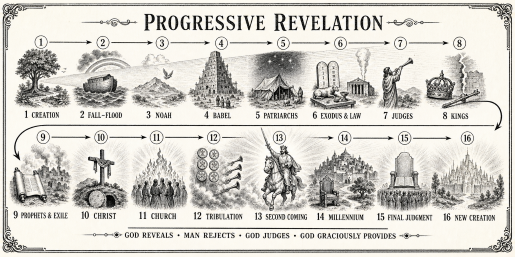
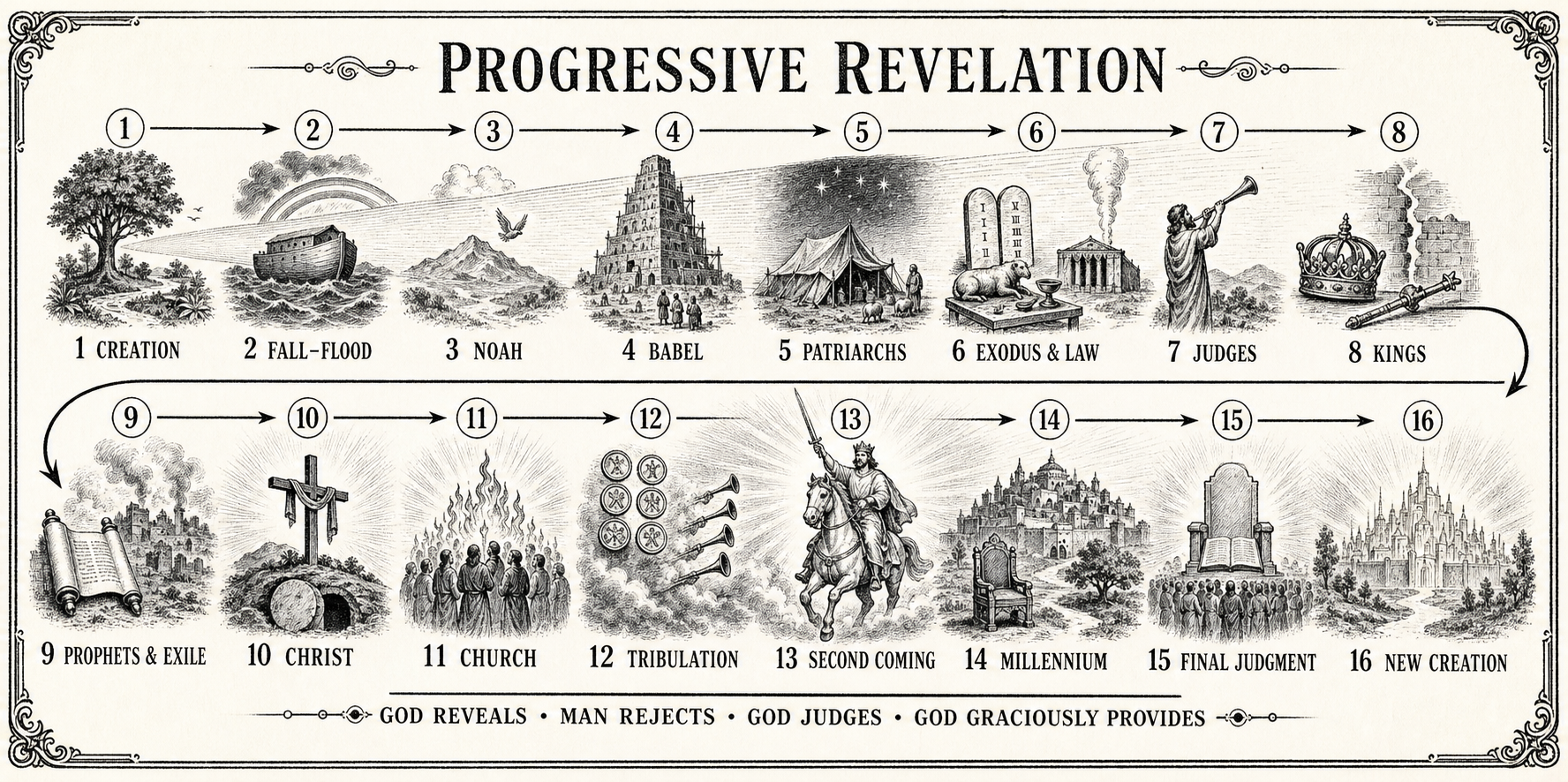
The Bible is one unfolding history in which the unchanging God progressively makes Himself and His purposes known. Progressive revelation does not mean that later Scripture corrects earlier Scripture. It means that God disclosed truth over time with increasing detail and clarity until His revelation reached its climax in Jesus Christ and was preserved for the Church in the completed Scriptures. “God, who at various times and in various ways spoke in time past to the fathers by the prophets,” has now “spoken to us by His Son” (Hebrews 1:1–2).
Alongside this increasing revelation runs a sobering pattern: God reveals, mankind rebels, God judges, God graciously preserves and provides, and then God reveals still more. (Download full-size chart) This does not mean that every person in every era rejected God. In every age, people have responded to God’s grace through faith in what He revealed (Genesis 15:6; Hebrews 11). The pattern shows, however, that neither a perfect environment, a warning, a covenant, a law, a prophet, a miracle, nor perfect government can cure the rebellion of the human heart.
The clearest example appears at the climax of Christ’s earthly ministry. After about three years of public teaching, fulfilled prophecy, unmistakable signs, and repeated testimony concerning His identity, Israel’s religious rulers still demanded, “If You are the Christ, tell us.” Jesus answered, “If I tell you, you will by no means believe” (Luke 22:67). Earlier, when they made the same demand, He replied, “I told you, and you do not believe. The works that I do in My Father’s name, they bear witness of Me” (John 10:24–25). Christos, the Greek word translated “Christ,” corresponds to the Hebrew Mashiach, “Messiah” or “Anointed One.” Their problem was not that God had failed to make the Messiah known, but that they would not believe the revelation He had given.
Sixteen Progressive Revelation Eras
Creation and Innocence – God reveals Himself as Creator, speaks directly to Adam and Eve, gives them a perfect home, and entrusts them with dominion under His authority. Mankind rebels by distrusting God’s Word and seeking moral independence, so God judges sin with death, pain, a cursed ground, and expulsion from Eden. Yet God graciously seeks the sinners, clothes them, preserves their lives, and reveals still more by promising that the woman’s Seed will crush the serpent (Genesis 1:26–31; Genesis 2:15–17; Genesis 3:1–24).
The Fall to the Flood – God continues to reveal Himself outside Eden by receiving Abel’s faithful offering, warning Cain about sin, walking with Enoch, and making His will known to Noah. Mankind rebels as murder, pride, corruption, and violence fill the earth, so God judges the ancient world through the Flood. Yet God graciously preserves Noah and his family in the ark and reveals still more by showing that the righteous live by faith and that He provides a way of rescue from judgment (Genesis 4:3–10, 23–26; Genesis 5:22–24; Genesis 6:5–9; Hebrews 11:7).
Noah and the New World – God reveals His covenant faithfulness through the rainbow, reaffirms the value of mankind made in His image, commands humanity to fill the earth, and establishes human responsibility to restrain murderous violence. Mankind rebels because the Flood changed the world but did not change the sinful heart, as shame and family disorder quickly reappear. God’s judgment on sin remains in death and human accountability, yet He graciously preserves the human race and reveals still more about covenant, government, justice, and the line through which blessing will come (Genesis 8:20–22; Genesis 9:1–17, 20–27).
Babel and the Nations – God reveals His will that humanity spread across the earth, but mankind rebels by gathering at Babel to resist dispersion, build a tower, and “make a name” for itself. God judges this collective pride by confusing their language and scattering them into nations. Yet God graciously preserves those nations and reveals still more by calling one man, Abram, to whom He promises, “I will make your name great,” and through whom all the families of the earth will be blessed (Genesis 9:1; Genesis 11:1–9; Genesis 12:1–3).
The Patriarchs and the Promise – God reveals His covenant purposes to Abraham, Isaac, and Jacob, promising descendants, land, national blessing, and blessing for all the nations through Abraham’s Seed. Mankind rebels through fear, deception, favoritism, jealousy, sexual sin, and unbelief within the chosen family, and God disciplines their disobedience through painful consequences. Yet God graciously preserves the patriarchs, counts Abraham righteous through faith, and reveals still more through covenant promises that ultimately point to Israel’s Messiah and the Savior of the world (Genesis 12:1–3; Genesis 15:1–21; Genesis 50:20; Galatians 3:16).
The Exodus, Wilderness, and Law – God reveals His name and power, redeems Israel from Egypt through the Passover, leads the nation visibly, dwells among His people, and gives His holy Law at Sinai. Israel rebels through complaining, idolatry, immorality, and refusal to enter the land, so God judges the unbelieving wilderness generation. Yet He graciously provides sacrifice, priesthood, manna, water from the rock, His abiding presence, and a faithful new generation, revealing still more about His holiness, atonement, worship, and the coming Christ (Exodus 3:13–15; Exodus 12; Exodus 32; Numbers 14; 1 Corinthians 10:4).
The Conquest and the Judges – God reveals His covenant faithfulness by bringing Israel into the land and repeatedly raising judges through whom His Spirit empowers deliverance. Israel rebels by failing to remove corrupting influences, worshiping the gods of surrounding nations, and doing what is right in its own eyes, so God judges the nation through oppression by its enemies. Yet God graciously hears Israel’s cries, preserves the nation through repeated deliverance, and reveals still more by exposing the need for a righteous and faithful King (Joshua 21:43–45; Judges 2:11–19; Judges 21:25).
The Kings and the Divided Kingdom – God reveals that He is Israel’s true King and warns the nation about the cost of demanding a king “like all the nations.” Israel rebels by rejecting God’s rule, and its kings repeatedly lead the people into pride, injustice, idolatry, and compromise, so God judges the kingdom with division, defeat, and national decline. Yet God graciously gives David a covenant promising an everlasting throne, preserves a royal line, and reveals still more about the perfect Son of David who will rule in righteousness (1 Samuel 8:4–20; 2 Samuel 7:12–16; 1 Kings 11:9–13; Isaiah 9:6–7).
The Prophets, Exile, and Return – God reveals His holiness and patience by sending prophets “again and again” to expose sin, call Israel and Judah to repentance, and announce the coming Messiah, New Covenant, and national restoration. The people rebel by mocking God’s messengers, despising His words, and clinging to idolatry, so God judges Israel through Assyria and Judah through Babylon. Yet He graciously preserves a remnant, returns part of Judah to the land, and reveals still more about the suffering Servant, the righteous King, and the salvation He will accomplish (2 Chronicles 36:15–23; Isaiah 53; Jeremiah 31:31–37; Micah 5:2).
- Rightly dividing Bible history for each age and dispensation – This broad outline of rightly dividing Bible history for each age and dispensation is helpful to understanding the Bible.
- The Bible Prophesizes the Future of Israel – God prophesized the divine future of Israel. He has not replaced, abandoned, or spiritualized away His promises to Israel.
The Incarnation and Earthly Ministry of Christ – God reveals Himself more clearly than ever when the eternal Word becomes flesh, Jesus fulfills Messianic prophecy, explains the Father, lives without sin, and confirms His identity by His words and works. Mankind rebels by refusing the Light and crucifying the promised Messiah, even after about three years of public ministry, so at the cross God judges human sin in the willing Substitute and later judges the unbelieving nation through Jerusalem’s destruction. Yet God graciously raises Christ bodily from the dead, offers salvation to everyone who believes, and reveals still more through the risen Lord and His chosen apostles (John 1:1–18; John 10:24–25; Luke 19:41–44; Luke 22:67; Acts 2:22–24; 1 Corinthians 15:1–4).
The Church Age – God reveals the accomplished gospel of Christ through the completed Scriptures, and God the Holy Spirit permanently indwells, seals, and teaches every genuine believer, beginning with the Church at Pentecost. Mankind continues to rebel as unbelievers reject the gospel, false professors distort it, churches compromise, and genuine believers sometimes grieve or quench the Spirit, so God disciplines His children and warns unfaithful congregations. Yet He graciously preserves every true believer in Christ, builds His Church among all nations, and will gather it to Christ before revealing still more through the events that prepare the world for the King’s return (Acts 2:1–41; Ephesians 1:13–14; Ephesians 4:30; Revelation 2–3; 1 Thessalonians 4:13–18).
- A Short History of Modern Non-denominational Evangelical Churches – Non-denominational evangelical churches blend Reformation doctrine, Anabaptist convictions, and Revivalist conversion urgency,
- A brief history of the future – Understand the grand narrative of God’s plan! We journey through biblical prophecy, covering everything from the Rapture and Tribulation to the glorious New Heaven and Earth described in Revelation.
The Tribulation – God reveals His authority through unmistakable worldwide judgments, angelic proclamations, prophetic witnesses, and the preservation of Israel as the Day of the Lord unfolds. Mankind rebels so stubbornly that people recognize God’s hand yet blaspheme Him and repeatedly refuse to repent, so God judges the kingdom of the beast and a Christ-rejecting world with increasing severity. Yet God graciously seals a remnant of Israel, saves a great multitude from every nation, and reveals still more by preparing the earth for the visible return of Jesus Christ (Revelation 7:1–17; Revelation 9:20–21; Revelation 14:6–7; Revelation 16:9–11).
The Second Coming – God reveals Jesus Christ openly as King of kings and Lord of lords when He returns personally, bodily, visibly, and in glory. The gathered nations rebel by making war against Him, so Christ judges His enemies, destroys the beast’s armies, and removes the wicked rulers who oppose His kingdom. Yet God graciously preserves the believing remnant, fulfills His covenant promises to national Israel, and reveals still more by establishing Messiah’s righteous kingdom on earth (Zechariah 12:10; Zechariah 14:1–9; Revelation 19:11–21; Romans 11:25–29).
The Millennium and Final Rebellion – God reveals the goodness of perfect government when Jesus Christ reigns from Jerusalem for one thousand years, Satan is bound, Israel is restored, and righteousness and justice govern the nations. Nevertheless, after Satan is released, multitudes rebel against Christ despite having lived under His visible rule, so God judges the final uprising with fire from heaven and casts Satan into the lake of fire. Yet God graciously preserves all who belong to Him and reveals still more by bringing history to the final judgment before the great white throne (Isaiah 11:1–10; Revelation 20:1–10).
The Final Judgment – God reveals His perfect holiness and justice before the great white throne, where the unbelieving dead are raised and the truth of every life is exposed. Their rejection of God ends not in repentance but in final accountability, so everyone whose name is not found in the Book of Life is cast into the lake of fire. God eternally preserves the redeemed on the basis of Christ’s finished work and reveals still more by unveiling the new heaven, the new earth, and the New Jerusalem (Daniel 12:2; John 5:28–29; Revelation 20:11–15).
The New Heaven and New Earth – God reveals His glory without obstruction as He dwells forever with redeemed humanity in a creation free from death, sorrow, pain, and the curse. Here the recurring pattern ends: there is no further rebellion to judge, because Satan and all evil have been permanently removed, and God graciously preserves His people in holiness, life, and fellowship forever. Revelation has reached its appointed goal, for the servants of God will see His face, reign with Him, and enjoy the full light of His presence without end (Revelation 21:1–8, 22–27; Revelation 22:1–5).
The Lesson of the Whole Story
The biblical record steadily removes every excuse for unbelief. Mankind fell in a perfect garden, corrupted conscience before the Flood, resisted God’s command after the Flood, broke His Law, abandoned His deliverers, rejected His prophets, crucified His Son, resisted His written Word, refused to repent during visible supernatural judgments, and will finally rebel after living under Christ’s perfect earthly government. The problem is not that God has left Himself unclear or that humanity merely needs better circumstances. The problem is sin in the human heart (Jeremiah 17:9; Romans 1:18–25).
Yet the story is not merely the history of mankind’s rejection. It is the history of God’s patience, faithfulness, justice, and saving grace. In every era, God preserves a believing remnant, advances His promises, and directs history toward Jesus Christ. Salvation has always been by grace through faith in God’s provision, never by human works, and the gospel now calls every person to believe that Jesus Christ died for our sins, was buried, and rose bodily on the third day (Ephesians 2:8–9; Romans 10:9–13; 1 Corinthians 15:1–4).
Luke 22:67 therefore confronts every reader personally. God has spoken plainly in His Son, and the question is no longer whether He has provided enough light, but whether we will believe and obey what He has revealed. Each era in this overview deserves closer study, but together they deliver one clear message: mankind repeatedly rejects increasing light, while God faithfully carries His redemptive purpose forward until Jesus Christ reigns and God dwells forever with His redeemed people.