Negotiation is a useful skill. If you are buying a house, negotiating the price of a used car, interviewing for a job, asking for a raise, or trying to avoid paying retail, a few good negotiating techniques can save you money and improve your position. In extreme situations, professional negotiators even use carefully developed techniques to communicate with kidnappers and hostage takers. Good negotiators gather information, establish leverage, ask strategic questions, trade concessions, and always know when they are willing to walk away.
So I started wondering whether some of those techniques might improve my negotiations with God.
After all, I have certainly tried negotiating with Him. “Lord, if You will just do this…” “God, I have been faithful about that…” “Surely this situation would turn out better if You would only…” Perhaps my problem was not that I was trying to negotiate with God. Perhaps I simply needed better technique.
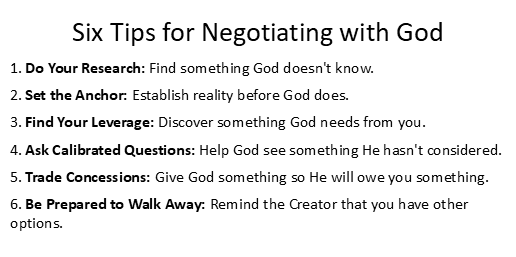
I found six of the best negotiating principles I could think of and decided to give them a try.
- Never Split the Difference: Negotiating As If Your Life Depended On It―Unlock Your Persuasion Potential in Professional and Personal Life by Chriss Voss – Life is a series of negotiations, and negotiation is at the heart of collaboration—whether you are a business executive, a salesperson, a parent , a community leader, or a spouse. As a former FBI hostage negotiator, Chris Voss gives you the tools to be effective in any situation: negotiating a business deal, buying (or selling) a car, negotiating a salary, acquiring a home, renegotiating rent, deliberating with your partner, or communicating with your children. Taking the power of persuasion, empathy, active listening, and intuition to the next level, Never Split the Difference gives you the competitive edge in any difficult conversation or challenging situation. This book is a masterclass in influencing others, no matter the circumstances.
It did not go quite as planned.
Tip #1: Do Your Research
Any good negotiator does his homework. Imagine buying a used car without knowing its market value, maintenance history, accident record, or how long it has been sitting on the dealer’s lot. You would be negotiating against someone who probably knows far more about the transaction than you do. Information closes that gap. The more you know about what the other person knows, wants, fears, or does not know, the stronger your position becomes.
The same thing works when buying a house. Perhaps the seller desperately needs to close before purchasing another property. Maybe the house has already fallen out of escrow twice. Perhaps comparable homes are selling for considerably less. Suddenly the asking price does not look quite as immovable as it did before. Even when one party appears more powerful, information can restore some balance. So the first rule seemed obvious: before negotiating with God, I needed to do my research and find something He had overlooked.
There was only one problem. Apparently God has already done His research.
Isaiah 40:14 asks, “Whom did He consult to enlighten Him?” Think about the staggering implication. God has never needed an expert. He has never requested a second opinion because the problem exceeded His knowledge. He has never discovered an unexpected variable halfway through a decision. He has never said, “I had not thought of that.” His understanding is infinite (Psalms 147:5), and His wisdom is unsearchable (Romans 11:33). I could research the situation for the rest of my life and never possess one piece of information that was missing from the mind of God. So Tip #1 failed rather spectacularly. But perhaps information was not the right approach. Good negotiators have another powerful technique.
Tip #2: Set the Anchor
Negotiators often try to establish the starting point of a discussion. Suppose a car is advertised for $30,000. If the salesman begins by explaining why $30,000 is already an incredible bargain, he has established one frame for the conversation. But if the buyer begins with evidence that similar vehicles are selling for $24,000, he has tried to establish another. The first credible number can become an “anchor” around which the rest of the negotiation moves.
Salary negotiations can work the same way. If an employer begins with $70,000, the conversation may revolve around that number. But if a well-qualified candidate demonstrates that comparable positions command $90,000, the entire discussion changes. Even when you do not control the final decision, controlling the starting assumptions can give you influence. Therefore, my second strategy for negotiating with God seemed promising: establish reality before He does.
Then I remembered the opening sentence of the Bible.
When Isaiah describes God measuring oceans in His hand and weighing mountains as though they were placed upon scales, he is deliberately stretching human language toward the incomprehensible greatness of the Creator. The Pacific Ocean that overwhelms us is not overwhelming to Him. The heavens whose distances escape our imagination were “marked off” by Him. “The earth is the LORD’S, and the fulness thereof” (Psalms 24:1). I cannot establish a frame of reference outside the One who created the frame. I cannot redefine good and evil for the One whose character is perfectly holy. I cannot establish better terms for the One who established the universe. Tip #2 was not looking especially promising either. Still, the best negotiators know that information and anchoring are not everything. What I really needed was leverage.
Tip #3: Find Your Leverage
Leverage is the thing the other party wants badly enough that losing it would hurt. Consider an employee asking for a raise. If he walks into the boss’s office saying, “I would really like more money,” he may not have much bargaining power. But suppose he possesses specialized knowledge that is difficult to replace, competitors are trying to hire him, and the company’s largest project depends upon his experience. Now the conversation is different. The employer needs something the employee possesses.
A homebuyer may find leverage when a seller must relocate quickly. A shopper gains leverage when several stores sell the same product. Even a seemingly powerful person can become negotiable when he needs something from the weaker party. That gave me an idea. Perhaps I simply needed to identify something God really needed from me. My service? My money? My abilities? My worship? Surely there must be something I could place on my side of the table that would make Him think twice about saying no.
Psalms 50 ruined that strategy rather quickly.
This power difference is infinitely greater than the difference between an employee and a multinational corporation. Corporations still need employees. Kings need subjects. Generals need soldiers. Wealthy buyers still need someone willing to sell. Even kidnappers who appear to hold overwhelming power usually want something, which is precisely why negotiation is possible. But the living God says, “The world is mine.” The oxygen I breathe while presenting my proposal belongs to Him. The mind I use to formulate my argument was created by Him. The strength I planned to offer in His service came from Him in the first place. I had discovered the ultimate leverage problem: everything I could possibly put on the table was already His. Tip #3 was a disaster. Fortunately, skilled negotiators have ways of influencing people even when they possess very little leverage.
Tip #4: Ask Calibrated Questions
Sometimes the best negotiator is not the person who talks the most but the person who asks the best questions. A carefully chosen question can make another person reconsider assumptions without feeling attacked. In a job interview, asking, “What would success in this position look like after six months?” may reveal what the employer really values. In a tense negotiation, asking, “How am I supposed to accomplish that?” can force the other party to confront a problem from your perspective.
This principle can even help negotiators in extreme situations where the physical power imbalance could hardly be greater. A hostage negotiator cannot simply order an armed captor to become reasonable. He listens, asks questions, identifies concerns, and tries to guide the person toward seeing alternatives. So perhaps this was the answer. Instead of trying to overpower God, I could ask questions skillfully enough to help Him consider my point of view. Maybe there was an angle He had not fully considered.
- Crisis Negotiations by McMains, Mullins, Young – This is the standard for experienced professionals in the field, this sixth edition of Crisis Negotiations is an invaluable resource for mitigating, managing, or responding to high-risk negotiation incidents. Their discussion of the strategic planning process involved in high-risk negotiation incidents focuses clearly on the critical questions negotiators need to ask themselves about any high-risk incident and provides a practical approach to the psychology of individuals that engage in high-risk incidents.
Then Isaiah asked a calibrated question of his own.
Job learned this distinction in unforgettable fashion. For many chapters Job wanted answers from God. Then, in Job 38, God spoke from the whirlwind and began asking questions: “Where wast thou when I laid the foundations of the earth?” Suddenly the interview had been rearranged. Job was not foolish because every question he had asked was dishonest. He was humbled because encountering God revealed the enormous distance between the creature’s perspective and the Creator’s wisdom. By Job 42:3 he confessed that he had spoken about things too wonderful for him to know. Tip #4 therefore failed. Apparently I was not going to talk God into seeing a problem from a perspective He had overlooked. But perhaps negotiation could still work through an exchange.
Tip #5: Trade Concessions
Negotiation often works because both parties surrender something in order to receive something they value more. “I will accept your price if you include the appliances.” “I can finish the project by Friday if you give me another engineer.” “I will agree to a smaller salary increase if you increase my vacation time.” Neither party gets everything, but both walk away with something important.
This may be the form of negotiating with God that feels most familiar. “Lord, if You get me through this crisis, I promise I will go back to church.” “God, if You give me this job, I will be more generous.” Or perhaps the bargaining looks backward: “Lord, I have served You faithfully for years. Surely I deserve this.” We may never say that God owes us, but sometimes our prayers quietly place our obedience on the table as though He were required to provide something comparable in return.
Then Paul asks a devastating question.
Imagine trying to negotiate with the owner of a store by offering him merchandise you took from his own shelves. That would be audacious enough. Yet our supposed bargaining position before God is weaker still because He did not merely own the shelves. He created the material from which the building, the merchandise, the customer, and the earth beneath them were made. David understood this when Israel gave generously for the temple: “All things come of thee, and of thine own have we given thee” (1 Chronicles 29:14). Tip #5 was another failure. But one great negotiating principle remained. This one is often considered the ultimate source of bargaining power.
Tip #6: Be Prepared to Walk Away
Experienced negotiators know that desperation destroys leverage. If you absolutely must buy this particular house, own this particular car, or accept this particular job, the other party possesses enormous power. But if you have alternatives, you can say, “Thank you, but that does not work for me,” and leave. In negotiation theory, your strongest alternative to the present agreement is extraordinarily important because it establishes the point at which you no longer need the deal.
A car salesman knows the difference between a customer who says, “This is the only vehicle my heart has ever wanted,” and one who says, “I have appointments at three other dealerships this afternoon.” So I finally arrived at my strongest possible strategy for negotiating with God. I would remind the Creator that I had options. If His terms were unacceptable, perhaps I could simply take my business elsewhere.
Then David asked where “elsewhere” might be.
This is where the negotiating metaphor finally collapses completely. I can walk out of a dealership because another dealer exists. I can reject a job because another employer may hire me. A nation may negotiate with another nation because neither possesses absolute sovereignty. But there is no “away” from the Creator. Every road on which I might attempt to leave belongs to Him. Every star toward which I might flee was made by Him. Every breath I would use to announce my independence remains His gift. Tip #6 was supposed to provide my greatest leverage. Instead, it exposed the truth I had been avoiding from the beginning.
The Problem Was Never My Negotiating Technique
After six attempts, I finally discovered the problem. I did not need better negotiating techniques. I needed a better understanding of God.
The entire exercise had assumed that God and I were sitting on opposite sides of a negotiating table. Certainly He had greater knowledge, greater resources, and greater power, but perhaps there was still some way to influence the discussion. Maybe I could discover information He had overlooked, establish better terms, find some leverage, ask the right question, offer something valuable, or threaten to walk away.
Then Isaiah walked into the room and removed the table.
Isaiah piles question upon question until the absurdity becomes unmistakable. Who taught God something He did not know? Who advised Him when He was uncertain? Who corrected His understanding of justice? Who explained the universe to the One who measured its heavens and weighed its mountains? Isaiah does not bother giving the answer because no answer is necessary. No one has ever instructed God, because God has never lacked knowledge, wisdom, understanding, or power.
The difference between God and us is therefore not merely a very large power imbalance. A king may be more powerful than a servant, but the king still needs food, counsel, soldiers, and sleep. A corporation may dwarf an individual employee, but it still needs customers, workers, capital, and time. God is different in kind. He is the Creator, and we are His creatures. “For of him, and through him, and to him, are all things: to whom be glory for ever” (Romans 11:36).
- A personal note from Nebuchadnezzar II, the richest most powerful man who ever lived
- The LORD says, Even now return to me
That truth should produce more than intellectual agreement. It should awaken reverence. The God before whom oceans are pictured as water in His hand and mountains as objects weighed upon a scale is not merely a larger version of ourselves. He is the eternal, self-existent, infinitely wise Lord of heaven and earth.
And yet the astonishing message of Scripture is that this God speaks to us. He invites us to come. He listens when His people pray. He has even provided the way for sinful human beings to approach Him through Jesus Christ.
That is far better than negotiation.
But Then I Remembered What God Said
Perhaps Scripture does describe something that resembles a negotiation, but I had the direction completely backward.
God is not waiting for me to establish the terms. He already knows what is good. He already knows what I need. He cannot be bribed, manipulated, intimidated, or placed in my debt. Yet instead of leaving sinful humanity without hope, He graciously tells us how we may approach Him.
The question therefore changes. Instead of asking, “What can I offer God that will persuade Him to give me what I want?” I should be asking, “What has God said He desires from me?”
His answer is both humbling and wonderfully encouraging.
God Says, Come Humbly
Near the end of Isaiah, God again confronts mankind with the staggering difference between the Creator and the creature.
What could we possibly build for the One who calls heaven His throne and earth His footstool? What material could we contribute when His own hand made everything that exists? Solomon understood the same truth when he dedicated the temple: “Behold, the heaven and heaven of heavens cannot contain thee; how much less this house that I have builded?” (1 Kings 8:27).
Yet after establishing His incomparable greatness, God says something remarkable. He tells us where He looks with favor. Not upon the person who arrives with the strongest bargaining position, the largest offering, or the most impressive religious résumé, but upon the one who is humble and contrite in spirit and who trembles at His Word.
That is almost the opposite of negotiation. A negotiator tries to strengthen his position before the other party. The humble worshiper recognizes his position before God. He does not come pretending to be God’s equal, but neither does he run away in despair. He bows before the One who made heaven and earth, listens carefully to what God has spoken, and approaches Him with reverence because he knows whose presence he has entered.
God does not tell us to impress Him. He tells us to humble ourselves before Him.
God Says, Stop Trying to Buy Me
Micah asks another question that sounds remarkably like negotiation: What will it take to satisfy God?
Notice how the imaginary offer keeps increasing. First comes a burnt offering, then thousands of rams, then an almost unimaginable quantity of oil. Finally the proposal becomes horrifying: Shall I give my own firstborn for my sin? The question behind the questions is familiar to every negotiator: What price will finally close the deal?
But God cannot be bought.
Religious extravagance does not place the Creator in our debt, and sacrifice without obedient faith has never impressed Him. God had already shown Israel what He desired. He called them to practice justice, love mercy, and walk humbly with Him. Those things were not payments offered to purchase His favor. They were the proper response of people who belonged to Him.
The gospel takes this truth even deeper. We cannot purchase forgiveness by increasing our religious offer. Scripture says salvation is “by grace…through faith” and “not of works” (Ephesians 2:8-9). We could never bring a sacrifice sufficient to remove our sin, so God provided the sacrifice Himself. Jesus Christ “once suffered for sins, the just for the unjust, that he might bring us to God” (1 Peter 3:18).
We came asking what we could put on the table.
God provided the Lamb.
God Says, Call Upon Me
Jeremiah 29 gives us another striking picture of the relationship between God and His people. Judah had been carried into Babylonian captivity, and false prophets were promising a quick escape. God told the exiles something they did not want to hear: the captivity would last seventy years. They could not bargain the sentence down, renegotiate God’s timetable, or persuade Him that their preferred plan was better.
Yet God’s judgment was not the end of the story.
Jeremiah 29:11 is not a blank check promising every believer immediate prosperity, easy circumstances, or success according to our preferred timetable. God spoke these words to Jewish exiles whom He had just told to settle in Babylon while seventy years passed. His plan included discipline, waiting, hardship, and eventually restoration according to His own promise.
But that historical setting makes the encouragement even richer. God knew what His people could not see. He knew the end from the beginning of their captivity. He had not forgotten His covenant promises, and Babylon had not disrupted His plans. When the appointed time came, He would act exactly as He had said.
Then God told them something astonishing: “You will call upon Me and come and pray to Me, and I will listen to you.”
The God who does not need our counsel still listens to our prayers. The God who cannot be manipulated invites us to seek Him. The God who cannot be placed in our debt graciously binds Himself to His own promises. He does not tell His people to find leverage over Him. He tells them to seek Him with all their heart.
That is much better than getting our way.
Something Better Than Negotiation
So what finally worked better than negotiating with God?
Prayer, trust, humility, submission to His Word, and faith in the wisdom of the One who knows infinitely more than I do.
Prayer is not the art of discovering enough leverage to move God toward my will. It is the privilege of bringing real requests before a gracious Father while trusting His wisdom when His answer differs from mine. Biblical prayer does not require us to pretend that we have no desires. Abraham pleaded for Sodom. Moses interceded for Israel. David poured out anguish, questions, fears, and petitions throughout the Psalms. Paul repeatedly asked God for things he deeply desired.
Jesus Himself showed us this posture in Gethsemane. Facing the cross, He prayed, “O my Father, if it be possible, let this cup pass from me,” and then added, “nevertheless not as I will, but as thou wilt” (Matthew 26:39). That was not indifference. It was complete submission to the Father’s will.
None of these prayers depended upon leverage over God. They depended upon something infinitely better: access to God.
For the believer, that access comes through Jesus Christ. We do not negotiate our way into God’s presence by presenting an impressive résumé of religious achievements. Christ has already accomplished what we never could. Through His finished work, those who trust Him are reconciled to God and invited to “come boldly unto the throne of grace” so that we may “obtain mercy, and find grace to help in time of need” (Hebrews 4:16).
Notice where Scripture tells us to come.
Not to a negotiating table, but to a throne.
Yet it is a throne of grace.
The One seated there possesses all the power, all the wisdom, and all the knowledge. He owns everything and needs nothing from us. We cannot surprise Him, outmaneuver Him, place Him in our debt, or threaten Him with better alternatives. Yet this same God invites His children to come near, bring their needs, seek His mercy, and trust His wisdom.
Perhaps Isaiah gives us one final negotiating lesson after all. A few chapters after declaring the incomparable greatness of God, the Lord issues an invitation no human negotiator would ever expect:
That invitation overturns the entire negotiating mindset. I came looking for leverage, but God offered grace. I came wondering what I could offer Him, but God showed me what He had already provided. I came hoping to persuade Him to adopt my plan, but He invited me to trust His wisdom. Most wonderfully, I came with nothing sufficient to purchase His favor, and God pointed me to His Son.
So I think I am finished negotiating.
I would rather come humbly before the God who measures the heavens with His hand. I would rather tremble at His Word, seek Him with my whole heart, bring my requests honestly before Him, and trust His wisdom when His answer is different from mine. I would rather rest in the grace He has freely provided through Jesus Christ than spend another moment trying to discover leverage over the One who holds the universe in His hands.
That is far better than winning a negotiation.