Artificial intelligence can be unsettling. AI can write essays, create convincing photographs of people who never existed, imitate voices, translate languages, write computer programs, analyze medical information, and carry on conversations that sometimes sound remarkably human. For someone who grew up before computers were everywhere, some of this can feel like science fiction suddenly becoming real. Add biblical prophecy about worldwide deception, economic control, and the coming Antichrist, and it is easy to understand why some Christians begin connecting the dots. This article examines artificial intelligence and biblical prophecy from a conservative evangelical, dispensational interpretation of Scripture.
But we need to be very careful about which dots the Bible actually connects. AI is an extraordinarily powerful human technology, and Christians should neither worship it nor fear it. It can be used to accomplish tremendous good, and it can be used to accomplish tremendous evil. But Scripture describes the coming Antichrist as a real personal ruler who deliberately opposes God, exalts himself, receives worship, persecutes those who resist him, and is ultimately destroyed by Jesus Christ. That is very different from a computer program.
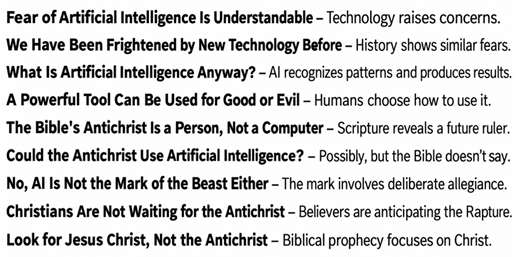
Fear of Artificial Intelligence Is Understandable
We should not begin by laughing at people who are concerned about AI. Some of their concerns are reasonable. Artificial intelligence is developing rapidly, and powerful technology always introduces risks along with opportunities. Fraud, impersonation, misinformation, surveillance, manipulation, job displacement, pornography, cybercrime, autonomous weapons, and the concentration of technological power are legitimate issues Christians should think about carefully.
Americans are becoming increasingly uneasy about AI. A Pew Research Center survey conducted in June 2026 found that 52 percent of U.S. adults were more concerned than excited about the increasing use of artificial intelligence, compared with 37 percent in 2021. Only 9 percent said they were more excited than concerned. That does not prove AI is dangerous, but it demonstrates that apprehension about AI is widespread rather than confined to a few people worried about biblical prophecy.
There is also an important difference between refusing panic and pretending there are no dangers. Christians do not have to choose between “AI will save humanity” and “AI will destroy humanity.” Both positions give technology more importance than it deserves. Technology is powerful because human beings are powerful creatures made in the image of God, capable of creativity, discovery, stewardship, rebellion, exploitation, and terrible destruction.
Our response should therefore begin with biblical discernment rather than fear. We can examine AI carefully, recognize genuine dangers, establish wise boundaries, and still refuse to identify it with something Scripture never calls it. Fear is a poor substitute for exegesis. We should understand what the Bible actually says before trying to fit today’s headlines into yesterday’s prophecy.
- Proverbs 18:15 “The heart of the prudent getteth knowledge.” – Wisdom investigates carefully instead of reacting merely to fear or appearances.
- 1 Thessalonians 5:21 “Prove all things; hold fast that which is good.” – Christians should evaluate new ideas and technologies rather than automatically embracing or rejecting them.
We Have Been Frightened by New Technology Before
Artificial intelligence feels unprecedented because in some important ways it is unprecedented. But the human reaction to transformative technology is not new. Every major technological revolution changes familiar patterns of work, commerce, communication, transportation, medicine, and daily life. When those changes happen quickly enough, people naturally wonder what might be lost along with what might be gained.
During the Industrial Revolution, skilled textile workers saw machines doing work that previously required years of learned craftsmanship. The Luddites of the early nineteenth century were not simply ignorant people who hated machines. Britain’s National Archives explains that mechanized looms and knitting frames threatened skilled workers, displaced traditional trades, and were associated with falling wages, eventually producing protests and the destruction of machinery. The resemblance to today’s concern about AI replacing writers, programmers, artists, customer-service workers, and other professionals is difficult to miss.
Motorized transportation produced similar apprehension. Britain became so suspicious of self-propelled road vehicles that the 1865 Locomotive Act required a three-person crew, including someone walking ahead to warn other road users, while limiting vehicles to four miles per hour in the country and two in towns. The National Motor Museum describes a general mistrust of motorized travel during this period. What seemed alarming and disruptive eventually became so ordinary that today we become impatient when the car in front of us is traveling only a few miles below the speed limit.
Electricity also brought genuine dangers and dramatic controversy. Smithsonian historical material records the bitter public battle over high-voltage alternating current, with books, pamphlets, and newspaper articles emphasizing its potentially deadly hazards. Yet electricity became one of the foundations of modern civilization, powering homes, factories, communications, hospitals, refrigeration, transportation, and countless devices we now take for granted. The technology was powerful enough to kill people, but its capacity for harm did not make electricity itself morally evil.
Medical technology followed much the same pattern. Smallpox vaccination encountered organized opposition during the nineteenth century, involving questions about safety, effectiveness, individual liberty, and compulsory government programs. Some early concerns were not entirely imaginary because nineteenth-century vaccination methods were primitive by modern standards and could carry real risks. Nevertheless, vaccination ultimately became one of the principal tools used in the worldwide eradication of smallpox.
Even computers produced warnings that sound surprisingly similar to today’s AI debates. In 1964, the widely discussed Triple Revolution memorandum warned that the combination of computers and automated machinery could create enormous productive capacity while requiring progressively less human labor. Automation became important enough that Congress investigated its potential economic and employment consequences during that same period. Sixty years later, we are asking many of the same questions about artificial intelligence.
The lesson is not that every fear about new technology is foolish. The Luddites really did face economic disruption, electricity really can kill, automobiles really can crash, early medical procedures really did have risks, and computers really did eliminate some occupations while creating others. The better lesson is that powerful technology can introduce profound benefits and serious dangers without becoming inherently evil. Artificial intelligence belongs in that same conversation.
What Is Artificial Intelligence Anyway?
The words artificial intelligence make the technology sound more mysterious than it needs to be. At the simplest level, AI is computer software designed to recognize patterns in information and use those patterns to produce useful results. The National Institute of Standards and Technology describes AI as a machine-based system capable of making predictions, recommendations, or decisions based on human-defined objectives. That technical definition can be made much simpler.
Imagine showing a computer enormous numbers of photographs labeled “dog” and “cat.” Instead of a programmer writing a rule describing every possible shape, color, size, ear, nose, and tail, a machine-learning system analyzes the examples and develops mathematical patterns that help distinguish dogs from cats. Later, when it receives a photograph it has never seen before, it uses those learned relationships to estimate whether the photograph contains a dog or a cat. Modern AI systems apply variations of this basic idea on a vastly larger and more sophisticated scale.
Language AI works with patterns in words, sentences, concepts, and relationships rather than merely pictures. A system can be trained on enormous quantities of text and learn statistical relationships that allow it to predict useful continuations, summarize information, answer questions, translate languages, or generate new text. Calling it “extremely sophisticated predictive text” is an oversimplification, but it is a useful starting point for someone with no technical background. The important point is that there is mathematics, computer hardware, software, training data, and human engineering underneath the impressive conversation.
AI can certainly perform tasks that appear remarkably intelligent. Some systems can solve problems, analyze information, plan multiple steps, write software, identify medical patterns, or control machines with limited human intervention. But impressive output should not be confused with supernatural power. AI is a created human technology operating inside God’s created universe, using matter, energy, mathematics, language, information, and physical laws that ultimately exist because God created them.
- Genesis 1:27 “God created man in his own image.” – Human beings possess a unique God-given status that should not be casually transferred to machines we create.
- Psalms 8:6 “Thou madest him to have dominion over the works of thy hands.” – Technology is properly understood as one expression of mankind’s delegated stewardship over creation.
A Powerful Tool Can Be Used for Good or Evil
Nuclear energy provides a useful comparison. The physical principles that allow a nuclear reactor to generate enormous amounts of electricity can also be used to produce weapons capable of destroying cities. The laws of physics are not morally righteous when they power a hospital and morally sinful when they power a bomb. The moral responsibility belongs to the human beings who decide what to build and how to use it.
We see the same distinction everywhere. Electricity can run a ventilator or an electric chair. A knife can prepare dinner, perform surgery, or commit murder. The Internet can distribute the gospel to a country where missionaries cannot easily travel, or it can distribute pornography, fraud, slander, and hatred around the world in seconds. Technology enlarges human capabilities, but human beings remain morally responsible for what they do with those capabilities.
AI should be treated the same way. Doctors can use AI to help identify patterns in medical images, scientists can use it to analyze enormous collections of data, disabled people can use it to communicate more effectively, students can use it to understand difficult concepts, and Christians can use it to organize research or improve communication. The same underlying technology can also produce deepfake pornography, impersonate someone during a fraud attempt, automate cyberattacks, generate propaganda, or assist oppressive governments.
Saying that AI is a tool does not mean that every AI application is morally neutral or safe. A particular system may be designed for an evil purpose, trained irresponsibly, controlled by people with evil intentions, or deployed in ways that predictably harm others. Automated systems can also cause damage through error, bad design, corrupted information, or inadequate oversight even when nobody intended the specific harm. Christians should therefore judge particular uses of technology according to truth, justice, love of neighbor, stewardship, and obedience to God.
The central biblical problem has never been man’s lack of technology. It is man’s sinful heart. Give sinful mankind a stone and someone will eventually use it as a weapon; give sinful mankind a printing press and someone will print lies; give sinful mankind a worldwide computer network and someone will distribute evil through it. Increasing our technological ability does not cure the moral condition Scripture says lies within us.
- Mark 7:21 “From within, out of the heart of men, proceed evil thoughts.” – Scripture locates the moral source of evil in fallen human beings rather than in the tools they create.
- James 1:14 “Every man is tempted, when he is drawn away of his own lust.” – Technology may amplify temptation or opportunity, but it does not remove human responsibility.
The Bible’s Antichrist Is a Person, Not a Computer
This is where speculation must give way to Scripture. The Antichrist is described as a personal ruler, not an impersonal technology. Paul calls him the “man of sin” and “son of perdition,” describing someone who deliberately opposes God and exalts himself as an object of worship. John distinguishes between the present spirit of antichrist, many antichrists who already oppose Christ, and the particular Antichrist whom believers had heard was coming.
Revelation develops that picture further. The Beast exercises political authority, speaks blasphemies, receives worship, persecutes the saints, works in cooperation with the False Prophet, and eventually meets Jesus Christ in judgment. Revelation 19 even distinguishes the Beast and False Prophet as personal participants in the final rebellion who are personally judged. Whatever technologies they may employ, the biblical characters themselves are not technologies.
This agrees with the prophetic sequence explained in the BibleTruths article “A Brief History of the Future.” That study begins with the Rapture of the Church, proceeds through the Tribulation and revelation of the Antichrist, continues through the mark of the Beast and Christ’s victorious return, and ultimately reaches Christ’s thousand-year reign, final judgment, and the new heaven and new earth. The prophetic framework is therefore centered upon God’s redemptive plan and real persons acting within history, not upon guessing which contemporary invention corresponds to which verse.
The earlier BibleTruths study “10 Differences Between Team Jesus Christ and Team Antichrist” makes another useful distinction. Christ is characterized by sacrificial love, humility, truth, life, obedience to the Father, and love for His people. The Antichrist pattern is characterized by rebellion, accusation, coercion, destruction, self-exaltation, opposition to God, and persecution. The biblical contrast is fundamentally spiritual and moral, not technological.
- 2 Thessalonians 2:3 “That man of sin be revealed.” – Paul describes the coming adversary as a man who will personally oppose God.
- 2 Thessalonians 2:4 “He as God sitteth in the temple of God.” – His defining sin is self-exaltation and usurped worship, not technological sophistication.
- Revelation 13:8 “All that dwell upon the earth shall worship him.” – The central issue surrounding the Beast is worship and allegiance.
- Revelation 19:20 “The beast was taken, and with him the false prophet.” – Both are portrayed as personal agents who are judged when Christ returns.
Could the Antichrist Use Artificial Intelligence?
Of course he could. He could also use computers, satellites, smartphones, television, banking networks, biometric identification, drones, telecommunications, weapons, databases, transportation systems, and technologies that have not yet been invented. Scripture does not require the Antichrist to reject modern technology in order to fulfill prophecy.
AI makes several aspects of a future worldwide dictatorship easier for modern readers to imagine. Artificial intelligence can already analyze vast quantities of information, generate convincing false media, automate surveillance, recognize faces, translate languages, and influence what millions of people see online. Those capabilities could certainly be abused by an oppressive government. But moving from “AI could be useful to the Antichrist” to “AI is the Antichrist” crosses a line Scripture never crosses.
This is where the difference between exegesis and eisegesis becomes extremely important. Exegesis begins with what Scripture actually says and draws its conclusions from the text. Eisegesis begins with something happening around us and then searches Scripture for language that can be made to resemble it. Prophecy becomes especially vulnerable to this mistake because every generation has technologies, wars, political leaders, economic systems, and frightening events that can be forced into prophetic passages.
We should therefore interpret Revelation from the text outward instead of reading today’s headlines backward into Revelation. The invention of radio did not prove radio was the Beast. Television did not prove television was the image of the Beast. Bar codes, credit cards, RFID chips, vaccines, smartphones, and artificial intelligence do not become the mark of the Beast merely because someone can imagine how they might participate in a future system of control.
No, AI Is Not the Mark of the Beast Either
The same biblical caution applies to the mark of the Beast. Revelation does describe a future economic system in which people cannot buy or sell without the Beast’s mark. Modern technology makes such economic control easier to imagine than it would have been for generations living before electronic banking and worldwide communication. But the text gives us far more information than simply saying that some kind of mark will exist.
The mark is associated with the Beast, his name, his authority, and the worship surrounding him. Revelation 14 also describes an extraordinary worldwide angelic warning specifically telling people about the consequences of worshiping the Beast and receiving his mark. This is the foundation of the BibleTruths article “No, You Can’t Get the Mark of the Beast by Accident.” That study emphasizes both the pre-tribulation Rapture of the Church and the unmistakable supernatural warnings God gives before people receive the mark.
That means a Christian does not accidentally receive the mark by using a smartphone, scanning a QR code, receiving a medical treatment, opening a bank account, using facial recognition, or talking to an AI assistant. None of those things fulfills the biblical description. A future technology could conceivably be incorporated into the Antichrist’s economic system, but Scripture does not identify that technology for us.
The important issue in Revelation is not merely commerce. It is allegiance. People living during that terrible period will face a deliberate choice involving the worship of the Beast in opposition to the Creator. Reducing that spiritual rebellion to an accidental technological transaction misses the most important part of the passage.
- Revelation 13:17 “No man might buy or sell, save he that had the mark.” – The mark will become part of the Antichrist’s future system of economic control.
- Revelation 14:9 “If any man worship the beast… and receive his mark.” – Scripture connects the mark with conscious allegiance and worship.
- Revelation 14:6 “Having the everlasting gospel to preach… to every nation.” – God will provide extraordinary worldwide proclamation during the Tribulation.
Christians Are Not Waiting for the Antichrist
There is an even greater reason Christians do not need to live in fear of accidentally becoming trapped in the Antichrist’s system. According to the pre-tribulational understanding of Scripture, the next great prophetic event for the Church is not the mark of the Beast. It is the return of Jesus Christ to catch away His Church.
Paul describes believers being caught up together to meet the Lord in the air. The Greek word harpazō carries the idea of being seized or snatched away, the event commonly called the Rapture. The BibleTruths article “A Brief History of the Future” places this event before the Tribulation, followed by the rise and revelation of the Antichrist, the mark of the Beast, Christ’s visible return to earth, and His millennial kingdom. That sequence is important because it changes the Christian’s perspective from fearful anticipation of Antichrist to hopeful anticipation of Christ.
Paul does not conclude his teaching about the Rapture by saying, “Therefore frighten one another with these words.” He says to comfort one another. Biblical prophecy should awaken us from spiritual laziness, encourage holy living, motivate evangelism, and strengthen our confidence in God’s sovereign plan. It was never intended to create a generation of Christians terrified that the newest invention might secretly condemn them.
Jesus Himself gave the same hope to His disciples. He promised that He was going to prepare a place for them and would return to receive them to Himself. Our security therefore does not rest upon being technologically clever enough to outsmart the Antichrist. It rests upon belonging to Jesus Christ.
- John 14:3 “I will come again, and receive you unto myself.” – Christ directs the believer’s attention toward His promised return.
- 1 Thessalonians 4:17 “Caught up together… to meet the Lord in the air.” – Christ will gather His Church to Himself.
- 1 Thessalonians 4:18 “Comfort one another with these words.” – Teaching about the Rapture is intended to comfort believers.
- 1 Thessalonians 5:9 “God hath not appointed us to wrath.” – The Church is not destined for the coming period of divine wrath.
- Titus 2:13 “Looking for that blessed hope.” – The believer’s prophetic expectation is centered upon Jesus Christ.
Look for Jesus Christ, Not the Antichrist
Christians should take artificial intelligence seriously. We should learn enough about it to understand what it can do, establish wise ethical boundaries, protect people from abuse, tell the truth about its limitations, and refuse applications that violate God’s Word. We should also use legitimate technological tools gratefully when they help us serve our families, churches, neighbors, workplaces, and communities.
But Christians should not become consumed with technological prophecy speculation. Every generation has been tempted to identify its dictators, wars, inventions, economic systems, diseases, and political crises as definitive proof that it had finally decoded Revelation. That approach often produces sensational predictions that eventually fail and leave unbelievers thinking biblical prophecy failed with them. Scripture deserves more careful treatment.
Artificial intelligence may eventually become one of the tools used by the Antichrist. Or the technology employed during the Tribulation may be something we have not yet imagined. God has not told us enough to know, and where Scripture remains silent, wisdom requires humility. We do not strengthen biblical prophecy by adding our speculation to it.
What Scripture does reveal is far more important. A real Antichrist will come. A real Tribulation will occur. A real Jesus Christ will return in power and glory, overthrow His enemies, establish His kingdom, judge wickedness, fulfill His promises to Israel, and ultimately make all things new. Technology does not control that future; Jesus Christ does.
So no, AI is not the Antichrist.
AI is another powerful tool placed into the hands of morally responsible human beings. We should use it wisely, guard against its abuse, refuse to make an idol of it, and never allow fear of it to replace our confidence in God. Most importantly, Christians should remember that our blessed hope has never been our ability to identify the Antichrist before everyone else.
Our blessed hope is Jesus Christ.
About the author: David Castle writes about biblical theology, Christian living, and Bible prophecy from a conservative evangelical and dispensational perspective. BibleTruths.org seeks to examine theological questions through the grammatical-historical interpretation of Scripture.