Most small-group leaders eventually encounter a highly verbal dominant participant who simply talks more than everyone else. They may be enthusiastic, knowledgeable, lonely, naturally verbal, or accustomed to processing their thoughts out loud. Whatever the reason, once they begin speaking, they can sometimes continue for several minutes without giving anyone else a natural opportunity to enter the conversation. Their contribution may gradually become a personal story, explanation, or monologue that wanders farther and farther from the question the group was actually discussing.
Calling such a person a “dominator” can unnecessarily assign a negative character trait to what may simply be an unrecognized behavior. Dominant participant or high-verbal participant is usually more gracious and accurate. The problem is not necessarily the person’s attitude or intentions. The problem is that one person’s extended contribution can unintentionally prevent everyone else from participating.
The usual solutions are not very satisfying. A timid leader waits helplessly for the person to stop. A frustrated leader eventually interrupts abruptly. Either approach can damage the group: the first allows the discussion to be monopolized, while the second may embarrass someone who had no idea they were causing a problem.
There may be a better way.
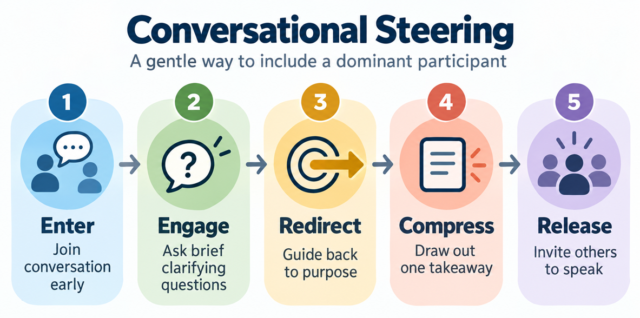
Conversational Steering is a simple technique that allows the leader to enter an extended monologue gradually, remain actively present in the conversation, redirect it toward the purpose of the meeting, help the speaker bring the thought to a conclusion, and then naturally transfer the conversation to someone else.
The progression is simple:
Micro-acknowledgment → Micro-question → Directional question → Summary question → Transfer the floor.
Or in five memorable words:
Enter. Engage. Redirect. Compress. Release.
The goal is not to silence someone. It is to shepherd the conversation so that everyone can participate and, as Paul says concerning the gathering of believers, “that all may learn.”
The Biblical Goal Is Edification, Not Airtime
The strongest biblical principle behind this approach appears in 1 Corinthians 14:26-33. The immediate context concerns the orderly exercise of spiritual gifts in the Corinthian church, so the passage should not be treated as though Paul were writing a handbook for twenty-first-century home Bible studies. Nevertheless, the principles governing Christian participation are remarkably applicable.
Paul begins with the purpose of the gathering:
The Corinthian gathering involved participation from several believers. Paul mentions one bringing a psalm, another teaching, another revelation, and others contributing according to the gifts God had given them. His answer to potential disorder was not to eliminate participation and turn the meeting into a monologue. Instead, he placed participation under the greater purpose of edification.
That distinction is important for small-group leaders. The question is not merely, “Has this person been speaking too long?” A better question is, “Is what is happening helping the whole group accomplish the purpose for which we gathered?”
Paul continues, “Let the prophets speak two or three, and let the other judge” (1 Corinthians 14:29). Again, a modern Bible-study comment is not equivalent to New Testament prophecy. But notice the structure Paul expects: one believer contributes while others listen, evaluate, and then participate themselves. The gathering was never intended to become the uninterrupted platform of whichever person happened to be the most verbal.
Verse 30 makes the principle even clearer: “Let the first hold his peace.” Paul expects someone who is currently speaking to be capable of stopping so another believer can contribute. Yielding the floor is not inherently rude, unspiritual, or unloving. Sometimes yielding the floor is exactly what love for the rest of the body requires.
“That All May Learn”
Paul explains the purpose in verse 31: “For ye may all prophesy one by one, that all may learn, and all may be comforted.”
Two phrases deserve attention: “one by one” and “that all may learn.”
Healthy Christian participation requires some form of turn-taking. One person contributes, then another contributes. The objective is not equal airtime measured with a stopwatch, but a meeting in which the contributions of individual believers serve the spiritual good of the whole body.
This changes how a leader thinks about redirecting a highly verbal member. The leader is not thinking, “How can I make this person stop talking?” He is thinking, “How can I lovingly shepherd this discussion so that all may learn?”
The quieter person sitting across the room matters just as much as the person currently speaking. Philippians 2:4 tells believers to look not merely to their own interests, “but every man also on the things of others.” James 1:19 similarly commends being “swift to hear, slow to speak.” Christian fellowship requires both speaking and listening.
Paul adds another important principle in 1 Corinthians 14:32: “The spirits of the prophets are subject to the prophets.” Even in the exercise of genuine spiritual gifts, a believer was not permitted to argue that he simply could not stop himself. Christian expression remained under Christian self-control.
That harmonizes naturally with Galatians 5:22-23, where self-control is part of the fruit produced by the Holy Spirit. A mature believer can pause. A mature believer can summarize. A mature believer can allow someone else to speak.
Paul concludes, “For God is not the author of confusion, but of peace” (1 Corinthians 14:33). In context, Paul is not teaching that God dislikes anything complicated. He is describing a gathering in which spiritual participation should occur peacefully and orderly rather than competitively and chaotically.
The biblical objective, therefore, is not less participation. It is ordered participation for mutual edification.
Why Some Monologues Are So Difficult to Enter
This problem has an interesting parallel in research on ordinary conversation.
In their classic 1974 study of conversational turn-taking, Harvey Sacks, Emanuel Schegloff, and Gail Jefferson observed that conversation normally contains recognizable places where one person’s speaking turn can end and another person’s turn can begin. Their work describes conversation as a locally managed and interactionally coordinated process in which speakers continually negotiate who has the conversational floor.
Normally, a speaker completes a thought, pauses, changes intonation, or reaches some other recognizable completion point. Another person senses the opening and begins speaking.
But some highly verbal speakers provide very few openings. Their speech sounds something like:
“I was thinking about this because last week something happened at work and then that reminded me of something my brother told me but of course he sees it differently because he was raised differently than I was and therefore I started thinking that maybe what this verse really means is…”
There is never quite a period.
Every potential ending becomes another “and,” “but,” “because,” or “therefore.” The other participants may repeatedly prepare to speak only to discover that the speaker has launched into another clause.
This helps explain why simply telling leaders, “Interrupt when necessary,” is not always very helpful. The leader knows an interruption is necessary. The difficulty is finding a way to enter the stream of words without making the interruption feel like a collision.
That is where Conversational Steering begins.
Enter: Join the Conversation Before Trying to Redirect It
Researchers use the term backchannel for short listener responses that demonstrate attention without normally claiming the conversational floor. Examples include “mm-hmm,” “okay,” “right,” and similar brief acknowledgments. Recent linguistic research continues to describe backchannels as listener responses that display active listening while allowing the current speaker to retain the floor.
Active-listening literature sometimes calls the same kinds of responses minimal encouragers. The Open University, for example, describes short responses such as “mm,” “yeah,” and “OK” as signals demonstrating that the listener is following the speaker.
A small-group leader can use these tiny responses to become conversationally present:
- “Right.”
- “Okay.”
- “I see.”
- “Interesting.”
- “Really?”
The leader is not yet stopping or correcting anything. He is simply changing his position from silent recipient to active participant.
That seemingly insignificant change becomes important later. The leader no longer has to leap suddenly from ten minutes of silence into “Okay, we need to move on.” He has already been participating in the conversation.
One caution is important here. Avoid using “Yes!” when you merely mean “I hear you.” “Yes” can communicate agreement with an assertion that the leader may not actually affirm. Neutral acknowledgments such as “Okay,” “I see,” or “right” are often safer.
Engage: Turn a Monologue Into a Dialogue
Once brief acknowledgments have established the leader’s presence, the next step is a tiny question.
- “How?”
- “Then what happened?”
- “What changed?”
- “Where?”
- “Because?”
- “What did you mean by that?”
The difference is subtle but significant. An acknowledgment allows the speaker to continue his monologue. A question causes the speaker to begin responding to the leader.
The communication has started changing from a speech into a dialogue.
Questions should initially remain small and natural. They are not yet intended to redirect the entire discussion. Their purpose is to establish an ordinary rhythm in which the leader can speak briefly and the participant comfortably responds.
This is particularly helpful with someone whose speech contains very few natural pauses. The leader no longer needs to wait indefinitely for the perfect opening. He begins creating small conversational openings of his own.
Redirect: Connect the Conversation Back to Its Purpose
Once that conversational rhythm has been established, the leader can make the next question more purposeful.
- “How does that connect with the passage we’re studying?”
- “So how did this verse help you with that?”
- “Where do you see that principle in the text?”
- “How does that answer the original question?”
- “What do you think Scripture is teaching us here?”
The transition can feel remarkably natural because the leader has not suddenly interrupted after being silent for five minutes. He has already been participating with acknowledgments and brief questions. The new question simply becomes another contribution to an existing dialogue.
This agrees with established facilitation guidance. The University of Kansas Community Tool Box warns leaders not to allow one or a few individuals to dominate a discussion at the expense of quieter members and recommends redirecting discussion in a nonthreatening manner. Brown University’s guidance similarly recommends redirecting the discussion to another participant or topic when someone is speaking too much.
Notice that the objective is not punishment. The leader is protecting the purpose of the meeting.
Compress: Help the Speaker Land the Airplane
Eventually, even a redirected contribution needs to end.
This is where a summary question can be much kinder than an abrupt command to stop.
- “So what would you say is your one-sentence takeaway?”
- “If we remember one thing from what you just said, what should it be?”
- “What is the main point you want us to remember?”
- “So, in one sentence, how would you answer the original question?”
These questions accomplish something psychologically and relationally important. The leader is not saying, “You have talked too much.” He is saying, “Your contribution has a point, and I want to make sure we understand it.”
The participant is therefore invited to complete the contribution rather than being publicly told that the contribution has become a problem.
That preserves dignity while restoring structure.
Release: Deliberately Transfer the Floor
The final step is easily overlooked.
After the participant summarizes, the leader should immediately give someone else an opportunity to enter:
- “That’s helpful. Susan, what stood out to you?”
- “Thank you. Mike, what did you notice in verse 28?”
- “Good. I’d like to hear from someone who hasn’t had a chance to answer yet.”
Without this final transfer, the highly verbal participant may hear the summary question as nothing more than another prompt. He summarizes his point and then immediately begins explaining the summary.
Release completes the steering process.
Enter the conversation. Engage the speaker. Redirect toward the subject. Compress the contribution. Release the floor to someone else.
Enter. Engage. Redirect. Compress. Release.
An Important Danger: Backchannels Can Make the Problem Worse
There is an important research-based warning built into this technique.
Backchannels and minimal encouragers normally encourage people to continue speaking. That is usually their purpose. Research on conversational backchannels consistently treats them as signals of attention that allow or encourage the current speaker to continue rather than surrender the conversational floor.
A 2024 experimental study of conversational backchanneling found greater conversational persistence and engagement when backchannels were used. The study involved human interaction with conversational agents rather than church small groups, so its findings should not be transferred directly to pastoral ministry. Nevertheless, it illustrates the very danger small-group leaders should understand: listener encouragement tends to encourage more talking.
Therefore, Conversational Steering must not become five minutes of:
- “Uh-huh.”
- “Right.”
- “Wow.”
- “Interesting.”
- “Go on.”
That would merely make the leader a more attentive audience for the monologue.
The acknowledgments are an entry ramp, not a parking place. Move from acknowledgment to question, from question to redirection, from redirection to summary, and from summary to another participant.
Protect the Person While Correcting the Pattern
A leader should also be careful not to turn a facilitation technique into covert manipulation.
The dominant participant is a brother or sister in Christ, not a conversational problem to be defeated. First Corinthians 13 remains just as relevant as 1 Corinthians 14. Whatever leadership technique we use must be exercised with patience, kindness, humility, and genuine concern for the person.
Avoid publicly labeling someone as “the dominator.” Do not joke about how much they talk. Do not roll your eyes, exchange knowing glances with other members, abruptly look at the clock, or make the person feel that everyone has been patiently enduring them.
Brown University’s discussion guidance rightly emphasizes treating participants with respect while simultaneously refusing to allow only the most dominant or verbal people to take over the conversation. Those two responsibilities are not contradictory.
The leader can protect both dignity and participation.
It is also wise not to assume motives. Someone may talk excessively because of enthusiasm, nervousness, loneliness, personality, lack of self-awareness, or simply because previous groups rewarded that behavior. We usually do not know why from observation alone.
Address the behavior that affects the group without pretending to diagnose the heart.
Do Not Turn Conversational Equality Into Another Legalism
Healthy participation does not mean everyone must receive precisely the same number of minutes.
Sometimes someone shares a painful experience that deserves patient listening. Sometimes a complicated biblical question legitimately requires more explanation. Sometimes the quietest person in the room has absolutely nothing they want to add that evening.
The principle of 1 Corinthians 14 is not mathematical equality of airtime. It is orderly participation directed toward edification.
A leader therefore needs judgment. There is a difference between someone vulnerably sharing something important and someone habitually turning every question into a ten-minute personal monologue. Conversational Steering is designed primarily for the latter situation.
Leadership means discerning the difference.
When Conversational Steering Is Not Enough
Sometimes gentle steering will solve the problem almost invisibly. The highly verbal participant may never realize that anything unusual happened. He simply experiences a healthy conversation in which the leader asks good questions and eventually invites someone else to speak.
But persistent patterns sometimes require a private conversation.
That conversation should still be encouraging rather than accusatory. A leader might explain how valuable the person’s contributions are and then ask for help creating room for newer or quieter members to participate. Some Christian small-group leadership resources similarly recommend privately enlisting a dominant participant’s help in allowing less-experienced members to answer first.
That approach changes the relationship from confrontation to cooperation.
Instead of:
“You talk too much.”
the message becomes:
“You contribute a lot to this group, and I need your help drawing other people into the discussion.”
A mature believer will usually understand the difference.
The Leader Is Stewarding the Conversation
The most important insight behind Conversational Steering may be this: you do not have to wait for a dominant participant to give you permission to enter the conversation.
If the leader remains completely silent throughout a long monologue, the eventual interruption can feel abrupt because it actually is abrupt. But when the leader has remained gently present through small acknowledgments and brief questions, a later redirection feels like a natural continuation of the conversation.
- You are not stopping the person.
- You are not publicly correcting the person.
- You are not wrestling the microphone away from them.
- You are getting alongside the conversation and progressively steering it toward the purpose for which everyone gathered.
That is a very different attitude from simply “controlling difficult people.”
A Christian small-group leader is a servant. Part of that service is listening patiently to the person who has much to say. But another part is noticing the believer across the room who has patiently waited twenty minutes for an opportunity to say something.
Both people matter.
Paul’s instruction gives us the governing objective: “Let all things be done unto edifying.” He describes orderly participation as occurring “one by one,” so “that all may learn.” He reminds us that Christian expression remains under self-control and that God desires peace rather than confusion in the gathering of His people.
Conversational Steering simply attempts to put those principles into practice with grace.
Enter. Engage. Redirect. Compress. Release.
Do not silence the participant.
Steer the conversation so the whole body can participate.
Resources for Deeper Study:
Here is a reader-focused rewrite that speaks directly to the person who wants to study the subject more deeply.
Resources for Deeper Study
If you want to study Conversational Steering more deeply, these resources will help you explore its biblical foundation, the science of conversation, and practical group facilitation.
- 1 Corinthians 12–14, especially 14:26–33 – Start with the biblical foundation. As you read the whole section, look for Paul’s emphasis on edification, orderly participation, self-control, and making room for others. Pay particular attention to “let all things be done unto edifying” (v. 26), “one by one” (v. 31), “that all may learn” (v. 31), and “the spirits of the prophets are subject to the prophets” (v. 32). You may also want to compare Philippians 2:3-4; James 1:19; Romans 12:3-8; Ephesians 4:11-16; Colossians 3:12-17; and Galatians 5:22-23.
- Harvey Sacks, Emanuel Schegloff, and Gail Jefferson, “A Simplest Systematics for the Organization of Turn-Taking for Conversation” – Read this classic study if you want to understand how normal conversation moves from one speaker to another. It will help you recognize conversational completion points and understand why a speaker who continually links thoughts with “and,” “but,” “because,” and “therefore” can make it unusually difficult for anyone else to enter the conversation.
- Research on backchanneling and minimal responses – Explore this research to understand why little responses such as “mm-hmm,” “right,” and “okay” can help you enter another person’s stream of speech without immediately taking over. It also highlights an important caution: these responses often encourage people to continue talking, so they should lead toward redirection rather than becoming endless encouragement.
- Roger Schwarz, The Skilled Facilitator, 3rd ed. – Use this book if you want to develop a broader philosophy of facilitation rather than simply collect techniques. Schwarz emphasizes guiding groups through mutual learning, which can help you redirect a dominant participant without embarrassing, overpowering, or treating that person as a problem.
- University of Kansas Community Tool Box, “Techniques for Leading Group Discussions” – This practical guide can help you learn how to involve quieter members, prevent one person from dominating, summarize contributions, ask productive questions, and keep a discussion moving toward its purpose.
- Brown University, “Facilitating Effective Group Discussions” – Read this for practical ways to balance two responsibilities at the same time: treating every participant respectfully while also preventing highly verbal members from taking over the conversation. It includes ideas for redirecting discussion, reframing comments, and establishing healthy expectations for participation.
- Cru, “The Essentials for Leading Small Groups” – This resource can help you think specifically about Christian small-group leadership. Its emphasis on guided conversation is especially useful because it treats the leader as someone who directs discussion around Scripture without turning the group into either a lecture or an uncontrolled conversation.
- Hope Community Church, “Facilitating a Small Group Bible Discussion” – Use this practical church resource to explore techniques that closely resemble Conversational Steering. It discusses sitting near a talkative participant, affirming contributions without sarcasm, asking clarifying questions, summarizing important thoughts, avoiding off-topic “bunny trails,” and making sure no single person dominates the discussion.
If you want to go even deeper into group facilitation, The Surprising Power of Liberating Structures by Henri Lipmanowicz and Keith McCandless explores meeting structures specifically designed to prevent a small number of people from controlling participation. Facilitator’s Guide to Participatory Decision-Making by Sam Kaner and colleagues provides more technical tools for balancing participation, managing group dynamics, and helping discussions move toward useful conclusions.
For a focused study, begin with 1 Corinthians 14:26-33, then study conversational turn-taking, backchanneling, and practical group facilitation. Those three areas will give you the biblical, conversational, and leadership foundations for understanding why Enter → Engage → Redirect → Compress → Release can be an effective way to include a dominant participant without humiliating them.