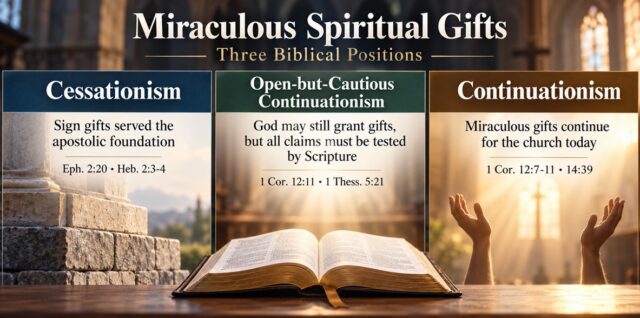
Does God still give believers the miraculous spiritual gifts of healing, prophecy, and speaking in tongues? Or were these extraordinary gifts intended primarily for the early Church, when the apostles were establishing its foundation and confirming the Gospel? Christians who sincerely believe in the inspiration, sufficiency, and final authority of Scripture have reached different conclusions about these important questions.
The New Testament clearly teaches that the Holy Spirit distributes spiritual gifts according to His sovereign will for the benefit of the Church and the glory of God (1 Corinthians 12:7-11). However, Christians disagree about whether certain miraculous gifts were temporary or remain available throughout the Church Age. These differences have produced three major theological perspectives: Cessationism, Continuationism, and Open-but-Cautious Continuationism.
- Cessationists emphasize the completed apostolic foundation of the Church (Ephesians 2:20).
- Continuationists generally understand the cessation of gifts as occurring when believers see Christ face to face (1 Corinthians 13:10-12).
- Open-but-Cautious Continuationism recognizes the unique role of the apostolic age without insisting that miraculous gifts have permanently ceased.
Because Scripture does not explicitly establish the timing of their cessation, we should distinguish clear biblical teaching from reasonable theological inference, exercise humility and charity toward Christians who interpret these passages differently, and remain united in our commitment to the sufficiency and final authority of God’s Word (2 Timothy 3:16-17).
Understanding these positions matters because our beliefs influence how we worship, pray for healing, evaluate claims of supernatural experiences, and recognize the Holy Spirit’s work in the Church today. We must neither dismiss genuine works of God simply because they challenge our expectations nor accept every extraordinary claim without biblical examination. Scripture commands believers to test all things and hold fast to what is good (1 Thessalonians 5:21).
- Cessationism: The Miraculous Gifts Served a Temporary Purpose – Examines how miraculous gifts authenticated the apostles, established the early Church, and apparently declined as the apostolic age concluded (Ephesians 2:20; Hebrews 2:3-4).
- Continuationism: The Miraculous Gifts Remain Available to the Church – Examines the continuing purposes of spiritual gifts, the Holy Spirit’s sovereign distribution of those gifts, and the absence of an explicit biblical declaration that they ceased during the Church Age (1 Corinthians 12:7-11; 13:8-12).
- Open-but-Cautious Continuationism: The Miraculous Gifts Remain Possible but Require Discernment – Examines the unique role of miracles during the apostolic age while recognizing God’s continuing sovereignty, the possibility of miraculous gifts today, and the necessity of testing every claim against Scripture (1 Corinthians 12:11; 14:29, 40; 1 Thessalonians 5:21).
Rather than allowing personal experiences, church traditions, or denominational preferences to determine our conclusions, we should carefully examine the biblical arguments for each position. Our goal is not to defend a particular theological camp, but to understand what God has revealed in His Word, rightly interpret Scripture, and faithfully submit to the authority of the Lord Jesus Christ (2 Timothy 3:16-17; Acts 17:11).
Cessationism: The Miraculous Gifts Served a Temporary Purpose
Cessationism teaches that certain miraculous and revelatory gifts of the Holy Spirit, particularly tongues, prophecy, and miraculous healing, were given primarily to authenticate the apostles, confirm the Gospel, and establish the early Church (Mark 16:20; 2 Corinthians 12:12; Hebrews 2:3-4).
- The Apostolic Foundation: The apostles and prophets established the doctrinal foundation of the Church (Ephesians 2:20). Cessationists argue that once this foundation was established and God’s New Testament revelation completed, the extraordinary gifts associated with that foundational ministry were no longer necessary. Today, believers possess the completed Scriptures as their sufficient and final authority for faith and practice (2 Timothy 3:16-17; Jude 3).
- The Decline of Miracles: Miraculous activity was prominent throughout Acts, including Paul’s healing ministry near the book’s conclusion (Acts 28:8-9). However, later epistles describe Epaphroditus recovering through God’s mercy (Philippians 2:25-27), Timothy receiving medical advice (1 Timothy 5:23), and Trophimus being left sick (2 Timothy 4:20). Cessationists interpret these accounts as consistent with a declining frequency of apostolic miracles, although they do not conclusively establish cessation.
- God Still Performs Miracles: Cessationism does not deny God’s supernatural power or His ability to heal in response to prayer (James 5:14-16). Rather, it distinguishes God’s sovereign intervention from the continuing possession of miraculous gifts by individual believers.
- The Central Argument: Miraculous gifts served a temporary, foundational purpose in establishing the Church. Because that foundation has been completed, cessationists conclude that those particular gifts have ceased, while God’s sovereign power to perform miracles remains unchanged.
Continuationism: The Miraculous Gifts Remain Available to the Church
Continuationism teaches that the miraculous gifts of the Holy Spirit, including tongues, prophecy, and healing, remain available throughout the Church Age. These gifts are distributed according to the sovereign will of the Holy Spirit for the edification of believers, the advancement of the Gospel, and the glory of God (1 Corinthians 12:7-11; 14:1, 26).
- The Continuing Purpose of Spiritual Gifts: Although miraculous gifts helped authenticate the apostles and establish the early Church, continuationists argue that Scripture also describes their broader purpose in strengthening the body of Christ (1 Corinthians 12:4-7; 14:12). They contend that the New Testament never explicitly declares that these gifts would cease following the apostolic age.
- The Duration of Spiritual Gifts: First Corinthians 13:8-12 teaches that certain gifts will eventually cease when “that which is perfect is come.” Continuationists generally interpret this as the future completion of God’s redemptive purposes when believers see Christ “face to face,” rather than the completion of the New Testament Scriptures.
- Biblical Authority and Order: Genuine spiritual gifts must operate according to biblical instructions, promote spiritual edification, and never contradict the inspired Scriptures (1 Corinthians 14:29, 33, 40; 2 Timothy 3:16-17). Continuationism does not inherently require tongues as evidence of salvation, modern apostles possessing the authority of the original apostles, or revelations that supersede Scripture.
- The Central Argument: Because Scripture describes miraculous gifts as beneficial to the Church and does not explicitly declare their cessation during the present age, continuationists conclude that the Holy Spirit continues to distribute them according to God’s sovereign will.
Open-but-Cautious Continuationism: The Miraculous Gifts Remain Possible but Require Discernment
Open-but-Cautious Continuationism teaches that God may still sovereignly distribute miraculous gifts of the Holy Spirit, including tongues, prophecy, and healing, while recognizing the unique role of these gifts during the apostolic age. All claimed manifestations must be evaluated according to Scripture, which remains the sufficient and final authority for faith and practice (1 Corinthians 12:11; 1 Thessalonians 5:21; 2 Timothy 3:16-17).
- The Apostolic Foundation: Miraculous gifts helped authenticate the apostles, confirm God’s revelation, and establish the early Church (2 Corinthians 12:12; Hebrews 2:3-4; Ephesians 2:20). Although the apostolic foundation and biblical revelation are complete, cautious continuationists distinguish that unique historical purpose from God’s continuing freedom to grant miraculous gifts.
- The Apparent Decline of Miracles: Miracles were prominent throughout Acts, but later epistles describe believers experiencing illnesses without immediate miraculous healing (Philippians 2:25-27; 1 Timothy 5:23; 2 Timothy 4:20). Cautious continuationists acknowledge that miraculous activity may have become less frequent as the Church became established but maintain that declining frequency does not establish permanent cessation.
- Biblical Discernment and Authority: No believer should be expected to demonstrate miraculous gifts as evidence of salvation or spiritual maturity (1 Corinthians 12:29-30). All claimed gifts must be tested, exercised with biblical order, and never introduce revelation that adds to, contradicts, or supersedes Scripture (1 Corinthians 14:29, 40; 1 Thessalonians 5:21; Jude 3).
- The Central Argument: Scripture neither explicitly declares that all miraculous gifts ceased with the apostles nor promises that they will occur with the same frequency throughout Church history. Therefore, cautious continuationists remain open to God’s sovereign distribution of miraculous gifts while requiring biblical evidence, discernment, and submission to the final authority of Scripture.
Conclusion: Biblical Conviction Without Unnecessary Dogmatism
After examining these three positions, we believe Open-but-Cautious Cessationism offers the best balance between recognizing the unique purpose of miraculous gifts in the apostolic age and acknowledging God’s continuing sovereign authority. Scripture demonstrates that miraculous gifts helped authenticate the apostles, confirm the Gospel, and establish the foundation of the early Church (Hebrews 2:3-4; Ephesians 2:20). The apparent decline of miraculous activity in the later New Testament is consistent with that foundational purpose. However, these observations do not necessarily establish that God permanently withdrew every miraculous spiritual gift.
An important exegetical distinction deserves our attention. First Corinthians 13:8 explicitly teaches that certain gifts will cease, but it does not establish precisely when that cessation occurs. The argument for their cessation during the apostolic age depends on theological inferences drawn from several passages, rather than an explicit biblical declaration. We should be careful not to elevate a reasonable theological inference to the level of an unmistakable command or declaration of Scripture. We can recognize that the apostolic age was unique without insisting that God has permanently prohibited Himself from granting extraordinary gifts according to His sovereign will (1 Corinthians 12:11).
We must also recognize that these three positions often come packaged with other theological teachings, particularly among classical Pentecostal, charismatic, and independent evangelical churches. Doctrines concerning a second baptism of the Holy Spirit, tongues as evidence of salvation, modern apostles and prophets, divine healing, and prosperity theology must each be examined independently. Accepting the possibility of miraculous gifts does not require accepting these additional doctrines. Neither emotional experiences nor denominational traditions should determine what we believe when Scripture provides the final standard of truth (2 Timothy 3:16-17).
Ultimately, our responsibility is neither to pursue supernatural experiences nor to dismiss every extraordinary claim automatically. Rather, we should remain firmly grounded in God’s completed revelation, carefully testing all things against His Word (1 Thessalonians 5:21). The Holy Spirit never contradicts the Scriptures He inspired, and genuine spiritual activity will always glorify Jesus Christ rather than exalt human personalities or experiences (John 16:13-14).
- The same Holy Spirit who inspired the Bible will guide your understanding of the Bible
- Practical Evidence of the Holy Spirit in Everyday Life
- The Fruit of the Spirit: A Three-Part Biblical Study
Our confidence must rest not in miraculous manifestations, theological labels, or personal experiences, but in the finished work of Jesus Christ and the sufficiency of His Word. Where Scripture speaks clearly, we should stand firmly. Where Scripture leaves room for reasonable disagreement, we should exercise humility, discernment, and Christian charity.