There are few problems quite as frustrating as being exhausted and unable to sleep. The house is quiet, the lights are off, tomorrow is getting closer, and somehow the brain has decided that 2:17 in the morning is the perfect time to reconsider every conversation from the last six months. The harder we try to sleep, the more aware we become that we are not sleeping. Before long, we are doing mental arithmetic about how many hours remain before the alarm goes off, which is rarely a successful strategy for becoming peaceful.
Christians are not exempt from insomnia. Scripture contains people who spent sleepless nights because of grief, danger, responsibility, prayer, or distress (Psalms 77:2-4; Daniel 6:18; 2 Corinthians 11:27). At the same time, the Bible repeatedly presents ordinary sleep as one of God’s good gifts to finite human beings. We were not created to remain constantly awake, constantly productive, constantly informed, or constantly in control.
Insomnia can also have more than one dimension. Physical symptoms can be caused by physical problems, spiritual problems, or a combination of circumstances that affect both body and mind. That means we should neither medicalize every sleepless night nor spiritualize every sleep disorder. Scripture teaches us to trust God, practice wisdom, exercise self-control, care for the body He has given us, and seek appropriate help when something appears wrong.
I am not a doctor and cannot provide medical advice. Persistent or severe insomnia deserves evaluation by a licensed physician or clinician, particularly because chronic insomnia may involve medical conditions, medications, other sleep disorders, or behavioral patterns requiring professional treatment. The practical suggestions below are consistent with established sleep guidance from the National Heart, Lung, and Blood Institute and the CDC.
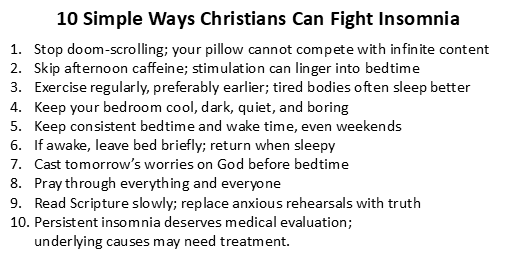
The following list deliberately begins with the small things and works toward the more important ones. Some are almost embarrassingly practical. Others reach much deeper into the heart. None promises that you will be unconscious seven minutes after your head hits the pillow, but together they provide a useful Christian way of thinking about those long nights when sleep refuses to come.
1. Stop Doom-Scrolling Before Bed
There is something slightly ridiculous about lying in a comfortable bed, in a quiet house, deliberately importing the entire world’s emergencies into our minds just before attempting to sleep. Yet smartphones make that remarkably easy. We can move from a family photograph to a political argument, from a war to a disaster, from an upsetting headline to a stranger’s angry comment, all within five minutes. Then we put the phone down and wonder why our minds are still racing.
The problem is not merely technological. It is also a question of what we voluntarily place before our eyes and allow to occupy our thoughts. Philippians 4:8 tells believers to think deliberately about what is true, honorable, just, pure, lovely, commendable, excellent, and worthy of praise. That does not mean Christians should ignore suffering or remain uninformed, but it does mean that constant consumption of agitation is not a spiritual virtue.
Modern sleep guidance adds a very practical reason to put the phone away. Electronic devices near bedtime can interfere with the sleep-wake cycle, while endlessly stimulating content can keep the mind engaged when it needs to wind down. The CDC recommends turning electronic devices off before bedtime, while NIH guidance similarly recommends avoiding televisions and electronic devices when preparing for sleep.
So perhaps one of the most spiritual things you can do at 10:30 tonight is surprisingly ordinary: put the phone down. The world will almost certainly continue operating without your supervision until morning. You do not need to finish the Internet before you sleep. God neither slumbers nor sleeps (Psalms 121:4), which means you are free to do both.
- The ultimate preppers guide to survive the apocalypse – The best way to survive the apocalypse is to avoid it. Forewarned, forearmed; to be prepared is half the victory. Prevention better than cure.
- Christian’s Guide to Investing for Eternity – As followers of Christ, we are called to be faithful stewards of our time, talents, and finances, investing them with eternity in mind.
2. Stop Drinking Caffeine So Late
Coffee is one of life’s pleasant little mercies, but even pleasant things require wisdom. Scripture does not condemn caffeine, nor does it establish a biblical hour after which coffee becomes sinful. The issue is simpler than that. If something lawful repeatedly interferes with something necessary, wisdom tells us to reconsider when and how we use it.
Paul expressed this principle in 1 Corinthians 6:12 when he said that although things may be lawful, he would not be brought under the power of anything. Christian liberty should never become thoughtless slavery to appetite or habit. Sometimes our evening prayer for sleep may need to be accompanied by the admission that the enormous coffee we drank late in the afternoon was probably not helping.
Caffeine can remain active in the body for hours, which is why established sleep guidance recommends avoiding it later in the day or near bedtime. NIH specifically lists caffeine among substances that may interfere with sleep, and the CDC advises avoiding caffeine in the afternoon or evening.
This is an excellent example of Christian stewardship because there is nothing particularly dramatic about it. You do not need a spiritual breakthrough to order decaf. Sometimes wisdom consists of recognizing the relationship between a choice at three in the afternoon and a problem at midnight. God ordinarily works through ordinary means, and self-control is among the fruit the Holy Spirit desires to cultivate in us (Galatians 5:22-23).
3. Give Your Body Some Work to Do
Human beings were created for activity. Adam was placed in the garden “to dress it and to keep it” before sin entered the world (Genesis 2:15). Work itself is therefore not part of the curse, although exhausting and frustrating labor became part of life after the Fall. Our bodies were designed to move, work, exert themselves, and eventually become tired.
Ecclesiastes makes an interesting observation about this natural rhythm. “The sleep of a labouring man is sweet” (Ecclesiastes 5:12). Solomon was not writing a medical prescription for insomnia, and we should not turn his observation into one. He was recognizing something deeply ordinary about embodied human life: physical labor and restful sleep often belong together.
Regular physical activity is also widely recommended as part of healthy sleep habits. Current NIH guidance recommends regular daytime physical activity, while cautioning that strenuous exercise too close to bedtime can make sleep more difficult for some people. So the principle is not necessarily “exercise vigorously five minutes before bed,” but rather “do not expect a sedentary body to behave exactly like an active one.”
There is also a spiritual balance here. Paul said that bodily exercise “profiteth little,” or profits for a little while, while godliness has value extending into eternity (1 Timothy 4:8). He did not say bodily exercise has no value. Christians need not worship physical fitness, but neither should we despise the body God created. A walk, some yard work, regular exercise, or another appropriate physical activity may be a surprisingly useful part of preparing for better rest.
4. Make Your Bedroom Boring Again
Many bedrooms have quietly become miniature entertainment centers, offices, newsrooms, restaurants, and communication hubs. We work in bed, watch television in bed, answer email in bed, scroll through social media in bed, and occasionally remember that the bed was originally intended for sleeping. The mind gradually learns that getting into bed means almost anything except becoming quiet.
There is wisdom in creating a place associated with rest. Jesus Himself sometimes withdrew from crowds and activity because human beings need periods of quiet and restoration (Mark 6:31). He did not treat physical limitations as moral failures. During His earthly ministry, He ate, slept, became tired, and experienced the ordinary limitations of genuine humanity without sin.
Sleep specialists likewise recommend making the bedroom conducive to sleep. NIH recommends a cool, quiet, dark sleeping environment and reducing television and electronic-device use there. There is nothing mystical about darkness, quietness, or comfortable temperature. They simply remove unnecessary reasons for the body to remain alert.
Perhaps your bedroom needs to become wonderfully uninteresting again. Not every room needs a screen, notification, headline, glowing clock, or stream of information. A dark and quiet bedroom is not technologically impressive, but that is rather the point. When bedtime arrives, boredom may be your friend.
5. Give Your Body a Regular Rhythm
God created the physical world with rhythms. Genesis begins with evening and morning, work and rest, seasons and appointed times. Psalms 104 describes the sun arising, mankind going out to labor, and the day eventually giving way to another period of rest. Human beings live inside these created rhythms whether we acknowledge them or not.
Modern life often encourages us to pretend otherwise. We may go to bed at ten one night, one in the morning the next, sleep until noon on Saturday, then wonder why sleep does not arrive obediently at nine-thirty Sunday evening. Our bodies are not machines with an instantaneous “sleep now” button. They respond to patterns developed over time.
Consistent sleep and wake times are among the standard recommendations for better sleep. NIH and CDC guidance both recommend going to bed and getting up at approximately the same time each day, including weekends when practical. Consistency helps reinforce the body’s normal sleep-wake rhythm rather than forcing it to adjust constantly.
There is a broader Christian lesson here about ordering our lives. Self-discipline is rarely spectacular, but it is often fruitful. The believer who develops reasonable patterns for work, meals, prayer, exercise, worship, and sleep is acknowledging that life has limits. We are creatures, not the Creator, and honoring those limits can itself become an act of humility.
6. If You Cannot Sleep, Stop Fighting the Mattress
One of insomnia’s great ironies is that desperately trying to sleep can make sleep more difficult. We lie perfectly still while internally shouting, “I MUST RELAX.” Then we check the clock, calculate the hours remaining, become irritated that sleep has not arrived, and begin treating the mattress as the scene of an athletic competition we are losing.
There is practical wisdom in interrupting that cycle. For persistent insomnia, stimulus-control strategies used in cognitive behavioral therapy for insomnia encourage people to associate the bed with sleep rather than extended periods of frustrated wakefulness. NIH describes getting out of bed when unable to sleep, doing something quiet until sleepiness returns, and then returning to bed.
This is not a biblical command, so we should not pretend Proverbs secretly teaches cognitive behavioral therapy. It does, however, fit a biblical understanding of wisdom. When repeatedly doing something increases frustration without accomplishing its purpose, changing what we are doing may be sensible. Get up, keep the lights low, read something quiet, sit peacefully, and return to bed when drowsiness begins to return.
Most importantly, do not turn a difficult night’s sleep into a moral crisis. Being awake at two in the morning does not mean God has abandoned you, that you have failed spiritually, or that tomorrow is already ruined. Insomnia can become self-reinforcing when fear of sleeplessness becomes another source of sleeplessness. The Christian can acknowledge, “I am awake right now,” without adding, “and therefore everything is terrible.”
- 3 ways to overcome procrastination – The real name for “procrastination” is “laziness.” The Bible provides a tried-and-true, proven prescription for fixing this problem. Consider the ant.
- Stop doing these things (they will destroy the joy of your salvation) – Stop doing these things. They will not help you grow in grace and knowledge. They will destroy the joy of your salvation.
7. Give Tomorrow Back to God
At this point the problem often moves beyond mattresses, screens, caffeine, and schedules. The room may be dark and quiet while the mind remains brightly illuminated. Tomorrow’s meeting appears. Then the unpaid bill arrives. Then the difficult conversation, medical appointment, family problem, unfinished project, uncertain future, and ten imaginary disasters line up for their turn.
Jesus addressed precisely this human tendency in Matthew 6. He did not deny that tomorrow would contain genuine responsibilities. Instead, He forbade us from dragging tomorrow’s troubles into today and carrying both loads simultaneously. “Sufficient unto the day is the evil thereof” (Matthew 6:34).
This does not mean planning is sinful. Scripture commends wise planning (Proverbs 21:5), yet there is a great difference between planning for tomorrow and mentally living through tomorrow fifty times before sunrise. Planning asks, “What should I responsibly do?” Worry keeps asking, “But what if?” long after every useful decision has already been made.
When those thoughts arrive in bed, consciously return tomorrow to God. You may have responsibilities in the morning, but you do not have responsibilities in tomorrow morning yet. God is already there, while you are still here. Faith does not require knowing what tomorrow contains because faith rests in the God who does.
8. Turn the Worry List Into a Prayer List
Paul gives Christians something better to do with anxiety than merely commanding themselves to stop feeling anxious. Philippians 4:6 says, “In every thing by prayer and supplication with thanksgiving let your requests be made known unto God.” Notice the breadth of that invitation: “in every thing.” The concerns that keep returning to our minds can become the very subjects we repeatedly bring before the Lord.
Prayer should not be reduced to a sleep technique. We do not pray because prayer is a Christian version of counting sheep. We pray because the living God hears His children, cares for them, and commands them to bring their requests to Him. Whether sleep comes immediately or not, a night spent entrusting people and problems to God is spiritually different from a night spent pretending we control them.
There is even something useful about praying through people when your mind refuses to become quiet. Pray for your spouse, children, grandchildren, pastors, missionaries, neighbors, coworkers, government leaders, unbelieving friends, struggling believers, and people you find difficult to love. Pray for their salvation, sanctification, protection, wisdom, marriages, ministries, and opportunities to know Christ. You may discover that an unwanted hour awake has become an unexpected hour of intercession.
The promised result of Philippians 4 is not necessarily instant unconsciousness. It is the peace of God guarding the believer’s heart and mind through Christ Jesus. Sometimes God may allow the circumstances to remain while changing the way we carry them. Whether sleep comes five minutes later or much later, the burden belongs in better hands.
9. Let Scripture Have the Last Word of the Day
Many Christians finish their day with whatever happened to be on a screen last. The final voice may belong to a news commentator, a stranger on social media, a television drama, an advertisement, or an angry commenter living three states away. Then we wonder why our minds continue replaying those voices after the room becomes dark.
There is a better final voice. Psalms 119 repeatedly describes a believer turning his thoughts toward God’s Word, including during the night. The psalmist says, “Mine eyes prevent the night watches, that I might meditate in thy word” (Psalms 119:148). His waking hours became occasions for returning his mind to what God had said.
Again, Bible reading is not a sedative. We should never treat Scripture as something boring enough to knock us unconscious. The purpose is far greater: Scripture corrects our perspective by reminding us who God is, what He has promised, what He commands, what Christ has accomplished, and where history is going. A worried mind continually exaggerates the size of the problem, while Scripture continually restores the greatness of God to our field of vision.
Try reading slowly rather than reading extensively. Read Psalms 23, Psalms 46, Psalms 121, John 14, Romans 8, or another familiar passage, and linger over what is actually written. Think about each phrase. Pray the truths back to God. Even if the body remains awake for a while, the soul is being fed with something infinitely better than another hour of scrolling.
10. Persistent Insomnia May Need More Than a Better Bedtime Routine
This final point is the most important partly because Christians can sometimes make the mistake of treating every physical difficulty as though it must have a purely spiritual cure. Scripture does not teach that. Paul advised Timothy concerning a recurring physical problem (1 Timothy 5:23), Luke was known as “the beloved physician” (Colossians 4:14), and Jesus Himself observed that sick people appropriately seek a physician (Matthew 9:12). Medicine is not the enemy of faith.
Persistent insomnia can sometimes be associated with physical illness, pain, medications, sleep apnea, mental or emotional distress, hormonal changes, or other conditions that cannot be identified merely by purchasing darker curtains. Long-term insomnia can also become a disorder in its own right. NIH defines chronic insomnia as sleep difficulty occurring at least three nights a week for more than three months and notes that clinicians may evaluate medical history, medications, sleep patterns, and other possible contributing conditions.
- MedlinePlus Insomnia – Excellent patient-friendly overview. It covers acute versus chronic insomnia, diagnosis, sleep studies, lifestyle changes, counseling, and medications without being overly technical.
- AASM Sleep Education – Especially useful because the AASM represents physicians and researchers specializing in sleep medicine. Its patient-oriented site discusses sleep disorders and can help readers understand when professional sleep evaluation may be appropriate.
For chronic insomnia, cognitive behavioral therapy for insomnia, commonly called CBT-I, is generally recommended as a first treatment option. It combines several behavioral approaches, including consistent sleep patterns, stimulus control, relaxation, and addressing thoughts and behaviors that perpetuate insomnia. Seeking appropriate professional evaluation is therefore not evidence that prayer failed. It may simply be another expression of responsible stewardship.
- Mayo Clinic Insomnia Diagnosis and Treatment – Very readable for the average person. Its insomnia material explains how physicians investigate causes, when a sleep study might be appropriate, and why CBT-I is commonly recommended before or alongside medication.
- Cleveland Clinic CBT-I Guide – Their insomnia and CBT-I pages are particularly good for explaining why insomnia can become self-perpetuating. They explain stimulus control, sleep schedules, cognitive therapy, and relaxation strategies in accessible language.
The Christian should pray and seek wisdom while also using appropriate means God has made available. We pray before surgery but still allow the surgeon to operate. We thank God for daily bread while still going to the grocery store. In the same way, persistent sleep problems can be brought earnestly before the Lord while also being discussed honestly with a qualified physician or sleep clinician.
Sleep Is a Gift, Not an Achievement
After all ten suggestions, we finally arrive at something deeper than sleep hygiene. Sleep is a remarkable daily confession of creaturehood. Every night we stop working, stop producing, stop solving problems, stop defending ourselves, and become unconscious while the universe continues without our assistance. For several hours we accomplish absolutely nothing, and God remains completely sovereign.
Psalms 127 describes the futility of anxious human striving: rising early, staying up late, and eating “the bread of sorrows.” The point is not that diligence is wrong, because Scripture repeatedly commends diligent labor. The problem is anxious labor that behaves as though everything depends entirely upon us. Against that exhausting illusion comes a wonderfully simple reminder: God “giveth his beloved sleep.”
David expressed the same confidence in Psalms 4:8: “I will both lay me down in peace, and sleep: for thou, LORD, only makest me dwell in safety.” His peace did not come from having eliminated every enemy or solved every uncertainty. It came from knowing who watched over him when he could no longer watch over himself. The safest place in the world is not a life without problems, but a life entrusted to the Lord.
So turn off the phone. Drink the coffee earlier. Move your body. Darken the room. Keep a reasonable schedule. Stop wrestling with the mattress. Give tomorrow back to God, turn worries into prayers, let Scripture have the final word, and seek appropriate medical help when insomnia persists.
Then remember the truth beneath all ten suggestions. You are a finite creature loved by an infinite God. You are permitted to stop working because He never does. You may close your eyes because the Lord who keeps you “shall neither slumber nor sleep” (Psalms 121:4).