Jesus Derangement Syndrome is not a medical diagnosis of the mind. It is a spiritual diagnosis of the heart.
The phrase is meant to describe the irrational hatred that fallen man often shows toward Jesus Christ, His gospel, His authority, and His people. It is not a clinical term. It is not meant to mock people with real mental suffering. Rather, it is a biblical way of describing what happens when sinful hearts are confronted by the light of Christ.
Jesus Himself explained the issue.
The world did not hate Jesus because He lacked love. No one ever loved like Jesus. The world did not hate Him because He lacked compassion. No one ever showed mercy like Jesus. The world hated Him because His holiness exposed sin, His truth exposed lies, His grace exposed religious pride, and His Lordship challenged human rebellion.
That same hatred continues today.
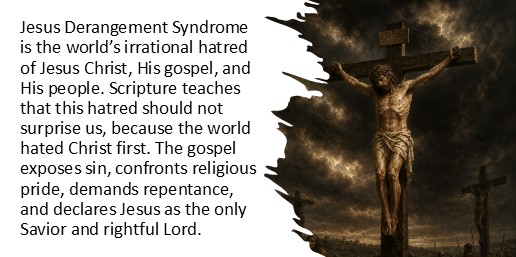
Jesus Derangement Syndrome is the world’s irrational hatred of Jesus Christ, His gospel, and His people. Scripture teaches that this hatred should not surprise us, because the world hated Christ first. The gospel exposes sin, confronts religious pride, demands repentance, and declares Jesus as the only Savior and rightful Lord. From Stephen to Paul, and from the apostles to faithful believers today, Christ’s people should expect opposition, endure it with holiness, answer it with truth, and overcome it with love.
Jesus Derangement Syndrome is Not New
When Peter and John preached Christ in Acts 4, they were arrested and brought before the religious rulers. Their crime was not violence, theft, rebellion, or immorality. They were preaching Jesus and the resurrection.
The rulers were not confused about the message. They understood it well enough to fear it.
Peter answered them plainly:
That verse is glorious to the believer, but offensive to the rebellious heart. It leaves no room for religious pluralism, self-salvation, human merit, or spiritual pride. Jesus is not one option among many. He is the only Savior.
Stephen faced the same hatred in Acts 7. He preached the truth to religious men who knew the Old Testament but rejected the Messiah to whom the Old Testament pointed. When Stephen declared that he saw the Son of Man standing at the right hand of God, they could bear it no longer.
Acts 7 says they were cut to the heart, gnashed their teeth, cried out with a loud voice, stopped their ears, rushed upon him, cast him out of the city, and stoned him. Their reaction was not reasonable debate. It was spiritual rage.
Paul later faced the same hatred. In Acts 22, after he testified that Christ had sent him to the Gentiles, the crowd erupted. They lifted up their voices, threw off their clothes, and cast dust into the air. In Acts 23, Paul stood before the Sanhedrin and was struck for beginning his defense by saying he had lived before God in good conscience.
From the beginning, the message of Christ has provoked opposition. Not because the gospel is evil, but because the human heart resists the truth of God.
What Is Jesus Derangement Syndrome?
Jesus Derangement Syndrome is not insanity in the medical sense. It is not a diagnosis made by doctors. It is not a label for people who need compassion for mental illness.
It is a spiritual description of the fallen heart’s hostility toward Christ.
The Bible teaches that man’s deepest problem is not ignorance, environment, politics, economics, or lack of education. Those things may matter, but they are not the root. The root problem is sin.
Romans 1 says fallen man suppresses the truth in unrighteousness. John 3 says men love darkness rather than light because their deeds are evil. Ephesians 2 says the lost are dead in trespasses and sins. Second Corinthians 4 says the god of this world blinds the minds of those who do not believe.
So, when the world reacts with rage against Jesus, the gospel, the Bible, Christian morality, or faithful believers, Scripture tells us what is really happening. The light is shining into darkness, and darkness does not like being exposed. These are the same kinds of people that went from crying Hosanna to the King on Palm Sunday to crying Crucify Him on the following Friday. Not because he was evil, or bad, or any sin was found in him. (1 Peter 2:22) But because he was the Son of God who came into the world to take away sin. (Hebrews 10)
That is the heart of the issue.
Jesus Derangement Syndrome is what happens when the sinner loves darkness, but Christ shines light. It is what happens when man wants to be his own lord, but Christ declares Himself Lord of all. It is what happens when religion wants self-righteousness, but Christ demands repentance and faith. It is what happens when the world wants a harmless Jesus, but the Bible presents the holy Son of God who died for sinners, rose bodily from the grave, and will judge the living and the dead.
This is closely related to the “Ten Commandment Derangement Syndrome,” which describes the fallen heart’s hostility toward God’s law. The Ten Commandments expose sin, rebuke rebellion, and remind man that he is accountable to the Creator. They do not save sinners, but they reveal why sinners need salvation. Like a mirror, the law shows guilt but cannot cleanse it. That is why public displays of the commandments often provoke irrational hatred. The world resists them because they speak with divine authority. Yet God’s law serves a gracious purpose: it exposes sin so people will stop trusting themselves and come to Jesus Christ for mercy.
The Gospel Is Good News, But It Offends Human Pride
The word “gospel” means good news. The good news is that Jesus Christ died for our sins, was buried, and rose again the third day according to the Scriptures.
But before a person sees the gospel as good news, he must first face the bad news. He is a sinner. He has broken God’s law. He cannot save himself. His religion cannot save him. His good works cannot erase his guilt. His sincerity cannot justify him before a holy God.
That is why the gospel offends pride.
The gospel tells moral people that their morality cannot save them. It tells religious people that their religion cannot save them. It tells rebellious people that their freedom is actually bondage. It tells successful people that they are spiritually bankrupt without Christ. It tells every person, rich or poor, educated or uneducated, religious or irreligious, that salvation is found in Jesus Christ alone.
The gospel is not “try harder.” It is not “be religious.” It is not “clean yourself up and maybe God will accept you.” The gospel is the finished work of Jesus Christ. He died for our sins. He rose again. He saves all who call upon Him in faith.
That message is life to the humble, but an offense to the proud. See: Why the Bible Speaks so Strongly about Pride.
Religious People Can Hate Jesus Too
One of the most sobering lessons in the New Testament is that much of the hatred against Jesus came from religious people.
The scribes, Pharisees, Sadducees, priests, and rulers were not atheists. They believed in God. They had the Scriptures. They practiced religion. They defended their traditions. Yet many of them hated Jesus.
Why?
Because Jesus exposed dead religion. See: Jesus Denounces Moralism (The Most Respectable False Gospel)
He exposed hypocrisy. He exposed spiritual pride. He exposed man-made traditions that nullified the Word of God. He exposed religious leaders who loved honor from men more than honor from God. He exposed men who appeared righteous outwardly but were inwardly full of uncleanness.
This is why Jesus warned His disciples:
That is a frightening verse. It teaches that people can persecute true believers while thinking they are serving God.
Paul knew this personally. Before his conversion, he persecuted Christians. He thought he was defending the truth, but he was actually fighting against Christ. The Lord Jesus stopped him on the road to Damascus and said, “Saul, Saul, why persecutest thou me?” (Acts 9:4).
Notice that Jesus took the persecution of His people personally. To persecute the church was to persecute Christ.
Do Not Be Surprised When the World Hates You
The Bible repeatedly tells Christians not to be shocked by hatred, rejection, slander, or persecution. These things are painful, but they are not strange.
Peter does not say suffering is easy. He says it is not strange. Faithful Christians should not expect the world to celebrate the message that exposes its sin and calls it to repentance.
Jesus said the same thing:
The word translated “world” often refers to the fallen human system organized in rebellion against God. The Greek word is kosmos. It can refer to the created world, the people of the world, or the sinful world-system depending on context. In John 15, Jesus is speaking about the world-system that rejects Him.
The word translated “hate” comes from the Greek word miseo. It means to hate, detest, or reject. Jesus is not saying every unbeliever will hate every Christian with the same intensity at every moment. He is saying that the world-system is fundamentally opposed to Christ, and therefore opposed to those who belong to Christ.
Important Verses on the World’s Hatred
- Matthew 5:11-12 – “Blessed are ye, when men shall revile you, and persecute you, and shall say all manner of evil against you falsely, for my sake. Rejoice, and be exceeding glad: for great is your reward in heaven…” – Jesus teaches that slander and persecution for His sake are not signs of failure, but marks of identification with Him.
- Matthew 10:22 – “And ye shall be hated of all men for my name’s sake: but he that endureth to the end shall be saved.” – Hatred comes “for my name’s sake,” because believers belong to Christ.
- Matthew 10:24-25 – “The disciple is not above his master, nor the servant above his lord…” – If they hated and slandered Jesus, His servants should not expect better treatment from the world.
- Matthew 24:9 – “Then shall they deliver you up to be afflicted, and shall kill you: and ye shall be hated of all nations for my name’s sake.” – Jesus connects end-times hostility to hatred of His name.
- John 15:20 – “Remember the word that I said unto you, The servant is not greater than his lord. If they have persecuted me, they will also persecute you…” – Persecution of believers follows the world’s persecution of Christ.
- John 16:3 – “And these things will they do unto you, because they have not known the Father, nor me.” – The root problem is spiritual ignorance of God, even when opposition comes from religious people.
- 2 Timothy 3:12 – “Yea, and all that will live godly in Christ Jesus shall suffer persecution.” – Godly living in Christ will bring opposition.
- 1 John 3:13 – “Marvel not, my brethren, if the world hate you.” – Christians should not be amazed when the world acts like the world.
- Persecution, hatred, and betrayal are signs of the end times
Cain Was the First Example
John points all the way back to Cain and Abel.
Cain did not murder Abel because Abel had wronged him. He murdered Abel because Abel’s righteousness exposed Cain’s evil. That is the same spiritual pattern behind the world’s hatred of Christ and His people.
The righteous life of a believer can convict the conscience of an unbeliever. The faithful preaching of the gospel can expose false religion. The clear teaching of Scripture can confront beloved sins. When that happens, the rebellious heart often attacks the messenger rather than repenting before God.
That is not new. It began with Cain.
The Apostles Faced the Same Hatred
The apostles were not hated because they were criminals. They were hated because they preached Jesus Christ.
They preached that Jesus was crucified and risen. They preached repentance. They preached forgiveness of sins. They preached that salvation is found in Christ alone. They preached that Jesus is Lord.
Scripture records the martyrdom of James the son of Zebedee in Acts 12:2. Scripture also records the suffering, beatings, imprisonments, threats, and persecutions of Peter, John, Stephen, Paul, and many other early believers.
However, we should be careful with church tradition. The Bible does not record the deaths of most of the apostles. Many ancient traditions say most of them died as martyrs, but those traditions are not equal to Scripture. They may be useful historically, but Scripture alone is our final authority.
With that caution, the following summary gives the commonly received traditions.
- Peter – Bold preacher of Christ crucified and risen, restored by Jesus after failure, prominent witness at Pentecost – Tradition says he was crucified in Rome, often said upside down.
- Andrew – Brother of Peter, known for bringing others to Jesus, a quiet but faithful witness – Tradition says he was crucified, often associated with an X-shaped cross.
- James, son of Zebedee – One of the inner three, brother of John, early apostolic leader – Scripture says Herod killed him with the sword (Acts 12:2).
- John – Beloved disciple, eyewitness of Christ’s glory, cross, resurrection, and future revelation – Tradition says he was exiled to Patmos and later died of old age, though some traditions include attempted martyrdom.
- Philip – Practical disciple who learned that seeing Christ is seeing the Father – Tradition says he was martyred, often associated with crucifixion or stoning.
- Bartholomew, also called Nathanael – Sincere Israelite who confessed Jesus as the Son of God and King of Israel – Tradition says he was martyred, often by flaying or beheading.
- Matthew – Former tax collector transformed by grace, Gospel writer presenting Jesus as Messiah and King – Tradition says he was martyred, often by the sword.
- Thomas – Honest doubter brought to worshipful faith, confessing Jesus as “My Lord and my God” – Tradition says he was killed with spears in India.
- James, son of Alphaeus – Lesser-known apostle, faithful though mostly hidden from the biblical record – Tradition says he was stoned, clubbed, or crucified.
- Thaddaeus, also called Judas son of James – Apostle who asked about Christ revealing Himself to His own – Tradition says he was martyred, often in Persia or Syria.
- Simon the Zealot – Former zealot transformed from political passion to gospel mission – Tradition says he was martyred, though accounts differ.
- Matthias – Chosen to replace Judas as a witness of the resurrection – Tradition says he was stoned and sometimes beheaded.
- Paul – Former persecutor turned apostle to the Gentiles, preacher of justification by grace through faith in Christ – Tradition says he was beheaded in Rome under Nero.
- James, the Lord’s brother – Jerusalem church leader, known for practical righteousness and wisdom, called an apostle in a broader sense in Galatians 1:19 – Tradition says he was thrown from the temple and beaten to death.
The Apostles Rejoiced to Suffer for His Name
Acts 5 gives one of the clearest examples of Christian courage. The apostles were beaten and commanded not to speak in the name of Jesus. Humanly speaking, that should have terrified them. Instead, they rejoiced.
They did not rejoice because pain is pleasant. They rejoiced because Christ is worthy.
They understood something many modern Christians forget. The goal of the Christian life is not comfort. The goal is faithfulness to Jesus Christ. If obedience brings peace, praise God. If obedience brings hatred, praise God still. Christ is worthy either way.
How Christians Should Respond to Hatred
The Bible never tells Christians to answer hatred with hatred.
We are not called to become bitter, cruel, suspicious, or combative. We are not called to mock the lost. We are not called to enjoy being hated. We are not called to act foolishly and then call the consequences persecution.
Peter makes that distinction very clear.
- 1 Peter 2:12 – “Having your conversation honest among the Gentiles…” – Believers should live honorable lives so that even hostile people have to reckon with their good works.
- 1 Peter 2:20 – “For what glory is it, if, when ye be buffeted for your faults, ye shall take it patiently?” – Suffering for sin is not the same as suffering for Christ.
- 1 Peter 3:15 – “But sanctify the Lord God in your hearts: and be ready always to give an answer…” – Christians should be prepared to answer, but with meekness and fear.
- 1 Peter 3:16 – “Having a good conscience; that, whereas they speak evil of you, as of evildoers…” – A clear conscience matters when false accusations come.
- 1 Peter 4:15 – “But let none of you suffer as a murderer, or as a thief, or as an evildoer…” – We must not confuse the consequences of wrongdoing with persecution for righteousness.
Christian suffering must be joined with Christian character. If the world hates us because we are arrogant, rude, dishonest, hypocritical, or needlessly offensive, that is not persecution for Christ. That is correction we need to receive.
But if the world hates us because we love Christ, preach the gospel, stand on Scripture, defend truth, practice righteousness, and refuse to bow to sin, then we should not be surprised.
We Must Answer Hatred with Truth
When Peter and John were commanded not to speak in the name of Jesus, they did not compromise.
That is faithful courage.
They were not rebellious troublemakers. They were not trying to overthrow Rome. They were not promoting violence. They were preaching Christ. When ordered to stop obeying God, they respectfully refused.
The Christian must be gentle, but he must not be silent about Christ. He must be respectful, but he must not deny the gospel. He must be loving, but he must not call evil good. He must seek peace, but not at the cost of truth.
Truth without love becomes harsh.
Love without truth becomes compromise.
Biblical faithfulness requires both. See: The Problem with Apologetics (Why I Stopped Being Jealous of Their Snappy Answers)
We Must Answer Hatred with Holiness
The world often looks for reasons to accuse Christians. Sometimes, sadly, professing Christians give the world real reasons through hypocrisy, pride, greed, sexual sin, cruelty, or dishonesty. That should grieve us deeply.
The answer is not to hide biblical truth. The answer is to live holy lives that adorn the truth. See: How can we abstain from all appearance of evil without the bondage of legalism?
A holy life does not guarantee the world will love us. Jesus was perfectly holy, and the world crucified Him. But holiness does remove unnecessary stumbling blocks. It shows that our witness is not merely words. It demonstrates that Christ changes lives.
The believer should be able to say, “You may reject my message, but I want my conduct to give you no legitimate reason to reject my Savior.”
We Must Answer Hatred with Love
Jesus told us to love our enemies.
That command is impossible in the flesh. The natural heart wants revenge. The natural heart wants to win every argument, humiliate every opponent, and return insult for insult. But the Spirit of God calls believers to a better way.
This does not mean we pretend evil is good. It does not mean we stop warning sinners. It does not mean we abandon truth. Biblical love tells the truth, but it does so with a sincere desire for the other person’s salvation.
Remember Paul. The man who became the great apostle to the Gentiles was once a violent persecutor of the church. If early Christians had looked at Saul of Tarsus, they might have thought, “That man is hopeless.” But Jesus saved him.
The angry critic today may be the converted witness tomorrow. See: Sharing the light by personal evangelism
So, we pray. We speak truth. We refuse bitterness. We trust God.
Why This Matters Today
The world still hates the biblical Jesus.
It may tolerate a sentimental Jesus who never judges. It may admire a moral teacher Jesus who gives inspirational sayings. It may use a political Jesus, a revolutionary Jesus, a therapeutic Jesus, or a religious symbol Jesus.
But the world hates the real Jesus.
The real Jesus is fully God and fully man. He is the eternal Son of God. He was born of a virgin, lived without sin, died as the substitute for sinners, rose bodily from the grave, ascended to the Father, and will return in glory. He is the only Savior. He is the only Mediator between God and man. He is Lord of all.
That Jesus cannot be safely ignored.
He must be received or rejected. Worshiped or hated. Trusted or resisted.
The gospel presses the question personally: What will you do with Jesus Christ?
The Believer’s Confidence
Christians should not be surprised by hatred, but neither should we be discouraged by it. Jesus told us beforehand so that we would not stumble.
That is our confidence.
The world may hate Christ, but it cannot defeat Him. The world may persecute His people, but it cannot separate them from His love. The world may silence a preacher, but it cannot silence the gospel. The world may kill the body, but it cannot take eternal life from the believer.
Jesus has overcome the world.
That does not make suffering painless. It makes suffering temporary. It does not make persecution pleasant. It makes faithfulness worth it. It does not remove the hatred of the world. It anchors the believer in the victory of Christ.
Conclusion: Expect Opposition, But Walk in Love
Jesus Derangement Syndrome is not a medical diagnosis of the mind. It is a spiritual diagnosis of the heart. It describes the fallen world’s hatred of Christ, His gospel, His authority, and His people.
We should not be surprised when the world hates us. Jesus told us it would. The world hated Him first. The gospel exposes sin, confronts pride, demands repentance, and declares that salvation is found in Christ alone.
But we must be careful. We are not called to be hateful people complaining that we are hated. We are called to be faithful witnesses. We are called to holiness, humility, courage, truth, and love.
Let the world see that we belong to Jesus.
Let them hear the gospel clearly.
Let them see our good works.
Let them find no true accusation except this: we believe Jesus Christ is Lord, we preach Him crucified and risen, and we will not stop speaking the things we have seen and heard.