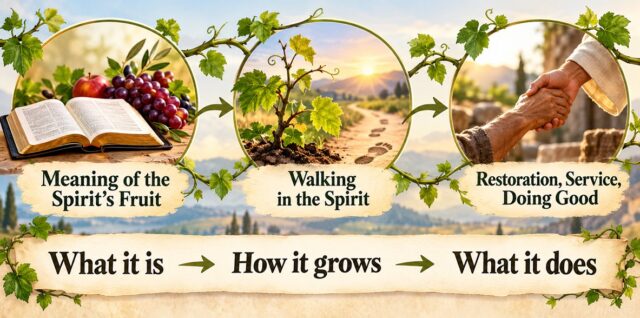
The fruit of the Spirit in Galatians 5:22-23 is one of the most familiar descriptions of Christian character in Scripture, but the nine qualities make the most sense when they are studied within Paul’s larger argument. Rather than treating love, joy, peace, patience, kindness, goodness, faithfulness, gentleness, and self-control as an isolated list of virtues, this study follows their place in the flow of Galatians 5 and 6. We begin by asking what the fruit actually is and what Paul’s words mean in their biblical and Greek context. Then we examine how that Spirit-produced character grows as believers walk by the Spirit rather than surrendering to the desires of the flesh. Finally, we follow Paul into Galatians 6 to see what this character looks like when it becomes practical Christian ministry. The natural progression of the series is therefore simple: what the fruit is → how it grows → what it does.
The Fruit of the Spirit: What It Is and What It Means – This first study examines Galatians 5:13-26 in context, explaining Christian freedom, the contrast between flesh and Spirit, the meaning of “fruit,” and the nine Greek terms that together describe the Spirit-produced character increasingly visible in a growing believer’s life today. The goal is to understand Paul’s words before attempting to apply them. Each fruit is considered as part of a unified picture of godly Christian character rather than as an isolated personality trait.
The Fruit of the Spirit: Growing in Christlike Character by Walking in the Spirit – This second study explains how Spirit-produced character develops through the believer’s daily walk. It focuses on walking by the Spirit, being led by the Spirit, crucifying the flesh, keeping in step with the Spirit, and pursuing active, dependent, lifelong sanctification. The emphasis is neither legalistic self-improvement nor passive spirituality, but Spirit-empowered obedience. Believers actively respond to God’s truth while depending upon the Holy Spirit to produce increasingly Christlike character.
The Fruit of the Spirit in Action: Restoration, Burden-Bearing, and Doing Good – This third study follows Paul into Galatians 6, showing how the fruit becomes practical ministry. Gentleness restores the fallen, love bears burdens, humility rejects comparison, goodness shares resources, faithfulness perseveres, and Spirit-led believers do good to others without growing weary. The fruit of the Spirit is therefore not merely something Christians possess inwardly or discuss theoretically. It becomes visible through the way believers respond to sin, weakness, need, responsibility, and opportunities to serve.
Taken together, these three studies show that the fruit of the Spirit is not a disconnected collection of admirable qualities or a checklist for earning God’s approval. It is the developing character of believers who have been saved by grace, indwelt by the Holy Spirit, and called to walk according to the new life God has given them. The Spirit produces Christlike character, but that character is intended to move outward into loving obedience and practical service. Love becomes service, gentleness becomes restoration, goodness becomes action, faithfulness becomes perseverance, and self-control becomes victory over desires that would otherwise rule us. Galatians therefore moves naturally from Spirit-produced character to Spirit-directed conduct. As believers continue walking by the Spirit, the fruit becomes increasingly visible for the good of others and for the honor and glory of the Lord Jesus Christ.