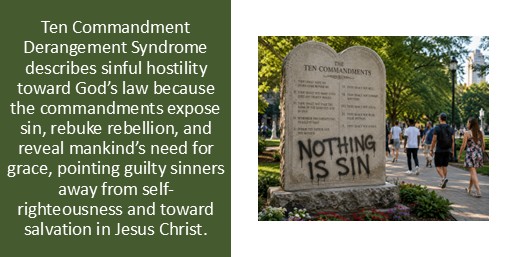
Closely related to Jesus Derangement Syndrome is what we might call “Ten Commandment Derangement Syndrome.” Again, this is not a medical diagnosis. It is a spiritual description of the heart’s hostility toward the law of God.
The same fallen world that resists Christ also resists God’s commandments. That should not surprise us, because Christ and the commandments of God are not enemies. Jesus perfectly fulfilled the law, exposed false interpretations of the law, and revealed the holy character of the Lawgiver. The Ten Commandments are not a man-made moral code. They are a summary of God’s holy standard, revealing His righteousness and exposing our sin.
That is why they provoke such strong reactions.
The Ten Commandments identify sin. They shine light on sin. They make sin more obvious. They rebuke sin. They tell the idolater that he has worshiped false gods. They tell the blasphemer that he has dishonored God’s name. They tell the rebel that he has despised God-given authority. They tell the murderer, adulterer, thief, liar, and coveter that his sin is not merely a private preference, but moral rebellion against the living God.
The law does not flatter people. It exposes them.
That is one of the main purposes of the law. It does not save the sinner. It shows the sinner why he needs to be saved. The law is like a mirror. A mirror can show dirt on the face, but it cannot wash the face clean. In the same way, the Ten Commandments reveal guilt, but they cannot remove guilt. They identify sin, but they cannot justify the sinner. Only Jesus Christ can do that.
Paul explains this clearly in Romans:
This does not mean the law created evil in an innocent heart. It means the law exposed sin for what it really is. Sin was already present, but when God’s commandment came, sin became clearer, more obvious, and more accountable. The commandment drew a bright line, and the rebellious heart crossed it.
This is why public displays of the Ten Commandments can provoke such irrational hostility. A stone monument in a courthouse or a framed display in a school hallway cannot force anyone to believe. It cannot convert the sinner. It cannot save the soul. But it does stand as a public witness that there is a God, that He has spoken, that His moral law is above human opinion, and that every person is accountable to Him.
That is what the world hates.
The issue is not merely the shape of the monument, the age of the display, or the wording on the wall. The deeper issue is spiritual. The Ten Commandments remind man that he is not autonomous. He is not his own god. He does not have the authority to define good and evil for himself. There is a Creator, a Lawgiver, and a Judge.
For the rebellious heart, that is intolerable.
This is the same pattern we see with Jesus. The world does not usually rage against a vague spirituality, a harmless religious symbol, or a sentimental version of Jesus who never confronts sin. But the biblical Jesus declares, “Repent.” The biblical Jesus says, “Follow Me.” The biblical Jesus exposes hypocrisy, condemns unbelief, forgives sinners, and claims absolute authority.
Likewise, the world may tolerate moral opinions when they are presented as personal preferences. But the Ten Commandments do not speak as preferences. They speak with divine authority.
Those are not suggestions. They are commandments.
I find it interesting that nobody wants other people to do any of the last six things to them. Everyone thinks everyone else should obey the last six commandments. In fact, almost every country has laws against these kinds of behaviors. Some with extreme consequences.
But these same people recoil at the thought of being bound by these commandments themselves. They do not want God’s law over them. They want to be free from divine restraint. But the tragic irony is that freedom from God is not freedom at all. It is slavery to sin.
Paul describes the proper function of the law in Galatians:
The law is not the Savior. It is the schoolmaster that leads us to the Savior. It shows us our guilt so that we stop pretending we are righteous. It shuts our mouth so that we stop boasting. It reveals our need so that we flee to Christ.
This is why the Christian should not be ashamed of the Ten Commandments. We do not preach the law as a way of salvation. We preach Christ as the only Savior. But we also understand that the law serves a holy purpose when used lawfully. It reveals sin. It awakens the conscience. It shows the sinner that he needs grace.
The problem is not with the law. The problem is with the sinful heart. God’s commandments are good, holy, and just. Man hates them because they expose what he wants to hide.
So when the Ten Commandments are hated, mocked, removed, or treated as dangerous, we should understand what is happening. The world is not merely rejecting ancient words carved in stone. It is rejecting the God who spoke them.
And this brings us directly back to Christ.
The law exposes sin, but Jesus saves sinners. The law condemns, but Christ justifies. The law reveals guilt, but Christ provides grace. The law says, “You have sinned.” The gospel says, “Christ died for our sins according to the Scriptures.”
That is why Romans 5:20-21 is so beautiful. Where sin increased, grace abounded all the more. God does not expose sin because He delights in condemnation. He exposes sin so that sinners will stop hiding, stop excusing themselves, stop trusting their own righteousness, and come to Christ for mercy.
The Ten Commandments are hated for the same reason Jesus is hated. They tell the truth about God, the truth about man, the truth about sin, and the truth about judgment. But when rightly understood, they also prepare the heart for the good news.
The law shows us our need.
The gospel shows us our Savior.