There was a time when I was jealous of Christians with a talent for apologetics who always seemed to have the perfect answer. You know the kind. Someone raises an objection, and they instantly fire back with a sharp quote, a clever illustration, a historical fact, a Greek word, a scientific point, or a devastating question that seems to end the conversation.
I used to think that was the goal. I thought effective witnessing meant being able to win every debate, answer every objection, expose every contradiction, and leave the other person with nothing to say.
But after years of conversations with Jehovah’s Witnesses, LDS Mormons, Catholics, skeptics, and confused churchgoers, I have become far less impressed with snappy answers. Not because truth does not matter. Truth matters eternally. Not because apologetics is useless. The Bible commands us to be ready to give an answer. But I have learned that winning an argument is not the same thing as winning a soul.
The problem is not apologetics itself. The problem is what apologetics can become when we forget the actual goal.
You Cannot Argue Someone into Faith
There is a simple logical problem with the way many Christians think about apologetics. We quietly assume that if we can make the better argument, the other person will become a believer. But that does not follow.
- An argument can answer a question.
- An argument can expose a contradiction.
- An argument can remove an obstacle.
- An argument can make someone think.
But an argument cannot repent for someone. An argument cannot believe for someone. An argument cannot humble a proud heart before God. An argument cannot make a sinner call upon the name of the Lord.
That is the logical fallacy. We confuse winning the debate with winning the person. We confuse silencing an objection with producing saving faith. We confuse the tool with the result.
Romans 10:17 says, “So then faith cometh by hearing, and hearing by the word of God.” Faith comes through the hearing of God’s Word, not through the cleverness of our performance. Romans 10:9-13 says salvation comes when a person believes in the risen Lord Jesus and calls upon Him. Our job is not to manufacture faith by force of argument. Our job is to faithfully preach Christ, explain the gospel, answer honest questions, and urge people to personally respond to Him.
My Conversations with Religious People Changed Me
Over the years, I have had many conversations with Jehovah’s Witnesses, LDS Mormons, and Catholics. One thing has stood out to me again and again. Most of them were not converted into their religion by an argument. Most did not sit down, carefully compare their religion to the Bible, study every doctrine from scratch, and then reason their way into that system.
Many were born into it. Some were loved into it. Some married into it. Some were socially absorbed into it. Some trusted parents, priests, missionaries, elders, teachers, or institutions. Some were afraid to question it. Some had never seriously examined the differences between their church’s teaching and Scripture.
That realization humbled me. If they were not argued into that system, why did I think I could simply argue them out of it in one conversation?
Likewise, in conversations with ex-Witnesses, ex-Mormons, and ex-Catholics who came to biblical faith in Christ, I have rarely found someone who said, “A Christian destroyed me in an argument, and that converted me.” What I have heard instead is something far more patient and human. Someone planted a seed. Someone asked a question. Someone gave them a Bible verse. Someone treated them with love. Someone refused to be cruel. Then, over time, they began to examine Scripture for themselves.
That does not mean arguments never matter. They do. But arguments often work like a pebble in the shoe. They may not convert a person in the moment, but they may bother the conscience long enough for the person to keep walking, keep thinking, keep reading, and eventually come face to face with Christ.
Research Can Become a Road to Repentance
There are excellent examples of people who came to faith through careful investigation. Lee Strobel, author of The Case for Christ, was a journalist who examined the claims of Christianity. J. Warner Wallace, author of Cold-Case Christianity, was a cold-case detective who investigated the evidence for the gospel. Their stories are encouraging because they show that Christianity is not afraid of facts, history, evidence, or honest scrutiny.
But even there, we should be careful with our wording. They did not save themselves by research. They investigated, they wrestled with the evidence, they encountered the truth, and they personally responded to Jesus Christ. The facts mattered, but the facts were not the Savior. Jesus is the Savior.
Apologetics can open the door. Scripture brings the light. The gospel calls for response. The sinner must personally believe.
The All-Out Blitz Usually Fails
Many Christians, when they sense an opportunity to witness, launch an all-out blitz. They fire every argument they know. They unload their spiritual arsenal. They quote verses, cite facts, correct errors, expose contradictions, and give the other person no room to breathe.
They do not really engage the person. They do not ask sincere questions. They do not build a bridge. They do not listen long enough to understand what the person actually believes. They simply present their arguments, make their case, and walk away feeling impressed with themselves.
Meanwhile, the person they were talking to may be silently wishing the conversation would end.
Later the Christian thinks, “I really blew them out of the water.” But that is not the goal. Our calling is not to blow people out of the water. Our calling is to point drowning people to the Savior.
That is why Proverbs 18:13 matters so much: “He that answereth a matter before he heareth it, it is folly and shame unto him.” A Christian who answers before listening may be technically correct and spiritually foolish at the same time.
The Prophets Rebuked Religious Speech Without Righteousness
Isaiah 58 gives a powerful warning against religious activity that looks impressive but lacks the heart of God. The people fasted, prayed, and acted religious, but they were harsh, self-centered, and unjust. God was not impressed with their religious display because their hearts were wrong.
Micah 3 gives a similar rebuke to corrupt spiritual leaders. They used religious language, but they did not love truth, justice, or mercy. They spoke as though God was with them, but their lives contradicted their message.
That should sober every Christian who loves apologetics. It is possible to defend truth with an ugly spirit. It is possible to quote Scripture while failing to love the person in front of us. It is possible to expose error while secretly enjoying the embarrassment of the person we are correcting.
Truth does not become more biblical when it is delivered with pride. Biblical truth should make us humble, not smug.
The Book of Acts Shows Boldness, Not Bragging
In Acts 2, Peter preached with clarity and courage. He did not entertain the crowd. He did not flatter them. He did not avoid sin. He proclaimed Jesus Christ, crucified and risen. He told them they were guilty, and when they were “pricked in their heart,” they asked, “Men and brethren, what shall we do?” Peter called them to repent.
That was not a clever performance. That was Spirit-empowered gospel preaching.
In Acts 4, Peter and John stood before the religious leaders and declared, “Neither is there salvation in any other: for there is none other name under heaven given among men, whereby we must be saved.” They were bold, but their boldness was not arrogance. They had been with Jesus. They were not trying to look brilliant. They were bearing witness.
There is a difference between boldness and combativeness. Boldness says, “Jesus is the only Savior, and I cannot deny Him.” Combativeness says, “I need to win this exchange so I can feel superior.” One honors Christ. The other feeds the flesh.
The Gospel Is Not a Debate Trophy
The gospel is not that Christians are smarter than unbelievers. The gospel is not that we have better debate tactics. The gospel is not that our religious team can defeat your religious team.
The gospel is that Jesus Christ, the eternal Son of God, died for our sins according to the Scriptures, was buried, and rose again the third day according to the Scriptures (1 Corinthians 15:1-4). All have sinned and fall short of the glory of God (Romans 3:23). Salvation is by grace through faith, not by works, religious effort, ritual performance, or institutional loyalty (Ephesians 2:8-9). Whoever calls upon the name of the Lord shall be saved (Romans 10:13).
That message must be explained clearly. False doctrine must be corrected. Jehovah’s Witnesses need to hear that Jesus is not a created being, but the eternal Son of God. LDS Mormons need to hear that God was never a man and man will never become God. Catholics need to hear that no priest, pope, sacrament, or purgatory can do what only Jesus Christ has finished by His blood. But even when we correct serious error, we must remember that the person in front of us is not a project, a target, or an opponent to humiliate. They are a soul made in the image of God.
Ask Better Questions
A better approach often begins with questions.
- “What do you believe a person must do to be saved?”
- “Where do you see that in Scripture?”
- “Do you believe Jesus’ death on the cross was enough to pay for all your sins?”
- “Are you trusting Christ alone, or Christ plus something else?”
- “If your church contradicted the Bible, which one would you follow?”
- “Would you be willing to read the Gospel of John and ask what Jesus says about Himself?”
Good questions do not replace the gospel, but they can expose the real issue. They also show respect. They slow the conversation down. They help the person think instead of merely defend.
Jesus often asked questions. Not because He lacked answers, but because questions reveal the heart.
Apologetics Should Serve Evangelism
Apologetics is useful when it serves the gospel. It becomes dangerous when it replaces the gospel.
A good apologetic answer can clear away confusion. It can show that Christianity is reasonable. It can expose the contradictions of false religion. It can defend the reliability of Scripture, the resurrection of Christ, the deity of Jesus, and the exclusivity of salvation in Him.
But apologetics must stay in its proper place. It is a servant, not the master. The goal is not to create an admirer of our intelligence. The goal is to call sinners to Jesus Christ.
Romans 10 does not say, “How shall they believe unless someone wins a debate?” It says, “How shall they hear without a preacher?” The central need is the proclamation of Christ. People must hear who Jesus is, what He has done, why they need Him, and how they must respond.
Stop Being Jealous of Snappy Answers
I am no longer jealous of Christians with snappy answers. I am thankful for gifted apologists, careful thinkers, and faithful defenders of the faith. The church needs people who can answer objections and contend for the truth. But I no longer think the sharpest answer is always the most useful answer.
Sometimes the most useful answer is a patient question. Sometimes it is a Bible verse read slowly. Sometimes it is a quiet testimony. Sometimes it is admitting, “I do not know, but I would be glad to study that with you.” Sometimes it is refusing to chase every rabbit trail so you can keep bringing the conversation back to Jesus.
The goal is not to sound impressive. The goal is to be faithful.
Conclusion: Win the Soul, Not the Argument
We should study. We should prepare. We should know what we believe and why we believe it. We should be able to answer error from Scripture. But we must never forget that no one is saved because we were clever. Sinners are saved because Jesus Christ died for their sins, rose from the dead, and offers eternal life to all who believe in Him.
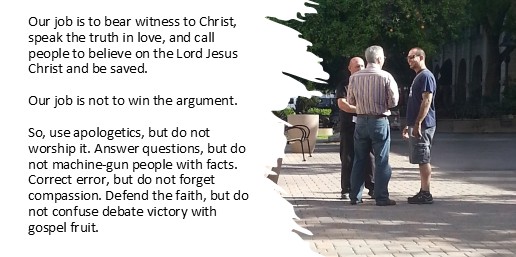
So, use apologetics, but do not worship it. Answer questions, but do not machine-gun people with facts. Correct error, but do not forget compassion. Defend the faith, but do not confuse debate victory with gospel fruit.
Our job is not to win the argument.
Our job is to bear witness to Christ, speak the truth in love, and call people to believe on the Lord Jesus Christ and be saved.