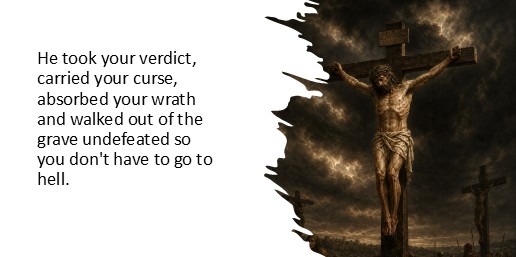
Some Christians have heard the phrase, “Jesus descended into hell,” and have wondered what it means. Did Jesus go to hell after He died? Did He suffer under Satan? Did demons torment Him? Did His atoning work continue after the cross? Or did Jesus fully pay for sin when He shed His blood, bore our sins, and cried, “It is finished”?
These questions matter because the Bible is very careful about the death of Christ. Scripture repeatedly says that Christ “died for our sins” (1 Corinthians 15:3), bore our sins “in his body on the tree” (1 Peter 2:24), redeemed us “through his blood” (Ephesians 1:7), became a curse for us by hanging on the tree (Galatians 3:13), and offered Himself “once for all” (Hebrews 10:10). The cross is the center of atonement. Any teaching that moves the completion of redemption away from the cross and into some later torment in hell creates serious biblical and theological problems.
The safest biblical answer is this: Jesus truly died. His body was buried. His spirit was consciously in Paradise. He entered death, but He was not abandoned to Hades. He did not suffer in the lake of fire. He did not need additional atoning torment after the cross, because before He died He declared, “It is finished” (John 19:30). Christ bore the full judicial penalty of sin on the cross as the sufficient Savior for the whole world, but only those who believe receive the saving benefits of His finished work.
The English Word “Hell” Can Confuse the Discussion
Part of the confusion comes from the English word “hell.” In older English Bible translations and in many theological discussions, “hell” can be used to describe different biblical realities. But the Bible uses several different words and categories, and we should not treat them all as identical.
In the Old Testament, Sheol is the Hebrew word commonly used for the realm of the dead. It can refer generally to death, the grave, or the unseen realm where the dead go. Psalms 16:10 says, “You will not abandon my soul to Sheol.” Peter applies this to Christ in Acts 2, showing that Jesus truly entered death but was not left there.
In the New Testament, Hades is the Greek word that often corresponds to Sheol. It refers to the realm of the dead, not the final lake of fire. Acts 2:27 says Christ was not abandoned to Hades. Revelation 1:18 shows the risen Christ holding “the keys of Death and Hades.” This means He conquered death and has authority over it. He was not a helpless prisoner of it.
Gehenna is different. Gehenna refers to final punitive judgment, often described with fire. Jesus uses this word in passages such as Matthew 10:28 and Mark 9:43-48. When Jesus warns about Gehenna, He is warning about God’s final judgment, not merely ordinary physical death.
The lake of fire is described in Revelation as the final place of judgment. Revelation 20:14 says, “Then Death and Hades were thrown into the lake of fire. This is the second death, the lake of fire.” That verse alone shows that Hades and the lake of fire are not the same thing. Hades is thrown into the lake of fire. The lake of fire belongs to final judgment after the great white throne, not to Christ’s experience after the crucifixion.
This means we should be very careful with the phrase, “Jesus descended into hell.” If by that phrase someone means Jesus truly died and entered the realm of the dead, yet was not abandoned there and rose bodily in victory, that can be explained biblically. But if someone means Jesus went to the lake of fire, suffered under demons, or continued paying for sin after the cross, Scripture does not teach that.
The Penalty for Sin Is Death
The story begins in Genesis. God warned Adam, “Of the tree of the knowledge of good and evil you shall not eat, for in the day that you eat of it you shall surely die” (Genesis 2:17). Death was not an accident in God’s world. Death came as the judicial consequence of sin.
When Adam sinned, death entered the human race. Romans 5:12 says, “Sin came into the world through one man, and death through sin, and so death spread to all men because all sinned.” Romans 6:23 says, “The wages of sin is death.” Sin earns death as its wage. That death includes physical death, spiritual separation from God, and, for those who reject God’s salvation, final judgment.
This is why Jesus came. He did not come merely to give moral advice. He came to save sinners. “Christ Jesus came into the world to save sinners” (1 Timothy 1:15). Jesus Himself said, “The Son of Man came to seek and to save the lost” (Luke 19:10). Lost sinners do not need self-improvement first. They need redemption, forgiveness, new birth, and eternal life.
Christ Died as the Substitute for Sinners
The Bible’s central answer to sin is not that Jesus suffered additional torment after death. The Bible’s answer is that Jesus died for sinners as the perfect substitute.
Isaiah 53 gives one of the clearest Old Testament pictures of substitutionary atonement. “He was pierced for our transgressions; he was crushed for our iniquities” (Isaiah 53:5). “The LORD has laid on him the iniquity of us all” (Isaiah 53:6). “His soul makes an offering for guilt” (Isaiah 53:10). The Servant suffers in the place of sinners, bears their guilt, and provides righteousness for many.
Jesus interpreted His own mission this way. “The Son of Man came not to be served but to serve, and to give his life as a ransom for many” (Matthew 20:28). He did not say He came to give His life and then continue the ransom by being tortured after death. He gave His life as the ransom. At the Last Supper, He said, “This is my blood of the covenant, which is poured out for many for the forgiveness of sins” (Matthew 26:28). Forgiveness is grounded in His shed blood.
John the Baptist announced Jesus as “the Lamb of God, who takes away the sin of the world” (John 1:29). Lamb language points to sacrifice. Passover language points to blood. Day of Atonement language points to substitution, priesthood, and removal of guilt. All of these biblical patterns find their fulfillment in Christ’s sacrificial death.
- Your Sins Were Paid by the Death, Burial, and Resurrection of Jesus Christ
- Jesus Christ is the Passover Lamb of God sacrificed for the sin of the world
The Cross Is Where Christ Bore Sin
The New Testament repeatedly locates atonement at the cross.
Romans 3:24-26 says believers are justified through the redemption in Christ Jesus, whom God put forward as a propitiation “by his blood.” Propitiation means that God’s righteous wrath against sin is satisfied. Paul locates that propitiation in Christ’s blood.
Romans 5:8-9 says, “Christ died for us” and “we have now been justified by his blood.” Again, the saving act is Christ’s death and shed blood.
Galatians 3:13 says, “Christ redeemed us from the curse of the law by becoming a curse for us, for it is written, Cursed is everyone who is hanged on a tree.” Paul ties Christ’s curse-bearing to the tree, that is, the cross. He does not tie it to a later descent into fiery torment.
Colossians 2:14 says God canceled the record of debt against us by “nailing it to the cross.” Verse 15 says Christ disarmed the rulers and authorities and triumphed over them. Satan was defeated by Christ’s cross and resurrection. Satan was not the administrator of atonement. Demons did not punish Jesus to help save sinners. Christ offered Himself to God.
Hebrews 10:10 says, “We have been sanctified through the offering of the body of Jesus Christ once for all.” Hebrews 10:12 says Christ “offered for all time a single sacrifice for sins” and then sat down at the right hand of God. Hebrews 10:14 says, “By a single offering he has perfected for all time those who are being sanctified.” The point is finality. Christ’s one offering is sufficient. No additional atoning suffering is needed.
First Peter 2:24 is especially important: “He himself bore our sins in his body on the tree.” Peter places sin-bearing in Christ’s body on the tree. 1 Peter 3:18 says, “Christ also suffered once for sins, the righteous for the unrighteous, that he might bring us to God.” The suffering was once for sins. The purpose was substitution. The result is access to God.
What Did Jesus Mean When He Cried, “My God, My God, Why Have You Forsaken Me?”
Matthew 27:46 records Jesus crying out, “My God, my God, why have you forsaken me?” These words are from Psalms 22:1. They reveal real anguish and real judicial suffering under the curse of sin. Jesus was not pretending. He was bearing sin as the righteous substitute for the unrighteous.
But this cry must be interpreted carefully. It does not mean the Trinity was broken. It does not mean the Son stopped being God. It does not mean the Father stopped loving the Son. It does not mean Jesus went into post-cross torment in the lake of fire.
Psalms 22 begins with suffering, but it does not end in defeat. Psalms 22:24 says, “He has not despised or abhorred the affliction of the afflicted, and he has not hidden his face from him, but has heard, when he cried to him.” The same Psalm that begins with forsakenness ends with vindication, worship, and worldwide praise. Jesus’ cry reveals the depth of His suffering under sin’s curse, but it should not be stretched beyond what Scripture says.
Jesus bore wrath, curse, condemnation, and death in our place. That is biblical. But we should not say the Father stopped loving the Son, the Trinity ruptured, or Jesus was handed over to Satan for punishment. Hebrews 9:14 says Christ “through the eternal Spirit offered himself without blemish to God.” The cross was Trinitarian, holy, voluntary, and sacrificial.
“It Is Finished” Means the Atoning Work Was Complete
John 19:30 records one of the most important statements in the Bible: “It is finished.” Jesus said this before He died. The work the Father gave Him to do had reached its appointed completion. The debt had been paid. The sacrifice had been offered. The blood had been shed. The curse had been borne. The ransom had been given.
This does not mean the resurrection was unnecessary. The resurrection is essential because it vindicates Christ, displays His victory over death, and secures the believer’s living hope. But the resurrection is not additional atoning suffering. It is God’s public triumph over death through the risen Christ.
The gospel Paul preached in 1 Corinthians 15:3-4 is simple and decisive: “Christ died for our sins in accordance with the Scriptures, that he was buried, that he was raised on the third day.” Paul does not add that Christ suffered in hell to finish redemption. He preached Christ crucified (1 Corinthians 2:2). The apostolic gospel centers on Christ’s death, burial, and resurrection.
- It is finished (G5055 Tetelestai)
- Christ in the Feasts (A Scripture-Centered Study of Leviticus 23 and God’s Redemptive Program)
What Happened After Jesus Died?
The Bible gives us several important truths.
First, Jesus truly died. Matthew 27:50 says He “yielded up his spirit.” John 19:34-37 emphasizes His real physical death. His body was buried.
Second, Jesus entrusted His spirit to the Father. Luke 23:46 says, “Father, into your hands I commit my spirit!” This is not the language of abandonment to demonic torment. It is the language of trust after completed obedience.
Third, Jesus promised the believing thief immediate blessed fellowship. Luke 23:43 says, “Truly, I say to you, today you will be with me in Paradise.” This weighs strongly against the claim that Jesus spent that day suffering punitive hellfire. Jesus said the thief would be with Him in Paradise that very day.
Fourth, Jesus was not abandoned to Hades. Acts 2:27 quotes Psalms 16:10: “You will not abandon my soul to Hades, or let your Holy One see corruption.” Acts 2:31 explains that David foresaw and spoke about the resurrection of Christ, “that he was not abandoned to Hades, nor did his flesh see corruption.” Hades here is the realm of death, not the lake of fire. Jesus entered death, but death could not hold Him.
Fifth, the risen Jesus now holds authority over Death and Hades. Revelation 1:18 says, “I died, and behold I am alive forevermore, and I have the keys of Death and Hades.” Jesus is not the victim of Death and Hades. He is Lord over them.
What About 1 Peter 3:18-20?
First Peter 3:18–20 is one of the most difficult passages in this discussion. It says Christ was “put to death in the flesh but made alive in the spirit,” and that He “went and proclaimed to the spirits in prison.” Christians have understood this passage in several ways.
Some believe Christ preached through Noah by the Spirit to the disobedient generation before the flood. Some believe Christ proclaimed victory after His death or resurrection to imprisoned spirits. Some believe He announced triumph to fallen angelic beings. The passage is difficult, and careful Bible students should be humble about the details.
But the passage does not say Jesus suffered in hell. It does not say He continued atoning after the cross. It does not say demons punished Him. It does not say He entered the lake of fire. Whatever interpretation one takes, 1 Peter 3 must not be made to contradict John 19:30, Luke 23:43, Acts 2:27-31, or Hebrews 10:10-14.
The safest conclusion is this: 1 Peter 3 teaches proclamation and victory, not additional atoning torment.
What About Ephesians 4:8-10?
Ephesians 4:8-10 says Christ “descended into the lower regions, the earth” and then ascended far above all the heavens. Some take this as a reference to Christ’s incarnation. Others understand it as His burial. Others see a reference to His descent to the realm of the dead. But the passage should not be used to teach that Jesus suffered punitive hellfire after the cross.
The context is not about atonement being completed in hell. The context is about Christ’s victorious ascent and His giving of gifts to the church. The emphasis is triumph, not post-cross torment.
What About Matthew 12:40?
Jesus said, “Just as Jonah was three days and three nights in the belly of the great fish, so will the Son of Man be three days and three nights in the heart of the earth” (Matthew 12:40). This means Jesus would truly die and be buried. It does not require the idea that He suffered in Gehenna or the lake of fire. His burial fulfilled His own prophecy, and His resurrection on the third day confirmed His victory.
Hades Is Not the Lake of Fire
Revelation 20 is crucial. Revelation 20:11-15 describes the great white throne judgment. The dead are judged. Then Death and Hades are thrown into the lake of fire. The text says, “This is the second death, the lake of fire.”
This makes several distinctions clear. Physical death is not the same as final judgment. Hades is not the same as the lake of fire. The second death belongs to final judgment. The lake of fire is not where Scripture places Christ after the cross.
Jesus did not go to the lake of fire. The lake of fire is the final destiny of the devil, the beast, the false prophet, and all unbelievers who reject God’s salvation (Revelation 20:10-15; 21:8). Matthew 25:41 calls it “the eternal fire prepared for the devil and his angels.” Revelation 14:10-11 describes final conscious punishment for those who worship the beast. Jude 6–7 speaks of irreversible divine judgment. These passages warn us that final judgment is real, eternal, and terrible.
But they do not teach that Jesus suffered in the lake of fire. Christ bore the judicial penalty of sin on the cross. He did not personally become an unbeliever in final judgment. He did not become a sinner in His nature. He remained the spotless Lamb of God while bearing sin as our substitute.
Guarding Against Universal Reconciliation
This distinction also protects us from a serious doctrinal error: universal reconciliation, the idea that all people, and sometimes even Satan and demons, will eventually be saved.
The Bible teaches that Christ’s atonement is sufficient for all and genuinely offered to all. John 3:16 says God loved the world and gave His only Son so that whoever believes in Him should not perish but have eternal life. 1 John 2:2 says Christ is the propitiation not only for our sins, “but also for the sins of the whole world.” 1 Timothy 2:5-6 says Christ “gave himself as a ransom for all.” Hebrews 2:9 says Jesus tasted death “for everyone.”
But the Bible also teaches that the saving benefits of Christ’s work are received through faith. John 3:18 says, “Whoever believes in him is not condemned, but whoever does not believe is condemned already.” John 3:36 says, “Whoever does not obey the Son shall not see life, but the wrath of God remains on him.” John 8:24 says, “Unless you believe that I am he you will die in your sins.” 1 John 5:12 says, “Whoever has the Son has life; whoever does not have the Son of God does not have life.”
Therefore, we should not say, without careful explanation, that Jesus suffered the exact lake-of-fire punishment of every unrepentant sinner in such a way that would logically require every person to be saved. A safer and more biblical wording is this: Jesus bore the full judicial penalty of sin on the cross as the sufficient Savior for the whole world, but only those who believe receive the saving benefits of His finished work.
Unbelievers are not condemned because Christ’s sacrifice was insufficient. They are condemned because they reject the only Savior God has provided.
A Simple Chronological Scripture Pathway
Genesis 2:15-17, “you shall surely die.” God announced death as the penalty for sin before the fall. This establishes that death is not merely natural decay, but the judicial consequence of rebellion against God.
Genesis 3:15, “he shall bruise your head.” The first gospel promise announces the coming seed who would defeat the serpent. Christ’s suffering was not defeat under Satan’s authority, but the path to victory over Satan, sin, and death.
Exodus 12:13, “when I see the blood, I will pass over you.” The Passover lamb shows substitutionary protection from judgment through blood. This anticipates Christ, the true Lamb, whose blood delivers believers from wrath.
Leviticus 17:11, “it is the blood that makes atonement.” Atonement is connected to sacrificial blood. This prepares us to understand why the New Testament repeatedly emphasizes Christ’s blood, cross, and bodily death.
Isaiah 53:5-6, “the LORD has laid on him the iniquity of us all.” The Servant bears sin substitutionally. Christ fulfills this by suffering for sinners, not by becoming a sinner, but by bearing their guilt as the spotless substitute.
Matthew 20:28, “to give his life as a ransom for many.” Jesus defines His mission as giving His life. The ransom is tied to His sacrificial death, not to later torment in hell.
Luke 23:43, “Today you will be with me in Paradise.” Jesus promised the believing thief immediate blessed fellowship after death. This strongly weighs against the idea that Jesus spent that day suffering punitive hellfire.
Luke 23:46, “Father, into your hands I commit my spirit.” Jesus died entrusting Himself to the Father. This expresses confidence and completed obedience, not abandonment to demonic torment.
John 19:30, “It is finished.” Jesus declared completion before death. This leaves no room for a necessary post-cross stage of atoning suffering.
Acts 2:31, “not abandoned to Hades.” Peter teaches that Jesus truly entered death but was not abandoned there. Hades here is the realm of death, not the lake of fire.
Romans 3:24-26, “propitiation by his blood.” Christ satisfied God’s righteous wrath through His blood. Paul locates atonement in Christ’s sacrificial death.
Galatians 3:13, “becoming a curse for us.” Jesus bore the law’s curse by hanging on the tree. The curse-bearing is tied directly to the cross.
Colossians 2:14-15, “nailing it to the cross.” God canceled the believer’s debt at the cross and disarmed demonic powers there. Satan was defeated by the cross, not invited to punish Christ.
Hebrews 10:12-14, “a single sacrifice.” Christ offered one sacrifice for sins and sat down at God’s right hand. His seated position shows the finality and sufficiency of His finished work.
1 Peter 2:24, “in his body on the tree.” Peter places sin-bearing specifically in Christ’s body on the cross. This is one of the clearest statements against moving atonement into post-cross torment.
1 Peter 3:18-19, “proclaimed to the spirits in prison.” This difficult passage speaks of proclamation, not additional atoning suffering. It should not be used to teach that Jesus suffered in hell after the cross.
Revelation 1:18, “the keys of Death and Hades.” The risen Christ rules over Death and Hades. He is conqueror, not captive.
Revelation 20:14, “Death and Hades were thrown into the lake of fire.” Hades and the lake of fire are not the same. The lake of fire is final judgment, not Christ’s post-cross suffering.
Conclusion: Christ Finished the Work at the Cross
Jesus bore the full judicial penalty of sin on the cross. He suffered as the righteous substitute for the unrighteous. He shed His blood, gave His life, bore the curse, endured wrath, died physically, was buried, and rose bodily in victory. His saving work is sufficient for the whole world and genuinely offered to all, but its benefits are received only through personal faith in Him.
Jesus did not suffer in the lake of fire. He was not tormented by demons. Satan did not administer the atonement. Hell was not the place where redemption was finished. Christ voluntarily offered Himself to the Father, bore our sins in His body on the tree, cried “It is finished,” and rose as the Lord of Death and Hades.
The glory of the gospel is not that Jesus needed more suffering after the cross. The glory of the gospel is that the Son of God fully accomplished salvation through His obedient death and victorious resurrection. Therefore, the sinner is not invited to trust in a vague story about hellish torment after death, but in the crucified and risen Christ, who died for our sins, was buried, rose again, and now offers eternal life to all who believe.