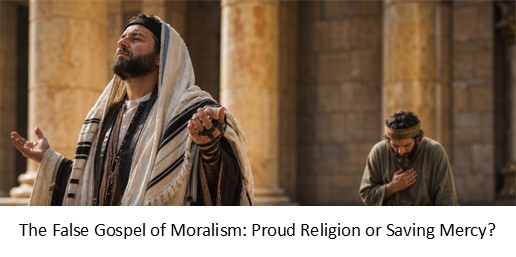
Moralism is one of the most dangerous religious errors because it often looks clean, disciplined, respectable, and biblical. It talks about good behavior, strong families, clean living, moral standards, religious duty, and personal responsibility. Those things may sound admirable, and in their proper place they are. The Bible does command holiness, obedience, self-control, integrity, purity, generosity, and love.
But moralism becomes false teaching when it turns morality into the basis of acceptance with God. It says, openly or subtly, “Be good, try harder, live decently, keep the rules, and God will approve of you.” It may use Bible verses, attend church, defend traditional values, and avoid scandalous sins, yet still miss the heart of the gospel.
The true gospel is not that sinners improve themselves until God accepts them. The true gospel is that guilty sinners are saved by grace through faith in Jesus Christ, who died for our sins, was buried, and rose again the third day according to the Scriptures (1 Corinthians 15:1-4). Good works matter, but they are the fruit of salvation, not the root of salvation.
GotQuestions summarizes the danger well by saying that Christian moralism emphasizes moral behavior so strongly that “obedience comes before faith, and grace is often obscured.” It also notes that moralism begins to look much like legalism. BibleTruths similarly defines legalism as requiring works for salvation, which is the opposite of faith alone, or emphasizing rules and regulations as the means of spiritual growth.
1. The False Teaching: Moralism as a False Gospel
Moralism is the teaching or assumption that moral behavior is the central solution to man’s spiritual problem. It may not always deny Jesus directly, but it often reduces Jesus to a moral example, a religious teacher, or a helper for self-improvement. In moralism, the main message becomes, “Do better,” rather than, “Believe on the Lord Jesus Christ, and thou shalt be saved” (Acts 16:31).
A moralistic message often sounds like this: be a good person, follow the rules, raise decent children, avoid bad sins, respect religion, serve others, and God will accept you. Some of those actions may be good in themselves, but they become spiritually deadly when they replace repentance, faith, the new birth, justification, and the finished work of Christ.
The false teaching of moralism can be stated clearly:
Moralism falsely teaches that moral behavior, religious discipline, or personal goodness can make a sinner acceptable to God.
That is not Christianity. That is self-righteous religion.
The Bible teaches that man’s deepest problem is not merely bad behavior. Man’s deepest problem is sin before a holy God. Romans 3:23 says, “For all have sinned, and come short of the glory of God.” Ephesians 2:1 says sinners are “dead in trespasses and sins.” Isaiah 64:6 says, “all our righteousnesses are as filthy rags.” Even our best works cannot erase guilt, satisfy divine justice, or produce spiritual life.
The Baptist Faith and Message rightly summarizes biblical salvation as the redemption of the whole man, freely offered to all who accept Jesus Christ as Lord and Savior, and it clearly states that there is no salvation apart from personal faith in Jesus Christ. It also distinguishes regeneration, justification, sanctification, and glorification, which helps preserve the biblical order of salvation before growth in holiness.
- Biblical Christianity vs Religion of Humanism – Humanism resembles moralism by trusting human reason, goodness, and achievement. Biblical Christianity begins with humanity’s fallenness and need for salvation, grounding righteousness in Christ, Scripture’s authority, and the Holy Spirit’s transforming work.
2. Concise Summary of Correct Biblical Teaching
The Bible’s answer to moralism is not immorality. It is the gospel of grace that produces real holiness.
The correct biblical teaching is this:
Sinners are saved by grace alone through faith alone in Jesus Christ alone, apart from works, and those who are saved are then transformed by the Holy Spirit into a life of obedience and good works.
Ephesians 2:8-10 gives the order clearly:
Good works are not the cause of salvation. They are the result of salvation. Verse 9 excludes works as the basis of being saved. Verse 10 includes good works as the purpose and fruit of the believer’s new life in Christ.
Salvation is by grace alone through free-will faith alone in the finished work of Jesus Christ alone, apart from works, while sanctification is a lifelong, Spirit-empowered transformation toward Christlikeness in which believers cooperate with the Spirit’s work.
This distinction is essential. Moralism says, “Obey so God will accept you.” The gospel says, “God accepts the believer in Christ, therefore obey Him in grateful faith.”
3. Moralism in Biblical History: Fig Leaves, Cain, Israel, and the Pharisees
Moralism did not begin in modern culture. It began in the fallen human heart. After Adam and Eve sinned, they tried to cover their shame with fig leaves (Genesis 3:7). That was the first human attempt to deal with guilt by self-covering. But God Himself had to provide covering (Genesis 3:21), pointing forward to the truth that sin requires God’s provision, not man’s invention.
Cain also approached God on his own terms (Genesis 4:3-7). Hebrews 11:4 says Abel’s offering was by faith, implying that Cain’s approach lacked true faith. Cain was religious, but not righteous before God.
Israel repeatedly fell into outward religion without inward repentance. Through Isaiah, God rebuked people who offered sacrifices while their hands were full of blood (Isaiah 1:11-17). Through the same prophet, God said, “this people draw near me with their mouth, and with their lips do honour me, but have removed their heart far from me” (Isaiah 29:13). Jesus later applied that same principle to the Pharisees (Matthew 15:7-9).
The Pharisees became the clearest New Testament picture of moralistic religion. They were not secular rebels. They were religious conservatives. They believed in Scripture, resurrection, angels, judgment, prayer, fasting, tithing, and moral separation. Yet Jesus repeatedly rebuked them because their religion had become self-righteous, external, proud, and spiritually blind.
Matthew 23:27-28 records one of Jesus’ strongest condemnations:
That is moralism. Outward righteousness before men. Inward uncleanness before God.
4. Key Word Study: Righteousness, Justification, Mercy, and Repentance
Righteousness
The Greek word commonly translated “righteousness” is dikaiosynē. It refers to righteousness, justice, or being right according to God’s standard. In Scripture, righteousness may refer to God’s own righteous character, righteous conduct, or the righteous standing God gives to the believer.
The moralist confuses outward moral conduct with righteous standing before God. The Bible does not deny that people can do relatively good actions. But no sinner possesses the perfect righteousness required for justification before God. Romans 3:10 says, “There is none righteous, no, not one.” Romans 3:21-22 then announces “the righteousness of God” which is “by faith of Jesus Christ unto all and upon all them that believe.”
Justification
The Greek verb translated “justify” is dikaioō. It means to declare righteous, acquit, or count someone righteous in a legal sense. Justification is not God pretending sin does not matter. It is God declaring the believer righteous because Christ has paid the penalty for sin and provides the righteousness the sinner lacks.
Romans 3:24 says believers are “justified freely by his grace through the redemption that is in Christ Jesus.” Romans 5:1 says, “Therefore being justified by faith, we have peace with God through our Lord Jesus Christ.”
The moralist seeks justification through personal performance. The gospel gives justification through faith in Christ.
Mercy and Propitiation
In Luke 18:13, the publican cries, “God be merciful to me a sinner.” The Greek verb translated “be merciful” is hilaskomai. This word is related to the idea of propitiation, meaning a sacrifice that satisfies wrath and provides atonement. The publican is not merely asking God to be emotionally lenient. He is pleading for atoning mercy.
This is important because the publican does not say, “God, I will do better and make it up to You.” He casts himself entirely on God’s mercy. He knows he needs more than improvement. He needs atonement.
Repentance
The Greek word for repentance is metanoia, meaning a change of mind that results in a turning toward God. Biblical repentance is not self-reform in order to earn salvation. It is the sinner’s honest turning from sin toward God while trusting His mercy.
Acts 20:21 summarizes Paul’s preaching as “repentance toward God, and faith toward our Lord Jesus Christ.” Repentance and faith belong together. Repentance recognizes the guilt and danger of sin. Faith rests in Christ as Savior.
5. Jesus Exposes Moralism Before Luke 18
Before Jesus told the parable of the Pharisee and the publican, He had already confronted moralistic religion many times.
In Matthew 5:20, Jesus said, “Except your righteousness shall exceed the righteousness of the scribes and Pharisees, ye shall in no case enter into the kingdom of heaven.” That statement would have shocked His hearers. The scribes and Pharisees were viewed as religiously serious people. If their righteousness was not enough, whose righteousness could be?
Jesus then showed that God’s standard reaches the heart. Murder begins with unrighteous anger (Matthew 5:21-22). Adultery begins with lust (Matthew 5:27-28). Love must extend even to enemies (Matthew 5:43-48). Moralism measures visible behavior. Jesus exposes the heart.
In Mark 7:20-23, Jesus said evil comes from within, out of the heart of man. He listed evil thoughts, adulteries, fornications, murders, thefts, covetousness, wickedness, deceit, pride, and foolishness. The moralist may clean the outside, but Christ diagnoses the inside.
In Luke 5:30-32, the Pharisees complained that Jesus ate with publicans and sinners. Jesus answered, “They that are whole need not a physician; but they that are sick. I came not to call the righteous, but sinners to repentance.” GotQuestions notes that publicans were despised, and that Jesus’ fellowship with tax collectors and sinners exposed the Pharisees’ disdain for those they considered spiritually beneath them.
Jesus did not deny the sinfulness of sinners. He denied the self-righteous illusion of the religious elite.
6. The Parable of the Pharisee and the Publican
Luke 18:9 introduces the parable with unusual clarity:
This verse identifies the target. Jesus is addressing people who trusted in themselves. That is moralism. They believed they were righteous. That is self-righteousness. They despised others. That is the fruit of proud religion.
GotQuestions says this parable contains “the very essence of the gospel of Jesus Christ,” and notes that Jesus spoke it to those who trusted in themselves that they were righteous and despised others.
The Pharisee: The Religious Moralist
Luke 18:10-12 says:
The Pharisee stood and prayed thus with himself, God, I thank thee, that I am not as other men are… I fast twice in the week, I give tithes of all that I possess.”
The Pharisee’s prayer sounds religious, but it is centered on himself. Notice the repeated emphasis: “I thank thee,” “I am not,” “I fast,” “I give.” He compares himself to worse sinners and assumes that his religious performance proves his righteousness.
He is not condemned because fasting is evil. Fasting can be good. He is not condemned because tithing is evil. Giving can be good. He is condemned because he trusts in his religious performance and despises the sinner beside him.
His morality became his hiding place from God.
The Publican: The Repentant Sinner
Luke 18:13 says:
The publican has no résumé. He lists no achievements. He makes no comparisons. He does not say, “At least I am not as proud as that Pharisee.” He simply confesses his guilt and pleads for mercy.
The phrase “the sinner” can carry the sense of deep personal awareness: “God, be merciful to me, the sinner.” He sees himself truly before God. He does not minimize sin. He does not negotiate. He does not boast. He asks for mercy.
The Shock: The Sinner Goes Home Justified
Luke 18:14 gives the stunning conclusion:
This is the thunderclap of the parable. The morally respectable religious man is not justified. The guilty, humbled, mercy-seeking sinner is justified.
Jesus does not say the publican went home with a probationary opportunity to prove himself. He says he went home justified. The verb is dikaioō, declared righteous. He is accepted by God, not because he has balanced the scales, but because he has come to God in humble repentance and faith in mercy.
This does not mean sin does not matter. It means grace is greater than sin, and self-righteousness cannot save.
David Guzik’s evangelical commentary insightfully observes that the tax collector’s justification was immediate, not earned by a probationary period, and that he came to God on the basis of atoning mercy. (Enduring Word)
7. Why Jesus’ Denouncement Was So Shocking
The parable is shocking because Jesus reverses human expectations. Most people would assume the Pharisee was closer to God. He was disciplined, religious, respected, and morally serious. The publican was viewed as compromised, corrupt, and socially despised.
But Jesus does not judge by appearances.
- The Pharisee had morality without humility. The publican had guilt with repentance.
- The Pharisee had religion without mercy. The publican had sin with confession.
- The Pharisee had works without faith. The publican had no works to offer, only a plea for atonement.
- The Pharisee compared himself with other men. The publican saw himself before God.
Jesus’ judgment is clear: the moralist was lost in his religion, while the repentant sinner was justified by mercy.
This is why moralism is so spiritually dangerous. It can keep a person from seeing his need for grace. Open sin may destroy a man, but self-righteous religion can blind him while he thinks he is safe.
8. Why Moralism Is Spiritually Harmful
Moralism Hides the True Problem
Moralism treats sin mainly as bad behavior. Scripture treats sin as guilt, corruption, rebellion, and spiritual death. Jeremiah 17:9 says, “The heart is deceitful above all things, and desperately wicked.” Romans 5:12 teaches that sin entered the world through Adam, and death by sin.
If the problem is only behavior, then education, discipline, and accountability may be enough. But if the problem is sin before God, then we need redemption, forgiveness, justification, regeneration, and reconciliation.
Moralism Produces False Assurance
A moral person may think he is right with God because he is not immoral in the obvious ways. He may say, “I am faithful to my spouse, I work hard, I pay my bills, I go to church, I am not like criminals, addicts, adulterers, or atheists.” That is exactly the spirit Jesus condemns in Luke 18:11.
But Jesus said, “Except a man be born again, he cannot see the kingdom of God” (John 3:3). Respectability is not regeneration.
Moralism Produces Pride
The Pharisee’s self-righteousness immediately produced contempt: “I thank thee, that I am not as other men are.” Moralism almost always compares downward. It looks for someone worse so it can feel righteous.
The gospel destroys boasting. Romans 3:27 asks, “Where is boasting then? It is excluded.” Ephesians 2:9 says salvation is “not of works, lest any man should boast.”
Moralism Produces Despair
Moralism crushes honest sinners because it tells them their hope depends on their performance. But what happens when they fail again? What happens when they see the depth of lust, pride, anger, envy, fear, or unbelief in their own hearts?
The gospel gives real hope because Christ saves sinners, not people pretending they are strong. Romans 5:8 says, “while we were yet sinners, Christ died for us.”
Moralism Weakens Evangelism
When moralism replaces the gospel, evangelism becomes moral advice. Instead of preaching Christ crucified and risen, we merely tell people to clean up their lives, fix their families, stop bad habits, and become religious.
But Paul preached “Christ crucified” (1 Corinthians 1:23). He delivered as first importance that Christ died for our sins and rose again (1 Corinthians 15:3-4). The gospel is not advice about how to become respectable. It is the announcement that Christ has accomplished salvation for sinners.
Moralism Confuses Sanctification
Moralism also damages Christian growth. It teaches believers to grow by rule-keeping, fear, comparison, and self-effort. Biblical sanctification is different. It is Spirit-empowered growth flowing from union with Christ.
Galatians 5:16 says, “Walk in the Spirit, and ye shall not fulfil the lust of the flesh.” Philippians 2:12-13 calls believers to work out their salvation because “it is God which worketh in you both to will and to do of his good pleasure.”
- Accepted in Christ, Transformed by Grace (Understanding Positional Acceptance and Progressive Sanctification) – Acceptance is grounded in Christ’s work, received through faith alone, and does not grow or diminish based on present performance. That distinction is vital because sanctification grows from acceptance in Christ, not a desperate attempt to earn it.
9. The Antidote: Salvation by Grace Through Faith
The antidote to moralism begins with the true gospel.
1 Corinthians 15:3-4 says: “Christ died for our sins according to the scriptures; And that he was buried, and that he rose again the third day according to the scriptures.”
Romans 10:9-13 teaches that salvation is received by faith in the risen Lord Jesus Christ: “If thou shalt confess with thy mouth the Lord Jesus, and shalt believe in thine heart that God hath raised him from the dead, thou shalt be saved.”
John 3:16 declares the universal offer of salvation: “For God so loved the world, that he gave his only begotten Son, that whosoever believeth in him should not perish, but have everlasting life.”
The gospel is not that good people go to heaven. The gospel is that sinners who believe in Christ are saved by grace.
Ephesians 1:7 says, “In whom we have redemption through his blood, the forgiveness of sins, according to the riches of his grace.” Romans 3:24 says believers are “justified freely by his grace.” Titus 3:5 says salvation is “not by works of righteousness which we have done, but according to his mercy.”
The publican in Luke 18 is a living picture of this truth. He does not bring moral achievement. He comes empty-handed. He pleads for mercy. Jesus says he goes home justified.
10. The Antidote Continued: Sanctification by Grace Through Faith
Rejecting moralism does not mean rejecting holiness. The Bible rejects both legalism and lawlessness. Grace saves, and grace trains.
Titus 2:11-14 says: “For the grace of God that bringeth salvation hath appeared to all men, Teaching us that, denying ungodliness and worldly lusts, we should live soberly, righteously, and godly.”
Grace does not say, “Sin does not matter.” Grace says, “Christ has saved you from sin’s penalty, and now He is training you to live for Him.”
Romans 6:1-2 asks, “Shall we continue in sin, that grace may abound? God forbid.” The believer has died with Christ and is called to walk in newness of life (Romans 6:3-4). Galatians 5:22-23 describes the fruit of the Spirit: love, joy, peace, longsuffering, gentleness, goodness, faith, meekness, and temperance. These are not self-manufactured badges of moral superiority. They are the Spirit’s fruit in the life of the believer.
- Antinomianism falsely abuses lawless grace – Antinomianism is moralism’s opposite error: it abuses grace as permission for sin. Both distort the gospel. Moralism denies grace by trusting works; antinomianism denies holiness by excusing sin. Biblical grace both justifies and sanctifies.
- The antidote for antinomianism and legalism – Legalism teaches people to earn God’s favor through laws, rules, or good works rather than by grace through faith in Christ. That balance matters. The cure for moralism is not antinomianism. The cure is grace-rooted obedience
11. Moralism Compared with Gospel Obedience
Moralism and gospel obedience may sometimes look similar externally, but they are completely different spiritually.
- Moralism obeys to earn acceptance. Gospel obedience obeys because the believer is accepted in Christ.
- Moralism compares itself with others. Gospel obedience humbles itself before God.
- Moralism hides sin to preserve image. Gospel obedience confesses sin and seeks cleansing.
- Moralism depends on willpower. Gospel obedience depends on the Holy Spirit.
- Moralism produces pride when it succeeds and despair when it fails. Gospel obedience produces humility, gratitude, repentance, and growth.
- Moralism says, “Look what I have done.” Gospel obedience says, “By the grace of God I am what I am” (1 Corinthians 15:10).
12. The Main Point of Luke 18:9-14
The main point is not that morality is bad and sin is good. The main point is that self-righteousness cannot justify, while repentant faith receives mercy.
The Pharisee was not condemned because he avoided extortion, injustice, adultery, or because he fasted and tithed. Those things were not the problem in themselves. The problem was that he trusted in himself that he was righteous and despised others.
The publican was not justified because tax collecting corruption was acceptable. He was justified because he came to God as a guilty sinner pleading for mercy.
Jesus’ conclusion is the key: “Every one that exalteth himself shall be abased; and he that humbleth himself shall be exalted” (Luke 18:14).
The moralist exalts himself through religious achievement. The repentant sinner humbles himself before God. God rejects the proud and gives grace to the humble (James 4:6).
13. Practical Applications
First, examine what you are trusting in. If someone asked, “Why should God accept you?” what would your answer be? If your answer begins with your morality, church attendance, baptism, giving, ministry, family values, or sincerity, you are thinking like the Pharisee. The only safe answer is Jesus Christ, crucified and risen for sinners.
Second, stop comparing yourself with people you think are worse. Comparison is one of moralism’s favorite hiding places. The question is not whether you are better than someone else. The question is whether you are righteous before a holy God.
Third, confess sin honestly. The publican did not manage his image. He told the truth before God. First John 1:9 says that if believers confess their sins, God is faithful and just to forgive and cleanse.
Fourth, pursue holiness as the fruit of grace, not the price of acceptance. Obedience matters deeply, but it must flow from faith, love, gratitude, and the Spirit’s power. Jesus said, “If ye love me, keep my commandments” (John 14:15).
Fifth, keep Christ central in teaching, parenting, preaching, counseling, and evangelism. Do not merely tell people to be good. Tell them they need Christ. Then teach those who belong to Christ to walk worthy of the Lord.
Discussion Questions
- In Luke 18:9, Jesus says the parable was aimed at those who “trusted in themselves that they were righteous.” What are some modern ways religious people can trust in themselves?
- Why is the Pharisee’s prayer spiritually dangerous, even though many of the things he mentions appear morally respectable?
- What does the publican’s prayer teach us about repentance, humility, and the need for atoning mercy?
- Why is it important to distinguish between good works as the fruit of salvation and good works as the supposed cause of salvation?
- How does Ephesians 2:8-10 protect us from both legalism and lawlessness?
- What are some ways churches can accidentally preach moralism while assuming the gospel?
- How can parents teach children biblical morality without teaching them to trust in morality for salvation?
- What is the difference between saying, “God accepts me because I obey,” and saying, “I obey because God has accepted me in Christ”?
- How does the doctrine of justification by faith give comfort to a believer who is grieving over sin?
- How does grace motivate deeper holiness than fear, pride, or religious comparison?
Conclusion: The Moralist and the Mercy-Seeker
Jesus’ parable of the Pharisee and the publican is one of the clearest denunciations of moralism in all of Scripture. The shocking point is that the religious moralist went home unjustified, while the repentant sinner went home justified. The issue was not that God approves of sin. The issue was that God rejects self-righteousness and gives mercy to sinners who humble themselves before Him.
Moralism says, “Climb up to God by your goodness.” The gospel says, “Christ came down to save sinners by His grace.” Moralism says, “Make yourself righteous.” The gospel says, “Receive the righteousness of God through faith in Jesus Christ.” Moralism says, “Compare yourself with worse people.” The gospel says, “Stand honestly before God and plead only the mercy found in Christ.”
The Christian life must never be less holy than moralism, but it must be far more gospel-centered. We are not saved by good works, but we are saved unto good works. We are not justified by moral improvement, but the justified believer is transformed by grace. The publican’s prayer remains the right starting place for every sinner: “God be merciful to me a sinner.” And Jesus’ verdict remains the sinner’s only hope: “This man went down to his house justified.”