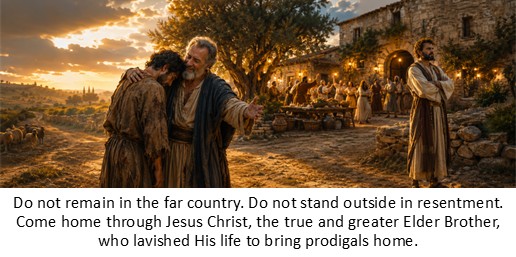
The parable commonly called “The Prodigal Son” has been preached, taught, illustrated, and applied countless times. Most Christians know the basic story. A younger son dishonors his father, demands his inheritance, leaves home, wastes everything, comes to himself in poverty, returns in repentance, and is received with astonishing compassion. The father runs, embraces him, clothes him, restores him, and celebrates his return.
But the parable does not end with the younger son. Jesus also tells us about the elder brother. This older son stayed home. He worked. He obeyed outwardly. He did not waste his inheritance in the far country. Yet when his sinful brother came home and was received with joy, the elder brother became angry and refused to enter the feast.
That means the parable exposes two kinds of lostness. The younger brother was lost in open rebellion. The elder brother was lost in self-righteous resentment. One wasted the father’s gifts in sinful living. The other served the father without sharing the father’s heart.
Yet there is an even deeper glory when this parable is read in the full light of the gospel. The elder brother in the parable failed. He would not rejoice over the restoration of the lost. He would not bear the cost of mercy. But Jesus Christ is the true and greater Elder Brother. He did not stand outside the feast in resentment. He left the glory of heaven, took the form of a servant, obeyed His Father perfectly, and gave His life to bring prodigals home.
In that carefully qualified, poetic sense, Jesus Christ may be called the Greater Prodigal Elder Brother. Not because He was wasteful, sinful, reckless, or foolish, but because the cross reveals the holy extravagance of divine grace. The Son of God lavished His life upon the undeserving, not in reckless waste, but in perfect, costly, saving love.
The Meaning of “Prodigal”
The word “prodigal” does not primarily mean “lost.” It means wastefully extravagant, recklessly spendthrift, lavish to the point of ruin. A prodigal person squanders what has been entrusted to him.
In Luke 15:13, the younger son “gathered all together, journeyed to a far country, and there wasted his possessions with prodigal living” (NKJV). The Greek word translated in that idea is ἀσώτως (asōtōs). It means recklessly, wastefully, dissolutely, or profligately. The King James Version says he wasted his substance with “riotous living.”
So the younger son was not merely lost geographically. He was lost morally, spiritually, and relationally. He rejected his father’s authority, despised his father’s household, treated his inheritance as a tool for self-indulgence, and destroyed himself in sinful freedom.
That is why the prodigal younger brother is such a fitting picture of fallen humanity. In Adam, the human race turned from God. Romans 5:12 says, “Through one man sin entered the world, and death through sin, and thus death spread to all men, because all sinned.” Romans 3:10-12 says, “There is none righteous, no, not one,” and Romans 3:23 says, “For all have sinned and fall short of the glory of God.”
We have all received life, breath, time, bodies, minds, families, abilities, opportunities, and consciences from God. Yet apart from grace, we spend His gifts as though they belong to us. We use God’s world while ignoring God’s Word. We enjoy God’s blessings while resisting God’s rule. We are all prodigals by nature, some in scandalous ways, others in respectable ways, but all in need of mercy.
The Younger Brother Represents Open Rebellion
The younger brother is easy to recognize. He is the sinner who runs away. He represents the obvious rebellion of humanity against God. He wants the father’s possessions but not the father’s presence. He wants blessing without obedience, freedom without holiness, pleasure without accountability, and inheritance without relationship.
This is the pattern of sin. Sin always promises liberty, but it produces bondage. Sin always promises fullness, but it produces emptiness. Sin always promises life, but it pays wages in death (Romans 6:23). The prodigal son began with money in his hand and ended with hunger in his belly. He began by demanding what he thought he deserved and ended by admitting he was no longer worthy.
When he “came to himself,” he said, “I will arise and go to my father, and will say to him, Father, I have sinned against heaven and before you” (Luke 15:18). That sentence is central. He did not merely say, “I made mistakes.” He did not merely say, “Life did not work out.” He confessed sin. First, he sinned against heaven. Then, he sinned before his father.
That is biblical repentance. It is not self-improvement. It is not bargaining. It is not promising to earn back what was lost. It is coming to God with the honest confession, “I have sinned.”
The father received him with grace, mercy, and peace. Grace is God’s undeserved kindness. Mercy is God’s compassion toward the guilty and helpless. Peace is the restored relationship that follows reconciliation. The son planned to return as a hired servant, but the father restored him as a son.
This is the glory of salvation. We were dead in trespasses and sins, but God, who is rich in mercy, made us alive together with Christ (Ephesians 2:1-5). We are saved by grace through faith, not by works, lest anyone should boast (Ephesians 2:8-9). The repentant sinner does not return with wages in his hand. He returns with confession, and the Father receives him by grace.
The Father Displays the Heart of God
The father in the parable portrays the compassion of God toward repentant sinners. Jesus told this parable because the Pharisees and scribes complained, “This Man receives sinners and eats with them” (Luke 15:2). They were offended by mercy. Jesus answered by revealing the joy of heaven over repentance.
The father did not need to be discovered in some hidden place. He was home. He was waiting. When the son returned, “his father saw him and had compassion, and ran and fell on his neck and kissed him” (Luke 15:20). The son did not earn that embrace. He did not buy that robe. He did not deserve that ring. He did not deserve the feast. He came home guilty, empty, and unworthy, and he found the father full of compassion.
This harmonizes with the whole message of Scripture. God loved us before we loved Him. First John 4:19 says, “We love Him because He first loved us.” John 3:16 declares, “For God so loved the world that He gave His only begotten Son, that whoever believes in Him should not perish but have everlasting life.” Luke 19:10 says, “For the Son of Man has come to seek and to save that which was lost.”
The sinner does not save himself by searching hard enough, climbing high enough, suffering long enough, or performing well enough. God has revealed Himself clearly in creation, so that mankind is without excuse (Romans 1:20). God has revealed His righteousness in His law, so that every mouth is stopped and all the world becomes guilty before Him (Romans 3:19). Most fully, God has revealed His saving love in Jesus Christ, who died for our sins and rose again.
The prodigal came home when he stopped pretending. He did not come home with an achievement. He came home with a confession. He did not say, “Father, look what I have done.” He said, “Father, I have sinned.”
That is still the way sinners come to God.
The Elder Brother Represents Self-Righteous Moralism
The elder brother is often missed because he looks so much better than the younger brother. He did not run away. He did not waste his inheritance in the far country. He did not live among harlots. He did not end up feeding pigs. Outwardly, he seems like the responsible son.
Yet his heart is exposed when grace is shown to someone else.
When he heard music and dancing, he asked what was happening. A servant told him that his brother had returned and that his father had killed the fatted calf because he received him safe and sound. Instead of rejoicing, “he was angry and would not go in” (Luke 15:28).
The father came out and pleaded with him, but the elder brother answered, “Lo, these many years I have been serving you; I never transgressed your commandment at any time” (Luke 15:29). Those words reveal the elder-brother spirit. He saw himself as a servant earning wages, not as a son enjoying grace. He viewed obedience as leverage over the father. He believed his faithfulness had earned him superior standing. He despised mercy when it was shown to someone he considered unworthy.
This is self-righteous moralism. It is not true holiness. True holiness loves what the Father loves. True obedience rejoices when sinners repent. True sonship is glad when the lost are found and the dead are made alive.
- Jesus Denounces Moralism (The Most Respectable False Gospel)
- Hello, my name is David, I am a recovering elder brother
The elder brother’s attitude is the same spirit Jesus exposed in Luke 18:9-14, where He told a parable “to some who trusted in themselves that they were righteous, and despised others.” The Pharisee prayed, “God, I thank You that I am not like other men.” But the tax collector cried, “God, be merciful to me a sinner!” Jesus said the tax collector went home justified rather than the Pharisee.
The issue is not that obedience is bad. Scripture calls believers to holiness, repentance, good works, self-control, and godliness. The issue is that self-righteousness turns obedience into pride. It compares itself to others. It resents grace. It refuses to celebrate mercy. It stands outside the Father’s joy.
The Failed Elder Brother Could Not Redeem Anyone
The elder brother in Luke 15 could not redeem himself, and he could not redeem his younger brother. He had no grace to give. He had no sacrifice to offer. He had no joy in restoration. He could condemn the prodigal, but he could not bring him home. He could boast in service, but he could not share the father’s compassion.
This is the failure of mankind. Open sinners cannot redeem themselves through pleasure, freedom, or self-expression. Religious sinners cannot redeem themselves through morality, effort, tradition, or comparison. The far country cannot save, and the field of self-righteous labor cannot save either.
Romans 5:7 says, “For scarcely for a righteous man will one die; yet perhaps for a good man someone would even dare to die.” Human love has limits. Human righteousness has limits. Human sacrifice has limits. We may admire worthy people. We may help respectable people. We may even sacrifice for those we believe deserve it. But the gospel goes far beyond that.
Romans 5:8 says, “But God demonstrates His own love toward us, in that while we were still sinners, Christ died for us.”
That is what the elder brother in the parable would not do. He would not rejoice over the undeserving. He would not bear the cost of restoration. From his perspective, the father’s mercy was unfair. The robe, the ring, the sandals, and the feast all looked like honor given to someone who had forfeited honor. Grace always looks offensive to the self-righteous because grace gives mercy to the undeserving.
But the gospel shows that grace is not unjust. God does not ignore sin. God does not pretend rebellion does not matter. God does not welcome sinners by sweeping righteousness aside. The Father welcomes sinners because the Son paid for sinners.
Jesus Christ Is the True and Greater Elder Brother
The elder brother in the parable failed, but Jesus Christ did not fail. He is the true and greater Elder Brother.
Hebrews 2:11 says that Christ is not ashamed to call His redeemed people “brethren.” Romans 8:29 says believers are predestined to be conformed to the image of God’s Son, “that He might be the firstborn among many brethren.” Christ is not merely a distant rescuer. He is the eternal Son who took on true humanity, identified with His people, and brought many sons to glory.
Unlike the elder brother in Luke 15, Jesus did not stay outside in anger. He left heaven in love. He did not resent the Father’s mercy toward sinners. He came to accomplish it. He did not complain that the unworthy were being welcomed. He died so the unworthy could be welcomed righteously.
Philippians 2:6-8 says that Christ, though existing in the form of God, “made Himself of no reputation, taking the form of a bondservant,” and “humbled Himself and became obedient to the point of death, even the death of the cross.” Second Corinthians 8:9 says, “Though He was rich, yet for your sakes He became poor, that you through His poverty might become rich.”
That is the greater Elder Brother.
The Son who is heir of all things (Hebrews 1:2) gave Himself so that sinners could become joint heirs with Him (Romans 8:17). He did not merely share a meal with prodigals. He shed His blood for prodigals. He did not merely plead with the Father to be kind. He satisfied divine justice by offering Himself as the sacrifice for sin.
First Peter 1:18–19 says we were redeemed “not with corruptible things, like silver or gold,” but “with the precious blood of Christ, as of a lamb without blemish and without spot.” Ephesians 1:7 says, “In Him we have redemption through His blood, the forgiveness of sins, according to the riches of His grace.”
The failed elder brother said, in effect, “This sinner does not deserve a feast.” The greater Elder Brother says, “I will bear his sin, pay his debt, clothe him in righteousness, and bring him home.”
The Holy Extravagance of the Cross
Here is where the word “prodigal” may be used carefully and poetically.
Jesus was never prodigal in the sinful sense. He was never wasteful, foolish, reckless, uncontrolled, or morally loose. His death was not an accident. His sacrifice was not a mistake. His blood was not wasted. He came in perfect obedience to the Father’s will. He laid down His life willingly, and He took it up again (John 10:17-18).
But if “prodigal” is used poetically to describe lavish generosity, then the cross displays the holiest prodigality the world has ever seen. It is the extravagance of grace. It is the overflowing mercy of God. It is the infinite Son giving Himself for guilty sinners. It is not reckless waste. It is costly redemption.
- At the cross we see grace, because salvation is God’s undeserved favor (Ephesians 2:8-9).
- We see love, because God gave His Son for the world (John 3:16).
- We see mercy, because God saved us not by works of righteousness which we have done, but according to His mercy (Titus 3:5).
- We see redemption, because Christ bought us with His blood (Ephesians 1:7).
- We see propitiation, because Christ satisfied God’s righteous wrath against sin (Romans 3:25; 1 John 2:2).
- We see sacrifice, because Christ offered Himself once for all in the putting away of sin (Hebrews 9:26-28).
This is why Jesus Christ is the Greater Prodigal Elder Brother, in the carefully guarded poetic sense. The younger son spent his inheritance in sin. The elder brother guarded his inheritance in resentment. But Jesus Christ spent Himself in love. The younger brother was prodigal in rebellion. The elder brother was anti-prodigal in self-righteousness. Jesus Christ was lavish in redemption.
By One Man’s Obedience
The parable of the prodigal son must be read in light of the greater biblical story. Humanity fell in Adam. We became sinners through one man’s disobedience. But God sent His Son as the last Adam, the obedient Man, the sinless Savior, and the true Redeemer.
Romans 5:19 says, “For as by one man’s disobedience many were made sinners, so also by one Man’s obedience many will be made righteous.” That one obedient Man is Jesus Christ.
The younger brother shows us what we are in sin. The elder brother shows us what we are in self-righteousness. Jesus shows us what only He can be, the obedient Son who brings sinners home.
Second Corinthians 5:21 says, “For He made Him who knew no sin to be sin for us, that we might become the righteousness of God in Him.” That is the robe of righteousness no sinner can earn. The prodigal came home in rags, but the father clothed him. In the gospel, sinners come to God guilty and empty, and God clothes them in the righteousness of Christ.
This is not salvation by works. This is not moral improvement dressed in religious language. This is justification by grace through faith in the finished work of Jesus Christ. The sinner is forgiven because Christ paid the penalty. The sinner is accepted because Christ is righteous. The sinner is adopted because Christ brings him into the family.
Come Home to the Father
The question now is not whether you are more like the younger brother or the elder brother. The truth is that sin shows itself in both ways. Some people run from God through open rebellion. Others stand outside the feast through religious pride. Some waste their lives in obvious sin. Others waste their lives trusting their own goodness. Both need grace.
Are you ready to repent and return to the Father?
Do not come with excuses. Do not come with bargaining. Do not come boasting that you are better than others. Come as the prodigal came, confessing, “Father, I have sinned.” Come as the tax collector came, praying, “God, be merciful to me a sinner.” Come believing the gospel, that Christ died for your sins, was buried, and rose again the third day according to the Scriptures (1 Corinthians 15:3-4). Romans 10:13 says, “Whoever calls on the name of the Lord shall be saved.”
If you come to the Father through Jesus Christ, your sins will be forgiven. You will be clothed in the righteousness of Christ. You will be adopted into the family of God. Your sins will not be remembered against you forever. Your eternity will be at home with the Father.
The Father receives repentant sinners. The Son has paid the price. The Spirit gives new life. The feast is ready.
Do not remain in the far country. Do not stand outside in resentment. Come home through Jesus Christ, the true and greater Elder Brother, who lavished His life to bring prodigals home.
- The Prodigal God: Recovering the Heart of the Christian Faith by Timothy Keller – Newsweek called renowned minister Timothy Keller “a C.S. Lewis for the twenty-first century” in a feature on his first book, The Reason for God. In that book, he offered a rational explanation of why we should believe in God. Now, in The Prodigal God, Keller takes his trademark intellectual approach to understanding Christianity and uses the parable of the prodigal son to reveal an unexpected message of hope and salvation. Within that parable Jesus reveals God’s prodigal grace toward both the irreligious and the moralistic. This book will challenge both the devout and skeptics to see Christianity in a whole new way.
- Why Grace Changes Everything by Chuck Smith – The difference grace will make for you…. Grace.. It’s a word we all love to hear. But do we all know what it means? Without it, our lives are dry and dusty. But when grace comes, it transforms our lives into something rich and beautiful. With remarkable insight gleaned from his own life, Pastor Chuck Smith unfolds the mystery of grace and reveals the surprising truth: We can never grow in grace by our own efforts. True grace flows from the heart of the Father through the love of Jesus Christ. To know that God is for you, that He loves you, is the greatest source of security you will ever know. That is grace-and that is what makes life worth living.