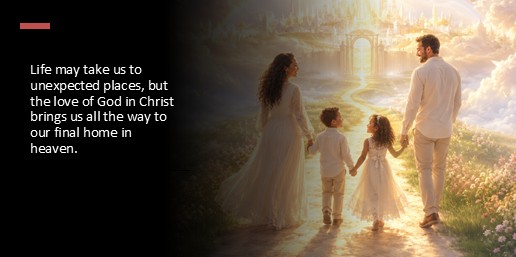
Life takes us to unexpected places. Sometimes those places are joyful, a new marriage, a new child, a new home, a new season of usefulness. Sometimes they are painful, a hospital room, a funeral home, an empty chair at the table, a body that no longer has the strength it once had. We make our plans, but life does not always follow the map we imagined. Yet for the believer in Jesus Christ, the final destination is not uncertainty, loneliness, or loss. The final destination is home with the Lord.
Jesus gave this comfort to His disciples on the night before the cross. He said, “Let not your heart be troubled: ye believe in God, believe also in me” (John 14:1). Those words were not spoken in an easy moment. The disciples were about to face confusion, grief, fear, and separation. Jesus would be arrested, crucified, buried, and for a little while, they would feel as though everything had fallen apart. But before the sorrow came, Jesus anchored their hearts in a promise: “In my Father’s house are many mansions… I go to prepare a place for you” (John 14:2).
That promise teaches us that heaven is not a vague spiritual idea. It is the Father’s house. It is the place where Christ receives His people to Himself. Jesus did not merely say, “I will prepare a place.” He said, “I will come again, and receive you unto myself; that where I am, there ye may be also” (John 14:3). The greatest joy of heaven is not golden streets, restored bodies, or reunion with loved ones, precious as those hopes are. The greatest joy of heaven is being with Christ.
- How many people will be in heaven?
- We will recognize friends and family in heaven
- How Many Times Did Jesus Think About You Today?
God gives us small earthly shadows of this kind of love in our families. A child running into a parent’s arms after being afraid, a husband and wife holding hands after decades of life together, a mother sitting beside a sick child through the night, a family gathering around a table where everyone knows they belong, these are not heaven, but they can faintly reflect the warmth of home. They remind us that love is not merely a feeling. Love receives, shelters, comforts, remembers, and stays.
But even the best earthly family love is only a shadow. Families can be separated by distance, weakened by age, wounded by sin, and broken by death. The love of God in Christ is greater. It is not fragile. It does not grow tired. It does not forget. It does not fail at the graveside. This is why Romans 8:38-39 is so precious: “Neither death, nor life… nor any other creature, shall be able to separate us from the love of God, which is in Christ Jesus our Lord.”
That means sickness cannot separate the believer from the love of God. A diagnosis may change our schedule, our strength, our plans, and our earthly future, but it cannot remove us from Christ. Loss cannot separate us from His love. Grief may empty our arms for a season, but it cannot empty God’s promises. Separation cannot separate us from His love. The miles between loved ones, and even the temporary separation of death, cannot undo what Christ has secured. Death itself cannot separate us from His love, because Jesus has already passed through death and risen in victory.
- Through the Valley of Death: A Bible Study on Psalm 23 and Romans 8:28–39
- Your Sins Were Paid by the Death, Burial, and Resurrection of Jesus Christ
- Favorite Bible Benedictions
Revelation 21 shows us where this love is taking us. John writes, “And I saw a new heaven and a new earth” (Revelation 21:1). Then he hears the great promise: “Behold, the tabernacle of God is with men, and he will dwell with them” (Revelation 21:3). The story of redemption ends not with God’s people wandering, grieving, and waiting forever, but with God dwelling among His redeemed people. The word “dwell” carries the idea of God making His home with His people. The separation caused by sin is gone. The curse is removed. The redeemed are finally and fully home.
Then comes one of the most tender promises in all Scripture: “And God shall wipe away all tears from their eyes” (Revelation 21:4). This is not cold theology. This is personal comfort. God does not merely announce that sorrow is over. He wipes away the tears of His people. Every tear of grief, every tear of loneliness, every tear of pain, every tear shed beside a bed, beside a casket, or in the quiet of the night, God knows them all. One day, He will wipe them away forever.
This is why John can say, “There shall be no more death, neither sorrow, nor crying, neither shall there be any more pain” (Revelation 21:4). Aging will not have the final word. Cancer will not have the final word. Dementia will not have the final word. The funeral will not have the final word. Christ will have the final word. The One who died for our sins and rose again will bring His people all the way home.
This hope does not make grief unreal. Christians still weep. Jesus Himself wept at the tomb of Lazarus (John 11:35). Faith does not require us to pretend that death is painless or that separation does not hurt. But Christian grief is different because it is grief with a promise. We sorrow, but not as those who have no hope (1 Thessalonians 4:13). The believer’s goodbye is real, but it is not final.
So, when life takes us to unexpected places, we can remember where the love of Christ is taking us. The road may pass through weakness, sorrow, aging, suffering, and death, but it does not end there. Jesus has prepared a place for His people. He will receive us to Himself. God will dwell with us. He will wipe away every tear. Nothing can separate us from His love.
Life may take us to unexpected places, but the love of God in Christ brings us all the way home.