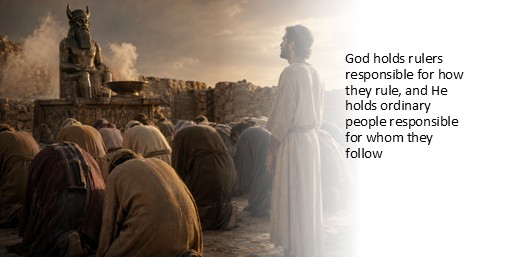
When we read the Old Testament accounts of the Judges, Kings, and Prophets, one troubling question naturally arises. Why did ordinary people suffer when their leaders were wicked? What about personal guilt or innocence? If a king promoted idolatry, corrupted the priesthood, ignored God’s Word, and led the nation into rebellion, was it fair for farmers, families, laborers, and children to experience the consequences?
The question becomes especially difficult when Scripture describes invasion, famine, captivity, and national destruction. It can sound as though God simply blamed everyone for the sins of their rulers. Yet a careful reading of Scripture reveals something far more precise. The Bible distinguishes between personal guilt before God, the responsibility of leaders who influence others toward evil, and the shared consequences that can fall upon an entire society under judgment.
Understanding that distinction helps make sense of much of the Old Testament. God never treated ordinary people as morally helpless simply because they lived under ungodly rulers. At the same time, faithful people could suffer terribly when the nation around them came under judgment.
God Held Each Person Responsible for His Own Sin
The principle of individual responsibility was built into Israel’s law long before the prophetic era. A person was not to be judicially condemned merely because his father had sinned, nor could a father be punished merely because of his son’s wrongdoing. God’s law recognized real personal responsibility.
This principle appears again when King Amaziah punished the men who had assassinated his father. He executed the murderers, but he did not kill their children, specifically because the Law said that children were not to die for their fathers’ sins (2 Kings 14:5-6). The king was required to distinguish between the guilt of one generation and the guilt of another.
Ezekiel later develops this principle in great detail because the people had begun blaming previous generations for their situation. God responded, “The soul who sins shall die” and explained that “the son shall not bear the guilt of the father, nor the father bear the guilt of the son” (Ezekiel 18:20). Jeremiah likewise declared, “Everyone shall die for his own iniquity” (Jeremiah 31:30).
This does not mean that one person’s sin never affects others. Scripture plainly shows that it does. A father’s foolishness can impoverish his children, a king’s wickedness can devastate a nation, and a generation’s rebellion can leave consequences for those who come afterward. But consequences and guilt are not the same thing. God can permit someone to suffer because of another person’s actions without declaring that sufferer personally guilty of the other person’s sin.
That distinction becomes extremely important when we move into the period of the Judges.
During the Judges, the Problem Was Not Merely Bad Leadership
It would be easy to read the Old Testament as though Israel’s primary problem was corrupt government. The book of Judges shows otherwise. Much of the time Israel did not even have a centralized king, yet the nation repeatedly descended into idolatry and rebellion.
- A Brief History of God’s Progressive Revelation – Progressive revelation shows God making Himself increasingly clear while rebellious mankind rejects His truth, grace, and redemption through Jesus Christ.
Judges repeatedly says that “the children of Israel did evil in the sight of the LORD” (Judges 2:11; 3:7, 12; 4:1; 6:1; 10:6; 13:1). The language is deliberately broad. The problem was not merely that a handful of rulers had abandoned God. The people themselves were participating in the rebellion.
Even when God graciously raised up judges to rescue Israel, the people often refused to listen. Judges 2:17 says, “They would not listen to their judges, but they played the harlot with other gods.” Their leaders certainly mattered, but the ordinary Israelite still had a responsibility to decide whether he would worship the LORD or follow the idols surrounding him.
This is one reason the book of Judges is so sobering. Without faithful leadership, people did not naturally drift toward righteousness. They drifted toward self-rule. Each person decided what seemed right to him, and eventually the entire society reflected that accumulated rebellion.
When the monarchy began, the influence of leadership became even greater, but personal responsibility did not disappear.
Wicked Kings Could Lead People Into Sin, but They Could Not Remove Their Responsibility
The books of Kings repeatedly describe rulers who “made Israel sin.” Jeroboam is perhaps the clearest example. He established rival worship centers at Bethel and Dan, created unauthorized priesthoods, and deliberately constructed a religious system designed to keep the northern tribes from returning to Jerusalem.
Jeroboam’s guilt was therefore enormous. He did not merely commit private idolatry. He institutionalized it and used governmental authority to encourage an entire nation to participate.
Yet Scripture does not describe the people as unwilling prisoners who had no choice. First Kings 12:30 says, “This thing became a sin, for the people went to worship before the one as far as Dan.” Jeroboam built the false system, but the people went.
This pattern continues throughout Israel’s history. Ahab and Jezebel promoted Baal worship and persecuted the prophets of the LORD, but God still distinguished between those who bowed to Baal and those who refused. Manasseh filled Jerusalem with idolatry and bloodshed, but his wicked policies did not make righteousness morally impossible.
The Law had anticipated this danger from the beginning. Israel’s kings were never supposed to be absolute authorities. Deuteronomy 17:18-20 required a king to write out a copy of God’s Law, read it continually, fear the LORD, obey His commandments, and avoid lifting himself above his fellow Israelites. The king was under God just as surely as the people were.
A government could command, encourage, reward, or normalize wickedness. It could even punish those who resisted. But it could never make disobedience to God morally right.
God Preserved Faithful People Under Wicked Governments
The reign of Ahab provides one of the clearest demonstrations that faithfulness remained possible even under a deeply corrupt government. Ahab and Jezebel did not merely tolerate Baal worship. They supported it aggressively, while Jezebel attempted to destroy the prophets of the LORD.
Elijah became so discouraged that he believed he was virtually alone. God corrected him.
Those seven thousand are important because Scripture tells us almost nothing about most of them. They were apparently not famous prophets, kings, or national reformers. They were simply people who refused to bow.
Obadiah gives us another example. He worked inside Ahab’s own administration and was responsible for the king’s household, yet Scripture says that “Obadiah feared the LORD greatly” (1 Kings 18:3). When Jezebel began killing God’s prophets, Obadiah secretly hid one hundred of them and supplied them with food and water.
He could not remove Ahab from office. He could not overthrow Jezebel. He could not reform the entire nation. But he could fear God, preserve life, and do what was right within the opportunities God had given him.
Naboth demonstrates the same principle from another direction. When Ahab wanted his vineyard, Naboth refused because the land was his family’s inheritance under God’s covenant law. “The LORD forbid that I should give the inheritance of my fathers to you,” he said (1 Kings 21:3).
Naboth’s refusal cost him his life. Jezebel arranged false accusations and had him executed. Yet Scripture never treats Naboth’s suffering as proof that God considered him guilty. He suffered because his rulers were wicked, not because he shared their guilt.
That distinction matters greatly when we consider the prophets and the eventual destruction of Israel and Judah.
The Prophets Spoke to Ordinary People, Not Only to Kings
If ordinary Israelites had been morally powerless under bad rulers, the prophets would have had little reason to call them personally to repentance. Yet the prophetic books repeatedly address the people themselves.
Isaiah told them, “Wash yourselves, make yourselves clean; put away the evil of your doings from before My eyes. Cease to do evil, learn to do good” (Isaiah 1:16-17). Micah declared, “He has shown you, O man, what is good” and called people to “do justly, to love mercy, and to walk humbly with your God” (Micah 6:8).
Jeremiah stood at the gate of the Temple and confronted those who came to worship, telling them to amend their ways and stop trusting in religious appearances while practicing injustice and idolatry (Jeremiah 7:1-11). His message was not simply directed toward the royal palace. God’s accusations reached households, priests, merchants, landowners, worshipers, and communities.
This makes the final judgments upon Israel and Judah easier to understand. God did not suddenly become angry because one king happened to be wicked. He warned generation after generation. He sent prophets repeatedly. He called kings and ordinary people alike to repentance.
The tragedy was not merely that rulers rejected God. The people often followed them willingly.
Ordinary Israelites Had Enough Revelation to Know What God Required
Another question naturally follows. What if ordinary people did not know any better? Could corrupt kings and priests have kept them so spiritually ignorant that they were unable to understand what God expected?
The Law itself was designed to prevent that kind of ignorance. God’s Word was not supposed to belong exclusively to rulers or religious elites. Parents were commanded to teach it in their homes. The nation was periodically to gather so that the Law could be read publicly to men, women, children, and foreigners living among them.
Deuteronomy 6:6-7 instructed parents to keep God’s words in their hearts and teach them diligently to their children. Deuteronomy 31:10-13 commanded the public reading of the Law so that the entire population could hear, learn, fear the LORD, and obey Him.
Israel also had priests, Levites, elders, prophets, festivals, covenant memorials, and written revelation. Corrupt leaders could suppress truth, distort worship, or encourage apostasy, but they could not erase God’s revelation entirely.
That is why the prophets could legitimately call ordinary people back to covenant faithfulness. God had spoken. The people were responsible for how they responded.
Personal Guilt and National Judgment Are Not the Same Thing
This brings us to the distinction that resolves much of the apparent unfairness. Israel existed under a national covenant with God, and Deuteronomy 28 plainly warned that persistent national rebellion would eventually result in famine, defeat, invasion, destruction, and exile.
When those judgments arrived, their effects were not limited to the individuals who had committed the worst sins. War does not carefully destroy only wicked houses. Famine does not affect only idolaters. Foreign armies do not carry away only corrupt officials.
Faithful people could therefore experience the temporal consequences of national judgment without sharing the moral guilt that brought the judgment.
Jeremiah was faithful, yet he lived through the destruction of Jerusalem. Ezekiel was carried into exile. Daniel was taken to Babylon as a young man, even though Daniel 1 immediately presents him as determined to remain faithful to God.
Their suffering did not prove that God considered them guilty alongside Judah’s idolaters.
This distinction can be stated simply:
Individual guilt is personal, but national consequences are often shared.
A faithful farmer could lose his field when an invading army arrived. A godly family could endure famine. A righteous young man could be carried into exile because his nation had collapsed. None of those experiences required God to confuse the righteous with the wicked.
God sometimes even made that distinction visible.
- A personal note from Nebuchadnezzar II, the richest most powerful man who ever lived – Nebuchadnezzar praises and glorifies the King of heaven, acknowledging God’s righteous and just actions that rule over the nations.
God Always Knew Who Was Faithful
Ezekiel 9 presents a striking picture of Jerusalem shortly before judgment. God commanded that a mark be placed upon those who “sigh and cry over all the abominations that are done within it” (Ezekiel 9:4).
God knew who embraced the wickedness and who grieved over it.
Malachi gives a similar picture near the end of the Old Testament. In a spiritually indifferent generation, some people continued to fear the LORD and encourage one another. God listened to them and declared that they belonged to Him.
This should prevent us from assuming that everyone who suffered during national judgment was equally guilty before God. Scripture itself gives us faithful prophets, obedient servants, persecuted believers, and righteous individuals living within societies that were ripe for judgment.
God knew exactly who they were.
What Was an Ordinary Person Supposed to Do?
Once we put these passages together, the Old Testament gives a surprisingly practical answer. An ordinary Israelite was not necessarily responsible to fix the entire government. He was responsible to remain faithful to God.
That meant knowing God’s Word, worshiping the LORD alone, refusing idolatry, practicing justice and mercy, caring for one’s family, listening when God sent prophets, repenting when confronted with sin, and refusing to participate in obvious wickedness even when the surrounding culture approved it.
Sometimes faithfulness meant quietly refusing to bow to Baal, as the seven thousand did. Sometimes it meant serving faithfully within a corrupt administration, as Obadiah did. Sometimes it meant protecting God’s servants. Sometimes it meant respectfully refusing a king’s unlawful demand, as Naboth did.
- A Personal Christian Mission Statement – It is wise and biblically healthy to identify a mission statement that captures your life’s direction under Christ.
- We need a new personal commission – Christians need a new personal commission to overcome the falling away that has happened in the world from wars, famines, pestilence, and disease.
Those specifically called as prophets had an additional responsibility to confront rulers publicly, as Elijah and Micaiah did. But Scripture never suggests that every faithful Israelite was required to become a revolutionary.
Jeremiah 29 makes this particularly clear when Judah’s exiles found themselves living under pagan Babylonian government. God told them to build houses, plant gardens, raise families, and seek the peace of the city where they had been carried captive (Jeremiah 29:5-7). They were not commanded to overthrow Babylon. They were commanded to live faithfully under Babylon.
“My Government Made Me Do It” Was Never a Defense
This may be the central principle running through Judges, Kings, and the Prophets.
A king might build the altar. Priests might bless the altar. Government policy might encourage the altar. The surrounding culture might celebrate the altar. Everyone you know might bow before the altar.
But you still decide whether you will bow.
Elijah’s challenge at Mount Carmel is remarkable precisely because Ahab and Jezebel had done everything possible to establish Baal worship in Israel. Yet Elijah still addressed the people directly: “How long will you falter between two opinions?”
- He did not tell them that they were innocent simply because their government was corrupt.
- Nor did he deny the king’s enormous responsibility for leading the nation into wickedness.
- Scripture holds both truths together.
- The ruler is responsible for how he rules.
- The people are responsible for whom they follow.
Shared Consequences Do Not Mean Shared Guilt
The Old Testament therefore gives us a much more careful picture than the idea that God simply punished helpless people because they happened to have bad leaders.
God gave Israel His Word. He required that it be taught publicly and privately. He sent prophets repeatedly when the people wandered. He held rulers especially accountable because their influence could lead thousands toward righteousness or wickedness.
Yet He also held individuals responsible for their own response to Him.
A wicked king could tempt, intimidate, corrupt, persecute, impoverish, or even kill those who resisted him. His responsibility before God was therefore enormous. But his wickedness did not eliminate the moral agency of everyone beneath him.
Some followed enthusiastically. Some compromised. Some remained silent. Some resisted. Some repented. Some stayed faithful.
And God knew the difference.
That is why Scripture can speak of national judgment while simultaneously identifying righteous people within the nation. Corporate judgment asks what happens to a society because of accumulated rebellion. Personal judgment asks where an individual stands before God.
Those are related questions, but they are not the same question.
The great lesson from Judges, Kings, and the Prophets is therefore not that ordinary people were helpless beneath evil governments. It is that God holds rulers responsible for how they rule, and He holds ordinary people responsible for whom they follow. Faithful people may sometimes suffer alongside a nation under judgment, but God never confuses their suffering with the guilt of the wicked.
The government may influence what is popular, profitable, legal, or dangerous. It cannot change what God has declared righteous.
And before God, “my government made me do it” has never been a defense for wickedness.