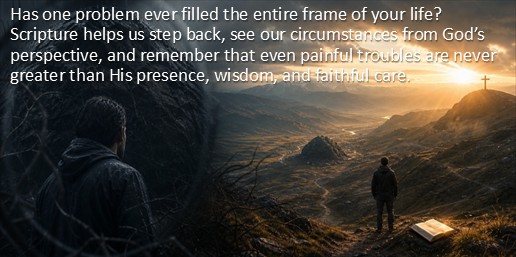
A difficult problem has a way of occupying the whole field of our vision. It fills the frame because we see everything from our own perspective. A troubling diagnosis, a strained relationship, a financial burden, an uncertain future, or a painful disappointment can become the first thing we think about in the morning and the last thing we consider at night. The problem may be real and serious, but our continual attention can make it appear even larger. Before long, we are no longer interpreting the problem in light of God’s truth. We are interpreting God, ourselves, and the future through the problem.
The late psychologist Daniel Kahneman described a pattern of human judgment known as the “focusing illusion.” He summarized it with the observation, “Nothing in life is as important as you think it is while you are thinking about it.” In other words, whatever holds our attention tends to grow in our estimation. When we focus almost exclusively on one circumstance, we can begin to believe that it will determine everything about our future happiness, usefulness, or security.
This observation may help describe how our minds sometimes function, but Scripture alone explains the spiritual danger and gives us the true remedy. God does not merely tell us to think more positively. He calls us to see our circumstances in the light of who He is, what He has promised, and what He is accomplishing through Jesus Christ.
When the Cares of Life Choke the Word
In the Parable of the Sower, the Lord Jesus warned about seed that fell among thorns:
“And that which fell among thorns are they, which, when they have heard, go forth, and are choked with cares and riches and pleasures of this life, and bring no fruit to perfection” (Luke 8:14).
The word translated “cares” refers to anxieties, concerns, or distracting worries. These cares become like thorns growing around the seed. The problem is not simply that difficult circumstances exist. The greater danger is that the concerns of this life can command so much attention that the Word of God is crowded out.
Jesus included riches and pleasures alongside worries. This reminds us that anything in this temporary world can monopolize our attention. Fear may do it, but so may success, comfort, ambition, possessions, or the pursuit of pleasure. Whatever consumes our thoughts can begin to appear more important than knowing God, obeying His Word, and bearing spiritual fruit.
The thorny soil does not bring fruit to maturity. This is a sobering warning for everyone who hears God’s Word. We must not assume that exposure to biblical truth automatically produces spiritual growth. The Word must be received, retained, and obeyed with a faithful heart (Luke 8:15).
- Learning from the parable of the sower and the seed
- The Sower, the Seed, and the Soil (Your Choice Changes Everything)
- Sin Has Consequences, But Repentance Brings Mercy (With 38 Examples from the Bible)
Our Problems Must Be Seen Beside Our God
Seeing life from God’s perspective does not mean pretending that suffering is painless. Scripture never asks us to call evil good, deny grief, or behave as though loss does not hurt. The Bible records the tears of Job, David, Jeremiah, Paul, and even the Lord Jesus. Biblical faith is not the denial of trouble. It is confidence in God in the midst of trouble.
Our difficulties begin to assume their proper scale when we place them beside the greatness of God. The prophet Isaiah wrote:
“Hast thou not known? hast thou not heard, that the everlasting God, the LORD, the Creator of the ends of the earth, fainteth not, neither is weary?” (Isaiah 40:28).
Our strength may fail, but His strength never does. Our understanding may be limited, but His wisdom is unsearchable. We may not know what tomorrow holds, but nothing in tomorrow will surprise or overpower Him.
The apostles learned to view their trials according to this eternal scale. Paul wrote:
“For our light affliction, which is but for a moment, worketh for us a far more exceeding and eternal weight of glory; while we look not at the things which are seen, but at the things which are not seen” (2 Corinthians 4:17-18).
Paul was not describing an easy life. He had experienced beatings, imprisonment, rejection, danger, hunger, exhaustion, and persecution (2 Corinthians 11:23-28). He could call his affliction “light” and temporary only because he compared it with the eternal glory God had promised. The weight of his trouble had not disappeared, but the weight of eternity was greater.
Scripture Restores the Proper Scale
Prayerful Bible reading is one of the primary ways God redirects our attention. Scripture reminds us of truths that our immediate circumstances tempt us to forget. God remains sovereign. Christ remains risen. The believer remains accepted in Christ. The Holy Spirit remains present. God’s promises remain trustworthy. Heaven remains certain, and the return of Jesus Christ remains our blessed hope.
The psalmist experienced this reorientation in the sanctuary of God. He had become troubled by the apparent prosperity of the wicked and the difficulty of his own life. His perspective changed when he entered God’s presence and understood the matter from the standpoint of eternity (Psalms 73:16-17). His circumstances had not immediately changed, but his interpretation of them had.
This is why we must do more than read an isolated verse when we are distressed. We should study Scripture in its grammatical, historical, and literary context, seeking the meaning God intended to communicate. As we trace His faithfulness through the whole Bible, we learn that God’s purposes are larger than the moment we can see.
Our problems tell us, “This circumstance will define your life.” Scripture answers, “Your life is hid with Christ in God” (Colossians 3:3). Fear tells us, “Everything depends upon you.” Scripture answers, “My help cometh from the LORD, which made heaven and earth” (Psalms 121:2). Suffering tells us, “Nothing good can come from this.” Scripture reminds believers that God works in all things for their ultimate good, conforming them to the image of His Son (Romans 8:28-29).
Prayer Transfers the Burden
God does not command us to ignore our anxieties. He commands us to bring them to Him:
“Casting all your care upon him; for he careth for you” (1 Peter 5:7).
To cast our cares upon God is not to become careless or irresponsible. It is to transfer the burden from our insufficient strength to His faithful care. We still obey what He has revealed, fulfill our responsibilities, seek wise counsel, and take appropriate action. Yet we refuse to carry tomorrow as though God had abandoned us to face it alone.
Paul gave similar instruction to the Philippian believers:
“Be careful for nothing; but in every thing by prayer and supplication with thanksgiving let your requests be made known unto God” (Philippians 4:6).
The expression “be careful for nothing” means that we are not to be ruled by anxiety. The answer is specific, thankful prayer. God invites us to name our concerns before Him while remembering His past faithfulness. His peace then guards our hearts and minds through Christ Jesus (Philippians 4:7).
Prayer does not manipulate God or guarantee that He will arrange our circumstances according to our preferences. It aligns our hearts with His will. In prayer we learn to say with the Lord Jesus, “Nevertheless not my will, but thine, be done” (Luke 22:42). Such surrender is not resignation. It is active trust in the wisdom and goodness of our heavenly Father.
God Often Carries Us Through His People
When a problem dominates our thinking, isolation usually makes it appear even larger. God has not designed Christians to mature alone. The local church provides biblical teaching, fellowship, prayer, encouragement, correction, and practical care.
Scripture commands believers, “Bear ye one another’s burdens, and so fulfil the law of Christ” (Galatians 6:2). It also tells us not to forsake assembling together, but to encourage one another as the day of Christ approaches (Hebrews 10:24-25). Through the faithful ministry of other believers, God reminds us that we have not been forgotten.
There are times when we need the courage to tell a mature believer, pastor, or trusted church member what we are facing. Honest fellowship can expose exaggerated fears, correct unbiblical assumptions, and help us see evidences of God’s faithfulness that we have overlooked. The church cannot replace Christ, but Christ often ministers to His people through the church.
Our own suffering may also prepare us to comfort someone else. God “comforteth us in all our tribulation,” so that we may comfort others with the comfort we have received from Him (2 Corinthians 1:3-4). A trial that seems to have interrupted our usefulness may become part of the way God equips us to serve.
Weakness Can Become a Place of Grace
We naturally want God to remove whatever makes us feel weak. Sometimes He does. At other times, He accomplishes a deeper purpose by sustaining us through the difficulty.
Paul repeatedly asked the Lord to remove his “thorn in the flesh.” God answered:
“My grace is sufficient for thee: for my strength is made perfect in weakness” (2 Corinthians 12:9).
God did not tell Paul that the thorn was imaginary or insignificant. He revealed that divine grace was greater. Paul’s weakness became an occasion for the power of Christ to rest upon him.
This changes the question we ask. Instead of asking only, “How can I escape this problem?” we may also ask, “How can I honor Christ within it? What truth must I believe? What command must I obey? What sinful response must I forsake? How might God use this trial to make me more like His Son?”
We should never assume that every tragedy will make sense to us in this life. God has not promised to disclose every reason for suffering. He has, however, revealed His character and demonstrated His love at the cross. The God who gave His Son for us can be trusted even when His providence is difficult to understand (Romans 8:32).
Fixing Our Eyes on Jesus
The decisive issue is not whether we think about our problems. Some circumstances require serious attention, prayer, planning, and action. The issue is whether the problem becomes the controlling center of our vision.
Scripture directs our attention to a Person:
“Looking unto Jesus the author and finisher of our faith” (Hebrews 12:2).
To look to Christ is to remember who He is and what He has accomplished. He is the eternal Son of God who became fully man without ceasing to be God. He bore our sins upon the cross, died in our place, rose bodily from the dead, ascended to the Father, and now intercedes for His people. Our greatest problem, sin and separation from God, has been answered through His finished work.
Salvation is God’s gift, received by faith in Jesus Christ rather than earned through religious works or personal effort (Ephesians 2:8-9; 1 Corinthians 15:1-4). Those who have trusted Christ are secure in His keeping (John 10:28-29). Therefore, no temporary circumstance has the authority to define their final identity or destiny.
Your problem may be large, painful, and beyond your ability to solve. But it is not larger than the Lord. Bring it honestly to Him. Search His Word. Receive the help of His people. Obey what He has already revealed, and entrust what you cannot control to His faithful care.
When the problem fills the frame, step back and look again. The Lord Jesus Christ is still present. His Word is still true. His grace is still sufficient. His purposes are still unfolding, and His eternal glory is still ahead. The thorns of this life do not deserve the final word. Christ does.