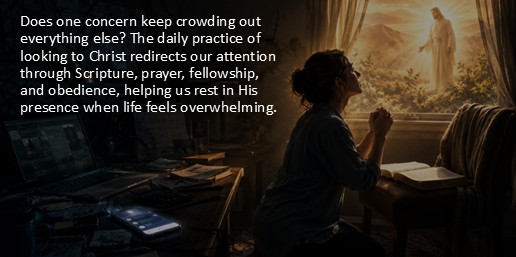
What occupies your attention will eventually influence your emotions, decisions, and spiritual direction. A single problem can grow so large in our thoughts that it seems to fill the entire horizon. The trouble may be real, painful, and important, but constant fixation can distort its apparent size until we can see little else.
Psychologist Daniel Kahneman described a tendency sometimes called the “focusing illusion.” His observation was that nothing in life seems as important as it does while we are intensely thinking about it. Psychology may describe this pattern, but Scripture reveals its spiritual danger and gives us the only trustworthy remedy. The Lord Jesus warned that “the cares of this world, and the deceitfulness of riches, and the lusts of other things entering in” can choke the Word and make it unfruitful in a person’s life (Mark 4:18-19).
The biblical answer is not to pretend that our problems do not exist. It is to place them within the larger reality of who Jesus Christ is. We must deliberately look away from the worries that dominate our vision and fix our attention upon the Savior who rules over them.
Looking to Jesus
Hebrews gives Christians a clear command:
“Let us run with patience the race that is set before us, looking unto Jesus the author and finisher of our faith” (Hebrews 12:1-2).
The Greek word translated “looking” is aphoraō (ἀφοράω). It carries the idea of turning one’s attention away from other things in order to fix the gaze upon one particular object. The Christian life cannot be run faithfully while we are continually looking backward at past failures, inward at our own weakness, or outward at the instability of the world. We must look away from every competing object and look unto Jesus.
Looking to Christ is not merely thinking pleasant thoughts about Him. It means directing our minds toward the truth of who He is, what He has accomplished, what He has promised, and what He presently does for His people.
He is the eternal Son of God who became fully man without ceasing to be fully God (John 1:1-14). He died as the substitutionary sacrifice for our sins, was buried, and rose bodily from the grave (1 Corinthians 15:1-4). He ascended into heaven, intercedes for believers, and will personally return in glory (Romans 8:34; Acts 1:9-11). He is not merely an example from the past. He is our living, present, all-sufficient Lord.
We first look to Christ for salvation, and then we continue looking to Him throughout the Christian life.
- Faith is Confidence in God and Obedience to His Word that Motivates Our Lives
- Innate Faith, Human Ability, and Divinely Strengthened
Look to Christ for Salvation
The daily practice of looking to Christ begins with the gospel. Before a person can follow Christ, serve Christ, or rest in Christ, that person must first believe in Him.
Jesus compared saving faith to Israel’s experience with the bronze serpent in the wilderness. When the Israelites were dying from the serpent bites, God instructed Moses to lift up a bronze serpent. Those who looked at it in faith lived. Jesus explained:
“As Moses lifted up the serpent in the wilderness, even so must the Son of man be lifted up: that whoever believes in him should not perish, but have eternal life” (John 3:14-15).
Salvation is not earned by religious works, moral improvement, church membership, baptism, or personal sacrifice. Eternal life is received by grace through faith in the finished work of Jesus Christ (Ephesians 2:8-9). The sinner must look away from self-righteousness, human effort, and every false hope, and look to the crucified and risen Savior.
The gospel invitation is extended genuinely to all: “Whoever calls on the name of the Lord will be saved” (Romans 10:13). Once a person believes, God forgives, justifies, regenerates, adopts, and seals that believer by the Holy Spirit. The Christian then begins a lifelong process of spiritual growth, learning day by day to keep looking to the One who saved him.
The Danger of Looking at the World
The world demands our attention. News reports, financial pressures, family concerns, political turmoil, health problems, workplace conflicts, and uncertain plans can crowd into our minds from the moment we awaken.
These concerns are not necessarily imaginary or unimportant. Jesus did not deny the reality of earthly needs. He spoke about food, clothing, tomorrow, and the burdens of ordinary life. Yet He repeatedly warned His disciples not to be consumed by them.
“Therefore do not be anxious, saying, ‘What will we eat?’, ‘What will we drink?’ or, ‘With what will we be clothed?’ For the Gentiles seek after all these things; for your heavenly Father knows that you need all these things. But seek first God’s Kingdom and his righteousness; and all these things will be given to you as well” (Matthew 6:31-33).
The problem is not responsible concern. The problem is anxious fixation that pushes God’s truth to the edges of our thinking. Worry magnifies the possibility of trouble while minimizing the presence, wisdom, power, and faithfulness of God.
When we look only at circumstances, distress increases. When we look only within ourselves, discouragement deepens because we quickly discover how weak, limited, and changeable we are. But when we look to Christ, we see One who is greater than our circumstances and stronger than our weakness.
Look to Christ Through Scripture
The primary way we look to Christ is through the prayerful reading of the Bible. Scripture is the inspired, inerrant, sufficient, and final authority for faith and practice (2 Timothy 3:16-17). It does not merely provide general encouragement. It reveals God’s character, explains His redemptive plan, corrects false thinking, exposes sin, and trains believers to live faithfully.
Jesus said that the Scriptures testify about Him (John 5:39). After His resurrection, He explained to two disciples “in all the Scriptures the things concerning himself” (Luke 24:27). Christ is not artificially inserted into every verse, but the entire biblical story ultimately points toward His person, work, kingdom, and glory.
We should therefore read the Bible using a literal, grammatical-historical approach. We ask what the biblical author intended to communicate to his original audience, paying attention to words, grammar, history, context, and literary form. Once the meaning is understood, we can apply its unchanging truth to our own lives.
Careful Bible study protects us from using isolated verses as slogans. It also keeps us from reshaping Jesus into the image of our personal desires. We do not look to an imaginary Christ created by our feelings. We look to the true Christ revealed in the written Word.
Daily immersion in Scripture restores a biblical scale to our circumstances. Our suffering may be deep, but God’s wisdom is deeper. Our resources may be limited, but His provision is not. Our path may be hidden from us, but nothing is hidden from Him.
- Minimum Daily Requirement of Bible Reading
- The same Holy Spirit who inspired the Bible will guide your understanding of the Bible
The Word becomes like spiritual radar that enables faith to see through the fog of present anxiety. As the psalmist declared, “Your word is a lamp to my feet, and a light for my path” (Psalms 119:105).
Look to Christ Through Prayer
Bible reading and prayer belong together. In Scripture, God speaks to us through His revealed Word. In prayer, we answer Him with worship, confession, thanksgiving, dependence, and specific requests.
Prayer is one of the clearest ways we turn our attention away from anxiety and toward Christ. Peter wrote:
“Casting all your worries on him, because he cares for you” (1 Peter 5:7).
The word “casting” describes deliberately placing a burden upon another. God does not command us merely to suppress our anxieties. He invites us to bring them to Him because He genuinely cares for His children.
Paul gave similar instruction:
“In nothing be anxious, but in everything, by prayer and petition with thanksgiving, let your requests be made known to God. And the peace of God, which surpasses all understanding, will guard your hearts and your thoughts in Christ Jesus” (Philippians 4:6-7).
Prayer does not inform God about circumstances He has overlooked. Our Father already knows what we need before we ask Him (Matthew 6:8). Prayer changes our posture. It moves us from self-reliance to dependence, from panic to petition, and from anxious speculation to thankful trust.
Pastor Greg Laurie has summarized this principle by observing that when our view of God becomes small, our problems appear enormous. When our understanding of God is enlarged by Scripture, the apparent size of our problems is brought back into proper proportion.
This does not mean that prayer always removes the trial. Paul prayed repeatedly for his “thorn in the flesh,” but the Lord did not remove it. Instead, Christ told him, “My grace is sufficient for you, for my power is made perfect in weakness” (2 Corinthians 12:9).
Sometimes Christ delivers us from suffering. At other times, He displays His sufficiency within it. In either case, prayer turns our attention toward the One whose strength is perfected in our weakness.
Look to Christ With the Local Church
Looking to Christ is personal, but it is not meant to be private or isolated. God places believers within local churches where they can learn the apostles’ doctrine, participate in fellowship, observe the ordinances, pray, serve, and encourage one another (Acts 2:41-42).
Isolation intensifies distorted thinking. When we are alone with our worries, the same fearful thoughts can circulate repeatedly without correction. We begin to assume that no one understands, no one cares, and nothing will ever change.
Biblical fellowship interrupts that cycle. Other believers remind us of truths we have temporarily forgotten. They pray when we struggle to find words. They help bear burdens that have become too heavy for us to carry alone.
“Bear one another’s burdens, and so fulfill the law of Christ” (Galatians 6:2).
The local church also turns our attention outward. When we begin serving others, we discover that our trials have not made us useless. God can use a suffering believer to comfort another suffering person with the comfort received from Him (2 Corinthians 1:3-4).
This does not mean concealing our pain behind a religious appearance. Christian fellowship requires appropriate honesty, humility, and vulnerability. James instructs believers to pray for one another, while Paul commands Christians to weep with those who weep (James 5:16; Romans 12:15).
As believers worship, learn, pray, and serve together, they collectively turn their attention toward Christ. The surrounding world may remain troubled, but the body of Christ can remain grounded because its Head is secure, sovereign, and unchanging.
Look to Christ Through Obedience
Looking to Christ is more than contemplation. A true sight of Christ leads to obedience.
Jesus said, “If you love me, keep my commandments” (John 14:15). Obedience does not purchase salvation or preserve our standing before God. Salvation is entirely by grace through faith. Nevertheless, the grace that saves us also trains us to reject ungodliness and live soberly, righteously, and godly in this present age (Titus 2:11-14).
Daily obedience is an active expression of trust. We obey because we believe Christ’s wisdom is greater than ours, His will is better than ours, and His commands are given for His glory and our good.
Sometimes our emotions will agree with obedience. At other times, they will resist it. Faithfulness cannot be governed by the changing temperature of the heart. We must choose to obey what Christ has revealed, even when we do not feel strong, enthusiastic, peaceful, or confident.
When we forgive someone who has wronged us, we are looking to Christ, who forgave us (Ephesians 4:32). When we serve someone who cannot repay us, we are looking to Christ, who came not to be served but to serve (Mark 10:45). When we refuse temptation, speak truth, show kindness, remain faithful, or endure hardship patiently, we are following the pattern and commands of our Lord.
- Faith is Confidence in God and Obedience to His Word that Motivates Our Lives
- God’s Law Written on the Heart: The New Covenant, the Ten Commandments, and Christian Obedience
Obedience does not merely demonstrate our focus upon Christ. It strengthens that focus. Each act of submission teaches the heart that Jesus is trustworthy.
A Simple Daily Pattern
The practice of looking to Christ should become part of the believer’s ordinary routine. It does not require a complicated system, but it does require intentionality.
Begin the morning with Scripture before allowing the world to set the direction of your thoughts. Read a manageable portion carefully, asking what the passage reveals about God, Christ, humanity, sin, salvation, obedience, and hope.
Name your principal burden before the Lord in prayer. Be specific. Do not merely say that you feel worried. Tell God what you fear, what outcome you desire, and where you are struggling to trust Him.
Identify one biblical truth that speaks directly to your concern. Your circumstances may not change that day, but your interpretation of them can be corrected by God’s Word.
Choose the next clear act of obedience. You may not know how the entire situation will be resolved, but God usually gives enough light for the next faithful step.
Pause during the day to redirect your attention. A brief prayer, a remembered verse, or a moment of thanksgiving can prevent one concern from consuming your thoughts.
End the day by reviewing it before the Lord. Confess sin, thank Him for evidence of His grace, and entrust unresolved matters to His care. Then rest in the truth that God continues working even while you sleep.
Looking to Christ Does Not Minimize Suffering
Looking to Christ should never be used to dismiss another person’s pain. The Bible does not teach believers to deny grief, suppress sorrow, or pretend that evil is harmless.
Jesus wept at the tomb of Lazarus even though He knew that He was about to raise him from the dead (John 11:35). Paul described himself as “sorrowful, yet always rejoicing” (2 Corinthians 6:10). Biblical faith makes room for lament, tears, questions, and weakness.
Looking to Christ does not mean saying, “This does not hurt.” It means saying, “This pain does not have the final word.” It does not mean, “Nothing is wrong.” It means, “Christ remains righteous, present, and faithful even when much is wrong.”
The believer may walk through a deep valley, but the Shepherd walks with him (Psalms 23:4). The trial may last longer than expected, but it cannot separate the Christian from the love of God in Christ Jesus (Romans 8:35-39). The body may weaken, but the inward person can be renewed day by day as the believer looks toward eternal realities (2 Corinthians 4:16-18).
Fix Your Eyes Upon the Unchanging Christ
The world will continually offer us new objects of fear, anger, desire, and distraction. Our hearts will also produce worries of their own. We cannot prevent every troubling thought from entering our minds, but we can choose where we will fix our attention.
Looking to Christ is the daily discipline of bringing our minds back to biblical reality. It is opening the Scriptures when circumstances confuse us, praying when anxiety presses upon us, gathering with believers when isolation tempts us, and obeying when our emotions resist the will of God.
Jesus Christ is greater than the problem that presently fills your vision. He is not anxious about tomorrow, confused about your circumstances, weakened by your opposition, or surprised by your suffering. He knows the end from the beginning, intercedes for His people, and promises never to leave or forsake them.
Therefore, look away from the world’s instability, your own insufficiency, and the fears that demand your attention. Look to Jesus, the author and finisher of your faith. Trust His finished work, rest in His sufficient grace, obey His revealed Word, and continue running the race He has placed before you.
The problem may still be real, but it will no longer occupy the throne of your vision. Christ will.