The Last Supper: Remembering the Lamb of God
On the night before His crucifixion, Jesus gathered with His twelve apostles in Jerusalem to celebrate the Passover Supper. For centuries, the Jewish people had observed Passover to remember how God delivered Israel from slavery in Egypt, when the blood of a sacrificial lamb protected their households from judgment (Exodus 12). But that first Passover also pointed forward to a far greater sacrifice. Jesus Christ is the Lamb of God who takes away the sin of the world (John 1:29), offering His own life to redeem mankind from the bondage and penalty of sin.
- Jesus Christ is the Passover Lamb of God sacrificed for the sin of the world – Jesus Christ is the Passover Lamb of God has been consistently preached throughout the entire Bible from Genesis to Revelation.
- Eternal covenant promises for Israel from the Bible – A comprehensive list of the eternal covenant promises Almighty God has made to Israel and Jerusalem.
Jesus had repeatedly warned His disciples that He would suffer, be rejected, and be killed, but that He would rise again on the third day (Matthew 16:21; 20:17–19). Although He had explained these things, the disciples struggled to understand what was about to happen (Luke 18:31-34). Jesus was preparing to fulfill the Scriptures by dying for our sins, being buried, and rising from the dead on the third day (1 Corinthians 15:3-4). His sacrifice would accomplish what the blood of countless Passover lambs could only symbolize: the forgiveness of sins through His own precious blood.
Throughout Israel’s history, God used physical objects and ceremonies to illustrate greater spiritual realities. The Passover lamb pointed forward to Christ’s sacrifice, while the Tabernacle in the Wilderness and later Solomon’s Temple served as earthly places of worship that pointed beyond themselves to the true sanctuary in heaven (Hebrews 8:5; 9:24). These visible patterns taught God’s people about holiness, sacrifice, atonement, and approaching God. In much the same way, Jesus used ordinary bread and wine to symbolize His body and blood, directing His disciples’ attention to the sacrifice He was about to make. The symbols were simple, but the truth they represented was extraordinary.
- The Seven Feasts of Israel: Redemption, Harvest, and Hope: A Simple Biblical Guide – The Seven Feasts of Israel, their biblical meaning, fulfillment in Jesus Christ, and prophetic themes of redemption, harvest, and hope.
- How Your Water Baptism Symbolizes Your Salvation – Water baptism symbolizes our death to sin, the washing away of our transgressions, and our resurrection to new life in Jesus Christ
This observance became known as Communion because believers share together in fellowship with Christ and one another through the remembrance of His sacrifice (1 Corinthians 10:16-17). It is also called the Lord’s Supper because Jesus Himself established it during His final Passover meal with His disciples (1 Corinthians 11:20). Communion is considered an ordinance of the church because Jesus did more than explain the meaning of the bread and cup. He gave an imperative command, telling His followers to continue observing this remembrance of Him (Luke 22:19; 1 Corinthians 11:24-25). It was not merely a description of something that happened, but an instruction for believers to obey.
Jesus was preparing these same disciples for an extraordinary new chapter in God’s plan of redemption. Within a few weeks, following His death, resurrection, and ascension, His remaining apostles and other believers would receive the promised power of the Holy Spirit at Pentecost (Luke 24:49; Acts 1:8; 2:1–4). This would mark the beginning of the church, the body of Christ, which would continue proclaiming the gospel throughout the world. The Lord’s Supper would become a regular observance among believers, remembering Christ’s completed sacrifice and proclaiming His death until He returns (Acts 2:42; 1 Corinthians 11:26).
- A Brief History of God’s Progressive Revelation – Progressive revelation shows God making Himself increasingly clear while rebellious mankind rejects His truth, grace, and redemption through Jesus Christ.
- A brief history of the future – Share this brief history of the future as revealed in the Bible. It is a good introduction to eschatology, which is the study of end times.
Jesus Establishes The Lord’s Supper
The following account brings together the Gospel descriptions of the Last Supper from Matthew 26:20-30, Mark 14:17-26, and Luke 22:14-23, with additional clarification from Paul’s instructions in 1 Corinthians 11:17-34. These passages have been combined into a single narrative, arranged in a reasonable chronological order, and paraphrased in contemporary English. Repeated details have been removed while preserving the important events, instructions, and promises recorded in Scripture. Together, they reveal the meaning of the Lord’s Supper and why Jesus commanded His followers to remember Him in this way.
When evening came, Jesus and His twelve apostles gathered around the table for the Passover meal. Jesus told them how eagerly He had looked forward to sharing this meal with them before His suffering began. He explained that He would not eat the Passover meal again until its meaning was fulfilled in the Kingdom of God. Then He took a cup of wine, thanked God for it, and told the disciples to share it among themselves. He also told them that He would not drink wine again until the day He drank it anew with them in His Father’s Kingdom.
While they were eating, Jesus announced that one of the twelve, someone sharing the meal with Him as a friend, would betray Him. Deeply troubled, the disciples began questioning one another, and each asked Jesus whether he might be the one. Jesus explained that His betrayer was someone who had shared the same bowl with Him. He told them that the Son of Man must die, just as the Scriptures had foretold, but terrible judgment awaited the one who betrayed Him. It would have been better for that man never to have been born. Judas, who would betray Him, asked, “Rabbi, am I the one?” Jesus answered, “You have said it.”
As they continued eating, Jesus took some bread and thanked God for it. He broke the bread into pieces and gave it to His disciples, telling them to take it and eat because it was His body, which would be given for them. He instructed them to continue doing this in remembrance of Him.
After supper, Jesus took another cup of wine, thanked God, and passed it to His disciples, who all drank from it. He explained that the cup represented the new covenant between God and His people, confirmed by His blood. His blood would be poured out as a sacrifice for them and for the forgiveness of the sins of many. He instructed them to continue sharing the cup in remembrance of Him. Afterward, they sang a hymn together and went out to the Mount of Olives.
The Apostle Paul later explained that whenever believers eat the bread and drink the cup, they proclaim the Lord’s death until He returns. He warned Christians not to dishonor this sacred observance through divisions, selfishness, or careless participation. Instead, believers should examine themselves, honor the body of Christ, and wait for one another when gathering for the Lord’s Supper. Paul explained that those who participated without proper regard for the Lord’s body brought God’s judgment upon themselves, which had resulted in weakness, sickness, and even death among some believers. He reminded them that the Lord’s discipline was intended to correct them so they would not be condemned along with the world, and instructed those who were simply hungry to eat at home.
–An original paraphrase combining Matthew 26:20-30, Mark 14:17-26, and Luke 22:14-23, with clarification from 1 Corinthians 11:17-34. Written in contemporary English following the NLT’s conversational style.
Symbolism of the Bread
Throughout the Old Testament, God used bread to illustrate His provision, His presence, and mankind’s dependence upon Him. From the manna that sustained Israel in the wilderness to the sacred bread in the Tabernacle, these physical provisions help us understand greater spiritual truths fulfilled in Jesus Christ. When Jesus declared Himself the Bread of Life, He revealed that only He could satisfy mankind’s greatest need: eternal life through faith in Him. At the Last Supper, Jesus used ordinary bread to symbolize His body, which He would willingly offer as the perfect sacrifice for our sins.
- Manna in the Wilderness (Exodus 16:4-15) – When Israel wandered through the wilderness, God miraculously provided manna from heaven to sustain their physical lives. The people had to depend upon God’s daily provision because they could not provide for themselves. Jesus later used this example to explain that He is the true Bread from Heaven, who gives eternal life to those who believe in Him (John 6:32-35).
- The Showbread in the Tabernacle (Leviticus 24:5-9) – God commanded that twelve loaves of bread, representing the twelve tribes of Israel, be continually displayed before Him in the Tabernacle. Known as the Bread of the Presence, these loaves served as a reminder of Israel’s covenant relationship with God and His provision for His people. Although Scripture does not explicitly identify the showbread as a prophecy of Christ, it beautifully illustrates the fellowship and provision ultimately found in Jesus, who brings believers into God’s presence (Hebrews 10:19-22).
- The Unleavened Bread of Passover (Exodus 12:8, 15) – During the original Passover, God commanded the Israelites to eat unleavened bread, reminding them of their hurried departure from slavery in Egypt. Leaven also became a biblical illustration of sin and corruption, and Paul later identified Jesus Christ as our Passover Lamb, calling believers to put away wickedness and live in sincerity and truth (1 Corinthians 5:7-8). The unleavened bread of Passover therefore provides a fitting reminder of Christ’s perfect sinlessness and the holiness He desires in those He has redeemed.
- Jesus Christ, the Bread of Life (John 6:35, 48–51) – Jesus explained that the manna in the wilderness could sustain physical life temporarily, but those who ate it eventually died. He declared Himself the living Bread from Heaven, offering eternal life to everyone who believes in Him. When Jesus spoke of giving His flesh for the life of the world, He was pointing forward to His sacrificial death, through which He would provide salvation for mankind.
- The Bread of Communion (Luke 22:19; 1 Corinthians 11:23-26) – At the Last Supper, Jesus took bread, thanked God, broke it into pieces, and gave it to His disciples as a symbol of His body given for them. Unlike the repeated sacrifices under the Old Covenant, Jesus offered His sinless body once for all as the perfect and sufficient sacrifice for our sins (Hebrews 10:10-14). When believers share the bread of Communion, they remember His completed sacrifice, proclaim His death, and give thanks for the eternal life God has provided through faith in Him.
Symbolism of the Wine
Throughout the Old Testament, God used the blood of sacrifices and the fruit of the vine to illustrate important spiritual truths about redemption, covenant relationships, and His provision for mankind. From the blood of the Passover lamb to the sacrifices offered in the Tabernacle and Temple, these practices pointed toward the greater sacrifice that Jesus Christ would accomplish on the cross. Jeremiah 31:31-34 contains God’s promise of a New Covenant with Israel and Judah. It includes spiritual transformation, a renewed relationship with God, and the forgiveness of sins. At the Last Supper, Jesus announced that His blood would establish this covenant, and Hebrews 8–10 explains the significance of His sacrifice. Wine also appeared in Israel’s worship as an offering to God and a symbol of His blessings. At the Last Supper, Jesus used the cup of wine to symbolize His blood, which would be shed for the forgiveness of sins and establish the New Covenant.
- The Blood of the Passover Lamb (Exodus 12:5-13) – When God delivered Israel from slavery in Egypt, He commanded each household to sacrifice a lamb without blemish and place its blood on their doorposts. The blood marked the households that would be spared from God’s judgment when the firstborn of Egypt were struck down. This foreshadowed Jesus Christ, our perfect Passover Lamb, whose sacrificial death provides deliverance from the penalty of sin for everyone who believes in Him (1 Corinthians 5:7; 1 Peter 1:18-19).
- The Blood of the Covenant (Exodus 24:6-8) – When God established His covenant with Israel at Mount Sinai, Moses sprinkled the people with the blood of sacrificed animals, declaring it the blood of the covenant. This blood solemnly confirmed their covenant relationship with God and the obligations they had accepted. At the Last Supper, Jesus used similar language to announce the New Covenant, established through His own blood rather than the blood of animals (Luke 22:20; Hebrews 9:15).
- The Blood on the Day of Atonement (Leviticus 16:14-17; Hebrews 9:7-12) – Once each year, Israel’s high priest entered the Most Holy Place with sacrificial blood to make atonement for the sins of the people. This sacred ceremony demonstrated that sinful mankind could not approach a holy God without atonement. Jesus Christ fulfilled what these sacrifices anticipated by entering the greater heavenly sanctuary through His own blood, obtaining eternal redemption for those who believe in Him. Unlike the repeated sacrifices of the Old Covenant, His sacrifice was perfect, complete, and sufficient forever.
- The Blood of the Sacrifices (Leviticus 17:11) – Under the Law of Moses, God commanded the Israelites to offer animal sacrifices for the atonement of sins, with blood playing a central role in their worship at the Tabernacle and later the Temple. These repeated sacrifices demonstrated the seriousness of sin and the necessity of a sacrificial death, but they could never permanently take away sins (Hebrews 10:1-4). Jesus fulfilled what these sacrifices anticipated by offering His own sinless life as the perfect and sufficient sacrifice, obtaining eternal redemption for those who believe (Hebrews 9:12; 10:10–14).
- The Wine of Israel’s Offerings (Numbers 15:5-10) – God instructed Israel to present wine as a drink offering alongside certain animal sacrifices, making it part of their worship and thanksgiving. Wine was also recognized as one of God’s blessings, bringing gladness to the human heart (Psalms 104:14-15). Although Scripture does not explicitly identify these drink offerings as prophecies of Communion, they provide a meaningful historical background for understanding how Jesus used the familiar cup of wine to illustrate His coming sacrifice.
- The Cup of Communion (Matthew 26:27-29; Luke 22:20) – At the Last Supper, Jesus took a cup of wine, thanked God, and gave it to His disciples as a symbol of His blood, which would be poured out for the forgiveness of sins. He explained that His blood would establish the New Covenant, providing redemption through His completed sacrifice rather than through repeated animal offerings (Ephesians 1:7; Hebrews 9:15). When believers share the cup of Communion, they remember the price Jesus paid for their salvation, proclaim His death until He returns, and look forward to the day He promised to drink the fruit of the vine with His followers in His Father’s Kingdom (1 Corinthians 11:25-26; Matthew 26:29).
Remembering the Finished Work of Jesus Christ
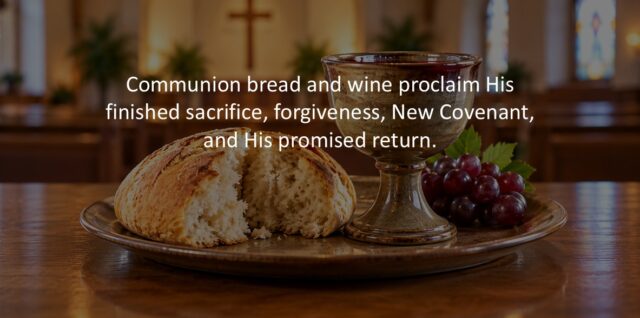
From the manna in the wilderness to the bread of the Tabernacle, and from the blood of the Passover lamb to the sacrifices offered in the Temple, God used physical symbols to prepare His people for the coming of Jesus Christ. These Old Testament patterns pointed toward the Lamb of God, who would take away the sin of the world through His perfect sacrifice. At the Last Supper, Jesus gave His disciples two simple symbols to remember what He was about to accomplish. The bread represents His body willingly given for us, and the cup represents His blood shed for the forgiveness of our sins.
Communion is not a ceremony that earns forgiveness or repeats Christ’s sacrifice. Jesus paid the full price for our redemption once for all when He died on the cross, and His resurrection confirmed His victory over sin and death (Hebrews 10:10-14; 1 Corinthians 15:3-4). When believers gather around the Lord’s Table, we look backward with gratitude for His finished work, inward with humble self-examination, and forward with joyful anticipation of His promised return. As we share the bread and cup, we also remember that all who belong to Jesus Christ are members of one body, united through faith in the Savior who gave Himself for us (1 Corinthians 10:16-17). Above all, Communion directs our hearts away from our own efforts and toward the grace of God, who has given us eternal life through His Son.
Before partaking of the Lord’s Supper, Scripture instructs every believer to examine himself and approach the Lord’s Table with reverence (1 Corinthians 11:27-29). Communion is not reserved for people who have achieved spiritual perfection, because our salvation rests entirely upon God’s grace. Rather, it is an opportunity to confess our sins, examine our attitudes, and remember the sacrifice that purchased our redemption. We should also examine how we treat fellow believers, recognizing that we are members of one body in Christ. Our participation should reflect genuine faith, gratitude, humility, and love for one another.
Prayers for the Lord’s Supper
Prayer for the Bread
Heavenly Father, thank You for sending Jesus Christ, the Bread of Life, to save us from our sins. Thank You for His sinless life, His willing obedience, and His body offered as the perfect sacrifice on the cross. As we partake of this bread, we remember His suffering and the incredible love that led Him to give Himself for us. Help us to live in grateful obedience, honoring Him with our hearts, our words, and our actions. In the precious name of Jesus Christ, Amen.
Prayer for the Cup
Heavenly Father, thank You for the precious blood of Jesus Christ, our Passover Lamb, who took away our sins through His sacrifice on the cross. Thank You for the New Covenant established through His blood, and for the forgiveness and eternal life You freely give to everyone who believes in Him. As we partake of this cup, we remember the terrible price He willingly paid for our redemption and rejoice that His sacrifice was complete and sufficient. Help us to proclaim His death faithfully, live in fellowship with one another, and look forward with joyful anticipation to His promised return. In the glorious name of our Lord and Savior, Jesus Christ, Amen.
Celebration of the Death, Burial, and Resurrection Until He Returns
Communion specifically proclaims the Lord’s death until He returns (1 Corinthians 11:26). Yet we do not remember a Savior who remains in the grave, but the living Lord Jesus Christ, whose resurrection confirms His victory over sin and death and assures us that His promises are trustworthy. His sacrifice was finished on the cross, and His resurrection demonstrates that our redemption was accomplished. Therefore, as we partake of the bread and cup, we look backward with gratitude for His completed sacrifice and forward with confident hope in His promised return. Communion is more than a solemn remembrance of His death; it is a joyful celebration of our risen Savior and the eternal life He has promised to everyone who believes in Him.