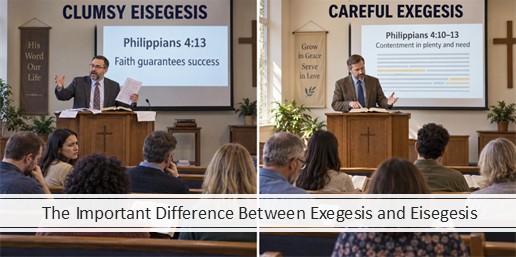
Exegesis seeks to understand what Scripture communicates in its context. Eisegesis imports a meaning that the interpreter brings to the passage. The difference matters because a sermon can contain many Bible verses while teaching something those verses never actually say. Faithful Bible study requires us to examine how a conclusion follows from the text, as well as whether the conclusion sounds Christian.
This series approaches Scripture from a Fundamental, Conservative, Biblical, Dispensational, Provisionist, Evangelical framework. It affirms the authority of the Bible’s 66 books, salvation by grace through faith in Jesus Christ, and the grammatical-historical approach to interpretation: understanding words according to their grammar, literary setting, and historical circumstances. These commitments call for careful explanation from Scripture; a theological label cannot replace that work.
What Does Exegesis Mean?
The English word exegesis comes from Greek exēgēsis, meaning explanation or interpretation, related to exēgeisthai, to explain or interpret. Its components include ex, meaning out, and hēgeisthai, meaning to lead. That background supplies the useful picture of drawing meaning out of a text. The word’s history helps explain the term, although sound interpretation depends on more than an etymology. See the American Heritage Dictionary entry for exegesis.
In biblical study, exegesis asks what the inspired author communicated through these words, to these readers, in this setting. We examine sentences, follow arguments, identify speakers, and recognize whether we are reading history, poetry, commands, or prophecy. Taking Scripture in its natural sense includes recognizing figures of speech. When Jesus calls Himself a door, faithfulness to His words requires understanding the metaphor rather than imagining a wooden object.
- Nehemiah 8:8 gave the sense – The reading of God’s law was accompanied by explanation that helped the people understand its meaning.
- 2 Timothy 2:15 rightly dividing the word of truth – Paul calls Timothy to handle God’s Word accurately, in contrast with the destructive misuse of words described nearby.
The basic movement is text, meaning, doctrine, and application. We first determine what a passage says, then consider what it contributes to biblical teaching and how that truth should govern our lives.
What Does Eisegesis Mean?
Eisegesis is formed with the Greek element eis, meaning into, in contrast with exegesis. It describes interpretation that puts the reader’s ideas into a text instead of deriving its meaning from the text. The contrast between leading out and leading in is a useful memory aid, rather than a complete method of interpretation. See the Collins Dictionary entry for eisegesis.
Eisegesis can begin with a desire, a political conviction, a favorite theological system, or even a doctrine that is true elsewhere in Scripture. The reader then finds a verse that sounds suitable and assigns it the desired meaning. The movement becomes idea, selected verse, imposed meaning, and confirmation.
- Mark 7:13 Making the word of God of none effect through your tradition – Jesus exposed a practice that used religious tradition to evade God’s command concerning parents.
Having prior knowledge does not automatically make someone an eisegete. We should bring what we have learned from Scripture to further study. The danger arises when those conclusions are protected from examination and the passage must accommodate them regardless of what it says.
One Verse, Two Very Different Readings
Philippians 4:13 is sometimes treated as a promise that Christ will enable a person to achieve any ambition. A promotion, athletic victory, or successful business venture becomes the assumed meaning of doing all things. But those ambitions are supplied by the reader. They are not the subject Paul is discussing.
Read Philippians 4:10-13 as a paragraph. Paul thanks the Philippians for their concern and explains that he has learned contentment through changing circumstances. He knows both abundance and need. Christ strengthens him to endure those circumstances faithfully, including circumstances in which material desires remain unmet.
- Philippians 4:11 I have learned – Paul’s contentment developed through experience; his testimony does not promise that believers will escape hardship.
The faithful application is deeply encouraging. Christ’s sufficiency does not disappear when a believer experiences deprivation. A Christian can depend on Him while pursuing a legitimate goal, but this passage gives no guarantee that every chosen goal will succeed.
Meaning Comes Before Application
A passage’s meaning is grounded in what God communicated through its author. That meaning can support many applications without becoming a different message for every reader. Ephesians 4:29 concerns speech that benefits others rather than corrupts them. Its relevance extends naturally to marriage, parenting, workplace conversations, and online comments.
- Ephesians 4:29 Let no corrupt communication proceed out of your mouth – Believers must reject destructive speech and speak in ways that serve the spiritual good of their hearers.
An application to social media is legitimate even though Paul did not mention the internet. The application carries his instruction into a new circumstance while preserving its meaning. By contrast, making the verse a promise that positive speech creates wealth would introduce a claim that Paul does not make.
Why an Incorrect Interpretation Can Sound Biblical
During Jesus’ temptation, Satan quoted Scripture while urging Him to jump from the temple. Jesus answered with Scripture that exposed the proposed action as testing God. The presence of a biblical quotation did not make Satan’s use of it faithful. A quotation must be understood and applied in harmony with what God has actually revealed.
- Matthew 4:6 For it is written – Satan appealed to a genuine biblical promise while urging a presumptuous use of it.
- Deuteronomy 6:16 Ye shall not tempt the LORD your God – Trust in God’s faithfulness does not authorize manufacturing a crisis to demand His intervention.
A teacher can also reach a true conclusion from an unsuitable passage. For example, Christ’s presence with individual believers is a biblical truth, but Matthew 18:20 belongs to a discussion of church discipline and agreement in prayer. Calling every use of that verse faithful merely because the conclusion is true teaches readers to overlook context. Correct doctrine deserves correctly interpreted support.
Read the Rest of the Series
The remaining articles move from examining our own assumptions to recognizing and practicing faithful interpretation. Together they address both personal Bible study and the teaching life of a church.
- The Important Difference Between Exegesis and Eisegesis: This introduction defines the terms and explains the relationship between meaning and application.
- The Danger of Eisegesis When We Already Know What the Bible Must Say: How a settled expectation can turn Bible study into a search for confirmation.
- Accidental False Doctrine Caused by Clumsy Eisegesis: How ordinary interpretive shortcuts grow into unsupported doctrines.
- Red Flags of False Doctrine from Eisegesis: How to recognize definitions, preaching habits, and authority claims that deserve examination.
- The Importance of Exegesis: Four Simple Questions for Careful Bible Study: A practical method for identifying speaker, audience, authority, and setting.
- The Green Flags of Faithful Doctrine from Exegesis: What sound interpretation looks like in the ongoing ministry of a church.
The purpose is to understand God’s Word so that we can believe it, teach it faithfully, and obey it. Study should deepen both conviction and teachability. We honor the Lord Jesus Christ when Scripture governs our conclusions and our conduct.