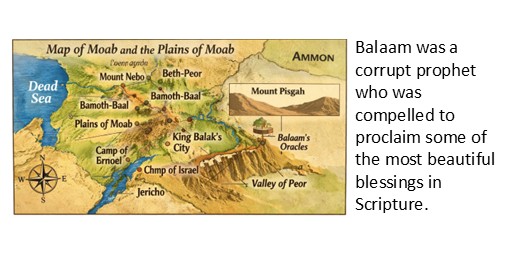
The account of Balaam in Numbers 22–24 is one of the most remarkable narratives in the Old Testament. A pagan diviner is summoned by a fearful king to curse Israel, yet the Lord intervenes and forces the prophet to bless the nation instead. What begins as a political attempt to destroy Israel becomes a profound theological declaration of God’s covenant faithfulness.
This study explores the narrative from a theological perspective: Balaam’s prophecies reveal God’s unbreakable commitment to bless Israel. The blessings pronounced in Numbers 23–24 illuminate the nature of God’s covenant promises, the distinct role of Israel among the nations, and the future Messianic kingdom.
Although Balaam himself was morally corrupt, the Spirit of God compelled him to speak divine truth. His words became part of the inspired Scriptures, demonstrating that God can use even flawed instruments to proclaim His purposes.
This study will examine:
- The historical context of Balaam’s story
- The theology of divine blessing revealed in his oracles
- The covenant promises affirmed through Israel
- The Messianic prophecy contained within the blessings
- The moral warning presented by Balaam’s life
Understanding Balaam’s prophecies helps believers grasp the certainty of God’s promises and the central role of Israel in the unfolding story of redemption.
1) The Historical Setting: Fear, Politics, and Spiritual Warfare
Numbers 22 begins with Israel encamped in the plains of Moab near the Jordan River, opposite Jericho. The generation that left Egypt has largely died in the wilderness, and a new generation now stands ready to enter the Promised Land.
Israel had recently defeated two powerful Amorite kings, Sihon and Og (Numbers 21:21-35). These victories terrified the surrounding nations. Moab in particular feared that Israel would overwhelm them.
“And Moab was sore afraid of the people, because they were many.” (Numbers 22:3)
Balak, king of Moab, believed Israel’s success was supernatural. Rather than confronting Israel militarily, he sought spiritual assistance.
He summoned Balaam, a well-known diviner from Mesopotamia. Balaam likely lived near the Euphrates River, far north of Moab. His reputation as a prophet capable of blessing or cursing nations had spread widely.
“For I wot that he whom thou blessest is blessed, and he whom thou cursest is cursed.” (Numbers 22:6)
Balak hoped Balaam could neutralize Israel through a curse. This request reveals the spiritual worldview of the ancient Near East, where kings believed prophets could manipulate divine powers to influence events.
However, Balak underestimated a critical truth: Israel’s God could not be manipulated.
The conflict in Numbers 22–24 is therefore not merely political. It is theological. The central question becomes:
Can anyone reverse the blessing that God has placed upon Israel?
2) Balaam: A Prophet with Divided Loyalties
Balaam is one of the most complex characters in Scripture. Unlike Israel’s prophets, he was not a servant of the covenant God. He was a professional diviner who practiced pagan forms of prophecy.
Numbers 22:7 records that Balak’s messengers brought “the rewards of divination.”
Despite this background, Balaam had some knowledge of the true God. He refers to the Lord by His covenant name and acknowledges divine authority.
“I cannot go beyond the word of the LORD my God.” (Numbers 22:18)
Yet Balaam’s heart was not devoted to God. Later Scripture reveals that he loved wealth and honor.
“Which have forsaken the right way… following the way of Balaam… who loved the wages of unrighteousness.” (2 Peter 2:15)
Balak’s offer of wealth and prestige appealed to Balaam’s greed. Although God initially forbade him from going to Moab, Balaam continued to seek permission. His persistence exposed his desire to do what God had already forbidden.
Eventually God allowed Balaam to go, but with strict limitations.
“But yet the word which I shall say unto thee, that shalt thou do.” (Numbers 22:20)
On the journey to Moab, God confronted Balaam in a dramatic way. The Angel of the Lord blocked his path, yet Balaam failed to see Him. Instead, Balaam’s donkey perceived the danger and turned aside.
Numbers 22:28 records one of the most unusual miracles in Scripture: God caused the donkey to speak.
The irony is powerful. The prophet who claimed spiritual insight could not see what his animal clearly perceived.
This episode reveals that Balaam’s spiritual condition was deeply flawed, even though God would still use him to proclaim truth.
3) The First Oracle: Israel Is a People Set Apart
Balak brought Balaam to several high places overlooking Israel’s camp. From these vantage points Balaam attempted to pronounce a curse. Each time, however, God placed words of blessing in Balaam’s mouth.
The first oracle appears in Numbers 23:7-10.
Instead of cursing Israel, Balaam declared:
“How shall I curse, whom God hath not cursed?” (Numbers 23:8)
This statement establishes the central theological principle of the narrative.
- God alone determines blessing and curse.
- Human kings cannot overturn what God has decreed.
Balaam then describes Israel’s unique identity.
“Lo, the people shall dwell alone, and shall not be reckoned among the nations.” (Numbers 23:9)
This declaration reflects the covenant relationship established with Abraham.
“I will bless thee… and thou shalt be a blessing.” (Genesis 12:2-3)
Israel was chosen to be distinct from the surrounding nations. Their identity was not political but covenantal. They belonged to God.
The first oracle therefore teaches that Israel’s blessing is rooted in divine election, not human strength.
4) The Second Oracle: God’s Character Guarantees the Blessing
Balak was frustrated with the first prophecy and attempted again to secure a curse. He moved Balaam to a different location, hoping a new vantage point would change the outcome.
Instead, Balaam delivered one of the most important theological statements in the Old Testament.
“God is not a man, that he should lie; neither the son of man, that he should repent.” (Numbers 23:19)
This verse reveals two essential truths about God.
- God does not lie. His promises are completely trustworthy.
- God does not change His mind the way humans do. His purposes remain firm.
Balaam continued:
“Behold, I have received commandment to bless: and he hath blessed; and I cannot reverse it.” (Numbers 23:20)
The blessing upon Israel could not be undone because it originated with God Himself.
Balaam also proclaimed God’s protective presence among His people.
“The LORD his God is with him, and the shout of a king is among them.” (Numbers 23:21)
This statement hints at a future king arising from Israel. Even at this early stage, the idea of royal leadership within Israel’s destiny begins to emerge.
5) The Third Oracle: Israel’s Prosperity and Future Strength
Balak tried again, but the outcome remained the same.
- Numbers 24:2 records that the Spirit of God came upon Balaam.
- This phrase confirms that the following prophecy was divinely inspired.
Balaam then described Israel’s beauty, prosperity, and strength.
“How goodly are thy tents, O Jacob, and thy tabernacles, O Israel!” (Numbers 24:5)
He compared Israel to fertile gardens, flowing rivers, and strong cedar trees. These images emphasize life, stability, and divine blessing.
Balaam also predicted Israel’s rising power among the nations.
“His king shall be higher than Agag, and his kingdom shall be exalted.” (Numbers 24:7)
This prophecy anticipates the rise of Israel’s monarchy. Ultimately it points beyond Israel’s earthly kings toward the future Messianic kingdom.
6) The Fourth Oracle: The Star and the Scepter
The final oracle contains one of the clearest Messianic prophecies in the Pentateuch.
“There shall come a Star out of Jacob, and a Sceptre shall rise out of Israel.” (Numbers 24:17)
The imagery of a star symbolizes a ruler whose rise will shine like a celestial light. The scepter represents royal authority and kingship.
- This prophecy foretells the coming Messiah who would arise from Israel and ultimately rule the nations.
- The prophecy continues by describing the defeat of Israel’s enemies and the establishment of lasting dominion.
- This prophecy likely influenced the Magi who followed a star in search of the King of the Jews (Matthew 2:1-2).
Thus, Balaam’s final oracle expands the theology of blessing to its ultimate fulfillment: the reign of the Messiah.
7) The Tragic Sin of Balaam
Although Balaam spoke true prophecy, his personal life ended in disgrace.
Later Scripture reveals that Balaam devised a plan to corrupt Israel.
- Revelation 2:14 explains that he taught Balak how to cause Israel to stumble through idolatry and sexual immorality.
- Numbers 25 describes how Moabite women seduced Israelite men, leading them to worship Baal-peor. This sin brought severe judgment upon Israel.
- Numbers 31:16 confirms that Balaam was responsible for advising this strategy.
Unable to curse Israel directly, Balaam chose a different approach: lead Israel into sin so that God Himself would discipline them.
His motivation remained the same: greed and desire for reward.
- Jude 11 calls this “the error of Balaam for reward.”
Balaam therefore stands as a warning about the danger of religious hypocrisy. A person may speak truth about God while living in rebellion against Him.
8) The Theology of Blessing for Israel
Balaam’s prophecies teach several important theological truths.
- God’s covenant promises cannot be overturned. When God declares blessing, no human power can reverse it.
- Israel occupies a unique role in God’s redemptive plan. The nation was chosen to be distinct among the nations.
- God’s character guarantees the fulfillment of His promises. Because God does not lie, His covenant with Israel remains secure.
- The ultimate expression of Israel’s blessing is the coming Messiah. The Star and Scepter prophecy points forward to the reign of Christ.
These truths affirm the reliability of God’s Word and the certainty of His purposes.
God’s Sovereign Blessing
The account of Balaam reveals a profound paradox. A corrupt prophet was compelled to proclaim some of the most beautiful blessings in Scripture.
Balak attempted to curse Israel, but every attempt resulted in blessing.
- This narrative demonstrates that God’s plans cannot be thwarted. His covenant with Israel remains firm, and His promises will ultimately be fulfilled.
- The story also points forward to Jesus Christ, the promised King who will arise from Israel and rule the nations in righteousness.
Balaam’s life serves as both a theological witness and a moral warning. His prophecies proclaim the certainty of God’s blessing, while his personal failure reminds us that true knowledge of God must be accompanied by obedience.
God’s blessing rests upon those who trust His promises, and His purposes will stand forever.
Suggested Resources for Further Study
- Eternal covenant promises for Israel from the Bible – A comprehensive list of the eternal covenant promises Almighty God has made to Israel and Jerusalem.
- Jesus Christ is the Rock of Israel – Jesus Christ is the Rock of Israel. The Old Testament prepared the way, Gospels revealed his person, and New Testament finished truth. He is the cornerstone.
- A brief history of the future – Share this brief history of the future as revealed in the Bible. It is a good introduction to eschatology, which is the study of end times.
- How to Read the Bible Book by Book: A Guided Tour by Gordon D. Fee – Reading the Bible need not be a haphazard journey through strange and bewildering territory. Like an experienced tour guide, How to Read the Bible Book by Book takes you by the hand and walks you through the Scriptures. For each book of the Bible, the authors start with a quick snapshot, then expand the view to help you better understand its message and how it fits into the grand narrative of the Bible. Written by two top evangelical scholars, this survey is designed to get you actually reading the Bible knowledgeably and understanding it accurately.
- The Moody Bible Commentary – This comprehensive and reliable reference work should be the first place Sunday school teachers, Bible study leaders, missionaries, and pastors turn to for biblical insight. Scripture being commented on is shown in bold print for easy reference, and maps and charts provide visual aids for learning. Additional study helps include bibliographies for further reading and a subject and Scripture index.
- The Moody Handbook of Messianic Prophecy: Studies and Expositions of the Messiah in the Old Testament — As Jesus walked the Emmaus road, he showed his companions how the whole of Scripture foretold his coming. Yet so often today we’re not quite sure how to talk about Jesus in the Old Testament. How do you know what applies to Jesus? And how do you interpret some of the strange prophetic language? Get answers and clarity in this authoritative and reliable guide to messianic prophecy from some of the world’s foremost evangelical Old Testament scholars.
These resources can help deepen understanding of Old Testament prophecy and its fulfillment in the person of Jesus Christ.