God did not give Israel feast days as mere religious folklore or cultural tradition. Leviticus 23 calls them “feasts of the LORD” and “holy convocations” (Leviticus 23:2-4). In other words, they are God’s appointed times, His calendar of worship, remembrance, and hope.
The New Testament teaches that these observances were not ends in themselves. They were “a shadow of things to come,” pointing beyond themselves to Christ (Colossians 2:16-17). Shadows are real, but they are not the substance. A shadow has shape, direction, and meaning, but it is designed to lead you to the Person standing in the light. When Christ came, He did not discard the meaning of the feasts, He fulfilled them.
This study shows how the sequence and symbolism of the feasts in Leviticus 23 correlate prophetically with key events in God’s redemptive program, centered on the Lord Jesus Christ, and consistent with a literal understanding of prophecy, including God’s future for national Israel and Christ’s visible return and kingdom.
1. How to Read the Feasts: Shadow and Substance
The Bible’s own warrant for typology
Typology is not allegory. Allegory can detach a text from what the author actually said and meant. Biblical typology, however, is rooted in history and God’s purposeful patterns. Real people, real events, real institutions can be designed by God to foreshadow later realities.
The New Testament gives us explicit permission to read certain Old Testament institutions this way:
- The law had “a shadow of good things to come” (Hebrews 10:1).
- The tabernacle system portrayed a pattern heavenly realities (Hebrews 8:5; 9:23–24).
- The feasts are included in the “shadow” category (Colossians 2:16-17).
So, we are not inventing symbolism. We are following Scripture’s own category: types, shadows, and patterns now, substance in Christ.
Guardrails for responsible interpretation
To handle the feasts faithfully, we must keep several guardrails in place.
First, honor the original meaning for Israel. These were covenantal ordinances given to Israel, tied to the land, priesthood, and temple worship. They taught Israel about redemption, holiness, provision, and fellowship with God.
Second, recognize progressive revelation. The feasts were meaningful in Moses’ day, yet their fullest meaning becomes clearer as God reveals Christ, the cross, the resurrection, the Spirit’s coming, and the future kingdom.
Third, keep Israel and the Church distinct. God’s covenant promises to national Israel will be literally fulfilled, including future repentance, restoration, and Messiah’s reign. (Eternal covenant promises for Israel from the Bible) This matters especially when we consider the fall feasts and end-times themes.
Fourth, keep salvation by grace through faith. No feast, ritual, or law-keeping ever saved anyone. Old Testament saints were saved by faith in God’s promise and provision (Genesis 15:6; Habakkuk 2:4; Hebrews 11), and New Testament believers are saved by faith in the finished work of Christ (Ephesians 2:8-9; Romans 3:21-26). We must never drift into legalism or any “two ways of salvation” model.
2. The Appointed Times of the Lord in Leviticus 23
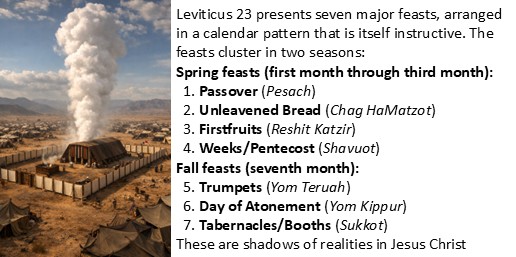
Leviticus 23 presents seven major feasts, arranged in a calendar pattern that is itself instructive. The feasts cluster in two seasons:
Spring feasts (first month through third month):
- Passover (Pesach)
- Unleavened Bread (Chag HaMatzot)
- Firstfruits (Reshit Katzir)
- Weeks/Pentecost (Shavuot)
Fall feasts (seventh month):
- Trumpets (Yom Teruah)
- Day of Atonement (Yom Kippur)
- Tabernacles/Booths (Sukkot)
Many Bible teachers have observed that the spring feasts correlate closely with Christ’s first coming (His death, burial, resurrection, and the Spirit’s coming), while the fall feasts anticipate events associated with His return and kingdom. We must state this carefully: Leviticus 23 does not give a full end-times chart, but the themes of these appointed times harmonize strikingly with later revelation.
3. Passover: A Spotless Lamb Dies
The feast in its Old Testament setting
Passover begins with a lamb “without blemish” (Exodus 12:5). Its blood was applied to the doorposts, and God promised, “when I see the blood, I will pass over you” (Exodus 12:13). Redemption from judgment and deliverance from slavery were at the heart of Passover.
The central theme: substitutionary death under divine judgment, with blood as the God-appointed means of protection.
Prophetic correlation: Christ our Passover
The New Testament does not leave this correlation to imagination. Paul states it plainly: “Christ our passover is sacrificed for us” (1 Corinthians 5:7).
Several lines converge:
Spotlessness. Jesus is morally spotless, “without sin” (Hebrews 4:15), the unblemished Lamb (1 Peter 1:18-19). John the Baptist identifies Him as “the Lamb of God, which taketh away the sin of the world” (John 1:29).
Substitution. Passover’s logic is substitutionary: the lamb dies so the firstborn does not die. At the cross, Christ dies “for our sins” (1 Corinthians 15:3), bearing our penalty (Isaiah 53:5-6).
Blood and judgment. In Exodus, the blood did not make Israel morally perfect overnight, but it did satisfy God’s stated condition for protection from the destroying judgment. Likewise, Christ’s blood propitiates (satisfies) God’s righteous wrath against sin (Romans 3:24-26; 1 John 2:2).
The gospel clarity
Passover points to the heart of the gospel: Jesus Christ, the sinless Lamb, died in the sinner’s place, and His blood is the only sufficient ground of deliverance. Salvation is received by faith (trust) in God’s provision, not by human merit (John 3:14-21; Romans 10:9-13). (Jesus Christ is the Passover Lamb of God sacrificed for the sin of the world)
3. Unleavened Bread: Sin Removed
The feast in its Old Testament setting
Immediately after Passover, Israel ate unleavened bread for seven days and removed leaven from their houses (Exodus 12:15-20; Leviticus 23:6-8). Leaven (yeast) in Scripture can symbolize permeating influence, often corruption, though not in every context. In this feast, the deliberate removal of leaven taught Israel separation from Egypt and a clean break with the old life.
The central theme: separation, purity, a decisive removal of defilement.
Prophetic correlation: Christ’s burial and the believer’s sanctification
Unleavened Bread follows the lamb’s death. In the life of Christ, after the cross came the burial. The sinless One lay in the tomb, His body not seeing corruption (Psalms 16:10; Acts 2:27-31). The imagery of “unleavened” fits Christ Himself: wholly pure, uncorrupted, holy.
Paul connects Passover and Unleavened Bread ethically in 1 Corinthians 5:7-8. Because Christ is our Passover, believers are to “keep the feast” in a spiritual sense, “not with old leaven… but with the unleavened bread of sincerity and truth.” The point is not that Christians must Judaize, but that the saving work of Christ produces a call to holy living.
So the correlation is twofold:
Christological. The sinless Messiah is not corrupted by death, and His burial sets the stage for resurrection.
Ecclesial and practical. Those redeemed by the Lamb are called to put away sin, not to earn redemption, but because redemption has been granted. We reject both legalism (trying to be justified by rituals) and antinomianism (using grace as an excuse to tolerate sin).
Sin removed: definitive and progressive
In Christ, believers experience a decisive cleansing (justification) and an ongoing cleansing (sanctification).
Definitive: God declares the believer righteous in Christ (Romans 5:1).
Progressive: the Spirit empowers real growth in holiness (Galatians 5:16-25).
Unleavened Bread helps us keep that order straight: the lamb dies first, then the leaven is removed.
5. Firstfruits: The First Sheaf Rises
The feast in its Old Testament setting
Leviticus 23 describes the presentation of the first sheaf of the harvest to the Lord (Leviticus 23:10-14). Firstfruits were a pledge and preview. The first sheaf was not the whole harvest, but it guaranteed more was coming.
The central theme: the beginning of harvest, life out of the earth, the pledge of more to follow.
Prophetic correlation: the resurrection of Christ
Again, the New Testament makes the link explicit: “Christ the firstfruits” (1 Corinthians 15:20, 23). He is the first to rise in a way that guarantees the resurrection harvest of His people.
This does not mean no one was ever raised before Christ (there were resuscitations, and rare raisings), but Christ’s resurrection is unique in quality and consequence:
- It is the decisive conquest of death (Romans 6:9).
- It is the guarantee of believers’ future bodily resurrection (1 Corinthians 15).
- It inaugurates a new creation reality (2 Corinthians 5:17).
Firstfruits logic fits perfectly: the first sheaf is accepted, therefore the harvest will follow. Christ is accepted, therefore those united to Him by faith will follow in resurrection glory.
Theological weight: resurrection as the hinge of redemption
If the cross is the payment, the resurrection is the receipt, the public vindication that the sacrifice was accepted. Paul is blunt: if Christ is not raised, your faith is vain (1 Corinthians 15:14-17). Firstfruits teaches the same: without the first sheaf, you have no pledge of harvest.
6. Pentecost: Fifty Days Later, the Harvest Begins
The feast in its Old Testament setting
Pentecost (Shavuot, “Weeks”) occurs fifty days after Firstfruits (Leviticus 23:15-21). It celebrates harvest ingathering and includes distinctive offerings. Unlike Unleavened Bread, the Pentecost loaves are baked with leaven (Leviticus 23:17), which is noteworthy.
The central theme: harvest ingathering, presentation to God, a new phase of gathering.
Prophetic correlation: the Spirit falls and the Church begins
In Acts 2, the Holy Spirit is poured out on the day of Pentecost. This is not a random date. God chose His appointed time to inaugurate a new era of redemptive administration: the Church Age.
Several theological threads meet here:
Promise fulfilled. Jesus promised Spirit empowerment (Acts 1:4-8). Pentecost is the historical fulfillment (Acts 2:1-4).
New covenant blessings. The Spirit’s coming signals the new covenant realities secured by Christ (Jeremiah 31:31-34; Ezekiel 36:25-27).
The Church begins. From a dispensational perspective, the Church begins at Pentecost, not in the Old Testament, and not in some later point of Acts. This guards the uniqueness of the Body of Christ and aligns with the Spirit’s baptizing ministry described in 1 Corinthians 12:13.
Why leavened loaves?
The leavened loaves do not suggest sin is being offered to God as acceptable. Rather, they picture something God is pleased to receive despite imperfection, because it is accepted by sacrifice and priestly mediation.
A fitting correlation emerges:
The Church is composed of redeemed people who are still being sanctified. We are not sinless, yet we are accepted in the Beloved (Ephesians 1:6) because of Christ’s finished work. Pentecost proclaims that God is now gathering a people from all nations, indwelt by the Spirit, presented to God as His own.
The harvest begins
From Pentecost onward, the gospel goes out as a harvest ingathering (Matthew 9:37-38). The Book of Acts is the firstfruits of that broader harvest across the nations, until “the fulness of the Gentiles be come in” (Romans 11:25).
7. Trumpets: A Gathering Announced with a Blast
The feast in its Old Testament setting
Trumpets (Yom Teruah) is marked by a “memorial of blowing of trumpets” and a holy convocation (Leviticus 23:24-25). Trumpets in Scripture often accompany:
- assembly and regathering (Numbers 10:1-10)
- warning and watchfulness
- royal announcement
- preparation for the Day of the Lord
The central theme: an announced gathering, an awakening call, a public proclamation that a new phase has arrived.
Prophetic correlation: the rapture gathering (1 Thessalonians 4:16)
Consider 1 Thessalonians 4:16, “the Lord himself shall descend from heaven with a shout… and with the trump of God.” The context is the gathering of believers, the resurrection of the dead in Christ, and the catching up (harpazō) of living believers to meet the Lord (1 Thessalonians 4:13-18).
From a pre-tribulation, dispensational framework, Trumpets harmonizes well with the next major event for the Church: Christ’s coming for His saints (John 14:1-3), distinct from His later return to the earth in judgment and kingship.
Important clarity: The Bible uses trumpet imagery in multiple contexts. We should not claim Leviticus 23 is giving a technical label, “this is the rapture.” Rather, the feast’s themes of convocation and trumpet announcement correlate naturally with the New Testament’s trumpet-gathering language.
Pastoral force: wake up and look up
Trumpets calls God’s people to readiness. The New Testament repeatedly applies that posture to the Church: watchfulness, sobriety, hope (1 Thessalonians 5:1-11; Titus 2:13). Trumpets teaches that history is not drifting, it is moving according to God’s appointed times.
8. Day of Atonement: Judgment, Cleansing, a Day of Reckoning
The day in its Old Testament setting
Yom Kippur was Israel’s most solemn day (Leviticus 16; Leviticus 23:26-32). It involved:
- afflicting the soul (humbling, repentance)
- priestly mediation
- blood atonement
- cleansing of sanctuary defilement
- the scapegoat imagery of sin removal
The central theme: holy judgment on sin, cleansing by blood, national humbling before God.
Prophetic correlation: judgment and cleansing in God’s program
This feast is connected with “Judgment. Cleansing. A day of reckoning” and cited Romans 14:10-12. That passage teaches that each believer will give account of himself to God. This aligns with the doctrine of the judgment seat of Christ (2 Corinthians 5:10; 1 Corinthians 3:10-15), where believers’ works are evaluated for reward, not their sins for condemnation (Romans 8:1).
At the same time, Scripture also teaches future judgment for the unbelieving world (Revelation 20:11-15). So we must keep biblical distinctions:
Believers: judgment seat of Christ (evaluation for reward and loss of reward).
Unbelievers: final judgment (eternal condemnation for Christ-rejection).
How does this relate to Atonement?
Atonement highlights the necessity of cleansing, the seriousness of sin, and the certainty that God will deal with it righteously. In the broader prophetic picture, many dispensational teachers also connect Atonement themes with Israel’s future national repentance and cleansing at the end of the Tribulation, when they look upon the One they pierced and mourn (Zechariah 12:10) and when “all Israel shall be saved” in the sense of national turning to Messiah (Romans 11:26-27). This is consistent with the affirmation that God will literally fulfill His promises to national Israel, including future repentance and Messiah’s reign.
The cross is the true atonement
We must never imply that a future day adds to Christ’s finished work. Hebrews is emphatic: Christ offered one sacrifice for sins forever (Hebrews 10:10-14). Yet the application of that finished work unfolds in history:
- Individually: sinners are justified at the moment of faith.
- Corporately: God will bring Israel to national repentance in His time.
- Universally: God will judge all the earth in righteousness.
Atonement teaches that God will cleanse, and God will reckon. The cross guarantees both mercy for the believing and justice for the unrepentant.
9. Tabernacles: God Dwelling with His People
The feast in its Old Testament setting
Tabernacles (Sukkot) was a week of joyful dwelling in booths, remembering Israel’s wilderness journey and God’s faithful provision (Leviticus 23:33-43). It is both commemorative and celebratory: God sustained His people and brought them home.
The central theme: God with His people, provision in pilgrimage, joy in the completed ingathering.
Prophetic correlation: God’s dwelling, kingdom joy, and ultimate restoration
This feast is connected to Revelation 21:3: “the tabernacle of God is with men.” That is a perfect thematic destination. The story ends where it was always meant to go: unhindered fellowship between God and His redeemed people.
Several layers of fulfillment are worth noting:
Christological. John 1:14 says the Word “dwelt” among us, literally “tabernacled.” In Christ’s first coming, God dwelt with man in the incarnation.
Kingdom. Many see Tabernacles’ joy and ingathering themes as harmonizing with Messiah’s millennial reign, when the King is present and the nations experience blessing flowing from Jerusalem (Isaiah 2:1-4; Zechariah 14:16-19). A literal kingdom expectation coheres with a literal reading of prophecy and the promised consummation of the Kingdom at Christ’s return.
Eternal state. Revelation 21–22 presents the climactic “God with us” reality, where death, sorrow, and curse are removed.
The aim of redemption
Tabernacles teaches that redemption is not merely rescue from judgment. It is restoration to fellowship. God saves a people to dwell with them, to be their God, and for them to be His people (Revelation 21:3). That is the covenant goal echoed from Genesis to Revelation.
10. The Feasts and Dispensational Distinctions: Israel, the Church, and the Kingdom
Why distinction matters
If we flatten Israel and the Church into one undifferentiated entity, we will either:
- spiritualize Israel’s national promises into vague church language, or
- misapply Israel’s covenant signs as mandatory for the Church.
A mainstream dispensational framework avoids both errors by maintaining:
- salvation is always by grace through faith, across all ages,
- Israel remains Israel, with future national restoration and Messiah’s reign,
- the Church is a distinct body that began at Pentecost,
- Christ will return personally and visibly to judge and consummate His redemptive mission.
A simple correlation map
Spring feasts and first coming fulfillment:
- Passover: the Lamb dies (the cross)
- Unleavened Bread: separation and purity (burial, and the call to holiness)
- Firstfruits: the first sheaf rises (resurrection)
- Pentecost: harvest begins (Spirit poured out, Church begins)
Fall feasts and second coming horizon:
- Trumpets: announced gathering (rapture gathering, and trumpet themes of Day of the Lord)
- Atonement: reckoning and cleansing (accountability, judgment, and Israel’s future repentance)
- Tabernacles: God dwelling with His people (kingdom joy moving toward eternal “God with us”)
Again, this is not forcing the feasts into a rigid chart. It is observing how God’s later revelation repeatedly uses the same thematic vocabulary (lamb, firstfruits, harvest, trumpet, atonement, dwelling) in ways that converge on Christ.
11. Practical Discipleship: Living in the Light of Christ’s Fulfillment
Worship: the feasts teach Christ-centered gratitude
When you see the Lamb, worship. When you remember sin removed, walk in sincerity and truth. When you rejoice in Firstfruits, hold fast to resurrection hope. When you consider Pentecost, depend upon the Spirit, not the flesh.
Holiness: redemption produces separation
Unleavened Bread confronts comfortable Christianity. God did not redeem Israel to remain in Egypt, and God does not redeem believers to remain in sin’s dominion (Romans 6:1-14). Holiness is not the root of salvation, but it is the fruit.
Hope: God’s calendar is moving toward dwelling
Trumpets trains the heart to watch. Atonement warns that God takes sin seriously and will judge righteously. Tabernacles comforts the pilgrim: the wilderness is not forever, God will bring His people home, and God will dwell with them.
Evangelism: harvest language is missionary language
Pentecost reminds us that the harvest is God’s work, but God uses laborers. The Spirit empowers witness (Acts 1:8). The gospel is to be preached, and sinners are to be called to repent and believe in Christ.
Appendix A: Feast Calendar and Key Texts
Passover (Pesach)
Key texts: Exodus 12; Leviticus 23:5; John 1:29; 1 Corinthians 5:7
Unleavened Bread (Chag HaMatzot)
Key texts: Exodus 12:15-20; Leviticus 23:6-8; 1 Corinthians 5:7-8
Firstfruits (Bikkurim)
Key texts: Leviticus 23:9-14; 1 Corinthians 15:20-23
Pentecost (Shavuot)
Key texts: Leviticus 23:15-21; Acts 2; 1 Corinthians 12:13
Trumpets (Yom Teruah)
Key texts: Leviticus 23:23-25; 1 Thessalonians 4:16-18; 1 Corinthians 15:52
Day of Atonement (Yom Kippur)
Key texts: Leviticus 16; Leviticus 23:26-32; Romans 14:10-12; 2 Corinthians 5:10; Zechariah 12:10; Romans 11:26-27
Tabernacles/Booths (Sukkot)
Key texts: Leviticus 23:33-43; John 1:14; Revelation 21:3
Appendix B: Hebrew Terms and Themes (brief)
Moed (מוֹעֵד) “appointed time”
Often used for God’s set times and meetings with His people (Leviticus 23:2). The feasts are God’s calendar, not man’s invention.
Pesach (פֶּסַח) “Passover”
Centered on substitutionary blood protection and deliverance (Exodus 12).
Chag HaMatzot (חַג הַמַּצּוֹת) “Feast of Unleavened Bread”
Removal of leaven, pictured separation from the old life.
Bikkurim (בִּכּוּרִים) “firstfruits”
A pledge of the harvest, fulfilled richly in Christ’s resurrection.
Shavuot (שָׁבוּעוֹת) “Weeks”
Harvest festival, correlating with Spirit outpouring and global ingathering.
Yom Teruah (יוֹם תְּרוּעָה) “Day of Blasting”
Trumpet proclamation, awakening, assembly.
Yom Kippur (יוֹם כִּפּוּר) “Day of Atonement”
Cleansing, reckoning, solemn humility before God.
Sukkot (סֻכּוֹת) “Booths”
Dwelling, provision, joy, and the goal of redeemed fellowship.
Recommended Resources
For further study (helpful, but never equal to Scripture), these tools can aid careful, Scripture-grounded interpretation:
- The Moody Bible Commentary – This comprehensive and reliable reference work should be the first place Sunday school teachers, Bible study leaders, missionaries, and pastors turn to for biblical insight. Scripture being commented on is shown in bold print for easy reference, and maps and charts provide visual aids for learning. Additional study helps include bibliographies for further reading and a subject and Scripture index.
- The Moody Handbook of Theology by Paul Enns – The study of God, His nature, and His Word are all essential to the Christian faith. Now those interested in Christian theology have a newly revised and updated reference tool in the 25th Anniversary Edition of The Moody Handbook of Theology. In this classic and timeless one-volume resource, Paul Enns offers a comprehensive overview of the five dimensions of theology: biblical, systematic, historical, dogmatic, and contemporary. Each section includes an introduction, chapters on key points, specific studies pertinent to that theology, books for further study, and summary evaluations of each dimension. Charts, graphs, glossary, and indexes add depth and breadth. Theology, once the domain of academicians and learned pastors, is now accessible to anyone interested in understanding the essentials of what Christians believe. The Moody Handbook of Theology is a concise doctrinal reference tool for newcomers and seasoned veterans alike.
- The Moody Handbook of Messianic Prophecy: Studies and Expositions of the Messiah in the Old Testament — As Jesus walked the Emmaus road, he showed his companions how the whole of Scripture foretold his coming. Yet so often today we’re not quite sure how to talk about Jesus in the Old Testament. How do you know what applies to Jesus? And how do you interpret some of the strange prophetic language? Get answers and clarity in this authoritative and reliable guide to messianic prophecy from some of the world’s foremost evangelical Old Testament scholars.
- Halley’s Bible Handbook by Henry Halley – The bestselling Bible handbook of all time with millions of copies sold, Halley’s Bible Handbook has been thoroughly updated, while retaining its time-honored features and Dr. Halley’s highly personal style, to offer even greater clarity, insight, and usefulness. Halley’s Bible Handbook makes the Bible’s wisdom and message accessible to everyone. Whether you’ve read the Bible many times or never before, you will find insights that provide a firmer grasp of God’s Word and an appreciation for the cultural, religious, and geographic settings in which the story of the Bible unfolds. Written for both mind and heart, this completely revised, updated, and expanded edition features:
Conclusion
Leviticus 23 is not a dusty relic. It is a Spirit-inspired prophetic portrait gallery. Passover proclaims the Lamb who dies. Unleavened Bread calls for sin removed. Firstfruits announces resurrection. Pentecost celebrates the Spirit’s arrival and the harvest’s beginning. Trumpets points toward God’s announced gathering. Atonement warns of reckoning and promises cleansing. Tabernacles lifts our eyes to the goal: God dwelling with His people.
The feasts are shadows, but they are God-shaped shadows. Follow them into the light, and you find the Lord Jesus Christ, the substance, the center, and the consummation of God’s redemptive program.