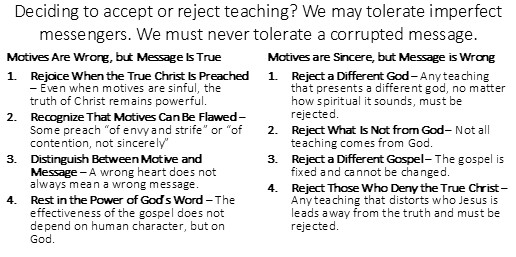
One of the most important responsibilities for every Christian is learning how to evaluate teaching. The Bible is clear about when to accept or reject teaching. It gives both encouragements to receive truth and strong warnings to reject error. At first glance, some passages seem difficult to reconcile.
How do we hold these truths together?
This study will walk through the key passages and show that the Bible makes a careful distinction between the motive of the teacher and the content of the message.
The Foundation: Scripture Is Our Final Authority
Before we begin, we must remember that the Bible alone is the gold standard by which all teaching is judged.
Because Scripture is “truth, without any mixture of error,” it remains “the supreme standard by which all human conduct, creeds, and religious opinions should be tried.”
So our goal is not to evaluate teaching by feelings, personality, or popularity, but by the Word of God.
A Crucial Distinction: Motive Versus Message
Paul writes:
When Motives Are Wrong, but the Message Is True
When are Motives are Sincere, but the Message is Wrong
The New Testament gives several clear categories where teaching must be rejected.
Putting It Together: A Biblical Framework
The first and most important principle is this. The content of the message is always primary. God’s Word is the final authority, and every teacher is measured by it. Second Timothy 3:16-17 teaches that Scripture equips us for truth, and Acts 17:11 shows that even respected teachers must be tested. So we do not begin by asking whether we like the teacher, but whether the teaching agrees with Scripture.
The second principle is that the gospel and the identity of God and Christ are non-negotiable. If a teacher presents a different God, a different Jesus, or a different gospel, that teaching must be rejected immediately. Galatians 1:8-9 leaves no room for compromise. Even if the teacher is sincere, kind, or persuasive, the message itself is false. This is not a minor issue, but a matter of eternal truth.
| Purpose | Best Verse | Why It Matters |
|---|---|---|
| Method | Nehemiah 8:8 | Explains how to preach: read, explain, ensure understanding |
| Heart | 1 Peter 4:11 | Shows the preacher’s posture: God’s words, God’s strength, God’s glory |
| Charge | 2 Timothy 4:2 | Gives the preacher’s mission: preach faithfully, boldly, patiently |
The third principle is that Philippians 1 applies only in a narrow situation. Paul is not giving a general rule to accept all imperfect teaching. He is describing a specific case where the true Christ is being preached, but the motives of the preachers are sinful. In that limited case, he rejoices in the truth being proclaimed. But this does not cancel his strong warnings elsewhere. It simply shows that God can use even flawed people to spread true doctrine.
- We told him to stop because he isn’t in our group
- 101 broken people that God used anyway
- 101 ways God looks past our failures to see our potential
- Biblical Instructions for godly leadership
- Ten considerations before appointing church leaders
The fourth principle is that we must learn to separate personal flaws from doctrinal error. A teacher may struggle with pride, jealousy, or poor judgment. These are serious issues, but they do not automatically make everything he says false. At the same time, a teacher may appear humble and sincere, yet teach serious error. Scripture warns us that false teachers often appear convincing (2 Corinthians 11:13-15).
So, the question is not simply, “Is this teacher sincere?” but rather, “Is this teaching true according to Scripture?”
The fifth principle is that discernment requires both humility and vigilance. We must be humble enough to receive truth even from imperfect people. And we must be vigilant enough to reject error, even when it comes from respected or popular voices. This balance protects us from pride on one side and deception on the other.
When we put all of this together, the framework becomes clear. We receive teaching when it faithfully presents the true God, the true Christ, and the true gospel as revealed in Scripture. We reject teaching when it departs from these truths in any essential way. And in cases like Philippians 1, we may acknowledge that truth is being proclaimed even when the motives behind it are wrong.
Practical Questions for Discernment
When listening to any teacher, ask:
| Category | Core Question | Key Verses |
|---|---|---|
| Fidelity to Scripture | Is this what the text actually says? | Acts 17:11; 2 Timothy 2:15 |
| Sound Doctrine | Does it align with the whole counsel of God? | Titus 1:9; Acts 20:27 |
| Christ‑Centeredness | Does it exalt Christ and the gospel? | 1 Corinthians 2:2; Luke 24:27 |
| Spiritual Fruit | Does it produce repentance, holiness, hope? | Matthew 7:16; Philippians 1:9-10 |
| Pastoral Motive | Is the preacher sincere, humble, and godly? | Philippians 1:17; 1 Thessalonians 2:3-6 |
| Clarity & Edification | Is it understandable and strengthening? | 1 Corinthians 14:3; Nehemiah 8:8 |
Philippians 1:17-18 teaches us an important lesson. God can use even flawed people to proclaim His truth. We should rejoice whenever the true Christ is preached. But the rest of the New Testament reminds us that truth itself must never be compromised.
- We may tolerate imperfect messengers.
- We must never tolerate a corrupted message.
- 8 Important Things for Christians to Embrace
- 8 Dangerous Things for Christians to Avoid
Let us be like the Bereans, searching the Scriptures daily, and holding fast to what is true, for the glory of the Lord Jesus Christ.