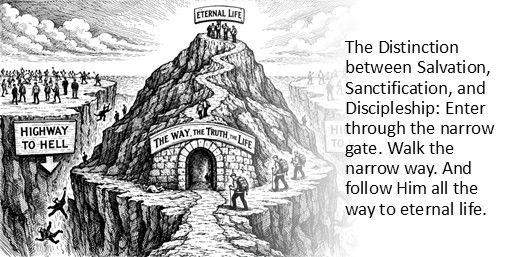
One of the most important foundations for a godly Christian life is understanding the biblical distinction between salvation, sanctification, and discipleship. When these are confused, the gospel is either burdened with human effort or stripped of its transforming power. But when Scripture is allowed to speak clearly, these truths come together in a beautiful and balanced way.
Jesus Himself gives us a framework for understanding this distinction in Matthew 7:13-14, where He speaks of a narrow gate and a narrow way. These two images correspond closely to the realities of salvation and the life that follows.
Salvation is the gate. Sanctification and discipleship are the way.
The Bible, which is “inspired… and sufficient” for all doctrine and life, consistently presents salvation as a finished work of God, and sanctification as a lifelong process that flows from it. Understanding this distinction is essential for both clarity and obedience.
Salvation: Entering Through the Narrow Gate
Jesus begins with a command: “Enter ye in at the strait gate.”
The word “strait” (Greek: stenos) means narrow, confined, exclusive. This gate represents salvation, and its narrowness emphasizes that there is only one way to be saved.
Jesus said in John 10:9, “I am the door.” In John 14:6, He declared, “No man cometh unto the Father, but by me.” Salvation is not one option among many. It is found in Christ alone.
Scripture is clear that salvation is by grace through faith, apart from works. Ephesians 2:8-9 teaches that it is “not of works, lest any man should boast.” At the moment a person believes the gospel, they are justified, born again, and sealed by the Holy Spirit. This is a complete and irreversible act of God. More impossible ways to lose your salvation.
Salvation is not a process. It is not something we grow into. It is something we receive.
The narrowness of the gate is not about difficulty of effort, but exclusivity of truth. Many reject it, not because it is hard to understand, but because it requires surrendering all self-righteousness and trusting Christ alone.
The Broad Gate: False Assurance and Human Religion
In contrast, Jesus describes a wide gate that leads to destruction. This represents every false system of salvation, whether religious or secular.
The broad gate is attractive because it allows:
- Trust in good works
- Confidence in religious activity
- Self-defined spirituality
- A refusal to submit to Christ alone
Proverbs 14:12 warns that there is a way that seems right to man, but its end is death. The broad gate is crowded because it affirms human pride. It offers acceptance without repentance, and spirituality without truth.
But it does not lead to life.
Sanctification: The Inner Work of Transformation
After the gate, Jesus speaks of a “narrow way.” This introduces the next phase of the Christian life, which Scripture calls sanctification.
Sanctification (Greek: hagiasmos) means to be set apart, made holy. It begins at salvation but continues throughout the believer’s life. It is the process by which God transforms the believer into the image of Christ. Accepted in Christ, Transformed by Grace (Understanding Positional Acceptance and Progressive Sanctification)
2 Corinthians 3:18 describes this as being changed “from glory to glory.” This is not instant, but progressive.
Sanctification is both:
- Positional, meaning the believer is already set apart in Christ (1 Corinthians 6:11)
- Practical, meaning the believer is continually growing in holiness
This work is empowered by God. The Holy Spirit indwells the believer, uses the Word of God, and produces spiritual fruit. Yet it also involves the believer’s participation.
Philippians 2:12-13 captures this balance. Believers are called to “work out” what God is already “working in.” God supplies the power, and the believer responds in obedience.
Discipleship: The Outward Walk on the Narrow Way
While sanctification describes the inner transformation, discipleship describes the outward life of following Christ.
A disciple (Greek: mathētēs) is a learner, a follower. Discipleship is the daily practice of living in submission to Jesus. Faith and Works: Understanding Their Biblical Relationship.
This is what Jesus refers to as the “narrow way.” It is the path of:
- Self-denial
- Obedience
- Faithfulness
- Growth in Christlikeness
In Luke 9:23, Jesus defines this clearly: “If any man will come after me, let him deny himself, and take up his cross daily, and follow me.”
This is not how a person becomes saved. This is how a saved person lives.
Sanctification is the internal transformation. Discipleship is the external expression of that transformation. Together, they describe the believer’s journey on the narrow way.
The Relationship Between the Gate and the Way
The distinction between salvation, sanctification, and discipleship becomes clear when we understand the relationship between the gate and the way.
The gate is entered once. The way is walked daily.
You do not walk the narrow way to earn entrance through the gate. You walk the narrow way because you have already entered.
Ephesians 2:8-10 provides this exact order. Salvation is by grace through faith, not by works. Yet believers are created for good works. Works are the result of salvation, not the requirement for it.
This preserves the purity of the gospel while affirming the necessity of a transformed life.
The Danger of Confusion
When these truths are blurred, two major errors arise.
The first is legalism, which adds discipleship or sanctification as a requirement for salvation. This turns the gospel into a system of works and contradicts passages like Romans 4:5, which says that God justifies the one who “worketh not, but believeth.”
The second is antinomianism, which separates salvation from transformation. This suggests that a person can be saved without any change in their life. But Scripture teaches that “if any man be in Christ, he is a new creature” (2 Corinthians 5:17). The antidote for antinomianism and legalism
True salvation is free, but it is never fruitless.
James 2:17 explains that faith without works is dead, not because works save, but because genuine faith produces evidence.
Why the Narrow Way Is Difficult
Jesus says the narrow way is difficult and that few find it. This difficulty is not about earning salvation, but about living a surrendered life in a fallen world.
The narrow way requires:
- Saying no to sin
- Resisting the world’s pressures
- Trusting God in trials
- Submitting to Christ’s authority
It is narrow because it is defined by truth, not preference. It is difficult because it opposes the natural tendencies of the flesh.
Yet it is also the path of life, joy, and eternal reward.
The Beauty of God’s Design
God’s design is both gracious and purposeful.
He saves sinners completely apart from works, so that no one can boast. Then He calls those same believers to walk in a life of obedience, so that His character is displayed through them.
Salvation is the foundation.
Sanctification is the transformation.
Discipleship is the expression.
This brings both assurance and direction. The believer rests in the finished work of Christ, while actively pursuing a life that reflects Him.
Conclusion
The distinction between salvation, sanctification, and discipleship is not merely theological. It is essential for understanding the Christian life.
Salvation is the narrow gate, entered by grace through faith in Jesus Christ alone. Sanctification is the ongoing work of God within the believer, shaping them into Christ’s image. Discipleship is the daily walk of following Christ on the narrow way.
These truths must never be confused, but they must never be separated.
When rightly understood, they reveal the fullness of God’s plan. He not only saves sinners, but transforms them. He not only brings them into life, but leads them along a path that reflects His glory.
The call of Christ remains clear:
Enter through the narrow gate.
Walk the narrow way.
And follow Him all the way to life.