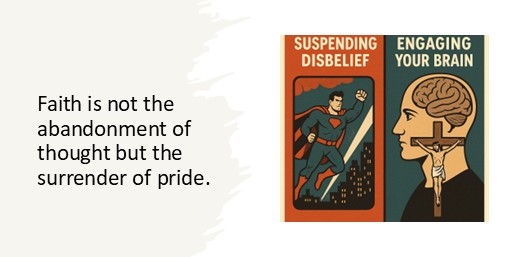
When people watch a superhero movie, they often “suspend disbelief.” They quiet the inner voice that says, “That could never happen,” long enough to enjoy the story. But this usually requires turning the brain off for the sake of entertainment. You willingly stop analyzing in order to relax into the world of fiction.
The gospel, however, calls for nothing of the sort. Paul’s preaching in 1 Corinthians 1:18–31 reveals that listening to the message of Christ requires humility and attentiveness, not the abandonment of reason. While there is a helpful comparison between suspending disbelief and listening to understand, the differences are profound and essential for anyone who wants to know the truth.
Understanding the Gospel Message
Paul preached a crucified and risen Savior. His message was historical, rational, and deeply theological. But to the self-confident thinker of Corinth, the cross sounded foolish. It contradicted their categories of power and wisdom. They rejected it not because it lacked truth, but because it offended their expectations.
Paul writes, “The word of the cross is foolishness to those who are perishing, but to us who are being saved it is the power of God” (1 Corinthians 1:18). Those who dismissed the message never truly heard it. Those who were saved by it listened, considered, and believed.
Where the Comparison Helps
There is a small but valuable similarity between suspending disbelief and hearing the gospel: both require us to pause our reflexive objections long enough to understand what is being said. But Scripture never tells us to shut off our brains. Rather, we engage our minds under the authority of God’s revelation.
How Listening to the Gospel Is Similar to Suspending Disbelief
- Both require pausing knee-jerk objections.
We easily reject what doesn’t match our expectations. The Bereans were noble because they listened carefully and then tested what they heard by Scripture (Acts 17:11). - Both call for focused attention.
The gospel deserves more than a casual hearing. “Faith comes by hearing” (Romans 10:17), which implies intentional listening. - Both invite us to consider something outside our familiar categories.
God’s wisdom overturns human wisdom. The cross challenges every assumption about power, success, and salvation.
The Crucial Difference of Hearing the Gospel
- Suspending disbelief requires turning the brain off; the gospel requires engaging it.
To enjoy fiction, people often stop analyzing. Paul, however, calls us to think carefully about God’s revealed truth. The gospel is not opposed to reason; it surpasses human reason while remaining absolutely true. God’s wisdom is not irrational but higher than our own (Isaiah 55:8-9). - Suspending disbelief deals with fiction; the gospel deals with reality.
A superhero story has no authority and makes no demands. The gospel proclaims real events that require real response (1 Corinthians 15:1-4). - Suspending disbelief sets aside reality; the gospel awakens us to reality.
The cross reveals God’s holiness, our sin, and His gracious provision in Christ (Romans 3:21-26). It calls us not to ignore reality but to finally see it clearly. - Suspending disbelief ends when the story ends; the gospel demands faith and repentance.
Entertainment requires nothing of you. The gospel calls you to turn to Christ and receive life (John 3:16). - Suspending disbelief offers escape; the gospel offers transformation.
God chooses “the foolish things… the weak things… the things which are despised” (1 Corinthians 1:27-28) so that all the glory belongs to Christ (1 Corinthians 1:31). Those who believe are not merely moved emotionally; they are made new.
A Needed Warning: Never “Turn Your Brain Off” With the Gospel
Some treat the gospel as if it must be accepted blindly or emotionally, without thinking. But Scripture never calls for mindless belief. Instead, God commands us to love Him with all our heart, soul, mind, and strength (Mark 12:30). Faith is not the abandonment of thought but the surrender of pride. The gospel invites careful consideration, humble listening, and rational trust in God’s revealed truth.
To turn off your brain is to dishonor the God who speaks. To engage your mind with Scripture is to honor the God who reveals Himself.
Application
When you hear God’s Word, do you listen with a humble, open, thoughtful posture? Or do you dismiss the message before truly considering it? Are you willing to pause your resistance—not to become unthinking, but to allow the truth of God to confront you?
Paul invites us to hear with humility, to think deeply, and to embrace the wisdom of God displayed in the cross.
Conclusion
Suspending disbelief may help you enjoy a fictional story, but listening to the gospel calls you into the truth that saves. The cross of Christ is not entertainment but revelation. It humbles the proud, rescues the repentant, and reveals the wisdom of God. As Paul teaches, Christ has become our wisdom, righteousness, sanctification, and redemption (1 Corinthians 1:30).
May we listen thoughtfully, respond faithfully, and boast only in the Lord (1 Corinthians 1:31).