Many commentators describe the aorist tense of “present” (παραστῆσαι) in Romans 12:1 as a one-time act that is finished and done. While this explanation is common, it often reflects a misunderstanding of how the Greek aorist functions. This misapplies the basic meaning of the aorist tense and risks flattening Paul’s exhortation into a past event rather than a defining posture of Christian life.
At its core, the aorist tense does not primarily express time. Instead, it expresses aspect, specifically perfective aspect. That is, the action is viewed as a whole, without focusing on its internal process, repetition, or duration. The aorist answers the question “What kind of action?” rather than “When did it happen?” This distinction is essential for rightly understanding Romans 12:1 and its relationship to the Christian life.
Romans 12:1 in Its Own Words
Paul’s appeal is pastoral, urgent, and grounded in grace. He does not command by law, but beseeches by mercy. The force of the exhortation flows directly from the gospel realities he has spent eleven chapters unfolding.
A Helpful Scholarly Observation
The Moody Bible Commentary offers a careful and balanced explanation:
This statement is significant. It resists the idea that the aorist demands a single historical act and instead emphasizes totality. The believer is called to place the whole self at God’s disposal, not merely to perform an isolated act of consecration.
Historical and Literary Context of Romans
The book of Romans was written to a mixed company of early Christians in Rome, both Jewish and Gentile, who were struggling with theology, identity, and unity. Paul addresses issues of sin, justification, sanctification, Israel, the law, and grace, culminating in a majestic exposition of God’s saving mercy in chapters 1 through 11.
Romans 12:1 begins the practical section of the letter. The word “therefore” is decisive. It gathers up everything Paul has said about human depravity, justification by faith, union with Christ, freedom from condemnation, the ministry of the Spirit, God’s sovereign faithfulness, and His mercy toward Jew and Gentile alike.
The exhortation to present their bodies would not have been understood by the original audience in any of the following ways:
- They would not have understood it as a past accomplishment, as though Paul was saying, “Since your bodies were presented as a one-time act that is finished and done, now proceed with the imperatives of chapters 12 through 16.”
- They would not have understood it as a future condition, as though Paul was saying, “Once your bodies have been presented as a one-time act that is finished and done, then you will be able to obey what follows.”
- Rather, they would have understood it as a call to a continual posture of life. The sense is best captured as, “Always be presenting yourselves, the totality of mind, soul, and actions, as a sacrifice that is alive, holy, and pleasing to God. This is your reasonable service.”
The Indicative–Imperative Transition
Romans 12:1 functions as a hinge between doctrine and duty, between what God has done and how believers are to live in response. The exhortation does not stand alone. It is the theological bridge between the indicative of grace in chapters 1 through 11 and the imperatives of obedience in chapters 12 through 16.
This is consistent with Paul’s pattern throughout his letters. He never calls believers to obedience in order to earn mercy, but always because mercy has already been received. Romans 12:1 defines the believer’s entire existence as worship. Life itself becomes “true and proper worship,” offered not to gain God’s favor, but in grateful response to God’s mercies.
- Greetings from Paul (Discovering the Heart of the Apostle)
- Paul’s Prayers (Discovering the Heart of the Apostle)
- Faith and Works: Understanding Their Biblical Relationship
The Scope of the Call
The phrase “present your bodies” is not a reduction of worship to physical acts alone. In biblical language, the body represents the whole person as an embodied being. Mind, will, affections, habits, relationships, and actions are all included. This presentation is comprehensive, not partial.
Because the aorist views the action as a whole, Paul is not focusing on the mechanics of how often the believer presents himself, but on the completeness of what is presented. Nothing is held back. The believer stands before God fully available for His service.
A Decisive Call with Ongoing Implications
Therefore, the call to “present your bodies a living sacrifice” requires a lifelong dedication flowing from a continuous reality of a transformed life. The aorist form carries the force of a decisive summons. It is a real “Do it.” Yet the life that flows from that summons is not momentary but sustained.
This is immediately confirmed by the grammar and logic of Romans 12:2, where Paul uses present imperatives to describe ongoing transformation.
“And be not conformed to this world: but be ye transformed by the renewing of your mind.” (Romans 12:2 KJV
The renewing of the mind is continuous. The non-conformity to this age is ongoing. These imperatives presuppose that the presentation of the body in verse 1 is not locked in the past, but operative in the present.
Harmony with Other New Testament Imperatives
This understanding aligns Romans 12:1 with other New Testament commands that clearly describe continuous realities.
-
Philippians 4:4 “Rejoice in the Lord alway: and again I say, Rejoice.” – A present imperative commanding habitual, continuous joy rooted in the Lord, not a one-time emotional response.
-
1 Thessalonians 5:16 “Rejoice evermore.” – A concise present imperative calling for a continual disposition of joy as a defining mark of Christian life.
-
1 Thessalonians 5:17 “Pray without ceasing.” – An imperative describing unbroken dependence upon God, not uninterrupted verbal prayer.
-
1 Thessalonians 5:18 “In every thing give thanks.” – A command requiring ongoing gratitude in all circumstances, grounded in God’s will.
-
Hebrews 13:15 “Let us offer the sacrifice of praise to God continually.” – An exhortational imperative calling for perpetual worship as a lifestyle, not a ritual moment.
-
John 15:4-5 “Abide in me, and I in you.” – A present imperative commanding continual relational dependence and communion with Christ.
Each of these imperatives commands an ongoing posture rather than a single completed act. They help frame Romans 12:1 not as a ceremonial moment, but as a defining orientation of the Christian life.
Connection to Romans 6 and the Living Sacrifice
This surrender is also consistent with Romans 6:13, where Paul uses the same verb root:
The believer’s presentation is grounded in resurrection life. The sacrifice is “living” because it flows from union with the risen Christ. This is not self-destruction, but self-offering animated by new life.
The Paradox of the Living Sacrifice
There is a deliberate paradox in Paul’s language. Old Testament sacrifices were killed and placed on the altar. A living sacrifice, however, remains alive. As has often been observed, a living sacrifice has a tendency to crawl off the altar.
This is not a flaw in Paul’s metaphor. It is the point. Because believers are alive, they must continually resist conformity to this age. The renewal of the mind in Romans 12:2 is the God-ordained means by which believers remain yielded. Continuous surrender is required because continuous pressure exists.
Conclusion
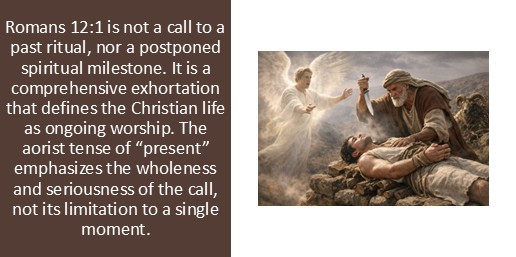
Romans 12:1 is not a call to a past ritual, nor a postponed spiritual milestone. It is a comprehensive exhortation that defines the Christian life as ongoing worship. The aorist tense of “present” emphasizes the wholeness and seriousness of the call, not its limitation to a single moment.
Grounded in God’s mercies, the believer is summoned to place the whole self at God’s disposal. That presentation, once embraced, becomes the foundation for a life of continual transformation, obedience, joy, prayer, gratitude, and praise. This is not legalism. It is the reasonable service of those who have been made alive from the dead.