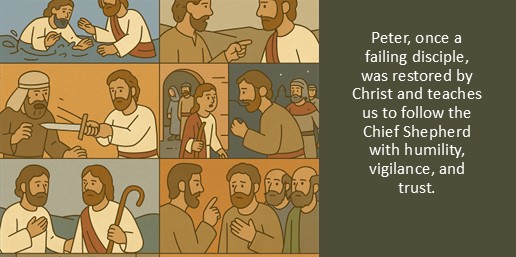
Peter’s counsel in 1 Peter 5:1-8 flows from his own story—he stumbled in pride, fear, and failure, yet restored by Christ, he now urges humility, vigilance, and trust in the Chief Shepherd. Most notably, Peter starts this list in humility “as a fellow elder” not in command “as chief apostle of Christ.” Even in his teaching, he is leading by example. And he ends with a sobering reminder that harkens back to untold suffering that Peter must have experienced when Satan tried to sift him as wheat (Luke 22:31).
| Peter | Failure | Victory |
|---|---|---|
| 5:1 – “as a fellow elder” | Once sought preeminence among the Twelve (Mark 9:33-35; 10:35–45). | Now speaks humbly as one restored after denial (John 21:15-19). |
| 5:1 – “a witness of the sufferings of Christ” | Denied Christ during His sufferings (Luke 22:54-62). | Later bore bold witness before rulers (Acts 4:8-20; 5:29). |
| 5:1 – “a partaker in the glory to be revealed” | Confused at the Transfiguration, wanting to build tents (Matthew 17:4). | Saw Christ’s glory revealed (Matthew 17:1-8; 2 Peter 1:16-18). |
| 5:2 – “Shepherd the flock… exercising oversight” | Once failed as a shepherd by denying Christ (John 18:17, 25–27). | Commissioned by Jesus to feed His sheep (John 21:15-17); led the church (Acts 2–5, 10–11, 15). |
| 5:2 – “not under compulsion… not for shameful gain” | Judas’ betrayal and Simon Magus’ greed showed ministry corrupted (Acts 1:16-20; 8:18–24). | Peter served eagerly out of love for Christ (John 21:17). |
| 5:3 – “not domineering… but being examples” | Tried to rebuke Jesus (Matthew 16:22) and used the sword rashly (John 18:10). | Followed Christ’s servant example (John 13:14-15); led gently by word and life. |
| 5:4 – “when the Chief Shepherd appears… crown of glory” | Once craved earthly recognition and misunderstood glory (Mark 10:35-37). | Awaited Christ’s true reward, recalling both John 21 and the Transfiguration (Matthew 17). |
| 5:5 – “clothe yourselves with humility” | First resisted Jesus washing his feet (John 13:6-8); pride led to denial (Matthew 26:35). | Learned humility through failure and restoration (John 21). |
| 5:6 – “Humble yourselves… that he may exalt you” | Rebuked as “Satan” (Matthew 16:23); humbled by bitter weeping after denial (Luke 22:61-62). | Exalted by God into leadership of the early church. |
| 5:7 – “casting all your anxieties on him” | Feared storm (Matthew 14:30), denied under pressure (Luke 22:57), and faltered at Antioch (Galatians 2:11-14). | Trusted God’s care, even sleeping peacefully in prison (Acts 12:6). |
| 5:8 – “Be sober-minded; be watchful… adversary the devil” | Slept in Gethsemane instead of watching (Matthew 26:41); Satan sought to sift him (Luke 22:31). | Now sober and vigilant, warning the flock from firsthand experience. |
Every line of 1 Peter 5:1-8 bears the imprint of Peter’s story. The man who once reached for a sword now teaches gentle oversight. The disciple who boasted and then denied now urges humility and watchfulness. The eyewitness of Christ’s sufferings and the preview of His glory calls leaders to shepherd Christ’s flock under the Chief Shepherd, casting anxieties on the caring God he has learned to trust.
- Ten considerations before appointing church leaders – The importance of taking time to approve church leaders, which ensures godly, faithful, experienced, proven leadership.
- Accepted in Christ, Transformed by Grace – Positional acceptance in Christ vs progressive sanctification explained: Bible study on justification, holiness, identity, spiritual growth.
- Christian’s Guide to Investing for Eternity – As followers of Christ, we are called to be faithful stewards of our time, talents, and finances, investing them with eternity in mind.
1 Peter 5:1
“Therefore I exhort the elders among you, as a fellow elder and a witness of the sufferings of Christ, as well as a partaker in the glory that is going to be revealed.”
- “Fellow elder” (sumpresbyteros).
Peter does not pull rank as “chief apostle,” but identifies as a fellow shepherd. This humility contrasts his earlier self-confidence and jockeying for prominence among the Twelve (Mark 9:33-35; 10:35–45). It reflects his post-restoration posture after denying Christ and being recommissioned (John 21:15-19). - “Witness of the sufferings of Christ.”
Peter literally witnessed Christ’s arrest and mistreatment (Luke 22:54-62). Yet that night includes his lowest point, the triple denial. Calling himself a “witness” ties both to his failure (denial in the courtyard) and to his later Spirit-bold witness before hostile authorities (Acts 4:8-20; 5:29). - “Partaker in the glory… to be revealed.”
Peter previewed that glory on the mount of Transfiguration (Matthew 17:1-8) and references it explicitly elsewhere (2 Peter 1:16-18). That high point stands in tension with his earlier confusion there (wanting to build three tents), now matured into hope fixed on Christ’s appearing.
1 Peter 5:2-3
“Shepherd the flock of God that is among you, exercising oversight, not under compulsion, but willingly, as God would have you, not for shameful gain, but eagerly, not domineering over those in your charge, but being examples to the flock.”
- “Shepherd the flock… exercising oversight.”
This all but quotes Peter’s restoration in John 21 (“Feed my lambs… Shepherd my sheep”). The one who failed grievously is entrusted to feed Christ’s people. Acts shows him living this out in teaching, protecting, and organizing the church (Acts 2–5; 10–11; 15). - “Not under compulsion, but willingly… not for shameful gain, but eagerly.”
Peter had learned to serve from love for Christ, not mere duty. His “eagerness” recalls his bold leadership after Pentecost (Acts 2–4). The warning about sordid gain contrasts the mercenary spirit he confronted in others (e.g., Simon Magus, Acts 8:18-24), and the greed that destroyed Judas, a sobering backdrop Peter knew intimately (Acts 1:16-20). - “Not domineering… but being examples.”
“Domineering” (katakurieuontes) echoes Jesus’ rebuke when the disciples sought status: “It shall not be so among you” (Mark 10:42-45). Peter once rebuked Jesus and swung a sword (Matthew 16:22; John 18:10), both heavy-handed moments. Now he commends leading by example (typoi), reflecting Christ’s foot-washing example (John 13:14-15) which Peter initially resisted but later embraced.
1 Peter 5:4
“And when the chief Shepherd appears, you will receive the unfading crown of glory.”
- “When the chief Shepherd appears”
Peter’s under-shepherd language flows from John 21’s commission. The hope of an “unfading” crown corrects his earlier, this-worldly instincts on the mountain and in debates about greatness. Having tasted both glory’s preview (Transfiguration) and shame (denial), he directs leaders to await Christ’s reward, not human acclaim.
1 Peter 5:5
“Likewise, you who are younger, be subject to the elders. Clothe yourselves, all of you, with humility toward one another, for ‘God opposes the proud but gives grace to the humble.’”
- “Be subject… clothe yourselves with humility.”
“Clothe” (egkomboomai) pictures tying on a servant’s apron, a likely allusion to Jesus girding Himself to wash the disciples’ feet (John 13:4-5). Peter first protested that act, then submitted, learning the very humility he now commands. - “God opposes the proud…”
Peter had boasted, “Even if I must die with you, I will not deny you” (Matthew 26:35), then fell. He tasted opposition to pride and grace in restoration. The line he quotes (Proverbs 3:34 LXX) is autobiographical counsel: pride led him to a fall; grace raised him to shepherd.
1 Peter 5:6-7
“Humble yourselves, therefore, under the mighty hand of God so that at the proper time he may exalt you, casting all your anxieties on him, because he cares for you.”
- “Humble yourselves… that he may exalt you.”
From “Get behind me, Satan” (Matthew 16:23) to his bitter weeping and later reinstatement (Luke 22:61-62; John 21), Peter learned that God’s path down leads up. His later public usefulness came after private humbling. - “Casting all your anxieties on him.”
Peter knew crippling fear: sinking when he looked at the wind (Matthew 14:30), fear of man in the courtyard (Luke 22:57), and pressure from the circumcision party at Antioch (Galatians 2:11-14). He also knew supernatural peace, sleeping the night before execution (Acts 12:6). His charge to “cast” anxieties is the seasoned counsel of one who learned to transfer burdens to the Lord who rescued him repeatedly.
1 Peter 5:8
“Be sober-minded; be watchful. Your adversary the devil prowls around like a roaring lion, seeking someone to devour.”
- “Be sober-minded; be watchful.”
In Gethsemane Jesus told Peter, “Watch and pray… the spirit indeed is willing, but the flesh is weak” (Matthew 26:41). Peter slept, then stumbled. The imperative now is the fruit of failure: vigilance would have guarded him when temptation came. - “Your adversary the devil…”
Peter had been targeted explicitly: “Satan demanded to sift you like wheat” (Luke 22:31). He had felt satanic enticement in trying to divert Jesus from the cross (Matthew 16:23), witnessed Satan’s work in the church (Ananias and Sapphira, Acts 5:3), and faced demonic opposition on mission. His lion metaphor grows out of a life schooled by real spiritual conflict, which makes his warning urgent and experiential.