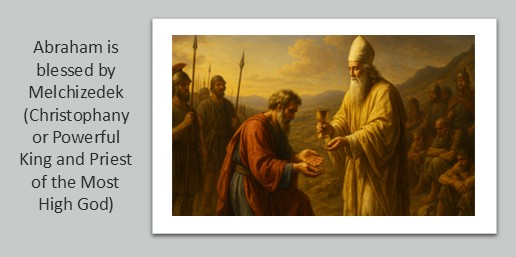
The account of Melchizedek blessing Abraham who tithes ten percent of everything to him might be a Christophany (Jesus Christ appearing in the Old Testament) or it might be an encounter with a powerful ruler and priest of the Most High God. Let’s examine the context and both sides of the argument to understand the broader theological lesson here is that Jesus Christ’s priesthood surpasses the Levitical/Aaronic priesthood because it is of a different and higher order.
The Meaning and Purpose of Hebrews 7
1. Context and Purpose of the Chapter
Hebrews 7 is the writer’s central theological argument for the superiority of Christ’s priesthood. The epistle’s readers—Jewish believers tempted to return to the Mosaic system—needed reassurance that in Christ, they possessed a greater and final covenant.
To prove this, the author demonstrates that Jesus’ priesthood surpasses the Levitical priesthood because it is of a different and higher order: the order of Melchizedek (Hebrews 7:11, 17).
The argument unfolds as follows:
- Abraham honored Melchizedek (7:1–10)
Abraham, the ancestor of Levi, paid tithes to Melchizedek. Thus, in a representational sense, the Levitical priesthood (still in Abraham’s loins) acknowledged Melchizedek’s superiority. - The Levitical priesthood was imperfect (7:11–19)
The Law made nothing perfect. It revealed sin but could not remove it. The need for another priesthood showed the insufficiency of the old one. - Christ’s priesthood is eternal and unchangeable (7:20–28)
Unlike mortal priests, Christ’s priesthood is based on divine oath, eternal life, and moral perfection. “He ever liveth to make intercession” (7:25).
Thus, Hebrews 7 does not glorify Melchizedek for his own sake. Rather, it uses him to illustrate Christ’s supreme and eternal priesthood—one that renders the old covenant obsolete (Hebrews 8:13).
The Superiority of Christ Demonstrated
- Superior Order:
Christ’s priesthood is patterned after Melchizedek, not Levi. It predates and transcends the Mosaic Law (Psalms 110:4). - Superior Nature:
It is eternal, not temporary; based on life, not lineage. Levitical priests died; Christ lives forever (Hebrews 7:23-25). - Superior Foundation:
It rests on God’s oath—“The Lord has sworn and will not repent” (Hebrews 7:21)—whereas the Levitical priests served without such a divine guarantee. - Superior Efficacy:
The old priests offered repeated sacrifices for sin; Christ offered one perfect sacrifice once for all (Hebrews 7:27; 9:12, 26).
Thus, Hebrews 7’s description of Melchizedek is not meant to mystify but to magnify Christ. The mysterious silence about Melchizedek’s birth and death becomes a literary symbol of perpetual priesthood—used by the Holy Spirit to direct attention to Jesus, our eternal High Priest.
Theological Implications: Literal vs. Symbolic Reading
The interpretation of Melchizedek hinges on whether one takes the description in Hebrews 7 literally or symbolically: considering the Common-sense Golden Rule of Interpretation Both methods carry significant theological implications.
1. Literal Interpretation
Definition:
A literal interpretation means the statements about Melchizedek’s lack of genealogy, beginning, and end are understood as factually true descriptions of his nature—implying a divine or pre-incarnate being.
Theological Evidence and Support:
- Textual Plainness:
Hebrews 7:3 explicitly says he was “without father, without mother…having neither beginning of days, nor end of life.” If taken literally, this cannot describe any human. - Christophany Parallels:
The “Angel of the LORD” in the Old Testament is frequently described as God yet distinct from the Father (Genesis 16; Exodus 3; Judges 13). Melchizedek could represent one of these divine manifestations. - Eternal Priesthood:
“Abideth a priest continually” (7:3) naturally describes the everlasting ministry of Christ (7:24). - Christological Continuity:
If Melchizedek is Christ, Hebrews 7 establishes that Christ’s priesthood was active from the earliest patriarchal era, demonstrating the timelessness of His mediation.
Implications:
- Emphasizes Christ’s pre-incarnate ministry and divine immutability.
- Reinforces the unity of the Testaments, showing Christ’s active role throughout history.
- However, it risks collapsing the typology of Hebrews—if Melchizedek is Christ, the author’s comparison between the two becomes unnecessary or redundant.
2. Symbolic (Typological) Interpretation
Definition:
A symbolic interpretation treats the details about Melchizedek’s “lack of genealogy” as intentional silences in Scripture designed to illustrate truths about Christ rather than describe literal facts about Melchizedek himself.
Theological Evidence and Support:
- “Made Like Unto the Son of God” (Hebrews 7:3):
The Greek aphomoiomenos (“made like”) signifies resemblance, not identity. The text carefully distinguishes Melchizedek from Christ. - Scriptural Silence:
Genesis records no birth or death for Melchizedek, but that does not imply nonexistence. The writer of Hebrews builds theological symbolism on the inspired omission of those facts. - Human King and Priest:
Genesis 14:18-20 presents Melchizedek as the “king of Salem” and “priest of the Most High God,” titles consistent with a historical human figure. - Typology Consistency:
Scripture frequently uses human types to prefigure Christ (Adam, Moses, David, Joseph). Melchizedek fits this consistent biblical pattern.
Implications:
- Preserves the historical-literary integrity of Genesis.
- Emphasizes the intentional design of Scripture, where silence or brevity serves theological purpose.
- Shows that God ordained a foreshadowing of Christ’s eternal priesthood before the Law—teaching that salvation was never confined to the Levitical system.
However, this approach requires recognizing certain statements as figurative, which may be misunderstood as denying the literal truth of Scripture. In reality, it affirms that the Spirit used historical realities as symbolic instruction (Romans 15:4; 1 Corinthians 10:11).
Evaluating the Evidence
| Feature | Literal (Christophany) | Symbolic (Typological) |
|---|---|---|
| “Without father/mother” | Actual divine being with no human ancestry | Genealogy omitted to prefigure a non-Levitical priesthood |
| “Abideth a priest continually” | Christ’s eternal priesthood literally described | Melchizedek’s priesthood pictured as continuous to typify Christ’s eternal role |
| Hebrews 7:3 wording | “Is” Christ | “Made like unto” Christ |
| Relation to Genesis 14 | Theophany (God appearing) | Historical king/priest used by God as a type |
| Implication for Christology | Shows pre-incarnate ministry of Christ | Shows predictive typology designed by God |
| Main strength | Emphasizes Christ’s eternal nature | Maintains grammatical-historical integrity |
| Main risk | Collapses type and antitype into one | Risks minimizing the literal tone of the text |
The Broader Theological Lesson
Regardless of which view one holds, Hebrews 7 teaches one central truth:
The priesthood of Christ is eternal, superior, and sufficient. It fulfills every purpose the Levitical system could only foreshadow.
- Christ’s priesthood is not inherited, but appointed by divine oath.
- It is not temporary, but permanent because He lives forever.
- It is not ritualistic, but redemptive, grounded in His once-for-all sacrifice.
Thus, the discussion of Melchizedek—whether viewed literally or symbolically—serves a single divine purpose: to exalt Jesus Christ as the one and only mediator between God and man (1 Timothy 2:5), the eternal “King of righteousness” and “King of peace.”
Conclusion
The description of Melchizedek in Hebrews 7 functions as a Christ-exalting contrast between the temporary and the eternal, the shadow and the substance, the Law and grace.
Whether one interprets Melchizedek as a Christophany or as a historical type, the theological end is the same: to reveal that Christ alone is the perfect, everlasting, and all-sufficient High Priest who brings sinners into lasting peace with God.