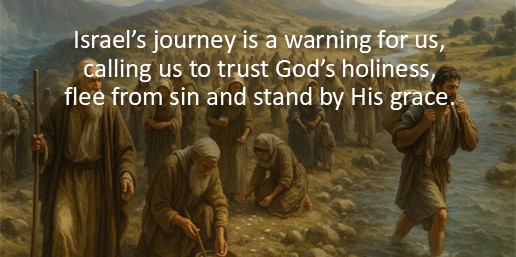
The Apostle Paul, writing to a confident Corinthian church, reaches back into Israel’s wilderness history and reminds his readers that spiritual privilege is no guarantee of spiritual safety. The generation that walked under God’s cloud, passed through the sea, and ate supernatural food died in the desert because their hearts turned from Him. Paul’s purpose is not to entertain with stories but to warn the church: “If you think you are standing strong, be careful not to fall.” These accounts are “examples” for us, real events preserved to instruct those who live at the end of the age. (1 Corinthians 10:1-12)
Paul begins with Israel’s privileges. They were guided by the cloud of God’s presence, delivered through the parted waters of the Red Sea, united under God’s chosen leader Moses, and sustained by food and drink from heaven. In a remarkable statement, he says “the Rock was Christ,” affirming that the preincarnate Son Himself shepherded His people. Yet privilege was no shield. “With most of them God was not well pleased,” Paul writes, “for their bodies were scattered in the wilderness.” The sobering truth is clear: nearness to holy things does not replace obedience and enduring trust.
The first example comes from the exodus itself. Israel passed under the cloud and through the sea (Exodus 13–14), witnessing one of history’s most dramatic deliverances. They identified with Moses as God’s appointed leader, just as believers today are identified with Christ. Yet the very people who sang the song of victory at the Red Sea later refused to enter the Promised Land. Great beginnings must be matched by faithful endurance, or the journey will end in discipline rather than reward.
Next Paul recalls the manna, bread from heaven that fell daily for forty years (Exodus 16; Numbers 11). It was spiritual food—divinely given, sufficient, and sweet. Yet Israel despised it, craving the foods of Egypt. The warning is timeless: when God’s provision no longer satisfies us, our hearts are already leaning toward idols. Ingratitude is not a small sin; it is a doorway to rebellion.
Likewise, the water from the rock (Exodus 17; Numbers 20) was spiritual drink, a miracle that Paul ties directly to Christ. God’s people drank from the Rock, yet they quarreled and tested His patience. Spiritual experiences are meant to deepen faith, not excuse disobedience. When provision becomes an occasion for complaint, the heart is hardening against the Giver.
Paul then turns to the sobering truth that “their bodies were scattered in the wilderness” (Numbers 14). After hearing the spies’ report, Israel refused to enter the land, fearing its inhabitants more than they trusted God’s promise. The Lord swore that the unbelieving generation would die in the desert. For the church, the parallel is not loss of eternal salvation for the truly redeemed, but the loss of usefulness, joy, and reward through unbelief and disobedience.
The next example is idolatry. At Sinai, Israel grew impatient for Moses to return and fashioned a golden calf (Exodus 32). They feasted, drank, and “rose up to play,” a phrase Paul quotes word for word. This was not innocent celebration but pagan revelry dressed in the language of worship. The warning is plain: idolatry often disguises itself with religious trappings. Any reshaping of God to suit our desires is a golden calf, whether cast in gold or crafted in the imagination.
Paul also warns against sexual immorality, recalling the incident at Baal of Peor (Numbers 25). Israel joined in idolatry with Moabite women, and a plague struck, killing thousands in a single day. Paul notes twenty-three thousand fell that day, while Numbers records twenty-four thousand total—one figure describing a single day’s toll, the other the overall number. The lesson is urgent: sexual sin invites swift and severe judgment, and grace never grants permission to indulge it.
Testing the Lord is another danger. In Numbers 21, the people grew impatient, spoke against God, and were punished by venomous serpents. Healing came only by looking in faith to the bronze serpent God provided. To test Christ is to demand proof of His goodness while refusing to trust His word. It is a form of unbelief that provokes discipline until repentance restores the relationship.
Finally, Paul warns against grumbling. In Numbers 16, after Korah’s rebellion, the congregation murmured against Moses and Aaron, accusing them falsely. A plague broke out until Aaron made atonement. Grumbling is more than venting frustration—it is rebellion against God’s providence and appointed order. It spreads through a community like a poison, draining spiritual vitality and inviting God’s corrective hand.
Twice Paul states the reason for recording these events: “These things became examples for us” and “they were written down to warn us.” They are not allegories or abstract morals; they are history, preserved by the Spirit for our instruction. The God who led Israel is the God who leads the church, and His holiness, faithfulness, and discipline remain unchanged.
The guardrails are clear. Privilege is not protection. Corporate sin matters, and congregations can fall into patterns of idolatry, impurity, or complaint. Humility is essential—“let the one who thinks he stands take heed lest he fall.” The warnings are not meant to paralyze us with fear but to keep us close to Christ, alert to temptation, and dependent on His grace.
For the believer today, these examples call for self-examination. Is your worship shaped by God’s Word or by the world’s appetites? Are you guarding your body against the lure of immorality? Are your words marked by thanksgiving rather than complaint? Do you receive God’s provision with gratitude? Do you honor God’s leaders and submit to His appointed order? Such questions are not burdens but blessings, guiding us away from sin’s snares and toward the joy of walking in the light.
Israel’s wilderness story is not a dusty chronicle; it is the church’s classroom. The cloud and the sea, the manna and the water, the victories and the graves—all speak of a God who is faithful, holy, and jealous for the hearts of His people. These things were written to keep us from craving evil, to turn us from idolatry and immorality, from testing Christ and grumbling against His ways. Let the warnings humble you, and let humility lead you to obedience. By His grace, you will stand.