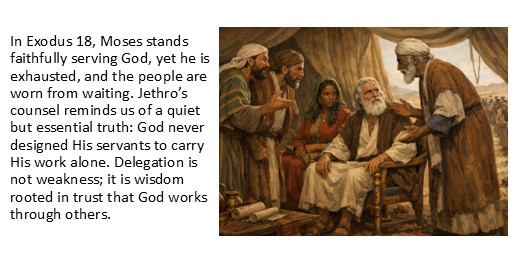
Delegation is not merely a pragmatic leadership strategy. In Scripture, delegation is a theological act rooted in God’s character, God’s design for human limitation, and God’s purpose for ordered authority. Exodus 18:13-27 records one of the clearest biblical case studies on godly delegation, where Jethro, Moses’ father-in-law, counsels Israel’s great leader to share the burden of leadership. This passage reveals that delegation is not a concession to weakness but an expression of wisdom, obedience, and trust in God’s design.
Jethro teaches a theology of delegating that is God-centered, people-protecting, leader-sustaining, justice-preserving, and covenantally faithful. When examined alongside the broader testimony of Scripture, this passage establishes enduring principles for leadership in Israel, the church, and all God-ordained authority structures.
The Context of Exodus 18: Delegation Born from Necessity and Compassion
Exodus 18 occurs shortly after Israel’s deliverance from Egypt. Moses stands as God’s chosen mediator, teacher, and judge. Yet the text presents a troubling scene. Moses sits alone from morning until evening adjudicating disputes. The people stand endlessly, and Moses bears the entire judicial and instructional load.
Jethro’s observation is not critical but discerning. He asks probing questions that expose the unsustainability of Moses’ approach. Moses’ motive is pure. He desires to make known the statutes and laws of God. However, sincerity does not sanctify inefficiency. Jethro’s assessment is blunt and theologically charged. “What you are doing is not good.” This judgment is not pragmatic alone. It is moral and spiritual. God’s work done in God’s way must honor God’s design for human limitation.
Delegation and the Doctrine of Human Limitation
A foundational theological truth emerges immediately. Even God-appointed leaders are finite. Moses is chosen, called, and empowered by God, yet he is not omnipresent, omniscient, or inexhaustible. Jethro warns that Moses and the people will “surely wear yourselves out.”
This aligns with the broader biblical doctrine of humanity. Man is created in God’s image but remains a creature, not the Creator. Scripture consistently affirms that God does not require His servants to function as though they were divine. Delegation, therefore, is not a denial of calling but an acknowledgment of creaturely dependence.
Numbers 11 reinforces this truth when the Lord Himself commands Moses to appoint seventy elders, promising to place the same Spirit upon them so they might share the burden. Delegation, in this sense, is not merely horizontal distribution of tasks but vertical participation in God’s provision.
Delegation as Theological Alignment with God’s Order
Jethro’s counsel is strikingly God-centered. He does not replace Moses’ role. He clarifies it. Moses is to remain the people’s representative before God. He is to teach the law, intercede, and handle the most difficult cases. Delegation does not diminish spiritual authority. It defines it.
This structure reflects God’s consistent pattern of mediated authority. God governs through appointed servants who themselves appoint others. Deuteronomy 1 records Moses later affirming this model as God’s will, not merely Jethro’s wisdom. The people themselves testify, “What you propose to do is good.”
This principle reappears throughout Scripture. In Acts 6, the apostles refuse to abandon prayer and the ministry of the Word. Instead, they instruct the church to select qualified men to handle necessary administrative responsibilities. The result is spiritual health, unity, and gospel advance.
Delegation preserves the priority of God-given roles while ensuring the whole community functions properly.
Biblical Case Studies That Confirm Jethro’s Model
The counsel Jethro gave to Moses was neither novel nor isolated. Rather, it reflects a pattern that God repeatedly affirms throughout redemptive history. From creation to the formation of Israel, from the ministry of Christ to the ordering of the New Testament church, Scripture consistently demonstrates that God advances His purposes through delegated authority exercised under His sovereign rule. These examples do not replace the teaching of Exodus 18; they confirm it. Together they reveal that godly delegation is not a temporary solution to leadership strain, but an enduring expression of divine wisdom, moral responsibility, and covenantal order. The following biblical case studies illustrate how this principle operates across varying contexts, highlighting both faithful and foolish forms of delegation and the spiritual consequences that follow.
- Delegated Dominion to Humanity (Genesis 1:26-28) – God grants mankind authority over creation under His sovereignty. – Delegation is creational, not corrective. Authority is exercised under God, not apart from Him. – Dominion Lost (to be continued)
- Judges Appointed Under Moses (Exodus 18; Deuteronomy 1; Deuteronomy 16) – Moses appoints qualified men to share judicial responsibility. – Delegation preserves justice, prevents burnout, and reflects covenantal order.
- Seventy Elders Share the Burden (Numbers 11:16-17) – God places His Spirit upon others to assist Moses. – Delegation is enabled by God’s Spirit, not merely human organization.
- The Delegation of the Twelve Spies (Numbers 13–14; Deuteronomy 1:22-33) – One representative from each tribe is sent to survey the Promised Land and report back. – Delegation requires faith-filled obedience; when delegated leaders operate by fear rather than trust in God, the mission fails and judgment follows.
- Levitical and Priestly Division of Labor (Exodus 28; Numbers 3–4) – Priests and Levites are assigned distinct worship duties. – Holy service requires structure, order, and shared responsibility.
- Gideon’s Military Delegation (Judges 6–7) – Gideon organizes men into units under God’s direction. – Delegation magnifies God’s glory by preventing human self-reliance.
- Foolish Delegation: Samuel’s Sons (1 Samuel 8:1-5) – Authority is given without regard for character. – Delegation divorced from righteousness leads to corruption and judgment.
- David’s Administrative Organization (1 Chronicles 23–27) – David appoints leaders over worship, military, and civil matters. – God-honoring leadership values preparation, order, and accountability.
- Solomon’s District Governors (1 Kings 4:1-19) – Officials are appointed to sustain the kingdom. – Wisdom expresses itself through sustainable governance.
- Rejected Counsel Under Rehoboam (1 Kings 12) – Wise advisors are ignored in favor of pride. – Failure to heed godly counsel fractures God’s people.
- Nehemiah’s Rebuilding Assignments (Nehemiah 3; 7:1–3) – Leaders and families are assigned specific sections of the wall. – Delegation fosters ownership, unity, and faithfulness in God’s work.
- Jesus Delegates Authority to the Twelve (Matthew 10:1-4) – The disciples are sent with authority to minister. – Delegation is essential to discipleship and ministry multiplication.
- Jesus Sends the Seventy-Two (Luke 10:1-20) – Authority is extended beyond the Twelve. – Delegation is scalable and mission-driven.
- Apostolic Delegation to Deacons (Acts 6:1-7) – Qualified men are appointed to meet practical needs. – Delegation protects prayer, doctrine, and unity in the church.
- Paul Appoints Elders and Delegates Authority (Acts 14:23; Titus 1:5) – Leadership is established in every church. – Delegation ensures doctrinal continuity and shepherding beyond the founder. – Ten considerations before appointing church leaders
- Spiritual Gifts as Delegated Ministry (1 Corinthians 12; Romans 12; Ephesians 4) – God distributes gifts across the body, not concentrated in one person. – Delegation is built into the design of the church itself. No believer is sufficient alone.
Qualifications Reveal the Moral Nature of Delegation
Jethro’s instructions for selecting leaders are theologically rich. Delegation is not task-based alone. It is character-based. The men chosen must be capable, God-fearing, trustworthy, and opposed to dishonest gain.
These qualifications echo throughout Scripture. Deuteronomy 16 demands righteous judges who reject partiality and bribes. First Timothy 3 and Titus 1 outline similar character requirements for church leaders. Delegation, therefore, is never morally neutral. To delegate authority is to entrust representation of God’s justice and character.
The example of Samuel’s sons in 1 Samuel 8 demonstrates the danger of careless delegation. They were appointed without regard for character, and their corruption led the people to reject God’s leadership in favor of a king. Foolish delegation produces societal groaning, as Proverbs 29 teaches.
Delegation Protects Justice and the People
One of Jethro’s central concerns is the well-being of the people. Endless waiting undermines justice. Overburdened leaders risk inconsistency, fatigue, and error. Delegation ensures that justice is timely, accessible, and fair.
Scripture consistently connects righteous leadership with peace and stability. Jethro promises that proper delegation will allow the people to “go home in peace.” This aligns with Solomon’s prayer for discernment to judge God’s people rightly and with Jehoshaphat’s charge to judges to remember they judge not for man but for the Lord.
Delegation is thus an act of love for those being led. It ensures that authority serves rather than oppresses.
Delegation and Servant Leadership
Jesus Christ redefines greatness as service. Authority in God’s kingdom is never self-exalting. Delegation reflects this servant posture. Leaders who delegate acknowledge that the mission is greater than personal control.
First Peter 5 exhorts shepherds not to lord authority over the flock but to lead by example. Delegation creates space for shared ministry, mutual accountability, and the development of future leaders. It mirrors Christ’s own ministry, where He entrusted authority to the apostles while remaining the ultimate head.
Delegation and Submission to God-Ordained Authority
Romans 13 teaches that all authority is established by God. Delegation does not fragment authority. It distributes it under God’s sovereign order. Each level remains accountable to God and to the structure He ordains.
Jethro’s model demonstrates layered accountability. Minor matters are handled locally. Major issues ascend to Moses. This preserves unity, order, and clarity. Authority flows downward in responsibility and upward in accountability.
Theological Implications for Today
The theology of delegating taught by Jethro has enduring relevance. Churches suffer when pastors attempt to do all the work alone. Families suffer when leadership is centralized without shared responsibility. Societies suffer when authority is either hoarded or irresponsibly distributed.
Godly delegation requires humility, discernment, prayer, and courage. It demands trust in God’s Spirit working through others. It safeguards leaders from burnout, protects people from injustice, and honors God’s design for community life.
Conclusion
Jethro’s counsel in Exodus 18 is far more than ancient administrative advice. It is a Spirit-recorded theology of delegation rooted in God’s character and covenant purposes. Delegation honors human limitation, preserves divine order, protects justice, and promotes peace. Scripture consistently affirms this model across redemptive history.
When leaders delegate according to God’s Word, they do not relinquish authority. They exercise it faithfully. In doing so, they reflect the wisdom of God, the humility of Christ, and the order of the kingdom of heaven.