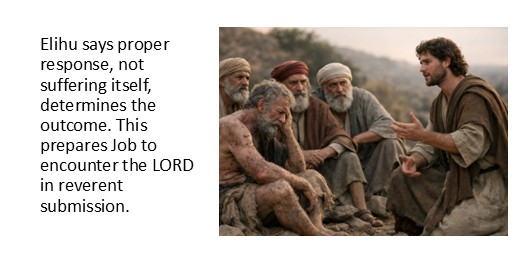
Elihu stands apart from Job’s three friends in both theology and tone. Unlike them, he does not assume suffering is automatic punishment for specific sins, nor does he rely on rigid tradition or human wisdom. He listens carefully, represents Job fairly, and consistently defends God’s righteousness without condemning Job as wicked. Elihu emphasizes God’s sovereignty, justice, and gracious purpose in suffering, presenting affliction as discipline and instruction, not merely retribution. Significantly, when the LORD speaks, Elihu alone is not rebuked, confirming the theological soundness of his perspective.
Elihu’s doctrine of suffering presents affliction as divinely governed, morally purposeful, spiritually instructive, and graciously redemptive. Suffering is not evidence of God’s injustice nor proof of personal wickedness but a means through which God disciplines, communicates, humbles, and restores. Proper response, not suffering itself, determines the outcome. This theology rightly prepares Job, and the reader, to encounter the LORD in reverent submission.
I. The Source of True Wisdom in Interpreting Suffering
Elihu begins by grounding all true understanding of suffering in divine revelation rather than age, tradition, or human reasoning. Wisdom comes from the “breath of the Almighty,” not from experience alone. Therefore, suffering cannot be interpreted rightly apart from God’s self-disclosure. This establishes that theological conclusions drawn from suffering must be God-centered, not man-centered, and guards against speculative or formulaic explanations.
Job 32:6-10 Elihu explains why he has waited to speak. Though young, he recognizes that wisdom does not automatically come with age but from the Spirit of God. Respect restrained him, yet the failure of Job’s friends to answer rightly compels him to speak. Elihu affirms divine illumination over human seniority, teaching that true wisdom comes from God alone. This rebukes the assumption that experience guarantees insight and introduces Elihu’s God-centered perspective.
Job 32:11-14 Elihu describes how he carefully listened to the arguments of Job’s friends. He waited for their wisdom to prevail but found their reasoning empty. They failed to refute Job’s claims or properly defend God’s righteousness. Elihu clarifies that he is not aligned with their flawed arguments. His purpose is not to echo tradition but to offer a fresh, truthful correction grounded in God’s justice rather than human formulas.
Job 32:15-22 Seeing the friends silenced, Elihu feels inward pressure to speak. He likens his restraint to wine fermenting without release. He insists he will speak honestly, without partiality or flattery, because he fears God rather than men. This passage emphasizes integrity in theological speech. Elihu understands that to misrepresent God is dangerous, and his motivation is accountability before the Creator, not approval from his audience.
Job 33:1-7 Elihu addresses Job directly and respectfully, inviting careful listening. He emphasizes his sincerity and humility, noting that he too was formed from clay. Elihu does not claim divine status or superiority. His goal is dialogue without intimidation. This contrasts sharply with Job’s friends, who often spoke harshly. Elihu presents himself as a fellow man seeking truth, creating space for correction without crushing Job’s spirit.
II. Suffering Is Not Proof of Divine Injustice
Elihu directly confronts Job’s implication that God has acted unjustly. He insists that God cannot do wrong because righteousness is intrinsic to His nature. Suffering must therefore be interpreted within the bounds of God’s perfect justice. Elihu rejects the assumption that unexplained suffering equals unfair treatment, affirming that divine justice transcends human perception and demands humility rather than accusation.
Job 33:8-11 Elihu summarizes Job’s claims accurately: that Job considers himself innocent and believes God treats him as an enemy. By restating Job’s words, Elihu demonstrates fairness and careful listening. However, this summary prepares for correction. Elihu identifies Job’s core error, not suffering itself, but interpreting suffering as proof of divine injustice. This section clarifies the theological issue at stake: God’s righteousness versus human self-vindication.
III. God Uses Suffering as a Means of Divine Communication
Elihu teaches that God speaks to humanity in multiple ways, including dreams, warnings, and suffering. Affliction functions as a gracious intervention to restrain pride and prevent spiritual ruin. Suffering is thus revelatory rather than merely retributive. It serves to awaken the conscience and redirect the heart before greater destruction occurs, demonstrating God’s preventive mercy.
Job 33:12-18 Elihu challenges Job’s conclusion by asserting that God is greater than man and is not obligated to explain His actions. God speaks in many ways, including dreams and warnings, to restrain man from pride and destruction. Suffering can be preventative, not punitive. Elihu introduces the idea of divine communication through discipline, shifting the discussion from retribution to gracious correction and preservation.
IV. Suffering as Loving Discipline Rather Than Punitive Judgment
Elihu explains that physical pain and weakness may discipline the righteous, not condemn them. God uses affliction to expose dependence, correct behavior, and invite obedience. If the sufferer listens and responds rightly, restoration follows. This sharply contrasts with the friends’ rigid retribution theology and presents suffering as corrective instruction within a covenantal relationship.
Job 33:19-22 Elihu explains that suffering can also come through physical pain, weakness, and nearness to death. Such affliction humbles a person and confronts him with mortality. Rather than viewing suffering only as punishment, Elihu frames it as God’s tool to draw attention to spiritual realities. This prepares the way for repentance and deliverance, showing that God’s purposes in suffering can be merciful and redemptive.
V. The Role of a Mediator in Deliverance from Suffering
Elihu introduces the concept of a mediating messenger who declares righteousness and intercedes for the afflicted. God responds by granting mercy and restoration. This section reveals that deliverance from suffering is grounded in grace, not human merit. Repentance and divine initiative are central. The passage anticipates the broader biblical theme of mediation and redemption.
Job 33:23-28 Elihu introduces the concept of a mediator, an angelic messenger who declares what is right and intercedes for a man. God responds with mercy, delivering the sufferer from death and restoring him. This passage highlights grace, repentance, and restoration. The emphasis is not human merit but God’s willingness to redeem. It anticipates the biblical theme of mediation and reconciliation through divine initiative.
Job 33:29-33 Elihu concludes that God works repeatedly in these ways to turn people from destruction and bring them into the light of life. He urges Job to respond wisely and remain silent if he cannot answer. Elihu’s aim is instruction, not condemnation. This section reinforces that God is active, patient, and purposeful in dealing with humanity, often using hardship to produce spiritual renewal.
Job 34:1-9 Elihu broadens his audience and critiques Job’s statements publicly. He accuses Job of implying that righteousness is useless and that God is unjust. Elihu does not claim Job is wicked, but that his words dangerously echo the logic of the ungodly. This section stresses that careless speech about God can mislead others and must be corrected for the sake of truth and God’s honor.
Job 34:10-15 Elihu strongly defends God’s justice. He declares that God cannot do wickedness or act unjustly. God governs impartially and sustains all life by His Spirit. If God withdrew His breath, all humanity would perish. This passage affirms God’s absolute righteousness and sovereignty. Elihu grounds his argument in God’s role as Creator and Sustainer, making injustice incompatible with His nature.
Job 34:16-20 Elihu emphasizes that God shows no favoritism. He judges rulers and common people alike, often suddenly and irresistibly. Human power offers no protection from divine justice. This section confronts the illusion of human security and reminds listeners that authority and wealth do not shield anyone from God’s judgment. God’s justice is universal, immediate, and not constrained by human systems.
Job 34:21-30 Elihu explains that God sees all human actions and motives. Nothing is hidden from Him. God disciplines nations and individuals to prevent oppression and preserve order. When God grants peace, no one can disturb it. This passage emphasizes divine omniscience and moral governance. God’s rule is purposeful, restraining evil and ensuring that no one suffers without His awareness or oversight.
VI. Human Response Determines the Outcome of Suffering
Elihu emphasizes that suffering itself is not the decisive factor; the response to suffering is. Humility, repentance, and teachability lead to deliverance, while pride and resentment lead to further judgment. The godless resist correction, but the afflicted who submit are rescued. Suffering thus becomes a test of the heart, revealing whether one will submit to God’s instruction.
Job 34:31-37 Elihu urges the proper response to discipline: confession, humility, and repentance. He criticizes Job for multiplying words without knowledge and demanding judgment rather than submitting to correction. Elihu warns that stubborn self-justification invites further testing. The emphasis is not punishment but teachability. God’s discipline is meant to restore, but pride resists its purpose.
VII. Suffering Does Not Render Righteousness Meaningless
Elihu corrects Job’s claim that righteousness has no value when suffering occurs. Obedience does not benefit God directly but aligns humans with His moral order and blesses others. Righteousness is not a transactional guarantee of comfort but an expression of reverence. Suffering does not negate righteousness; it refines and validates it.
Job 35:1-8 Elihu addresses Job’s claim that righteousness brings no benefit. He argues that human obedience or sin does not affect God’s nature but impacts other people. God is self-sufficient. This corrects Job’s utilitarian view of righteousness. Obedience is not a bargaining tool but a response to God’s worth. Elihu reorients morality away from personal gain toward reverence for God.
Job 35:9-16 Elihu explains why some prayers go unanswered. People cry out under oppression but do not seek God rightly or acknowledge Him as their Maker. Pride and empty words hinder prayer. This passage teaches that suffering alone does not produce true faith. God listens to humble, God-centered prayer, not self-focused complaints. Elihu calls for repentance rather than accusation.
Job 36:1-4 Elihu asks for patience as he continues, claiming his knowledge comes from afar, meaning from God’s truth rather than personal speculation. He asserts his sincerity and completeness of understanding, not as arrogance but confidence in God’s revelation. This introduction reinforces Elihu’s role as a theological instructor, aiming to vindicate God’s righteousness accurately.
Job 36:5-7 Elihu affirms God’s power joined with justice. God preserves the righteous and does not overlook the wicked. He watches over His people and ultimately honors them. This corrects the friends’ rigid theology by emphasizing God’s care rather than mechanical punishment. God’s strength is never separated from His compassion or moral purpose.
Job 36:8-12 Elihu explains that when the righteous suffer, God uses affliction to teach and correct them. If they listen and obey, they are restored and blessed. If they refuse, they perish. This section reinforces the instructional purpose of suffering. Affliction is a test of response, not a verdict of condemnation. Obedience, not accusation, is the path to restoration.
Job 36:13-15 Elihu contrasts the godless, who resent discipline, with the afflicted who respond humbly. God delivers the humble through suffering rather than removing it immediately. This passage highlights God’s method of salvation through discipline. Pride resists God’s work, while humility receives deliverance. Suffering becomes the means by which God opens the ear to truth.
Job 36:16-21 Elihu warns Job that God is inviting him into a place of abundance and relief, but Job must avoid choosing sin or resentment. Elihu cautions against interpreting suffering as injustice and urges Job not to turn to rebellion. This section emphasizes the danger of responding wrongly to discipline. God’s purpose is gracious, but response determines outcome.
VIII. God’s Sovereignty Governs the Purpose and Limits of Suffering
Elihu stresses that God sees all, governs all, and limits suffering according to His wisdom. Nothing occurs outside divine oversight. God uses suffering to restrain evil, preserve justice, and accomplish purposes beyond human understanding. This assures the sufferer that affliction is neither random nor meaningless but operates under sovereign control.
Job 36:22-33 Elihu magnifies God’s greatness through His works in nature. God teaches through His deeds, and no one instructs Him. Storms, rain, and thunder reveal His power and provision. This passage shifts Job’s focus from personal suffering to God’s majesty. It prepares for the LORD’s appearance by emphasizing that creation itself testifies to divine wisdom and authority.
IX. Creation Testifies to God’s Wisdom in Human Affliction
Elihu points to God’s control over storms, seasons, and natural forces as evidence of His supreme wisdom. If humans cannot explain or command creation, they are unqualified to judge God’s governance of suffering. Nature teaches humility and trust. The same God who orders the cosmos orders affliction with precision and purpose.
Job 37:1-13 Elihu continues describing God’s power in the storm. Thunder, lightning, snow, and rain operate under God’s command for judgment, mercy, or provision. Nature obeys God perfectly, unlike humanity. This section underscores God’s sovereign control over all forces. The storm imagery anticipates God’s entrance, reinforcing that the One who governs creation also governs human lives.
Job 37:14-18 Elihu challenges Job to consider God’s wonders, particularly the heavens. Job cannot explain or control these phenomena. The implication is humility. Human understanding is limited, and God’s ways exceed human wisdom. This passage directly prepares Job to listen rather than argue. Awe, not accusation, is the proper response to God’s greatness.
X. The Proper Posture of the Sufferer: Fear, Humility, and Silence
Elihu concludes that the correct response to suffering is reverent fear of God, not self-justification. God does not honor those who claim wisdom but those who acknowledge their limits. Suffering calls the believer to worshipful silence and trust. This posture prepares the way for divine revelation rather than resisting it.
Job 37:19-24 Elihu concludes by affirming God’s unapproachable majesty. Humans cannot speak rightly before Him apart from reverence. God does not regard the self-wise but honors those who fear Him. This final appeal calls Job to humility and worship. Elihu steps aside, having pointed consistently to God’s righteousness, wisdom, and sovereignty, preparing the way for the LORD to speak.
Concluding Summary
Elihu’s speeches correct Job without condemning him, defend God without distortion, and reframe suffering as instructional discipline rather than mere punishment. He bridges the gap between human debate and divine revelation. Significantly, God does not rebuke Elihu, indicating that his theology aligns with truth and faithfully prepares Job to encounter the LORD Himself.
If you would like, I can also provide:
- A theological outline of Elihu’s doctrine of suffering
- A comparison of Elihu with the three friends
- A Christological trajectory from Job 33:23-28
- Teaching notes or sermon-ready material