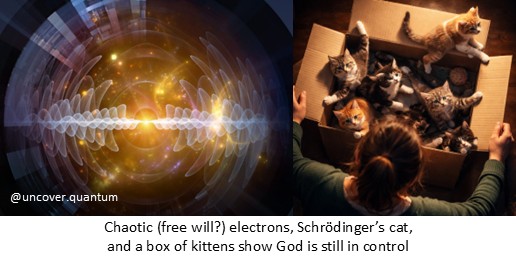
A viral science post can be entertaining, and sometimes it can also stir up a serious question. The following article about electrons tries to capture how strange the quantum world feels to human beings:
We do not need to accept every dramatic phrase in that post to learn something useful from it. The main takeaway is simple: at extremely tiny scales and extremely fast times, the world can behave in ways that feel unfamiliar to us.
Here is the Bible-student question that naturally follows.
If reality looks unpredictable at its foundations, does superposition mean the universe has “free will,” and if so, where does that leave God’s sovereignty?
Do Electrons “Look Like” They Have Free Will?
Let’s start with perspective.
From our human viewpoint, quantum events often look like this: we can describe several possible outcomes, but we cannot always predict which exact one will occur in a particular moment. In everyday speech, that can feel like “freedom.” It can feel like the electron “could do this or that,” and we only find out when we observe it.
That is close to what the post is trying to communicate when it speaks about “superposition,” and about cause and effect feeling “blurry” at attosecond timescales.
But here is the important Bible-friendly distinction.
Unpredictable to us does not mean ungoverned by God.
Scripture already gives us an analogy for events that seem random to humans while still being governed by the Lord:
Casting lots was, from a human standpoint, unpredictable. Yet God says He rules the outcome.
So, if an electron’s behavior looks probabilistic to us, we should not rush to call that “free will” in the moral, personal sense (as if an electron has a mind, motives, or guilt). Electrons are not people made in God’s image. They do not repent, believe, obey, or rebel. They are part of the creation that obeys God’s design.
Still, it is fair to say this: from our limited vantage point, the micro-world can look like it has multiple possible paths, and we learn which path occurs when we measure.
That observation is not a threat to Scripture. It simply highlights creaturely limits. We see “through a glass, darkly” (1 Corinthians 13:12). God does not.
Sovereignty, Not Fatalism, Not Chaos
Now we need to place the universe on the spectrum from fatalism to chaos.
- Fatalism says everything is strictly predictable, like a cold machine. Not only galaxies, but even human emotions and choices would be nothing but unavoidable physics.
- Chaos says anything can happen because nobody is in control, no plan, no rule, no meaning.
The Bible rejects both extremes.
The Bible affirms order and regularity in creation. God created a world that is intelligible and stable. Day and night, seasons, sowing and reaping are examples of dependable patterns God sustains (Genesis 8:22). God is not the author of confusion (1 Corinthians 14:33, in its immediate context about orderly worship, yet consistent with God’s character as orderly and wise).
At the same time, the Bible also affirms real contingency and real human responsibility. People make real choices. God commands, warns, and calls people to repentance and faith. “Choose you this day whom ye will serve” (Joshua 24:15). That is not pretend. It is meaningful.
So where does the universe lie?
Biblically speaking, the universe is neither fatalistic nor chaotic. It is governed.
A helpful word is providence. God reigns over His creation, including events that look random to us, and He accomplishes His purposes through means, choices, and secondary causes.
This is why Proverbs can say both things at once:
The verb “deviseth” speaks of real planning. People truly choose, think, and intend. Yet God “directeth,” meaning God establishes and orders the steps. Both are true at the same time. The Hebrew word for “deviseth” (chashav) means to plan or calculate. Humans truly plan. Yet the Lord directs (kun: To establish, prepare, make firm, set up, fix, direct) their steps. Scripture affirms both realities without apology.
Humans genuinely plan. The Lord genuinely directs.
The Baptist Faith and Message expresses this balance by affirming that God’s perfect knowledge extends to all things, including “the future decisions of His free creatures.”
That one line quietly dismantles both fatalism and chaos.
- Not fatalism, because creatures truly decide.
- Not chaos, because God perfectly knows and governs the whole story.
So even if something in nature appears to us like “chaotic freedom,” Scripture trains us to say: it is within God’s rule, and never outside His control.
Schrödinger’s Cat, a Box of Kittens, and a Caretaker Above the Chaos
Schrödinger’s Cat is a thought experiment designed to make you feel the weirdness of applying quantum descriptions to everyday objects. In the story, a sealed box contains a setup where the cat’s fate is tied to a microscopic event. Until you open the box, you do not know whether the cat is alive or dead, and the thought experiment pushes the unsettling idea that, in some sense, the system is described as both possibilities.
Here is a playful thought experiment for everyday theology: a box of kittens trying to escape.

They tumble over each other.
They push at corners.
They climb, slide, mew, and panic.
From inside the box, it feels like pure chaos.
But the caretaker is not worried.
Why? Because the caretaker is operating at a higher level.
The kittens are real agents at their level. They really wiggle. They really attempt. They really choose this corner instead of that one. But they are still contained. The caretaker can lift the box, open it, close it, move it, calm the kittens, or pick them up one by one.
That is a simple picture of a deep truth.
God’s ways are higher than our ways, not because He is merely wiser than we are, but because He is the sovereign Creator who sees and governs the whole story at once. When life feels like competing forces, love versus truth, righteousness versus peace, Scripture reminds us that in the Lord there is no contradiction at all, “Mercy and truth are met together, righteousness and peace have kissed each other” (Psalms 85:10), and what looks impossible to us is perfectly harmonious to Him, with “truth” rising in the world and “righteousness” looking down from heaven as God prepares the path before His steps (Psalms 85:11-13). That is why the Lord can say, “My thoughts are not your thoughts, neither are your ways my ways,” and then anchor the difference in sheer height and scale, “as the heavens are higher than the earth, so are my ways higher than your ways” (Isaiah 55:8-9). We are creatures inside the moment, but He is the One who holds the oceans, measures the heavens, weighs the earth, and needs no counselor to advise Him, instruct Him, or teach Him what is right (Isaiah 40:12-14). So when our perspective feels cramped, confused, or chaotic, faith rests in this, the God who unites what we cannot unite, and who never needs guidance, is guiding everything.
And that is why life can look confusing from our viewpoint without being confusing from God’s.
The ultimate example is the cross.
If God can govern the darkest event in human history for the greatest good in human history, He can govern everything else that feels chaotic in our smaller lives.
Conclusion: God’s Higher-Level Rule Over Our Chaotic-Looking Lives
From our perspective, the world often looks probabilistic. We do not know which phone call is coming. We cannot see the traffic jam tomorrow. We cannot predict exactly how a health scare will turn out. We often feel like we are living among scrambling kittens.
But Scripture teaches that what looks like confusion to us is never confusion to God.
- God’s sovereignty is not fatalism. He is not an impersonal machine forcing a script while pretending we matter.
- God’s sovereignty is not chaos. He is not watching the world spin out of control while hoping for the best.
God is sovereign in a personal, wise, purposeful way. He can permit creaturely freedom and real contingency while remaining perfectly in control, because He operates at a higher level than His creation.
- Even if electrons “look free” from our vantage point, God is still sovereign.
- Even if Schrödinger’s cat is both alive and dead at the same time from our vantage point, God is still sovereign.
- Even if the world looks as chaotic as a box of kittens trying to escape, God is still sovereign.
The caretaker is not panicking. The kittens may be.
-
- Whosoever will may come – The universal call of “whosoever will” includes everyone and anyone. No one has ever been excluded. You must choose to accept or reject the call.
- God Predestined the Plan of Salvation – Discover how God predestined the plan of salvation, preserving responsibility while securing Jesus Christ’s redemption for believers.
- God can Change His Mind: Sovereign and Relational – God’s response to our choices isn’t a contradiction—it’s a reflection of His mercy, justice, and desire for relationship.