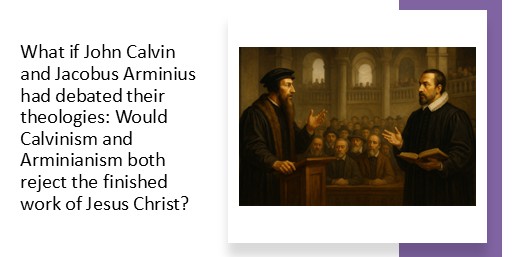
Calvinists make a big point about salvation being 100% God’s sovereign work from start to finish. Jesus paid for it. God calls and gives faith. And the person responds because God has already made them alive spiritually.
The ironic truth is this actually rejects the finished work of Jesus Christ according to the gospel (1 Corinthians 15:3-8) because without faith it is impossible to please God (Hebrews 11:6). But the Calvinist position requires an additional unbiblical work by the Holy Spirit to implant faith into the heart of the elect. They say, “Dead in trespasses” means spiritually unable to respond. God must make a person alive (regeneration) before they can believe. Faith is then described as “not your own doing.”
The Bible teaches God loves you so much that He sent His Son, Jesus Christ, to pay the full penalty for all the sins of the whole world—including yours. On the cross, Jesus took your place, carrying the punishment you and I deserved so that we could be forgiven. (John 3:14-21) He rose again from the dead to give new life to anyone who will come to Him. This salvation is a free gift—it’s not something you can earn by being good or doing religious things. (Romans 5) God’s promise is clear: whoever believes in Jesus—trusting Him to save them—will not perish but will have eternal life. (Romans 6)
Most Calvinists flounder at the idea of a sovereign God allowing free will. Calvinists reject free will in salvation because they believe it makes God’s plan dependent on human choice, undermining His absolute sovereignty to accomplish His will without external conditions.
The Bible teaches God loves you more than you can imagine. From the very beginning, He had a plan to rescue humanity from sin and death. In His great love, He sent His Son, Jesus Christ, to die on the cross and pay the full penalty for the sins of the whole world—including yours. When Jesus rose from the dead, He opened the way for anyone to receive forgiveness and eternal life.
This salvation is a free gift. You don’t have to earn it. You can’t buy it. God offers it to you because of His grace. But like any gift, you must choose whether to accept it or not.
Jesus said, “Come to Me, all of you who are weary and carry heavy burdens, and I will give you rest” (Matthew 11:28). The choice is yours. Will you trust Him to forgive your sins and give you new life? Or will you turn away?
God, in His sovereignty, has made a way for all people to be saved—but He will not force you. He invites you. He knocks at the door of your heart, but only you can open it.
“For God so loved the world that He gave His one and only Son, so that whoever believes in Him shall not perish but have eternal life” (John 3:16).
Arminianism also rejects the finished work of the Jesus Christ. Arminianism teaches that salvation is received by freely choosing to trust in Christ through faith, but a believer can later forfeit that salvation by willfully turning away from God and rejecting His grace.
From a Biblical perspective that emphasizes the finished work of Christ, the idea that a believer must maintain their salvation through continued faithfulness or obedience is seen as rejecting Christ’s finished work because it shifts the focus from His once-for-all payment for sin to the believer’s ongoing performance, effectively making salvation partly dependent on human works rather than solely on God’s grace.
The bottom line is, God’s sovereignty and human free will aren’t enemies. He is so sovereign that He designed a plan where Jesus’ finished work is fully sufficient for all but only applied to those who willingly trust Him. The offer is universal; the acceptance is personal.
The Bible teaches that when a person truly puts their faith in Jesus Christ, they are fully and permanently saved because salvation rests entirely on Christ’s finished work on the cross, not on their own efforts. Jesus paid for all their sins—past, present, and future—and secured their place in God’s family. Since salvation is a free gift of grace and not earned by works, it also cannot be lost by failures or sin. This assurance is based on God’s promises, such as John 10:28-29 where Jesus says no one can snatch His sheep from His hand, and Romans 8:38-39 which declares nothing can separate believers from God’s love. True believers may stumble or fall into sin, but God’s saving grace keeps them secure, and He will complete the work He began in them (Philippians 1:6).
This truth was proclaimed by Isaiah almost 3000 years ago, which was before the church began, and before the apostasy, and before the reformation, and before any of us can imagine.
Therefore, this is what the Sovereign LORD says:
“Look! I am placing a foundation stone in Jerusalem,
a firm and tested stone.
It is a precious cornerstone that is safe to build on.
Whoever believes need never be shaken. (Isaiah 28:16 NLT
Isaiah 28 presents a strong prophetic message to the tribes of Ephraim and the leaders of Jerusalem. The chapter begins with a divine judgment against Ephraim, then progresses to address the spiritual drunkenness and complacency of Israel’s leaders. God’s message of wisdom and a promise of a cornerstone in Zion permeate the chapter, finally leading to an assurance of redemption and restoration. –Biblehub Chapter Summary
Digging deeper
- Free Will in the Old Testament – The Old Testament contains almost 4000 years of history about people exercising free will to obey or disobey God bringing blessings and curses.
- Have you hardened your heart against God like Pharaoh? – Don’t be like Pharaoh who chose to deny God, so God hardened his heart to bear the plagues until the destruction was complete.
- The potter and the clay – The sovereign potter tries to make one kind of vessel but the stubborn willful clay ruins it by resisting him so he makes another kind of vessel.
- The Restless Seeker (A Journey from Predestined Reprobate to Whosoever Will) – The Restless Seeker journeys from despair of Calvinist predestination to biblical assurance through John 3:14 and the whosoever promise.
Other resources
- Do Calvinists worship a different God? – Calvinism proposes a deity who is not “good to everyone,” a deity who does not “shower compassion on all his creation.” The deity proposed by Calvinism is a corruption of the true God. It is a different god, a god who is definitely “outside the pale of Christianity.”
- Five Reasons Calvinism is Wrong – The five points of Calvinism—Total Depravity as inability, Unconditional Election, Limited Atonement, Irresistible Grace, and Perseverance of the Saints—stand in conflict with the clear teaching of Scripture. They distort God’s character, obscure the freeness of the gospel, and erode assurance. The biblical gospel proclaims that Christ died for all, that salvation is offered to all, that eternal life is received through faith alone, and that believers are eternally secure, called to grow in grace—not to prove they were saved, but because they are.