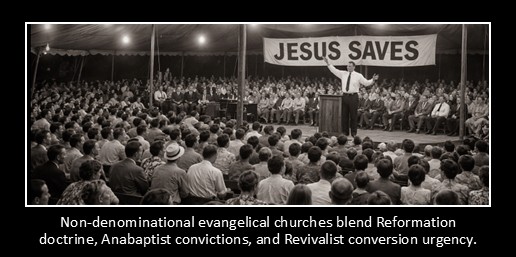
Most modern non-denominational evangelical churches are not “theologically blank.” In practice, they tend to share four core commitments that were inherited from previous movements based on the early church in Acts:
- The Bible as final authority (Sola Scriptura in principle, even if the phrase is not used) (2 Timothy 3:16-17; Acts 17:11).
- The gospel centered on Christ’s substitutionary death and bodily resurrection, received by faith (1 Corinthians 15:1-4; Ephesians 2:8-9; Romans 3:24-26).
- The necessity of the new birth (John 3:3-7), often emphasized as a definite conversion and repentance (Acts 20:21).
- A “believers’ church” instinct: membership and baptism closely tied to personal profession and discipleship (Acts 2:41-42; Matthew 28:18-20).
Several Greek words help frame the discussion:
Ekklesia – “assembly” or “called-out congregation” (Matthew 16:18; Acts 2:47). It points us to the gathered local church, not merely a brand.
Euangelion – “good news” (Romans 1:16). It keeps the church’s message anchored to Christ’s saving work.
Metanoia – “repentance,” a change of mind that results in a turned life (Acts 26:20).
Pistis – “faith,” trust in Christ, not mere agreement (John 3:16; Romans 4:3).
This article describes how godly leaders contributed to recovering biblical gospel-centered churches for the honor and glory of the Lord Jesus Christ.
Chapter 1: The Early Church (about AD 30–313)
The apostolic foundation
The earliest churches were planted through preaching Christ, calling for repentance and faith, baptizing converts, and gathering them into accountable congregations (Acts 2:38-42; Acts 14:23; Titus 1:5). Several features matter for our story:
- Scripture and apostolic doctrine: The church “continued steadfastly in the apostles’ doctrine” (Acts 2:42). The early church operated under God-breathed revelation, which later generations would recognize as New Testament Scripture (2 Peter 3:15-16).
- Local congregational life: Churches met, practiced discipline, cared for one another, appointed qualified leaders, and defended sound doctrine (Matthew 18:15-20; Acts 6:1-6; 1 Timothy 3; Titus 1).
- Ordinances as obedient symbols: Baptism and the Lord’s Supper functioned as Christ-given practices pointing to the gospel realities (Matthew 28:19-20; 1 Corinthians 11:23-26).
Good carried forward
- A simple, Christ-centered gospel.
- A church defined by regenerate membership in principle: believers gathering as believers.
- A missionary posture: “to the uttermost part of the earth” (Acts 1:8).
Weaknesses that later grew
Even in the New Testament we see dangers that become recurring temptations:
- Doctrinal drift (Galatians 1:6-9).
- Personality factions (1 Corinthians 1:10-13).
- Moral compromise requiring discipline (1 Corinthians 5).
- By the time The Apostle John wrote Revelation around A.D. 95, many of these early churches were practically unrecognizable (Revelation chapters 2 and 3).
From persecution to imperial favor
After long seasons of persecution, Christianity gained legal status (early 300s) and gradually became intertwined with the empire. This shift did not create “denominations” as we know them, but it did normalize a state-church instinct: citizens of a region were treated as Christians by default. That instinct later provoked reform and, eventually, believers’ church movements.
Chapter 2: The Reformation (about 1517–1648)
The Reformation’s theological recovery
The Reformation was not primarily a worship-style debate. It was a gospel and authority crisis. Key recoveries included:
- Scripture as final authority (Sola Scriptura): Human traditions must be tested by God’s Word (Mark 7:7-13).
- Justification by grace through faith: Salvation is not earned by sacraments or merit (Romans 3:28; Galatians 2:16).
- The priesthood of believers in access to God: Christ is our mediator (1 Timothy 2:5; Hebrews 4:14-16).
Why this matters for non-denominational evangelicalism
Modern non-denominational evangelical churches largely inherit the Reformation’s insistence that:
- Doctrine must be grounded in Scripture.
- The gospel is about God saving sinners by grace through faith, because of Christ alone.
- Preaching and Bible teaching should be central.
This affirms Scripture is the “supreme standard” and that salvation is offered freely to all who accept Christ, involving regeneration, justification, sanctification, and glorification.
The Reformation’s structural tension
However, most major Reformers retained state-church structures and infant baptism. So you get a mixed legacy:
- A strong gospel and authority recovery.
- A weaker ecclesiology (church doctrine) regarding regenerate membership and voluntary faith.
Good carried forward
- High view of Scripture.
- Serious theology and doctrinal clarity.
- Gospel-centered preaching.
Weaknesses that later reformers reacted against
- State-church assumptions (being “born into” the church).
- Baptism and church membership not consistently tied to personal conversion.
- In some places, coercion of conscience, which contradicts the New Testament pattern of persuasion rather than compulsion (2 Corinthians 4:2; 1 Peter 3:15).
Chapter 3: The Anabaptists and the “Believers’ Church” (about 1525 onward)
The Anabaptist protest
The Anabaptists (often grouped under “Radical Reformation”) insisted that the church must be a community of believers, not a territory of citizens. Their key convictions included:
- Voluntary faith and regenerate church membership: People should join the church by personal faith, not by birth.
- Believers’ baptism: Baptism as the confession of faith by the one being baptized (Acts 8:36-38).
- Separation of church and state: Civil power must not coerce faith.
This believers’ church impulse is very close to how many evangelicals today describe the local church: an assembly of baptized believers, autonomous under Christ’s lordship. The Baptist Faith and Message, for example, explicitly defines a New Testament church as an “autonomous local congregation of baptized believers.”
Good carried forward
- A clearer biblical logic for membership and discipleship.
- A stronger emphasis on obedience and visible discipleship (James 2:17; John 14:15).
- A robust case for religious liberty of conscience, which aligns with the biblical principle that God alone is Lord of the conscience.
Weaknesses and extremes to avoid
Historically, some Anabaptist streams drifted toward:
- Cultural withdrawal that neglected broader witness.
- Over-identifying discipleship with certain external distinctives.
- Occasionally, fragmentation because “pure church” ideals can become hard to administer without patience and pastoral wisdom (2 Timothy 2:24-26).
Modern non-denominational churches often inherit the Anabaptist “voluntary faith” instinct, but they do not always inherit the Anabaptist seriousness about disciplined, accountable discipleship. That mismatch becomes important later.
Chapter 4: Revival Movements (about 1700s–1900s)
The “experiential engine”
Revivalism did not invent conversion. Scripture is clear about the new birth (John 3) and the call to repent and believe (Mark 1:15). Revivalism’s historical contribution was methodological: it normalized urgent evangelistic preaching aimed at immediate personal response.
Key developments
- The Great Awakenings (1700s and early 1800s) emphasized heartfelt religion, personal conversion, and preaching in the open air and in large gatherings.
- Camp meetings and itinerant evangelists brought the gospel to the frontier.
- Later mass evangelism used newspapers, radio, and stadiums.
Good carried forward
- A refusal to treat Christianity as mere tradition.
- Bold evangelism and missions urgency (Romans 10:14-15; Matthew 28:18-20).
- A practical emphasis on repentance and faith, not ritual.
- A strong expectation that God changes lives (2 Corinthians 5:17).
Weaknesses and dangers
Revivalism also introduced temptations:
- Emotional manipulation: confusing tears, music-induced sentiment, or crowd pressure with the Spirit’s regenerating work.
- Decisionism without discipleship: counting “responses” without producing durable obedience (Matthew 7:21-23; Matthew 28:20).
- Shallow doctrine: when urgency replaces instruction, churches can become spiritually malnourished (Hebrews 5:12-14).
Non-denominational evangelical churches today often carry revival strengths (evangelistic clarity and urgency), but they must vigilantly anchor those strengths in biblical teaching and accountable discipleship.
Chapter 5: The Evangelical Synthesis (about early 1900s–1950s)
Why a synthesis was needed
By the late 1800s and early 1900s, several pressures forced evangelicals to define themselves:
- Theological liberalism questioned miracles, the virgin birth, the deity of Jesus Christ, the resurrection, and biblical authority.
- Rapid urbanization and modernity created new ministry contexts.
- Denominational conflicts and the fundamentalist-modernist controversy pushed many Bible-believing Christians to cooperate across denominational lines.
What the synthesis combined
This synthesis braided a rope from the diverse movements from the past:
- Reformation strand: Scripture as final authority and salvation by grace through faith (2 Timothy 3:16-17; Romans 3:24-28).
- Anabaptist strand: a believers’ church model, voluntary faith, and liberty of conscience (Acts 2:41-42; 1 Peter 3:15).
- Revivalist strand: the necessity of personal conversion and urgent evangelism (John 3:3-7; Romans 10:13-15).
How it stabilized
The synthesis tended to filter extremes:
- It resisted Anabaptist withdrawal by leaning into missions and public witness.
- It resisted revivalist excess by building Bible institutes, conferences, confessions, and training structures.
- It resisted purely state-church or sacramental assumptions by emphasizing regenerate membership and evangelism.
For example, statements of faith serve as guidance but do not replace Scripture as final authority, and they function as instruments of accountability rather than infallible replacements for the Bible.
Good carried forward
- Cross-denominational cooperation for missions and evangelism, without necessarily erasing local church autonomy. The BFM language about voluntary cooperation without one body having authority over another captures that instinct well.
- A portable core: Bible, cross, conversion, commission.
- Renewed confidence in the supernatural gospel, against anti-supernatural culture.
Weaknesses that began to appear
- Minimalist ecclesiology: churches sometimes treated “doctrine” as only the gospel facts, neglecting the full counsel of God on church leadership, discipline, ordinances, and holiness (Acts 20:27).
- Platform-driven leadership: conferences and celebrity preachers could overshadow local church shepherding (1 Peter 5:1-3).
- A tendency to define unity as shared experience rather than shared truth (Ephesians 4:11-16).
Chapter 6: From the Evangelical Synthesis to Modern Non-denominational Evangelical Churches (about 1940s to the present)
Why non-denominational evangelical churches multiplied
Several forces accelerated independent churches after World War II:
- Cultural mobility: people moved frequently, weakening inherited denominational identity.
- Media and technology: radio, television, recordings, and later the internet allowed teaching and worship to travel beyond denominational channels.
- Church planting entrepreneurship: leaders could start churches without denominational gatekeeping.
- A desire for “New Testament simplicity”: many believed denominational structures were unnecessary layers over biblical church life.
In this environment, many churches adopted a “no label” identity while retaining a very real theological family resemblance, often Baptist-leaning in ecclesiology and broadly evangelical in soteriology.
- How to find a good local church? – Practical suggestions and Biblical foundations to help you find a good local church.
- What about “closed” or “separatist” fundamentalism? – Separatist fundamentalism emphasized separation, not only from non-Christians, but also from other Christians who did not agree with them in every detail.
- It is high time for the church to awaken and grow up – The church has been asleep for too long. It is time to awaken and grow up before it is too late. The night is over, the day is approaching.
- What is the One True Church? (many ekklēsía one sṓma) – Among the thousands of denominations, sects, and churches, is there one true church? Many churches claim the title. What does the Bible say?
Common distinctive features today (good and bad)
- Biblical authority and expositional teaching
Good: Many emphasize verse-by-verse preaching and Bible literacy, aligning with the conviction that Scripture is the supreme standard.
Bad: Others slip into topical, therapeutic messages that use Bible verses as decorations rather than the text’s intended meaning (2 Timothy 4:3-4). - Conversion-centered ministry
Good: Clear calls to repent and believe, expecting new birth and changed lives (John 3:3-7; 2 Corinthians 5:17).
Bad: Pressure for quick decisions, weak follow-up, and confused assurance (Matthew 7:21-23; 1 John 2:19). - Informal worship and accessibility
Good: Lower cultural barriers for outsiders (1 Corinthians 9:22-23).
Bad: Informality can drift into irreverence or entertainment, obscuring the fear of the Lord (Hebrews 12:28-29). - Local autonomy and flexible organization
Good: Faster decision-making, contextualized evangelism, and freedom from bureaucratic drift. The BFM’s description of the local church as autonomous under Christ is consistent with this impulse.
Bad: Autonomy without accountability can produce doctrinal drift, financial opacity, moral scandals, and “pastor-as-CEO” models (1 Peter 5:2-3; 1 Timothy 3:1-7). - Ordinances and church membership
Good: Many practice believers’ baptism by immersion and treat baptism and the Lord’s Supper as obedient symbols of the gospel.
Bad: Some downplay ordinances and meaningful membership, weakening discipleship and church discipline (Acts 2:41-42; 1 Corinthians 5). - Missions, cooperation, and networks
Good: Non-denominational churches often cooperate through voluntary networks for missions, training, and church planting, a principle consistent with voluntary cooperation for kingdom purposes.
Bad: Networks can become “denominations in everything but name,” sometimes with less transparency than historic denominational structures. - Church and state instincts
Good: Many defend religious liberty and separation of church and state, consistent with the principle that the state should not coerce religion.
Bad: In polarized times, churches can confuse political mobilization with disciple-making (John 18:36; 2 Timothy 2:4).
Summary of the evolution from the early church to modern non-denominational evangelical churches
Modern non-denominational evangelical churches are typically Reformation-shaped in doctrine (Bible and gospel), Anabaptist-shaped in church instinct (voluntary believers’ church), and Revivalist-shaped in method (conversion invitation and mission urgency), all operating within a post-1940s American context that rewards flexibility, media reach, and entrepreneurial church planting.
The central question is not whether a church is denominational or non-denominational. The biblical question is whether it is a true ekklesia that holds fast to apostolic doctrine, preaches the true gospel, practices Christ’s commands, and shepherds God’s people faithfully (Acts 2:42; Galatians 1:8-9; Matthew 28:18-20; 1 Peter 5:1-4).
If you are evaluating a modern non-denominational evangelical church, ask simple, Scripture-shaped questions:
- Is the Bible treated as the final authority, or merely a starting point? (2 Timothy 3:16-17)
- Is the gospel clearly defined as Christ’s saving work received by repentance and faith? (1 Corinthians 15:1-4; Acts 20:21)
- Are believers discipled into obedience, not merely counted as decisions? (Matthew 28:20; James 1:22)
- Is there qualified, humble, accountable leadership? (1 Timothy 3; 1 Peter 5:2-3)?
- Are baptism and the Lord’s Supper practiced biblically, and is membership meaningful? (Acts 2:41-42; 1 Corinthians 11:23-26)
When those marks are present, the braided rope of evangelical synthesis becomes a strength for world missions and local holiness. When those marks are absent, the same braid can unravel into pragmatism, drift, and personality-driven religion.
Digging Deeper
- Rightly dividing Bible history for each age and dispensation – This broad outline of rightly dividing Bible history for each age and dispensation is helpful to understanding the Bible.
- history-modern-non-denominational-evangelical-churches-infographic.pdf – a one-page infographic of this material.
- A brief history of the future – Share this brief history of the future as revealed in the Bible. It is a good introduction to eschatology, which is the study of end times.